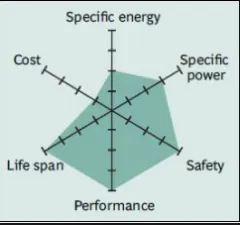
Week 1 Understanding Different Battery Chemistry
Problem statement:
1. Prepare a table that includes materials & chemical reactions occurring at the anode and cathode of LCO, LMO, NCA, NMC, LFP and LTO type of lithium-ion cells. Give your detailed explanation on it
2. Compare the differences between each type of Li+ion batteries based on their characteristics
Solution:
1. Lithium-ion battery chemistry:
Lithium-ion batteries are the batteries that involve Lithium-ion in the chemical reaction that drives the battery. Both the electrodes in Lithium-ion battery are made of materials that intercalate/absorb lithium-ion. Intercalation is the process of holding charged ion inside a structure without significantly altering the chemistry of the structure. In the case of the lithium-ion battery, the anode is made up of material that holds lithium clubbed with an electron. The electrolyte of the battery usually contains lithium salt dissolved in dimethyl carbonate or diethyl carbonate.
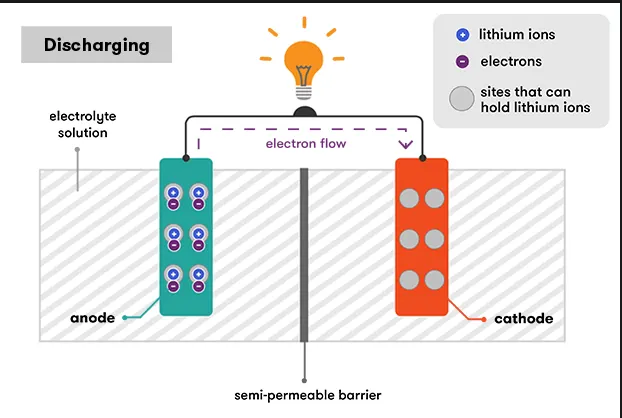
When the battery discharges, The lithium-ion and electron pair at the anode is broken up. The electrons travel to the cathode through external circuit and lithium-ions is freed up to travel to the cathode through an electrolyte medium. This flow of electrons generates electricity. The current flows in the direction opposite to the flow of electrons. With the migration of electrons to cathode, the lithium-ions too migrate to cathode to balance the charge. At cathode, the lithium-ions get deposited by accepting the free electrons available. There is a semi-permeable barrier between both electrodes to prevent short-circuiting. The electrons are not permeable through this barrier but the ions are. The discharging phenomenon is depicted in the image below.
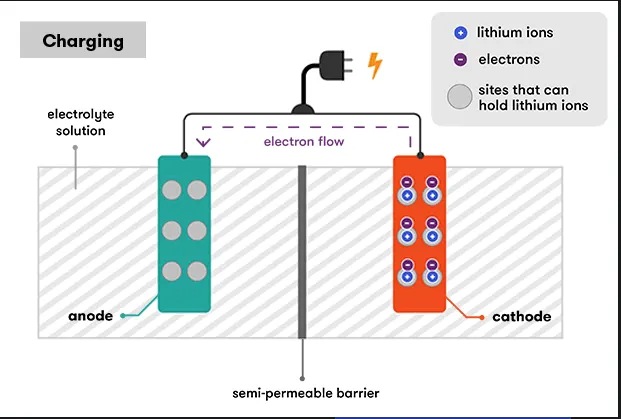
In the state of full discharge, lithium ions are completely absorbed by the cathode and the battery does not have the ability to produce electricity anymore. Hence the battery is charged. During the charging process, the cathode loses negative charge in the form of electrons that travel to the anode through an external circuit. The lithium-ions get dissolved in the electrolyte at cathode and travel to anode to maintain the charge balance. Then these ions intercalate at the anode that is made of graphite. This material holds the lithium-ions tied up with electrons. The discharging process is depicted in the following image.
Since the electrolyte already consists of lithium-ions in the form of lithium salt, the individual ions are not required to travel all the way from one electrode to the other. The ions available in the electrolyte around an electrode, get deposited. The lithium atoms are small in size and every 6 atoms of carbon can hold 1 atom of lithium. Hence higher amount of lithium can be packed in a smaller volume. This makes lithium-ion battery a high energy density electricity storage device. The higher the number of lithium atoms, the higher is the number of electrons, hence lithium-ion cell can produce a voltage as high as 3.6 V.
Types of Lithium-ion battery:
|
Battery type |
Anode material | Cathode material | Anodic reaction (During discharge) | Cathodic reaction |
| Lithium Cobalt Oxide- LCO | Carbon (C) |
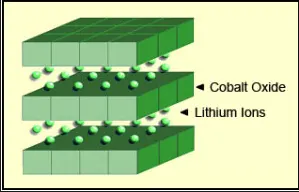
Lithium Cobalt Oxide (LiCoO2) Cobalt and Oxygen bond together to form octahedral structure separated by Lithium sheet. This structure allows cobalt oxide to change its valence state between CO+3 and CO+4 (lose and gain electron while charging and discharging)
|
Lithium is oxidised. Lithium ions are dissolved in the electrolyte and electrons too are released from Carbon. |
Lithium ions are absorbed by lithium dioxide. And the cathode is reduced as it receives electrons. |
| Lithium Iron Phosphate- LFP | Graphite (C) |
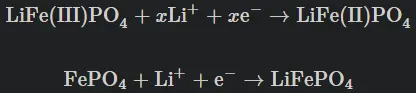
Lithium Iron Phosphate (LiFePO4) or Iron Phosphate (FePO4) for fully charged cell (No Lithium remains in the Cathode) It is a natural mineral from olivine family |
Oxidation of Lithium. |
|
| Lithium Manganese Oxide- LMO | Graphite (C) |
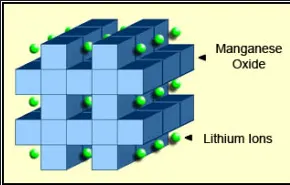
Lithium-manganese spinel (Li+Mn3+Mn4+O4)
The three-dimensional structure |
 |
 |
| Lithium Nickel Manganese Cobalt Oxide- NMC | Graphite (C) |
Lithium Nickel Manganese Cobalt Oxide (LiNiMnCoO2) |
|
 |
| Lithium Nickel Cobalt Aluminum Oxide- NCA | Graphite (C) | Lithium Nickel Cobalt Aluminum Oxide (LiNiCoAlO2) |  |
 |
| Lithium Titanate- LTO | Lithium Titanate (Li2TiO3) | Lithium-manganese spinel (Li+Mn3+Mn4+O4) |  |
 |




2. Comparing Li-ion battery based on the characterization:
- Lithium Cobalt Oxide:
- This battery has the highest energy density. The specific energy is in the range of 150 to 200 Wh/Kg
- The limitation is thermal instability. The anode can overheat. At high temperature, the cathode can decompose and produce oxygen. Sometimes, the electrolyte used is diethyl carbonate, which is flammable in nature. Hence, this type of battery can catch fire due to overheating. The thermal runaway occurs at 150 oC.
- It has a short life span due to formation of Solid Electrolyte Layer (SEI) at anode and lithium plating due to fast charging and charging at low temperature. Typically, it has life span of 500 to 1000 cycles.
- It has limited load capabilities since it cannot be charged or discharged beyond its C-rate. C-rate should be maintained in the range of 0.7 C to 1 C.
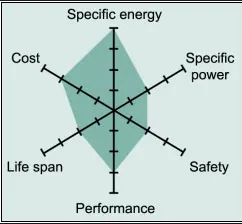
- Applications: Mobile phones, laptops, camera etc (Portable consumer electronic devices)
- Lithium Manganese Oxide:
- The spinel structure (AB2O4 structure) of Lithium manganese enables this type of battery to have better thermal stability. So it is better in terms of safety. The high charge promotes thermal runaway at a high temperature of 250 oC.
- The spinel structure promotes the ion flow within the electrolyte, and this reduces the internal resistance of the battery.
- The limitation is that it loses the battery power over time
- It has a shorter lifetime of 300-700 cycles and lower capacity (equivalent to one-third of Lithium Cobalt battery). The specific energy of this battery is 100-150 Wh/kg.
- It has the ability to charge and discharge at a higher C-rate. The C-rate can go as high as 3 C. So it is used for a high current boost on acceleration in Electric vehicles.
- Applications: Power tools, medical devices and electric powertrains.
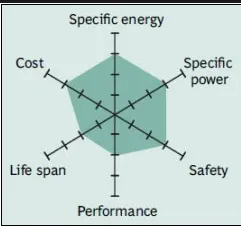
- Lithium Nickel Manganese Cobalt Oxide:
- This type of battery has the advantage of Lithium Cobalt Oxide (high specific energy and higher life span) and Lithium Manganese Oxide (high thermal stability and high C-rate capability)
- The thermal runaway occurs at a high temperature of 210 oC.
- It has a life span of 1000 to 2000 cycles.
- This combination has a mixture of one-third Nickel, one-third Cobalt and one-third Manganese. Cobalt is expensive and limited in supply. Hence the proportion of Cobalt in the recent batteries.
- This battery is preferred for electric vehicles due to its low self-heating rate.
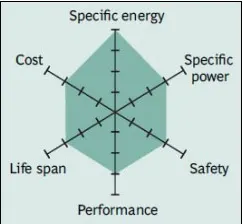
- Lithium Iron Phosphate:
- This battery has a high discharge rate because of low internal resistance made possible by nano-scale phosphate cathode material
- Due to the presence of Phosphate (PO4) that can cope up with high temperature. At cathode, phosphate anions are bonded with iron cations. This structure holds the oxygen molecules tightly and gives cathode chemical stability. This battery has good thermal stability. Thermal runaway is caused at 270 oC.
- It can be used for a higher number of discharge cycles as high as 2000.
- It has a higher self-discharge rate
- The energy capacity is less than that of a Lithium cobalt battery.
- This battery is more tolerant to full charge and less stressed when kept at full voltage for prolonged period.
- It had lower nominal voltage and hence lower specific energy density (90-120 Wh/kg) than Cobalt blended Lithium.
- Applications: It is used in stationary and portable devices needing high load current and endurance
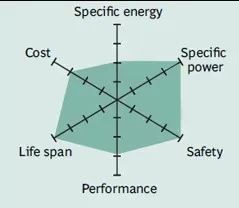
- Lithium Nickel Cobalt Aluminum Oxide:
- It is a further development of Lithium Nickel Oxide. Adding Aluminum to the chemistry gives the battery greater stability.
- It has features similar to NMC battery: high specific energy (200-260 Wh/kg), good specific power and a long life span (500 cycles).
- Applications: Medical equipment and electric vehicles (Tesla)
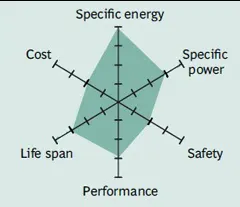
- Lithium Titanate:
- In this battery, graphite, as anode is replaced by Lithium Titanate, formed into a spinel structure.
- It has a fast charge capability and a high discharge current of 10 C, which is 10 times the usual capacity.
- This battery is safe. It has a good low-temperature discharge capability and can achieve a charge level of 80 % at -30 oC.
- It is advantageous over Lithium Cobalt oxide because there is no Solid ELectrolyte Interface formation or lithium plating while fast charging or discharging at low temperature.
- The limitation is that specific energy is very low: 65 Wh/kg and this type of battery is expensive.
- It has a greater life span than any other Lithium-ion battery. It can go up to 5000 cycles.
- Applications: Electric powertrains, solar street lights