Week 1- Mixing Tee
Aim : To set up steady-state simulations to compare the mixing effectiveness for Mixing Tee,when hot inlet temperature is 360C & the Cold inlet is at 190C.
- Objective : At one end of the model the hot air will be passing & the other end the chilled air will be allowed to flow,sso by adjusting the flow rate of chilled air we can meet the required temp air at the outlet of T- Joint.
- Introduction : In this challange we deal with the model called as Mixing Tee joint,It is so called because it splits the flow & angle between them is 90 deg. Here we will be simulating the flow through mixing t-joint model to measure the effectiveness of mixing hot & cold air.
ex: lets have a example of geeser, the required output is say 50 deg hot water,but the geeser is ready to give hot water of temp say 75 deg, this is when the mixing tee is helpfull because by allowing the cold water with the required temp to flow with inlet y ,& mixing of water with different temp happens & at outlet desired temp hot water is available.
Note: But in this challange we deal with air.
- Theory of topic & its Importance :
In this case the thermal fatigue & many other factors are caused by the fluctauting streeses on a piping system due to flow of hot & cold gases mixed together & flows through piping ,It describes the K-Epslion & k-Omega,simulation data of thermal mixing &than compared the results.
the fluid in this case is the hot air & cold air with the temp 36 dec celcius & 19 deg,respectively.
the other boundary conditions are given as:
- Case 1
- Short mixing tee with a hot inlet velocity of 3m/s.
- Momentum ratio of 2, 4.
- Case 2
- Long mixing tee with a hot inlet velocity of 3m/s.
- Momentum ratio of 2, 4.
finally its simulated & ploted required graphs & compared with 2 cases.
- Solving & Modelling approach :
- Before proceding with procedure we will select or use K omega SST model for better results.
-
Pre-processing and solver setting
- download the different models which are available in the source for simulation of mixing.
- Than open the ansys workbench drag the ansys fluent into the work space,a fluid flow dialouge box appears for the further procedure.
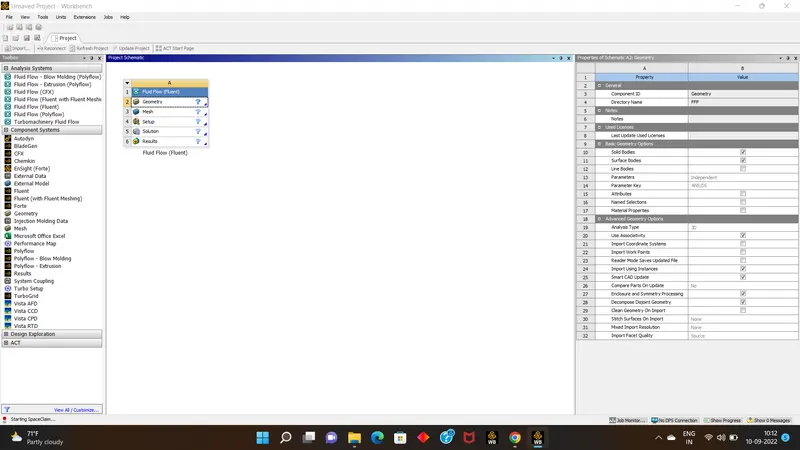
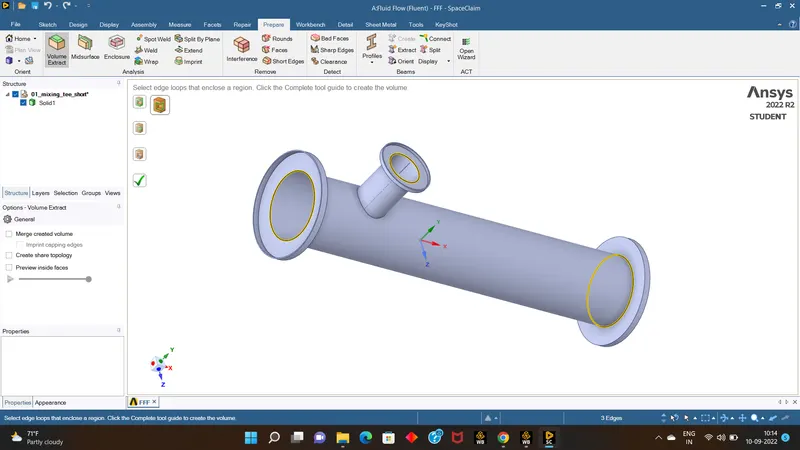
- than go for first option geometry to get the geometry model on work space, after geting model juzz select the volume parts where only fluid passes through it,select it & surpass the remaving exterior part ,&close the application.
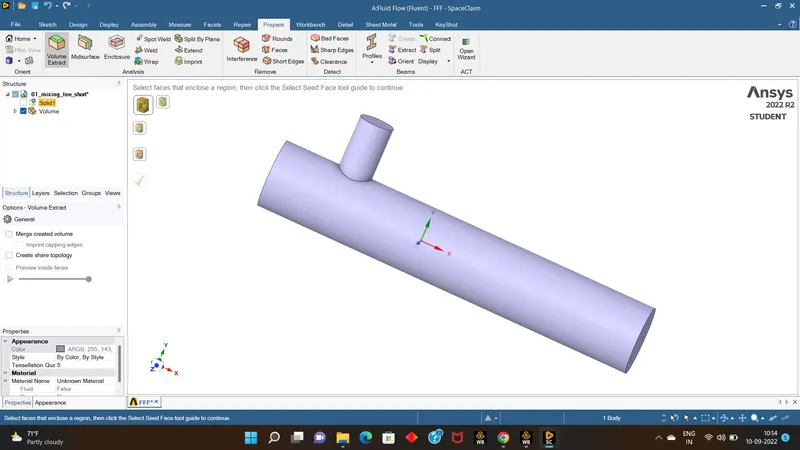
- Nxt open mesh,in this select the face & name them particularly.and by clicking right button from mouse click on the generate mesh ,so mesh will be deployed over the model,& get exit fom the application .
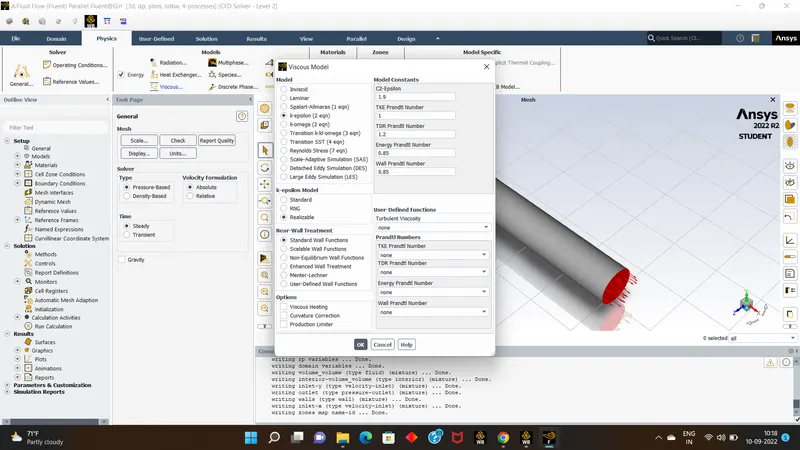
- than open setup part & new fluent launcher appears,click on prallel processor ,double precession.& say ok.
- Than go to physics slot enable/select the required conditions such as energy , in viscous select the K-EPSILON for first simulation & later we choose K-omega sst model.
- select the material wch flows inside the model, & by selecting the face give the boundary conditions as give in question
- Than go to solutions we definations for outlet & walls of the model by selecting in definations tool
- than do go for initillisaton , select the no of itterations & run the calculation.
- than open results from workbench ,& make the walls of cyclinder enable with proper transperancy ,than create a plain at center of the model where z coordinates will be (0,0).
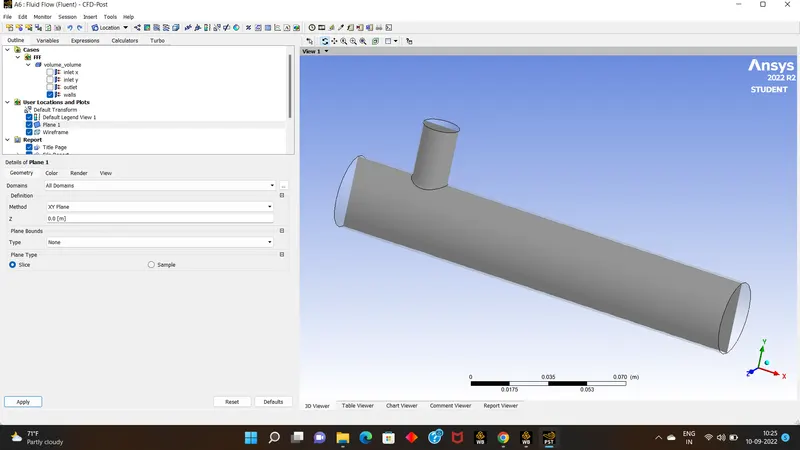
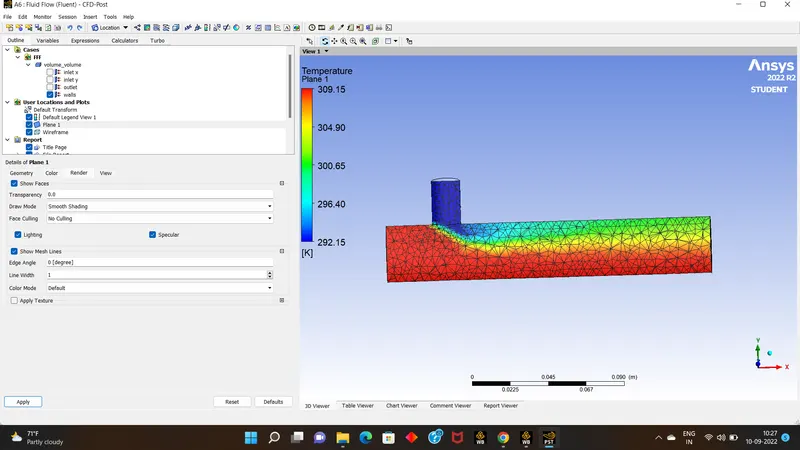
- than go or plan and in edit section click on the colour & select mode as variable ,unables meshing options from rendering & finally click on the apply the simulation part will be shown . the same procedure will be repeated to all the remaining part model accept selection the visous mode.
- Results :
- Velocity and temperature contour plots on the cut planes along and across the pipe.
as we know that the temperature along the plots on the cut plane is at moderate temperatue only & the velocity decreases as the length of the pipe increases & even the temperature decreases as the length of the pipe increases.
its better to choose K-OMEGA SST rather than K-EPSILON beccause the boundary conditions & parameters are reducing stably in OMEGA model but where as in EPSILON it will be fluctating .
- CONCLUSION :
the outlet flow of fluid is moderate only,but as the length of the pipe increases the velocity & temperature of fluid flow decreases.