Week 1:- Introduction to BiW and Fixtures Challenge
- Body In White: The most widely used modern car structure type, is the unitary type, spot welded, pressed steel sheet metal body. It is well suited to mass production methods. The body is self-supporting, so that the separate ‘chassis’ is omitted, with a saving in weight. In the integral structure the panels and body components are stamped from sheet steel and fixed together mostly by spot welding. The beam members are formed out of folded or pressed sheet steel shapes and welded together. These beams can be independent like B-pillar, or they can be formed as part of the larger panels as in the case of the transmission tunnel, or they can be attached to panels by spot welding like floor cross-members.
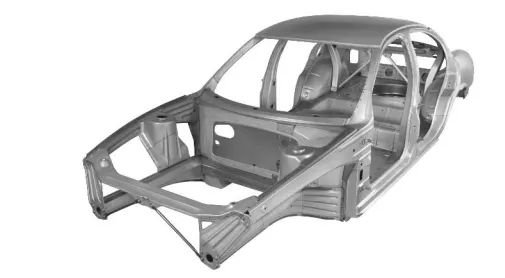
Parts of Body in White
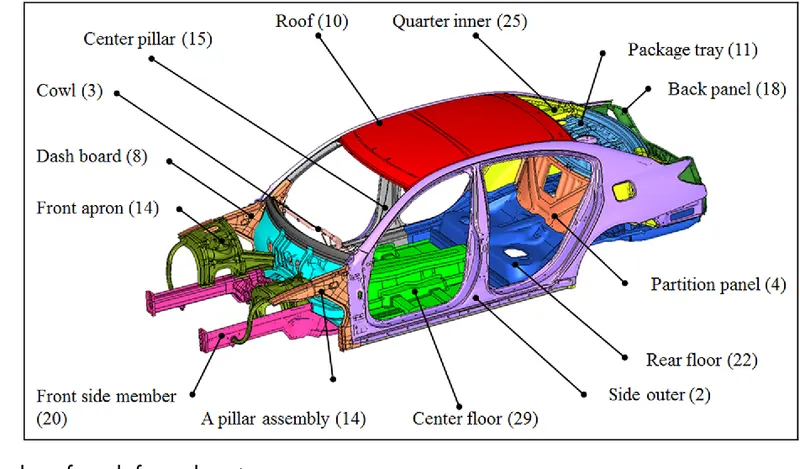
- Body Sides
- A-pillar: frontmost support to the roof.
- B-pillar: second support to the roof
- C/D pillar: C- is the rearmost support to the roof in case of a two-row seating system, it will third one. D- is the fourth support, usually the rear side of the quarter panel.
- Ring Panel: a structure panel connecting the rear and front portion.
- Quarter Panel: rearmost panel of a body side structure
- Drip rails/Gutter: an exposed channel applied to the roof over the side windows to direct water away from the windows
- Underbody
- Dash panel: provides partition b/w engine and the driver cabin.
- Front floor provides a base for seats
- Raiser: connects front floor to rear floor by providing the level difference
- Rear floor: floor on the rear of the car and provides partition from ground and base for rear seats.
- Rear wheelhouse
- Closures
- Front door
- Rear door
- Hood
- Decklid
- Roof
- Header: structural member above the windshield at the juncture with the forward edge of the roof panel
- Bows
- Front End Structure
- Plenum Panel: a chamber located b/w the throttle body and runner of the intake manifold.
- Fender: is an encasement around the wheel.
- Wing Panel: outermost side panel in the front
- Cowl: portion of the body bounded by the front fenders, the base of the windshield, and the rear edge of the hood.
- Upper tie bar: upper panel in the front connecting the two sides of the front structure.
- Lower tie bar: lower panel in front connecting the two sides of the front structure.
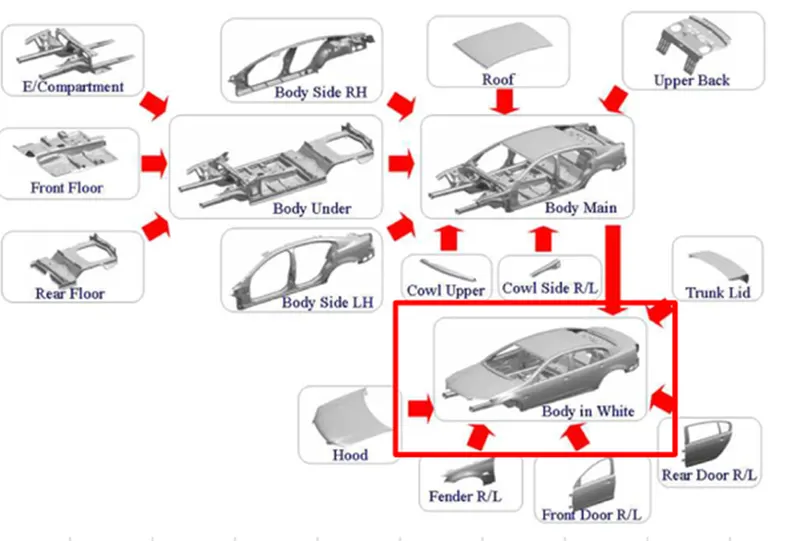
2.BIW Nomenclature
BIW Nomenclature refers to a system used for identifying various components and assemblies in the body shop of the body structure. It is a standardized system that helps track and manage a plethora of parts involved in the assembly of the BIW.
3.Fixture and its types
A fixture is a production tool that locates, holds, and supports the work securely so the required machining operations can be performed. Set blocks and feeler or thickness gauges are used with fixtures to reference the cutter to the workpiece. A fixture should be securely fastened to the table of the machine upon which the work is done. Though largely used on milling machines, fixtures are also designed to hold work for various operations on most of the standard machine tools. The device also enables loading and unloading of components with ease. The aspect, which distinguishes a fixture from a jig, is the absence of bushes to guide the tools. In absence of the guiding bush, the fixture deploys setting blocks to locate the cutter properly in relation to the fixture or the components.
Types of Fixtures
- Plate fixtures are the simplest form of fixture. The basic fixture is made from a flat plate that has a variety of clamps and locators to hold and locate the part. The simplicity of this fixture makes it useful for most machining operations.
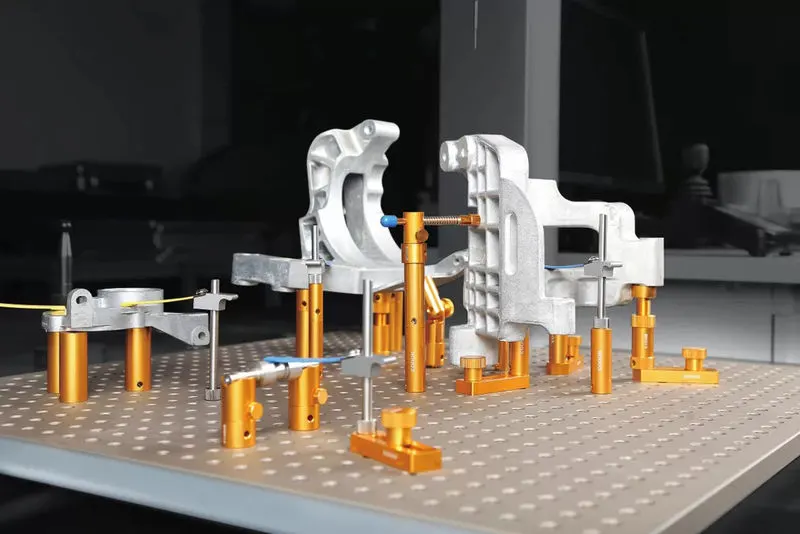
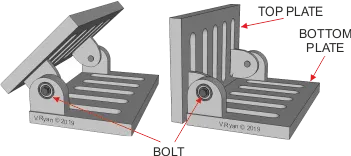
- The angle-plate fixture is a variation of the plate fixture. With this tool, the part is normally machined at a right angle to its locator. While most angle-plate fixtures are made at 90 degrees, there are times when other angles are needed. In these cases, a modified angle-plate fixture can be used.
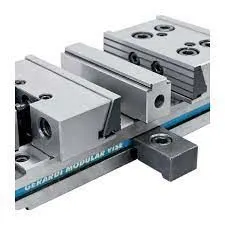
- Vise-jaw fixtures are used for machining small parts. With this type of tool, the standard vise jaws are replaced with jaws that are formed to fit the part. Vise-jaw fixtures are the least expensive type of fixture to make. Their use is limited only by the sizes of the vises available.
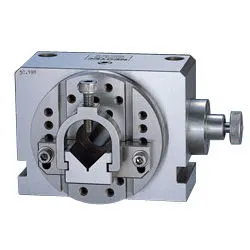
- Indexing fixtures are very similar to indexing jigs. These fixtures are used for machining parts that must have machined details evenly spaced.
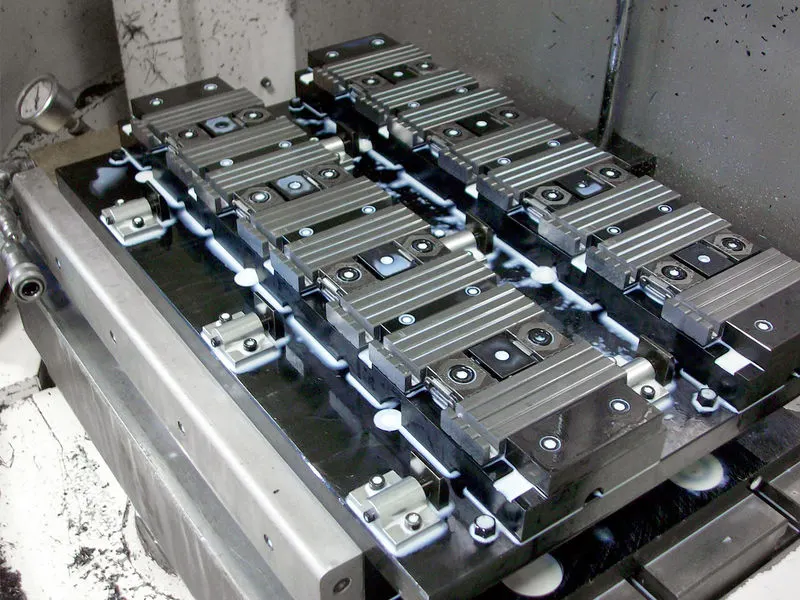
- Multistation fixtures are used primarily for high-speed, high-volume production runs, where the machining cycle must be continuous. Duplex fixtures are the simplest form of Multistation fixture, using only two stations. This form allows the loading and unloading operations to be performed while the machining operation is in progress. For example, once the machining operation is complete at station 1, the tool is revolved and the cycle is repeated at station 2. At the same time, the part is unloaded at station 1 and a fresh part is loaded.
- Profiling fixtures are used to guide tools for machining contours that the machine cannot normally follow. These contours can be either internal or external. Since the fixture continuously contacts the tool, an incorrectly cut shape is almost impossible. The operation in shows how the cam is accurately cut by maintaining contact between the fixture and the bearing on the milling cutter. This bearing is an important part of the tool and must always be used.
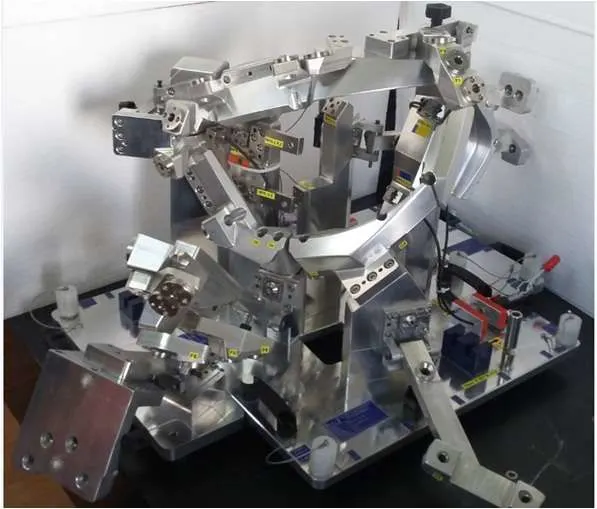
4. Fixture design principle
- To ensure precision in any machining operation, the work must be properly positioned with respect to the cutter or other tool. This is called referencing.
- Repeatability is the feature of the tool that allows different parts to be machined
consistently within their required tolerances. Accurate location is an important element in the repeatability of any tool.
3-2-1 Principle
- To accurately locate a part in a fixture, movements must be restricted. This is done with locators and clamps.
- By placing the part on a three-pin base, five directions of movement (2, 5, 1, 4, and 12) are restricted. Using pin- or button-type locators minimizes the chance of error by limiting the area of contact and raising the part above the chips.
- To restrict the movement of the part around the Z-Z axis and in direction eight, two more pin-type locators are positioned. To restrict direction seven, a single-pin locator is used. The remaining directions, nine, ten, and eleven, are restricted by a clamping device. This three-two-one, or six points, locating method is the most common external locator for square or rectangular parts.
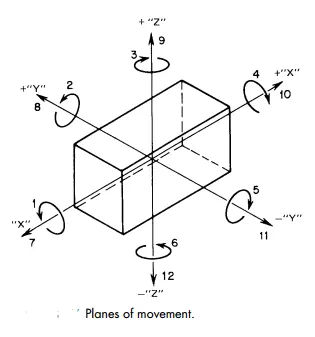
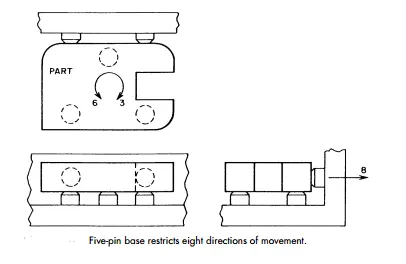
- Locators positioned under a part are referred to as supports. Locators position a part by its edges.
- The three primary supports are solid, adjustable, and equalizing. The major types of locators used to locate parts on an internal diameter are shank-mounted locators and pin locators. Pin locators may also be used to locate a part from its external edges.
5. Types of BIW Stations
BIW stations are specific workstations or areas within the automotive manufacturing process where the body structure of a vehicle is assembled.
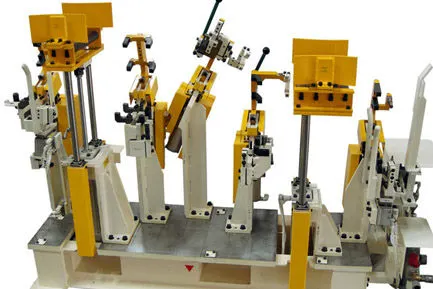
- Tool: A tool is a fixture which consists of units together to hold a car part in general.
- Geo Tools: A geo tool is a fixture in which the geometry of the panels which are welded together is defined accurately.
- Re-Spot Tools: A re-spot tool is a fixture in which the remaining weld spots which are not achieved in geo tool are welded for the pre welded panel from the geo tool.
- Hemming or Marriage Tool: A marriage or a hemming tool is a fixture in which the inner panel assembly and outer panel assembly are joined together. These are done by welding or by hemming in case of closure panels.
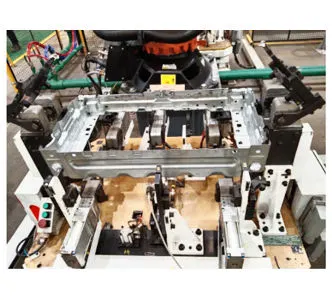
- Checking Station: A Checking Station tool is a fixture which is used to check the automotive parts or assemblies, ensuring all the coordinates, relative dimensions & positions as per the tolerances. A checking station can be a gauge type, fixed type, or automated checking fixtures.
- A Checking gauge is a tool where work piece is held & various measuring gauges are introduced to ensure the dimensions & repeatability.
- A fixed type checking fixture is used where the work piece is fixed with clamps & pins & a CMM machine is used which measures the coordinates of different points of the panel or assembly, compares it with the nominal values & gives a report.
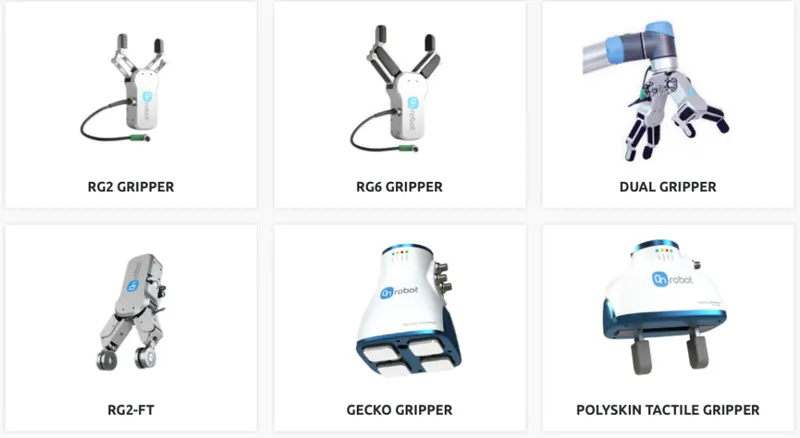
- Gripper: A Gripper is a device or a fixture which holds the car panel and is fixed to the manipulating end of a robot or an end effector.
- Material Handling Gripper: Material Handling gripper are designed for handling the car panel from one tool (Station) to other tool (Station)
- Dual Gripper: Dual gripper are designed for handling the car panel from one tool (Station) to another tool (Station), With two-sided gripper.
- Combo Gripper: Combo gripper are designed for handling the car panel from one tool (Station) to another tool (Station), Also with combination of weld gun at another side of the gripper for welding. For Example: Gripper + Weld Gun
- Process Gripper: Process gripper are designed for handling the car panel from one tool (Station) to other tool (Station), And in addition to that it undergoes process like pedestal welding, pedestal riveting, gluing, sealing, etc.,
- Stands
- Pedestal Gun Stand: Weld gun is mounted to a fixed stand which is grouted to the floor permanently, Where the process gripper carries the car panel to weld the spot with this fixed weld gun.
- Gluing and Sealer Stand: Gluing gun or sealer gun is fixed to a welded or a standard stand which is grouted to the floor permanently.
- Docking Stand: When robots are selected for multi-tasking like material handling & welding, which cannot carry both due to some limitations (payload capacity of the robot or space constraint) the robot will drop and pick the gripper or gun after completing the respective operation with the help of Docking stands.
- Miscellaneous
- Buffer Storage: A buffer storage stand is a storage solution used in manufacturing or assembly processes to temporarily store components, parts, or products during production. It serves as an intermediate storage area between various stages of the production line, allowing for smoother workflow and reducing the risk of bottlenecks or interruptions.
- Rack: Racks refer to specialized structures or frameworks used for organizing, storing, and transporting fixtures.
- Takeout Trolley: Take out trolley is used to take the car panel out of the robotic working cell between the cycle for purpose.
- Conveyor: A conveyor is a material handling system that consists of a continuous belt, chain, or other flexible surface that moves materials from one location to another.
- Curing: In this Station product received after sealing application, is kept idle at ambient temperature, which allows sealant to get dry with better bonding between the panel.
6. BIW Fixture Terminologies
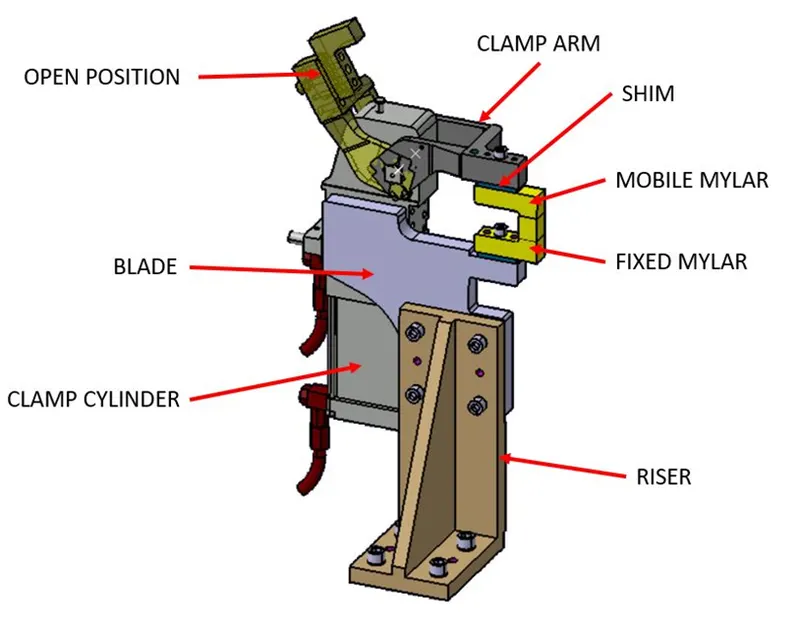
- Mylars: Mylar is one kind of block that touches the panel and holds or clamps the panel. Mylar is also called NC (Numerically Controlled) Block. Mylars are mounted on any block or plate with Shimming, so that height of mylar can be adjusted accordingly at the assembly level.
- Blade: The plate which connects Riser to the Clamp cylinder is named Blade. The blade can be of any shape.
- Risers: The part which is mounted on the base plate and holds a clamp or pin cylinder on it, is called Riser. Riser can be Standard Part or manufactured part;
- Shims: A shim is a thin plate to adjust receiving panels. Shims are typically used to support, adjust for better fit, or provide a level surface.
- Rough locators: rough locator is a type of locating feature or component used in fixtures to provide initial or coarse positioning of the workpiece. They are designed to align the workpiece quickly and roughly within the fixture before precise or fine positioning takes place.
- Hardware: Hardware refers to various components and fasteners that are used to assemble, secure, and adjust the different elements of the fixture system.
- Units: A unit represents an individual element or module that serves a particular purpose in supporting, positioning, or securing the workpiece during the manufacturing process. Example: - Clamping Unit, Locating Unit, Support Unit
- Number plate: A number plate in a fixture refers to a plate or tag that is affixed to the fixture, displaying a unique identification number or code assigned to that fixture. The number plate is typically used for tracking, inventory management, and identification purposes.
- Clamp arm: A clamp arm is a component used in fixture systems to secure and hold workpieces in a fixed position during machining, assembly, or inspection operations. It is designed to exert a clamping force on the workpiece, ensuring stability and precision during the manufacturing process.
- Pivot: Pivot refers to a component or mechanism that allows rotational movement or adjustment within the fixture. It enables the workpiece or specific fixture elements to rotate or pivot around a fixed point or axis.
- Reed switches: A reed switch is a type of electrical switch that operates based on the presence or absence of a magnetic field. It consists of two thin, ferromagnetic metal reeds sealed within a glass or metal tube filled with an inert gas. The reeds are typically made of materials such as nickel-iron or nickel-cobalt alloys.
- Sensors: A sensor is a device that measures physical input from its environment and converts it into data that can be interpreted by either a human or a machine. Most sensors are electronic (the data is converted into electronic data), but some are simpler, such as a glass thermometer, which presents visual data.