Week 1:- Introduction to BiW and Fixtures Challenge
1. What is BIW & define its parts?
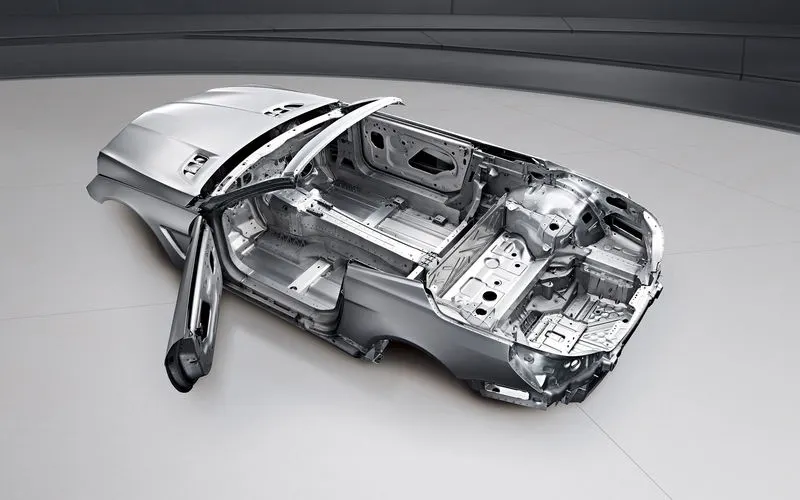
ANS:- (1.) BIW (Body in White) is stage of vehicle developement by different parts joining by welding, adhesion, screwing or reveting processes. Difefrent parts like chassis, engine, fuel tank, etc attched over BIW. The name BIW arose from colour of primer which applied after assemling all parts of BIW. Actually colour of primer is slightly greyish or silver. As we can see in below picture of BIW diffrent sheet metal components assembled together.
(2.) Different parts of BIW:-
| BIW | ||
| 1. Fenders | ||
| 2. Closures | a. Front Door | |
| b. Rear Door | ||
| c. Tank lid | ||
| d. Hood | ||
| 3. Body Sides | a. Body Side inner | |
| b. Body Side outer | ||
| 4. Roof | a. Inner Roof | |
| b. Outer Roof | ||
| 5. Under Body | a. Front End Under Body | |
| b. Rear end Under Body | ||
| c. Main Floor |
1. Fenders:- This part is extend from wheel arc to front of the vehicle. It is fixed to other component of BIW with by means of athesion or screwing. It avoid dust or mud flow into engine compartment or on the wheels.
2. Closures:- As name suggest this are the components which can be open and closed. Doors, hood, tank lid comes under this category. Gaps and flushes are to be maintained arond the closures. This components provides dust, noise and any other external substances as well they allow opening while specific applications.
3. Body Sides:- This are side parts of BIW. They need to be strong considering side crashes. It includes body side inner and body side outer.
4. Roof:- This is the upper protective member of BIW. It extends from front of the car to rear. Somtimes there is slot for sunroof. It also has two parts i.e. inner and outer roof.
5. Under Body:- This are the underneath components of BIW. It should be strong enough to resist pits or other obstructions over the ground. It includes mainly 3 parts i.e. front end , rear end and main floor. Front and rear ends are generally flexible in design.
2. What do you understand by BIW nomenclature?
ANS:- BIW nomenclature is simply naming of different components. But standards has to be maintained while assigning names. Tere are two types of standards which generally follows word wide American and Europian standards. We have to follow this standards while assigning names to different parts.
3. What is fixture & its types?
ANS:- Fixture is device to hold workpiece wich is to be welded. Correct use of fixture is define by 3-2-1 principle. There are 3 types of fixtures:-
(1) Production Fixtures :- This fixtures used for mass production purpose.
(2) Pre-production Operation Fixtures:- This fixtures are used for checking feasibilty in initial batch production
(3) Checking Fixtures:- This are used for inspection purpose.
4. What is the basic principle of fixture design?
ANS:- The basic principle of fixture design is 3-2-1 principle. Workpiece free in spcae have 12 degrees of freedom i.e. it has 12 possible movements, 6 translational and 6 rotational. So fixture need to restrict workpiece in this degrees of freedom with correct orientation and position. Locating of workpiece is the toughest function of fixture. So we use principle called 3-2-1 which is as follows,
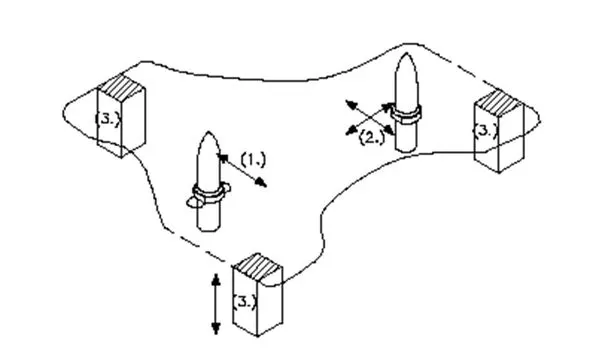
(3):- We need at least three plain supports below the workpice. so three locators needs to restricts 1 axial movement i.e. downward and 4 rotational movements. The locators must ensure eveness in height of job.
(2):- Generally round pin is used in a round hole to restrict 4 translational movements.
(1):- At last we use a round pin in slot two restrict 2 rotational movements of the workpeice.
In this way we use fixtures for correct position and orientation of workpiece.
5. Elaborate types of BIW Stations?
ANS:- Station is integral part of assembly line. Different stations forms a zone and combining different zones assembly line is formed. There are different type of stations namely, tools, gripper, stands and some miscellaneous.
(1.) Tool station:- Tool is a type of fixture in which different units combine to hold a panel. There are various type of tool stations as follows
a. Geo Tool:- It is a fixture which defines geometry of workpiece which is welded. The pin tolerance of geo tool is -0.15.
b. Re-spot Tool:- This fixture achieves remaining spot of welding in geo tool. The pin tolerance in Re spot tool is -0.28.
c. Marraige or hamming tool:- At this fixture assembly of inner and outer panels is achieved. In case of close panels hammening is done otherwise panels are welded toghther.
d. Checking Tool:- At this station checking of parts and assemblies is done. It ensures posiotion, orientation and dimensions of diferent components while considering tolerances. There are three types of cheching manual, fixed automative. We use manual type of checking tool where panel is hold in a fixture and different dimensions are checked with hand.
(2.) Gripper Station:- Gripper is component which is used to hold workpiece. There are always a pair of gripper, one is below the workpiece for resting of panel and other is attched to robotic arm which is movable type. Following are the different types of gripper we use:-
a. Material handling gripper:- This gripper is use for transportation purpose pf panel from one station to other.
b. Process Gripper:- As the name suggest this gripper transport the panel as well as helps in various joining processes. Processes like welding, screwing, reveting, gluing, etc.
c. Combo Gripper:- This grippers use for transporting panel from one station to other as well it carries weld gun at other end of gripper. This type of grippers are very useful in case of conjusted area.
d. Dual Gripper:- This grippers have two sides for holding of panel. This type of gripper are useful in case of symmetrical assembly.
(3.) Stand stations:- There are different types of stands which are included as a station in different zones of assembly line.
a. Gluing stand:- This stands is use for gluing purpose. Gluing gun or sealing gun is attached over this stand.
b. Docking stand:- If a robot is specified for multple type of work in which it cannot do both works at a same time. At such point robot exchanges gripper of weld gun with panel to be handled.
c. Date stamp stand:- As the name suggest this stand supports stamping device of date on components. So that we can understand process timing.
d. Pedestal gun stand:- This type of stands use for fixing weld gun via gripper. This fixed type welding guns.
(4). Miscellaneous stands:-
a. Butter storage:- This stands use for maintaning stocks. It stores extra components so that if preceding process is not up to the mark we can store extra componenets so that succeeding processes will not hampered.
b. Take out Trolley:- This trollies transport the panels from welding station to inspection station.
c. Conveyor tools:- This stations are for transporting purpose of various components.
(6.) What are the basic terminologies used in the BIW fixture?
ANS:- Folowing are the terminologies that we use in BIW:-
a. Fasteners:- This are screws, nuts, nolts,etc use for assembly purpose of different components.
b. Mylars:- They are also called as fingers. This are jaw like parts which are use for grabbing panels. Mylars also comes in a pair i.e. holding mylar and resting mylar.
c. Blades:- Blade used for attchement of different components to riser.
d. Risers:- This components are use for increasing height of different units.
e. Shims:- This components are just a flat olate of specific size. Is is use for adjust tolerances.
f. Clamp arm:- This is movable arm of clamp unit.
g. Units:- Fixture has different units with specific purpose like clamp unit, pin unit, etc.
h. Rough Locator:- It is use for prcise locating of workpiece. It is 30-45 degree of angle at edge and must be 2-3mm away from workpiece.
i. Class 'A' surfaces:- This are directly visible surfaces. This members must be protected from scratches or dents.
j. Number Plate:- This is aluminium plate imposing of numbers to recognize different parts.
k. Co-ordinate Plate:- We take measurement from master hole with the help of CMM. For the protection of master hole we use co-ordinate plate.