Week 1 Challenge
AIM:
1.To compare the specifications of the fuel cell cars that were first launched with those currently in the market.
2.To analyse the trend in the cost of fuel cell production.
EXPLANATION:
1.
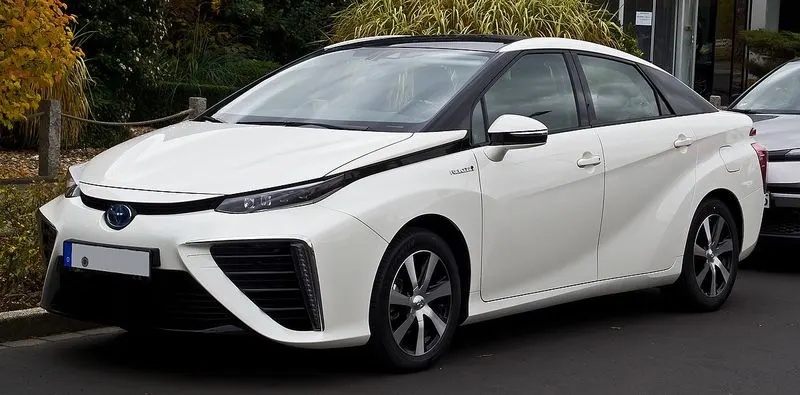
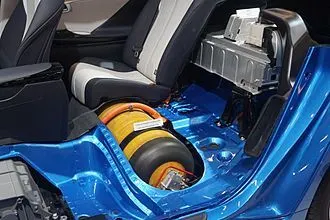
The Toyota Mirai is one of the frst fuel cars that was launched.It has combination of fuel cell and a hybrid architecture.The vehicle can accelerate from 0 t0 100 kmph in a matter of 9 seconds.The expected range of the vehicle is 480km.The estimated refueling time was between 3 to 5 minutes.The fuel cell stack that power the vehicle can deliver a maximum utput of 114 kW and there is a high voltage booster in place which can increase the voltage to 650V.The fuel source which is essentially hydrogen has to pressurised to 70MPa in order to be stored in the fuel tanks.The vehicle has two tanks with a combined capacity of 5kg or 122 litres. The tanks in total weigh 87.5kg.Since the car is of hybrid configuration there is an electric motor which can deliver a maximum power and torque of 113kW and 335Nm, powering it is a nickel metal hydride battery pack with 1.6kWh capacity capable of producing 245V.
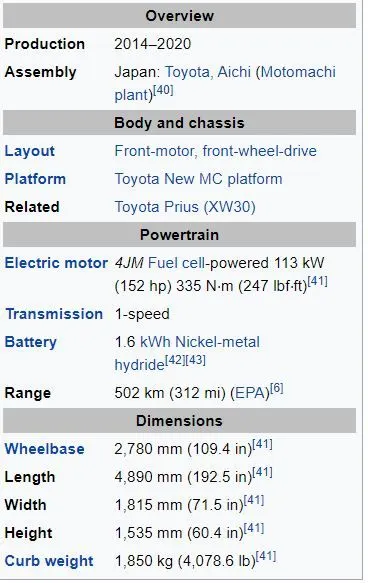
The fuel stack when assembled looks like as follows
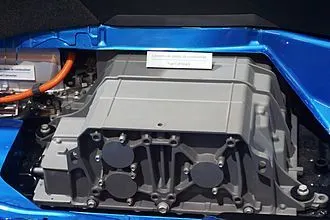
The rechargable battery along with the hydrogen fuel storage tank is as follows
The current generation of Mirai has a hydrogen fuel cell powered engine which is capable of delivering 130kW of power.The electric motor is capable of delivering 136kW of power and 300Nm of torque, powering it is a 1.2kWh lithium ion battery pack.The vehicle has an improved range of 850km.
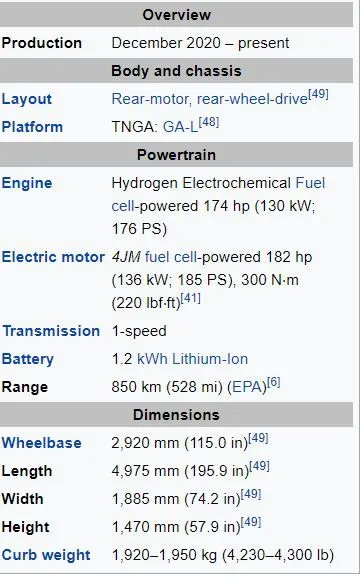
Other improvements include the driver moinitoring camera, which helps in lane changing, overtaking among others.The software system can receive remote software updates making it very convinient in case of a glitch.
2.
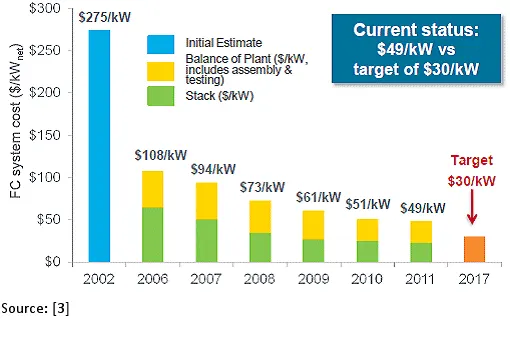
The cost of making fuel cells were very high initially as they were not produced in huge numbers.There was no dedicated hydrogen infrastructure in place to make the fuel easily available like in the case of fossil fuels and recharging stations.As the years passed the technology associated with fuel cells improved as a result their cost also reduced another reason is that they were made in higher volumes.With dedicated infrastructure in place for refueling increasing the cost of fuel cells are becoming more affordable.
RESULT:
1.The initial and current model of fuel cell vehicles are compared and analysed.
2.The factors contributing to reduction of fuel cell costs are listed.