Week 1 Challenge
1. AIM : To determine the most efficient truss
Truss type reasoning
Out of the two through type truss systems shown below, which is the most efficient in carrying gravity load? Reason it out.
Truss A: Pratt Truss
- A truss having vertical members between the upper and lower members and diagonal members sloping toward the center.
- It places compression on shorter vertical members and tension on longer diagonal members which is advantageous for steel.
- Hence Pratt truss is the most efficient in carrying gravity loads
Truss B : Howe Truss
- The design of Howe truss is the opposite to that of Pratt truss in which the diagonal members are slanted in the direction opposite to that of Pratt truss (i.e. slanting away from the middle of bridge span)
- It places compressive stress on longer diagonal members and tension on shorter vertical members which is disadvantageous for steel.
Since steel is strong in tension, and the Pratt truss has tension along the longer diagonal members , the material utilization is optimum in Pratt truss compared to the Howe truss where tension is borne by the shorter vertical members
RESULT: Pratt truss is the most efficient in carrying gravity loads
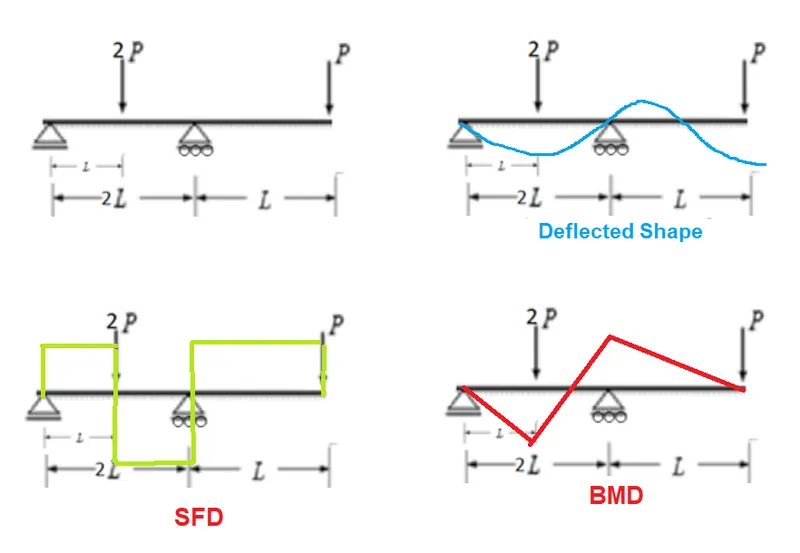
2.AIM : To draw Deflection shape & Bending Moment Drawing (Qualitative approach)
For the beam & Frame below draw deflected shape and bending moment drawing. (Qualitative approach). E & I are constants.
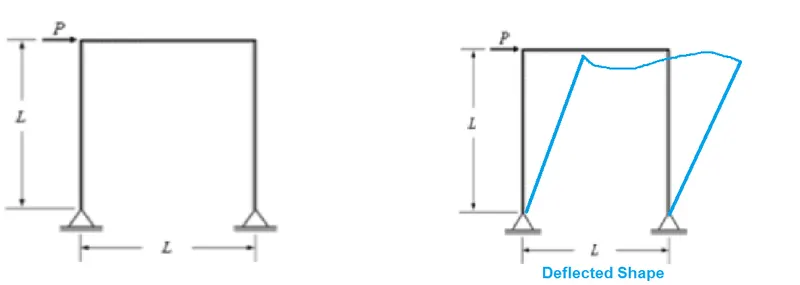
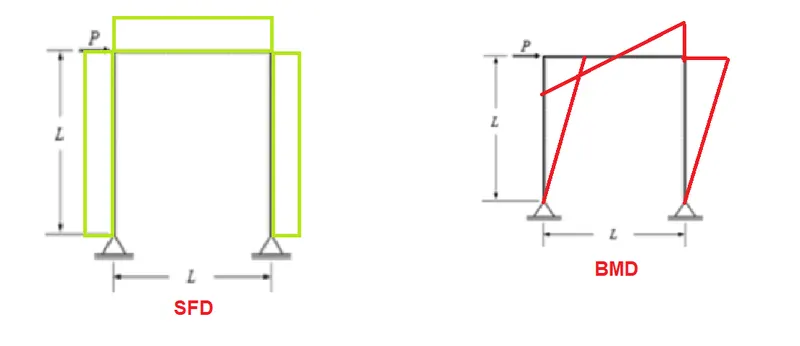
Note that the hinge support doesn't carry any moment so the BM about the hinge is zero
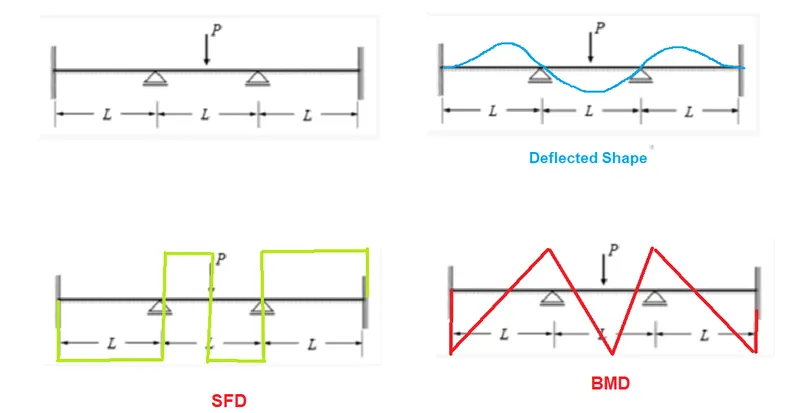
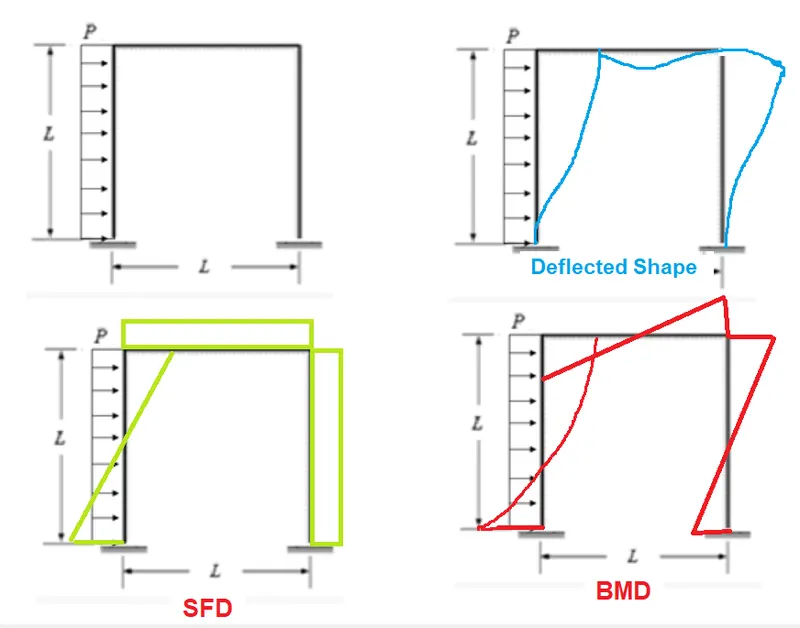
3)AIM : To determine MOI, Weight, C/S area of sections below
1)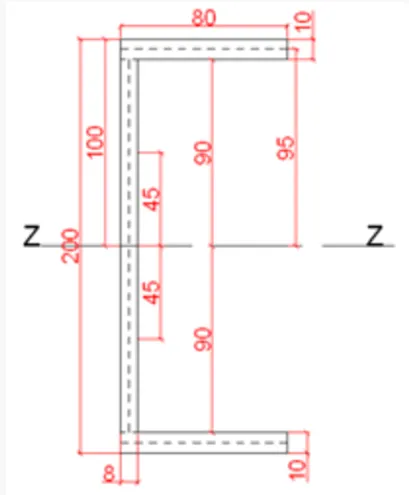

Ixx = 1.834 * 10^7 mm^4
Iyy = 1.843 * 10^6 mm^4
Weight = 23.864 kg/m
2) 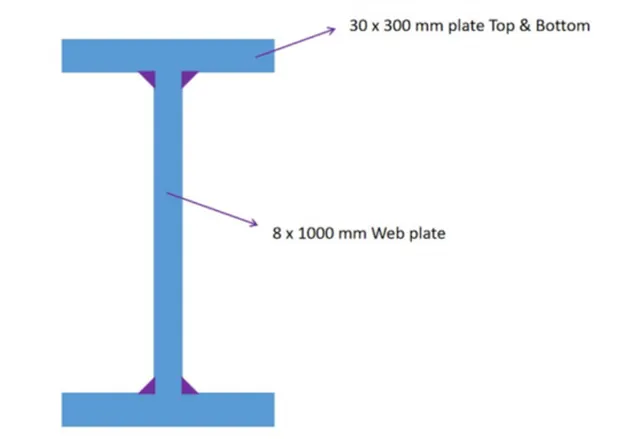

Ixx = 5.44 * 10^9 mm^4
Iyy = 1.35 * 10^8 mm^4
Weight = 204.1 kg/m
3)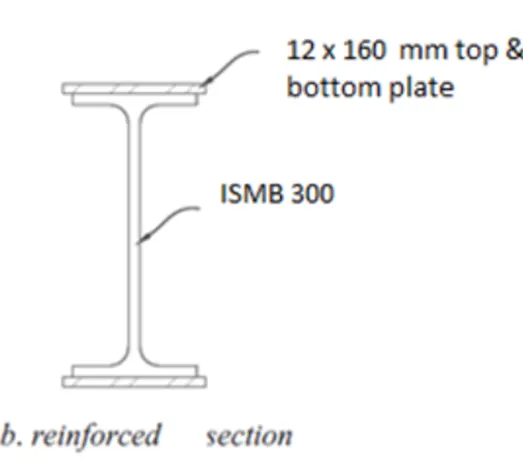
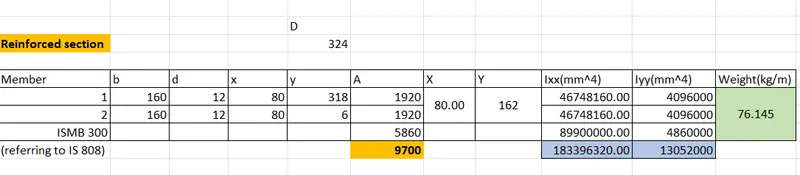
Ixx = 1.83 * 10^8 mm^4
Iyy = 1.31 * 10^7 mm^4
Weight = 76.145 kg/m
4) 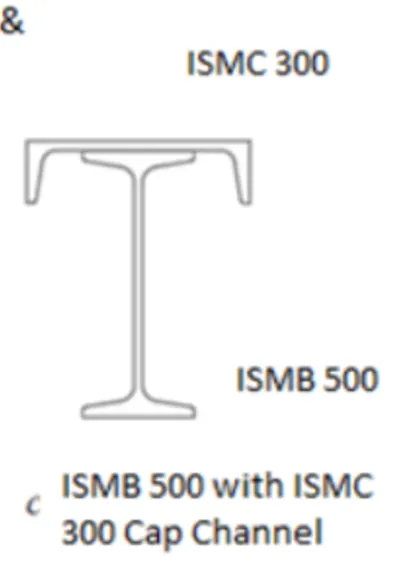

Ixx = 6.68 * 10^8 mm^4
Iyy = 7.79 * 10^7 mm^4
Weight = 123.2 kg/m
4) AIM : To determine the load coming on the beams and girders
For the floor framing below, Calculate the load on interior beam, Exterior beam, Interior Girder and exterior girder having Floor Load of 10kN/m2
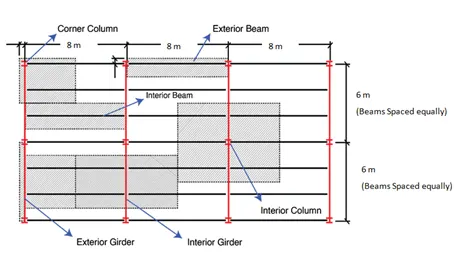
i) Load on Interior beam = (10 * 1) * 2 = 20 kN/m
ii) Load on Exterior beam = 10 * 1 = 10 kN/m
iii) Load on Interior girder = Load on interior beam * Length of distribution
So that the load gets distributed as a concentrated load. This load will come from both the sides since its a interior girder
Load on Interior girder = 20 kN/m * 4 = 80 kN
Load from 2 sides = 80 * 2 = 160 kN
Therefore load on interior girder is 160 kN coming from 2 interior beams on either sides.
Load = 160 kN spaced at 2m
iv) Load on Exterior girder = 20 kN/m * 4 = 80 kN
Load = 80 kN spaced at 2m
5. AIM : To determine the Expansion joint size for temperature stated problem
Assuming a bridge, made of steel, with an initial total length of 2000 m at -20 ºC, calculate the length difference at 40 ºC and its total length.
Length difference,
Δ L = L `alpha`Δ T
= 2000 * 12 * 10 ^-6 * [40-(-20)] = 1.44 m
Total length = L + 1.44 = 2001.44 m
RESULT :
Length difference,
Δ L = 1.44 m