Week 1 Challenge
1.Create a design summary report (DSR) for the following items for any highway you are aware of in your region. Mention the highway name, and location: -
- Category/Class of the road.
- Design speed of the road.
- Terrain classification.
- Travel Lane width.
- Typical min. cross slope.
- Horizontal curve radius without superelevation.
Ans:
Name of the Road: GMR Hyderabad Vijayawada Expressways Private Limited
Category/ Class of the Road: Expressway
The design speed of the road: 120 km/hrs at plain terrain and 80 km/hrs at hilly terrain
Terrain classification: Plain & Hilly
Travel Lane width: 4-lane (expandable to 6) with paved and unpaved shoulders on both sides, with each lane width of 3.5m.
Typical min. cross slope: Minimum Cross Slope of 2.5% (as per IRC SP 99)
Horizontal curve radius without superelevation: Generally Max radius where no SE is needed for 120KMPH design Speed and min cross slope of 2.5% is 4000m
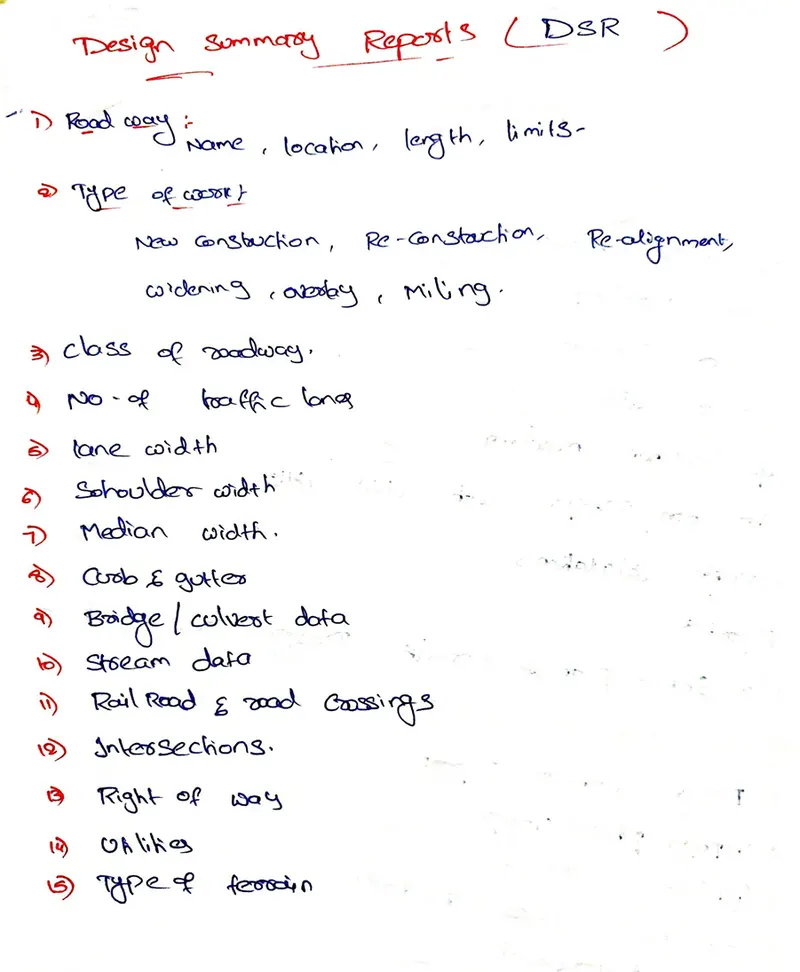
2. What is the typical roadway project life cycle workflow? List out in points. What is the typical roadway design workflow? Also, list out all the experts needed on a roadway project.
Ans:
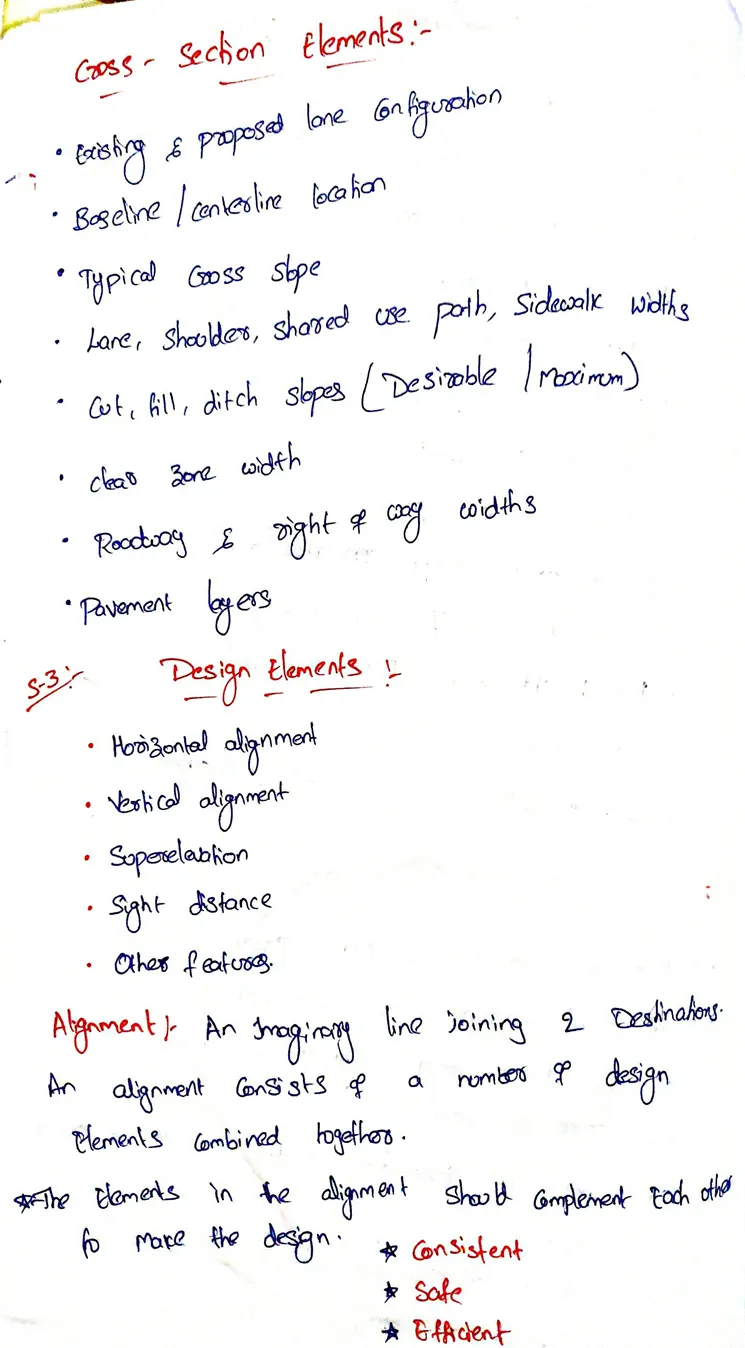
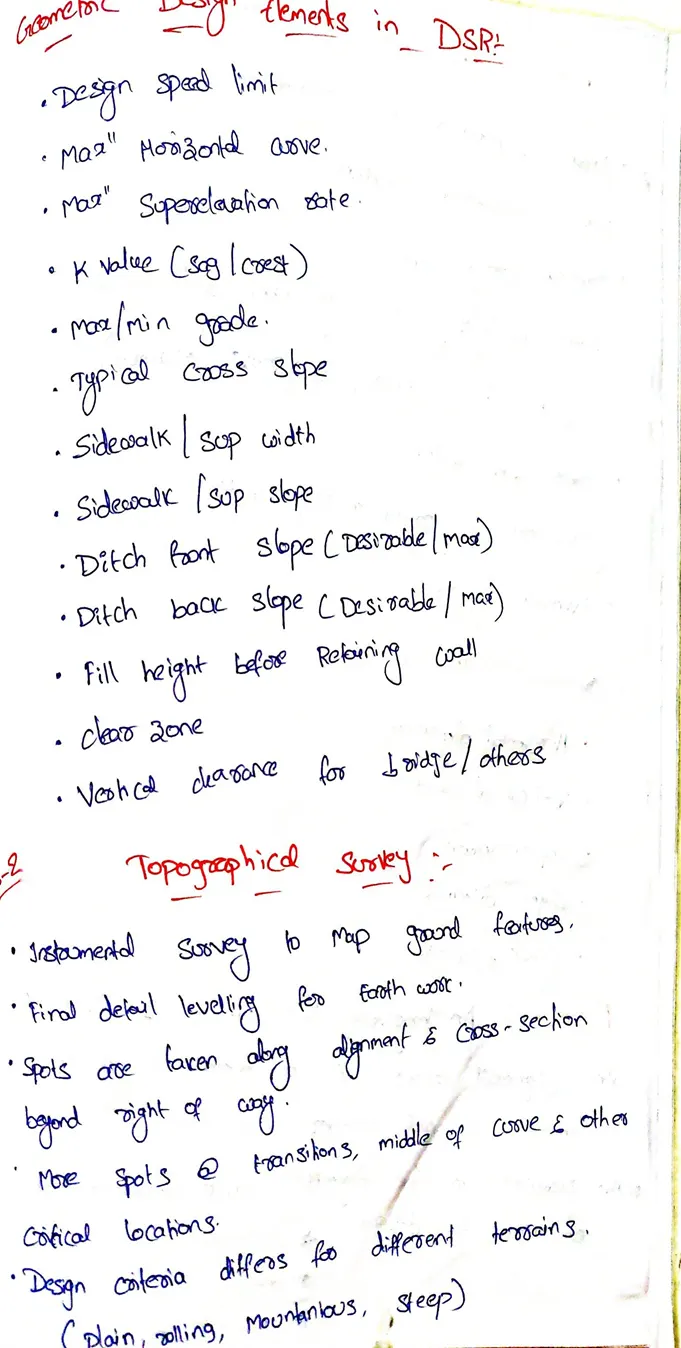
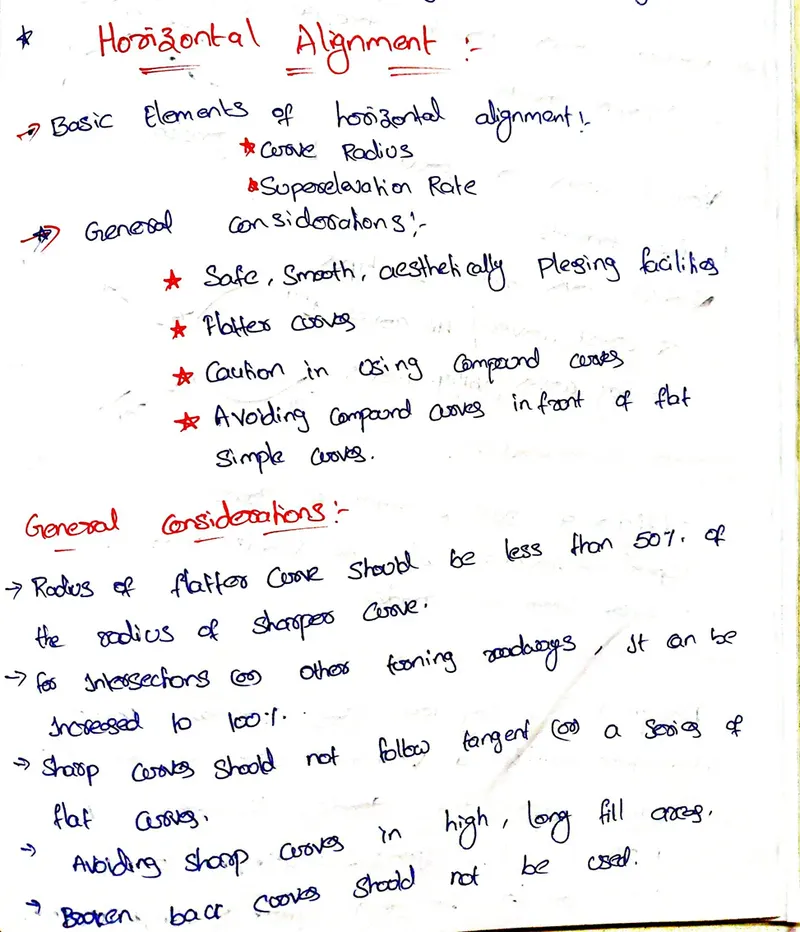
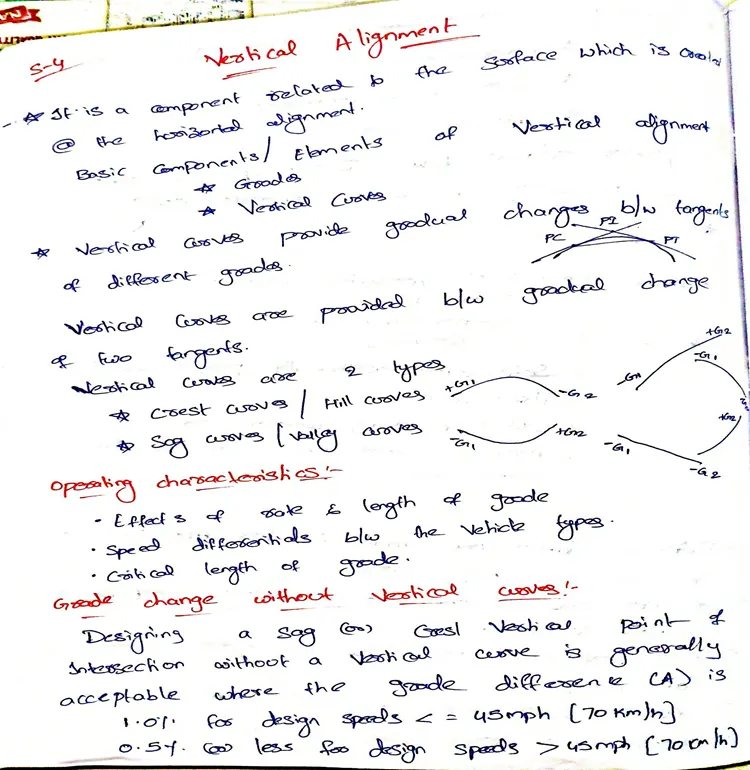
3.What are the important geometrical parameters of a horizontal alignment and vertical profile? When is a vertical curve needed? List the formula with a diagram for vertical curve. List all types of vertical curves with the diagrams.
Ans:
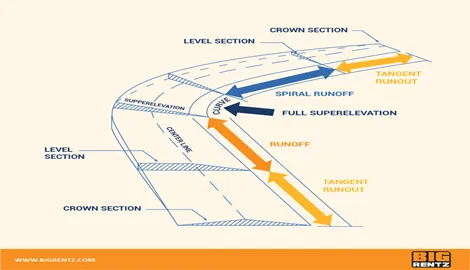
4.When is superelevation necessary? Show diagrammatical presentation of super concept.
Ans: Superelevation works with several interacting forces of physics to help drivers maintain speed and stay safely on the road through a curve. A complex combination of centrifugal and centripetal force, friction, inertia, weight, and velocity or speed all interplay to determine the need for superelevation on a road or highway.

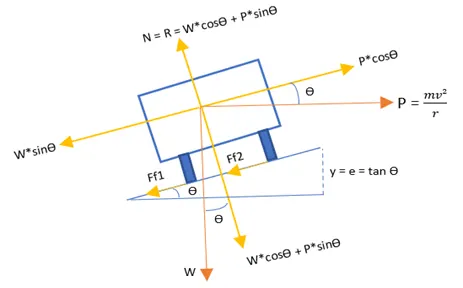
For equilibrium condition in the transverse direction,
W*sinθ - P*cosθ + Ff1 + Ff2 = 0
P*cosθ - W*sinθ = R1 + R2
P*cosθ - W*sinθ = fN1 + fN2
P*cosθ - W*sinθ = f*(N1+N2)
P*cosθ - W*sinθ = f*(P*sinθ + W*cosθ)
P*cosθ - f*P*sinθ = W*sinθ + f*W*cosθ
P/W = (sinθ + f*cosθ)/(cosθ - f*sinθ), dividing by cosθ on R.H.S.,
(v^2)/gR = (tanθ + f)/(1 - f*tanθ)
Substituting tanθ = e,
v^2/(gR) = (e + f)/(1 - e*f)
As per I.R.C., f=0.15 and e is limited to 0.07 (for plain and rolling zone). Therefore e*f becomes 1.
v^2/(gR) = e + f
Superelevation Formula
e = rate of superelevation
f = design value of coefficient of lateral friction = 0.15
v = design speed of the vehicle, m/sec
R = radius of the horizontal curve, m
g = acceleration due to gravity = 9.8 m/sec^2
Substituting g = 9.8 and converting v to kmph, we get,
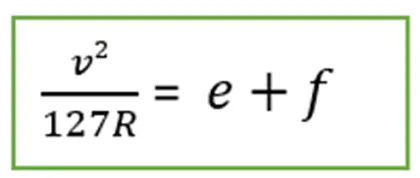
Superelevation formula simplified
v = design speed of the vehicle, kmph
R = radius of the horizontal curve, m
With these formulas, e value could be found out. If f is taken as 0 (zero), then equilibrium superelevation could be found out. Suitable radius (R) for the constrained values of e and f could also be found out.
5.List out the typical set of submission needed for a roadway project.
Ans:


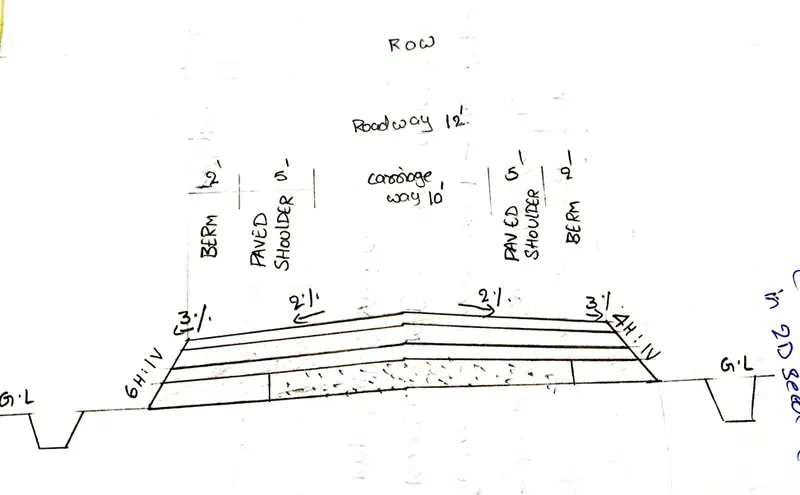
6.Draw a typical cross section with following parameters –
- 12’ travel lane
- 10’ shoulder lane
- 2% cross slope
- 2’ berm
- End conditions with cut/fill of 6:1 and 4:1
- Ditch condition of front slope 4:1, back slope 4:1, 3:1
Ans: