Week 1 Challenge
1. Truss type reasoning
Out of the two through type truss systems shown below, which is the most efficient in carrying gravity load? Reason it out.
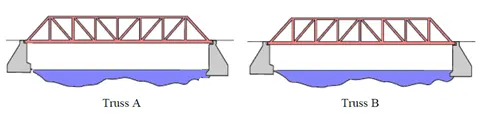
ans) out of the two truss ,A is more efficient in carrying gravity load, in truss A we can see the
top and bottom chords are provided to keep the inclined members intact and transfer shear
not moment. In the centre we can see two M shaped inclined members which trasfer the
axial force and gravity force.
2. Deflection shape & Bending Moment Drawing (Qualitative approach)
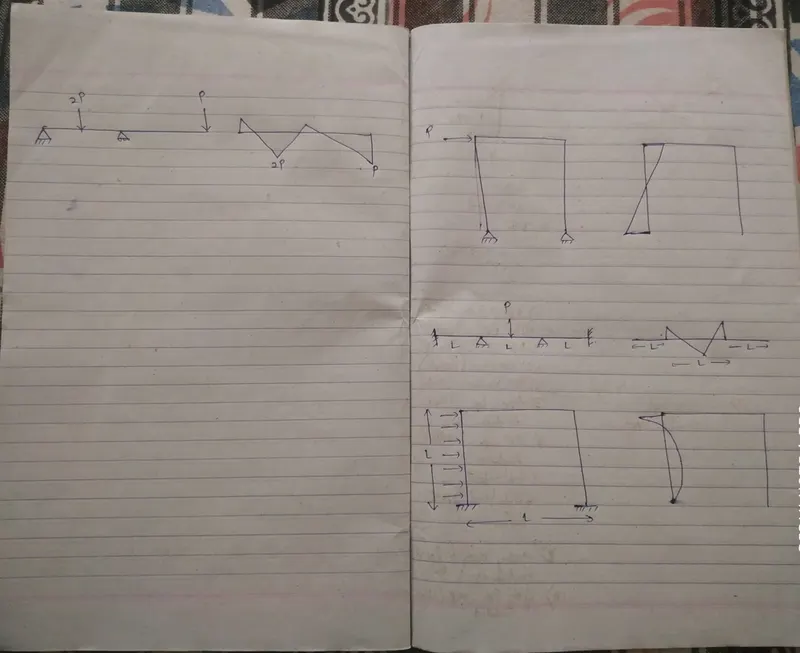
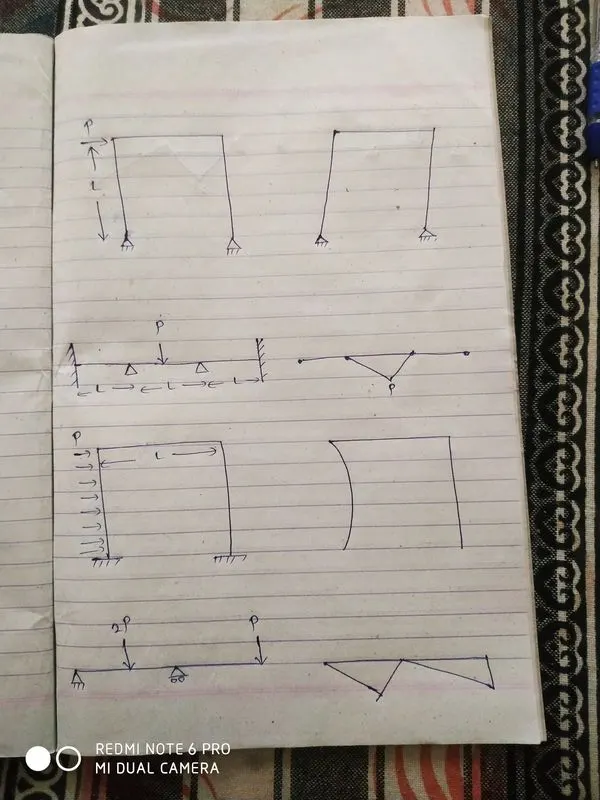
For the beam & Frame below draw deflected shape and bending moment drawing. (Qualitative approach). E & I are constants.
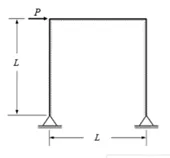
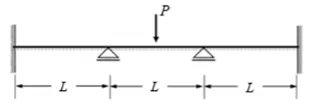
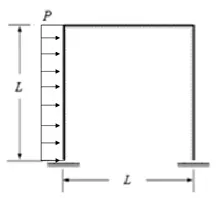
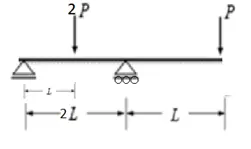
ans)
Bending moment diagrams:
deflected shapes :
5. Expansion joint size determination for temperature stated problem
Assuming a bridge, made of steel, with an initial total length of 2000 m at -20 ºC, calculate the length difference at 40 ºC and its total length.
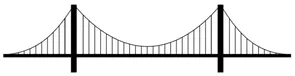
Coefficient of Thermal expansion of steel = 12x10-6/°C
ans)
change in length = cofficient of thermal expansion x original length x change in temperature
= 12 x 10^-6 x 2000 x 20
= 0.48m
Q5)
ans)
Load calculation problem
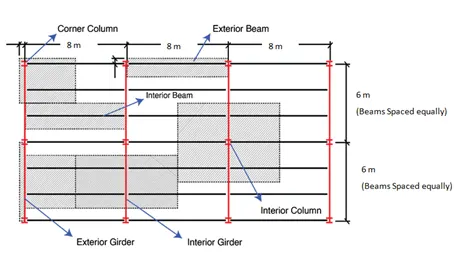
For the floor framing below, Calculate the load on interior beam, Exterior beam, Interior Girder and exterior girder having Floor Load of 10kN/m2
ans)
Floor load = 10kn/m^2
tributary width of exterior girder = 0.5(0+8) = 4m
tributary width of interior girder = 0.5(8+8) = 8m
tributary width of exterior beam = 0.5(0+2) = 1m
tributary width of interior beam = 0.5(2+2) = 2m
Load on beam = tributary width x floor load
load on exterior girder = 4 x 10 = 40Kn/m
Load on beam interior girder = 8 x 10 = 80 Kn/m
Load on beam exterior beam = 1 x 10 = 10Kn/m
Load on beam interior beam = 2 x 10 = 20 Kn/m