Construction Technology_Concrete Mix Design_Project 1
AIM :
To calculate the concrete mix design for M35 grade concrete with flyash.
INTRODUCTION:
Mix design is the process of specifying the mixture of ingredients required to meet anticipated properties of fresh and hardened concrete .concrete mix design is a well established practice around the globe . the concrete mix design methods used in countries such as britain, india and usa are based on similar basic properties and empirical relations developed after substantial experiments on locally available materials , not withstanding just about small differences exists.these methods are mostly based on empirical relations developed after charts graphs and tables developed through extensive experiments and investigations using locally available materials. therefore a detailed comparative analysis of these methods of mix design is warranted. this type of comparative study can helpdistinguish variations in either method or wouldotherwise substantiate their validity. it is must study that how design calculations for aggregates water content ratio are different in these methods . the experimental program was planned to study the influence of change in proportioning of aggregates on the properties of concrete when designed with different mix design methods.
EQUATIONS :)
Target mean strength : ft = fck + 1.65 s
where ,ft= target mean strength
fck = compressive strength at 28 days of concrete
s = standard deviation
volume of cement = (mass of cement /specific gravity of cement ) * (1/1000)
volume of water = (mass of water / specific gravity of water )* (1/1000)
volume of chemical admixture = (mass of chemical admixture /specific gravity of chemical admixture)*(1 / 1000)
volume of flyash = (mass of flyash/ specific gravity of flyash)*(1/1000)
volume of concrete = 1m3
volume of aggregates = volume of concrete -( volume of cement+ volume of flyash+ volume of water +volume of admixture)
mass of coarse aggregate = volume of aggregate *volume of coarse aggregate * specific gravity of coarse aggregate*1000
mass of fine aggregate = volume of aggregate *volume of fine aggregate* specific gravity of fine aggregate *1000
CODES FOR CONCRETE MIX DESIGN :
IS 10262-2009
IS 456- 2000
IS 8112
IS 9103
IS 3812 ( part 1)
OBJECTIVE :
The main objective is to produce the concrete as economical as possible. to achieve desired workability ,durability and minimum strength of M35 grade concrete.
PROCEDURE AND CALCULATION:
1. Target mean strength
Ft= fck + 1.65s
fck = 35N/mm2. ( M35 )
table 1 of IS 10262 : 2009
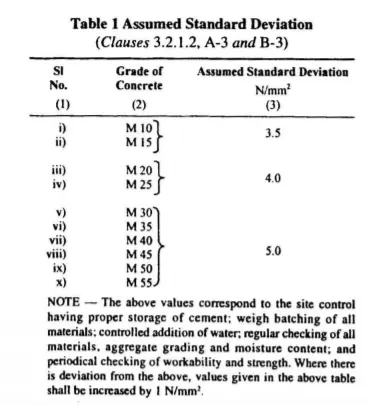
s = 5N /mm2
Ft = 35 + 1.65*5
=43.25N/mm2
2)SELECTION OF WATER CEMENT RATIO :
given :
M35
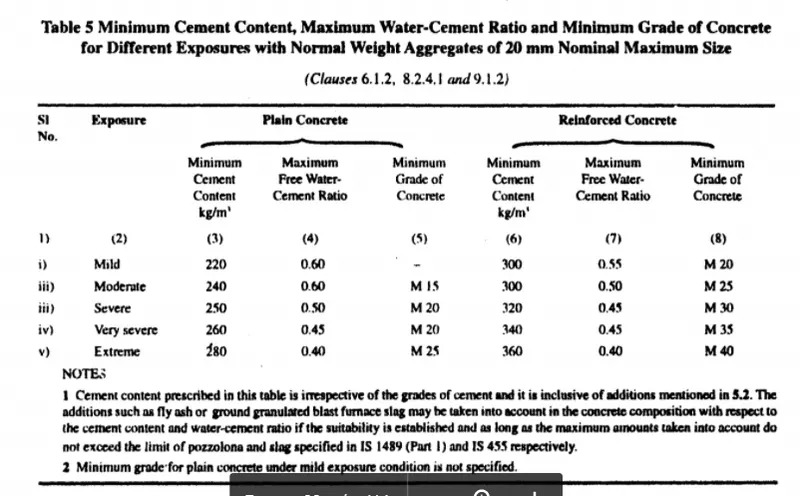
assume : exposure condition as extreme( for reinforced concrete )
table 5 - IS 456 2000
therefore,
extreme = w/c ratio = 0.40
M35 = w/c ratio = 0.45
Lower the water cement ratio better the workability
0.40 < 0.45
water cement ratio = 0.40
minimum cement content = 360 kg/m3
3 ) SELECTION OF WATER CONTENT
Assume :
nominal size of aggregate : 20mm
Table 2 of IS 10262 2009
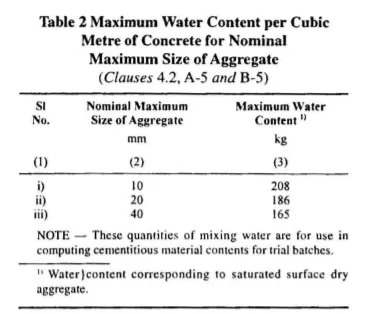
minimum water content = 186 litres or kg
slump ranges from 25 to 50mm
as superplasticizers( 20% reduced)
=186*(80/100) = 148.8
water content = 149 litres
4)CALCULATION OF CEMENTITIOUS CONTENT ( CEMENT + FLYASH )
water cement ratio = 0.40
water content = 149kg
cementitious content = c = 149/0.40 =372.5 = 370kg/m3
minimum cement content = 360 kg/m3
360 < 370kg/m3 ( hence okay )
increase by 10%
370*.10+370= 407 kg /m3
W = 149kg
water cement ratio = 149/407 = 0.366
flyash at 30% total cementitious material content
= 407* (30/100) = 122kg/m3
cement ( ordinary portland cement )= 407-122=285kg/m3
saving of cement while using flyash = 370 -285 =85kg/m3
flyash = 122kg/m3
5)VOLUME OF COARSE AGGREGATES AND FINE AGGREGATES
Fine aggregates are sieved according to zone 1 of table 4 Is 383
coarse aggregate are sieved according to table 2 of Is 383
according ,
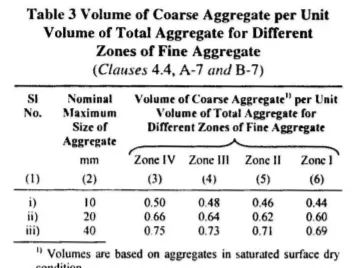
table 3 of IS 10262 2009
nominal size of aggregates = 20mm
Fine aggregates ( zone 1 )
therefore, volume of coarse aggregate = 0.60
water cement ratio = 0.4
so, volume of coarse aggregate = 0.62
volume of fine aggregate = 1-0.62=0.38
6)MIX CALCULATION:
1)Volume of concrete = 1m3
2)volume of cement = ( 285 / 3.15)* 1/1000=0.090m3
3)volume of flyash = (122/2.2)*(1/1000)= 0.055m3
4)volume of water = (149/1)*(1/1000)= 0.149m3
5)volume of admixture = (7.6/1.145)*(1/1000)= 0.006m3
6) volume of coarse aggregate and fine aggregate = a-(b+c+d+e) = 1 - (0.090+0.055+0.149+0.006) = 0.7m3
7)mass of coarse aggregate = 0.7* 0.62*2.74*1000 = 1189.16kg /m3
8)mass of fine aggregate = 0.7* 0.38* 2.74*1000 = 728kg/m3
RESULT AND CONCLUSION:
TRIAL MIX
cement = 285kg/m3
flyash = 122kg/m3
water = 149kg
coarse aggregate = 1189kg/m3
fine aggregate = 728kg/m3
chemical admixture= 7.6kg/m3
water cement ratio = 0.366
trial mix ratio : 285 :728 :1189 = 1: 2.55 :4.17 ( C : FA : CA )
this trial mix ratio should match the workability , durability ,minimum strength of M35 grade concrete. if it does not satisfy the above criteria two or more trials for increased 10% should be done.
various literatures have been reviewed in order to generalize the effect of change in proportions of aggregates ,on the properties of concrete when designed by different mix design methods . the experimental program was carried out to compare ACI, BIS,DOE USBR method of mix design. M35 and M40 grades of concrete were used to carry out the comparision based on mechanical properties of concrete. it was observed that all the methods achieved the target mean strength either, in case of M35 or M40 except the ACI method in case of M40 for which the cement content has to be raised to fulfill the minimum requirements of strength. the overall comparision shows that USBR method comes out with the best results among the four mix design methods compared in terms of strength ,toughness and durability ,but method is little more expensive than doe method. doe method has been recognized for delivering optimum perfomance in a relative economic budget except when the toughness of concrete is not a mandatory concern. so in daily concrete practice where only strength and durability is required in a comparatively low budget ,DOE method of concrete design should be practiced with the stipulation that the toughness of concrete is not a primary concern, and where site conditions require strength, toughness and durability side by side irrespective of the budget ,USBR method can be practiced for optimum results.
AIM: TO CALCULATE MIX DESIGN FOR M50 GRADE WITHOUT FLYASH.
equations:
target mean strength :
ft = fck +1.65s
where, ft = target mean strength
fck = compressive strength
s= standard deviation
volume of cement: (mass of cement / specific gravity of cement)*(1/1000)
volume of water : (mass of water / specific gravity of water)(1/1000)
volume of chemical admixture : (mass of chemical admixture/specific gravity of chemical admixture)(1/1000)
volume of concrete = 1m3
volume of aggregates : volume of concrete - (volume of cement + volume of water + volume of chemical admixture)
mass of coarse aggregate : volume of aggregate *volume of coarse aggregate * specific gravity of coarse aggregate *1000
mass of fine aggregate : volume of aggregate *volume of fine aggregate*specific gravity of fine aggregate*1000
CODES FOR CONCRETE MIX DESIGN:
IS 10262 2009
IS 456 2000
IS 8112
IS 9103
IS 3812( PART 1)
OBJECTIVES :
the main objective is to produce concrete as economically as possible ,to achieve desired workability ,durability and minimum strength of M50 grade concrete.
PROCEDURE AND CALCULATION:
1)target mean strength :
ft = fck + 1.65s
fck = 50 N/mm2 (M50)
table 1 - IS 10262 2009
s = 5N/mm2
ft = 50 +(1.65 *5 )
=58.25N/mm2
2)selection of water cement ratio:
given : M50
assume : exposure condition = extreme
table 5 - IS 456 2000
therefore,
extreme = w/c ratio= 0.40
M50 = w/c ratio = 0.40
lower the water cement ratio better the workability
water cement ratio =0.40
minimum cement content = 360kg/m3
3) SELECTION OF WATER CONTENT
assume
nominal size of aggregate = 20mm
table 2 of IS 10262 2009
minimum water content = 186litres
slump ranges from 25 to 50mm
as superplasticizers ( 20% reduced )
= 186* (80/100) = 148.8
water content = 149 litres
4)CALCULATION OF CEMENT CONTENT:
water cement ratio = w/c ratio = 0.40
water content = w =149kg
cement content = c =149/0.40 = 372.5= 373kg/m3
minimum cement content = 360kg /m3
360 < 370 kg/m3 (hence ok)
5)VOLUME OF COARSE AGGREGATES AND FINE AGGREGATES:
fine aggregates are sieved according to zone 1 of table 4 of Is 383
coarse aggregates are sieved according to table 2 of IS 383
according,
table 3 of IS 10262 2009
nominal size of aggregates = 20mm
fine aggregates ( zone 1)
therefore ,
volume of coarse aggregate = 0.60
water cement ratio = 0.4
so, volume of coarse aggregate = 0.62
volume of fine aggregate = 1 - 0.62 =0.38
6) MIX CALCULATION:
1)volume of concrete = 1m3
2)volume of cement = (373/3.15)*(1/1000)= 0.118
3)volume of water = (149/1)*(1/1000) = 0.149m3
4)volume of admixture = (7.6/1.145)*(1/1000)= 0.006
5) volume of coarse aggregate and fine aggregate = a - ( b + c + d )
= 1 - (0.118 + 0.149 + 0.006) = 0.727m3
6) mass of coarse aggregate = 0.727 * 0.62* 2.74*1000 = 1235.02 kg/m3
7) mass of fine aggregate = 0.727 *0.38*2.74*1000 = 756.9 kg/m3
RESULTS AND CONCLUSION:
TRIAL MIX
cement = 373 kg/m3
water = 149kg
coarse aggregate = 1235.02 kg /m3
fine aggregate = 756.9 kg/m3
chemical admixture = 7.6 kg/m3
water cement ratio = 0.40
trial mix ratio : 373 : 756.9 : 1235.02 = 1 : 2.02 : 3.31 ( C : FA : CA )
this trial mix ratio should match the workability ,durability , minimum strength of M50 grade concrete. if it does not satisfy the above criteria two or more trials for increase of 10% shoul be done.