Understanding the concepts on Degrees of Freedom
A five storey structure with 5 translational DOF is shown here. Each storey has mass ‘m’. The eigenvalue problem has been solved and the 5 periods of vibration Tn and their corresponding mode shapes, φn has been derived.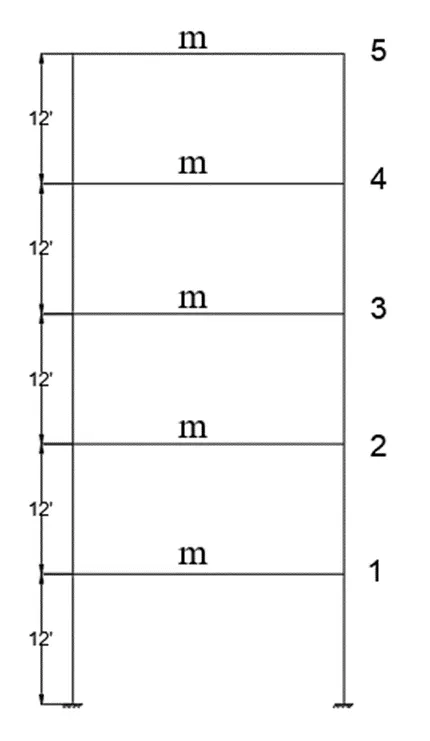
The fundamental period of vibration (T1 = 2 seconds) and its associated mode shape:
`Phiunderset(1)`=`[[0.334],[0.641],[0.895],[1.078],[1.173]]`
The second mode of vibration (T2 = 0.6852 seconds) and its associated mode shape:
`Phiunderset(2)`=`[[-0.895],[-1.173],[-0.641],[0.334],[1.078]]`
The third mode of vibration (T3 = 0.4346 seconds) and its associated mode shape:
`Phiunderset(3)`=`[[1.173],[0.334],[-1.078],[-0.641],[0.895]]`
The fourth mode of vibration (T4 = 0.3383 seconds) and its associated mode shape:
`Phiunderset(4)`=`[[-1.078],[0.895],[0.334],[-1.173],[0.641]]`
The fifth mode of vibration (T5 = 0.2966 seconds) and its associated mode shape:
`Phiunderset(5)`=`[[0.641],[-1.078],[1.173],[-0.895],[0.334]]`
- Ln , Mn and Γn for each of the five modes are to be computed from Equations below.
- Also, calculate the effective modal mass Mn* and the modal mass participating ratio for the 5 modes. The mass matrix will be required to evaluate these parameters.
- Finally, obtain the base shear for each of the 5 modes of vibration and the combined base shear as per SRSS rule. The pseudo acceleration design spectrum to obtain the base shear for each mode is provided below.
- How many modes are to be considered such that a modal mass participating ratio of 90% is obtained?
AIM:
- To calculate Ln, Mnand Γn for each of the five modes.
- To calculate the effective modal mass Mn* and the modal mass participating ratio for the 5 modes.
- To find the base shear for each of the 5 modes of vibration and the combined base shear as per SRSS rule.
Solution
- Calculation of generalized mass (`Mundersetn`)
`Mundersetn`= `PhiundersetnoversetT` m `Phiundersetn`
Mode 1
`Munderset1`= `Phiunderset1oversetT` m `Phiunderset1`
`Munderset1`= `[0.334,0.641,0.895,1.078,1.173]``[[m,0,0,0,0],[0,m,0,0,0],[0,0,m,0,0],[0,0,0,m,0],[0,0,0,0,m]]``[[0.334],[0.641],[0.895],[1.078],[1.173]]`
This solution is calculated using Matlab
`Munderset1`= 3.861m
Mode 2
`Munderset2`= `Phiunderset2oversetT` m `Phiunderset2`
`Munderset2`= `[-0.895,-1.173,-0.641,0.334,1.078]``[[m,0,0,0,0],[0,m,0,0,0],[0,0,m,0,0],[0,0,0,m,0],[0,0,0,0,m]]``[[-0.895],[-1.173],[-0.641],[0.334],[1.078]]`
This solution is calculated using Matlab
`Munderset2`= 3.861m
Mode 3
`Munderset3`= `Phiunderset3oversetT` m `Phiunderset3`
`Munderset3`= `[1.173,0.334, -1.078, -0.641, 0.895]``[[m,0,0,0,0],[0,m,0,0,0],[0,0,m,0,0],[0,0,0,m,0],[0,0,0,0,m]]``[[1.173],[0.334],[-1.078],[-0.641],[0.895]]`
This solution is calculated using Matlab
`Munderset3`= 3.861m
Mode 4
`Munderset4`= `Phiunderset4oversetT` m `Phiunderset4`
`Munderset4`= `[-1.078, 0.895, 0.334, -1.173, 0.641]``[[m,0,0,0,0],[0,m,0,0,0],[0,0,m,0,0],[0,0,0,m,0],[0,0,0,0,m]]``[[-1.078],[0.895],[0.334],[-1.173],[0.641]]`
This solution is calculated using Matlab
`Munderset4`= 3.861m
Mode 5
`Munderset5`= `Phiunderset5oversetT` m `Phiunderset5`
`Munderset5`= `[0.641, -1.078, 1.173, -0.895, 0.334]``[[m,0,0,0,0],[0,m,0,0,0],[0,0,m,0,0],[0,0,0,m,0],[0,0,0,0,m]]``[[0.641],[-1.078],[1.173],[-0.895],[0.334]]`
This solution is calculated using Matlab
`Munderset5`= 3.861m - Calculation of Coefficient vector (`Lundersetn`)
`Lundersetn`= `PhiundersetnoversetT` m `iota`
Mode 1
`Lunderset1`= `Phiunderset1oversetT` m `iota`
`Lunderset1`= `[0.334,0.641,0.895,1.078,1.173]``[[m,0,0,0,0],[0,m,0,0,0],[0,0,m,0,0],[0,0,0,m,0],[0,0,0,0,m]]``[[1],[1],[1],[1],[1]]`
This solution is calculated using Matlab
`Lunderset1`= 4.121m
Mode 2
`Lunderset2`= `Phiunderset2oversetT` m `iota`
`Lunderset2`= `[-0.895,-1.173,-0.641,0.334,1.078]``[[m,0,0,0,0],[0,m,0,0,0],[0,0,m,0,0],[0,0,0,m,0],[0,0,0,0,m]]``[[1],[1],[1],[1],[1]]`
This solution is calculated using Matlab
`Lunderset2`= -1.297m
Mode 3
`Lunderset3`= `Phiunderset3oversetT` m `iota`
`Lunderset3`= `[1.173, 0.334, -1.078, -0.641, 0.895]``[[m,0,0,0,0],[0,m,0,0,0],[0,0,m,0,0],[0,0,0,m,0],[0,0,0,0,m]]``[[1],[1],[1],[1],[1]]`
This solution is calculated using Matlab
`Lunderset3`= 0.683m
Mode 4
`Lunderset4`= `Phiunderset4oversetT` m `iota`
`Lunderset4`= `[-1.078, 0.895, 0.334, -1.173, 0.641]``[[m,0,0,0,0],[0,m,0,0,0],[0,0,m,0,0],[0,0,0,m,0],[0,0,0,0,m]]``[[1],[1],[1],[1],[1]]`
This solution is calculated using Matlab
`Lunderset4`= -0.381m
Mode 5
`Lunderset5`= `Phiunderset5oversetT` m `iota`
`Lunderset5`= `[0.641, -1.078, 1.173, -0.895, 0.334]``[[m,0,0,0,0],[0,m,0,0,0],[0,0,m,0,0],[0,0,0,m,0],[0,0,0,0,m]]``[[1],[1],[1],[1],[1]]`
This solution is calculated using Matlab
`Lunderset5`= 0.175m - Calculation of Modal participation factor (`Gammaundersetn`)
`Gammaundersetn`= `underset(n)(L)/underset(n)(M)`
Mode 1
`Gammaunderset1`= `underset(1)(L)/underset(1)(M)`= `(4.121m)/(3.861m)`= 1.067
Mode 2
`Gammaunderset2`= `underset(2)(L)/underset(2)(M)`= `(-1.297m)/(3.861m)`= -0.336
Mode 3
`Gammaunderset3`= `underset(3)(L)/underset(3)(M)`= `(0.683m)/(3.861m)`= 0.177
Mode 4
`Gammaunderset4`= `underset(4)(L)/underset(4)(M)`= `-(0.381m)/(3.861m)`= -0.099
Mode 5
`Gammaunderset5`= `underset(5)(L)/underset(5)(M)`= `(0.175m)/(3.861m)`= 0.045
- Calculation of Effective modal mass (`underset(n)(M)^**`)
`underset(n)(M)^**`= `underset(n)(L)^2/underset(n)(M)`
Mode 1
`underset(1)(M)^**`= `underset(1)(L)^2/underset(1)(M)`= `(4.121^2m^2)/(3.861m)`= 4.398m
Mode 2
`underset(2)(M)^**`= `underset(2)(L)^2/underset(2)(M)`= `(-1.297^2m^2)/(3.861m)`= 0.436m
Mode 3
`underset(3)(M)^**`= `underset(3)(L)^2/underset(3)(M)`= `(0.683^2m^2)/(3.861m)`= 0.121m
Mode 4
`underset(4)(M)^**`= `underset(4)(L)^2/underset(4)(M)`= `-(0.381^2m^2)/(3.861m)`= 0.038m
Mode 5
`underset(5)(M)^**`= `underset(5)(L)^2/underset(5)(M)`= `(0.175^2m^2)/(3.861m)`= 0.008m - Calculation of Modal mass participating ratio (`underset(n)(M)^**/underset(j)(M)`)
`underset(j)(M)`= 5m
Mode 1
`underset(1)(M)^**/underset(j)(M)`= `(4.398m)/(5m)`= 87.9%
Mode 2
`underset(2)(M)^**/underset(j)(M)`= `(0.436m)/(5m)`= 8.7%
Mode 3
`underset(3)(M)^**/underset(j)(M)`= `(0.121m)/(5m)`= 2.4%
Mode 4
`underset(4)(M)^**/underset(j)(M)`= `(0.038m)/(5m)`= 0.8%
Mode 5
`underset(5)(M)^**/underset(j)(M)`= `(0.008m)/(5m)`= 0.2% - Calculation of Base shear (`underset(bn)(V)`)
`underset(bn)(V)`= `underset(n)(M)^** times underset(n)(A)`
From given graph
`underset(1)(T)` = 2 sec, `underset(1)(A)` = 0.27g
`underset(1)(T)` = 0.6852 sec, `underset(1)(A)` = 0.76g
`underset(1)(T)` = 0.4346 sec, `underset(1)(A)` = 1.03g
`underset(1)(T)` = 0.3383 sec, `underset(1)(A)` = 1.03g
`underset(1)(T)` = 0.2966 sec, `underset(1)(A)` = 0.76g
Mode 1
`underset(b1)(V)`= `underset(1)(M)^** times underset(1)(A)`
`underset(b1)(V)`= `4.398m times 0.27g`= 1.187W
Mode 2
`underset(b2)(V)`= `underset(2)(M)^** times underset(2)(A)`
`underset(b2)(V)`= `0.436m times 0.76g`= 0.331W
Mode 3
`underset(b3)(V)`= `underset(3)(M)^** times underset(3)(A)`
`underset(b3)(V)`= `0.121m times 1.03g`= 0.125W
Mode 4
`underset(b4)(V)`= `underset(4)(M)^** times underset(4)(A)`
`underset(b4)(V)`= `0.038m times 1.03g`= 0.039W
Mode 5
`underset(b5)(V)`= `underset(5)(M)^** times underset(5)(A)`
`underset(b5)(V)`= `0.008m times 0.76g`= 0.006W - Calculation of Combined base shearas per SRSS rule (`underset(b)(V)`)
`underset(b)(V)`= `sqrt (underset(b1)(V)^2 + underset(b2)(V)^2+ underset(b3)(V)^2 + underset(b4)(V)^2+ underset(b5)(V)^2`
`underset(b)(V)`=`sqrt((1.187)^2 + (0.331)^2 + (0.125)^2 + (0.039)^2 + (0.006)^2)timesW`
`underset(b)(V)`= 1.239W - Two modes are to be considered such that a modal mass participating ratio of 90% is obtained.
In this, the combined first two modes modal participating ratio of 96.6% is obtained