Sketch a G+1 residential plan according to Vaastu Shastra and Calculation of Loads as per IS code
Aim: To prepare a G+1 Residential Building plan according to Vaastu Shastra and calculation of loads from the individual structural element as per IS code.
40 X 50 North facing Duplex House Plan with Vaastu Shastra
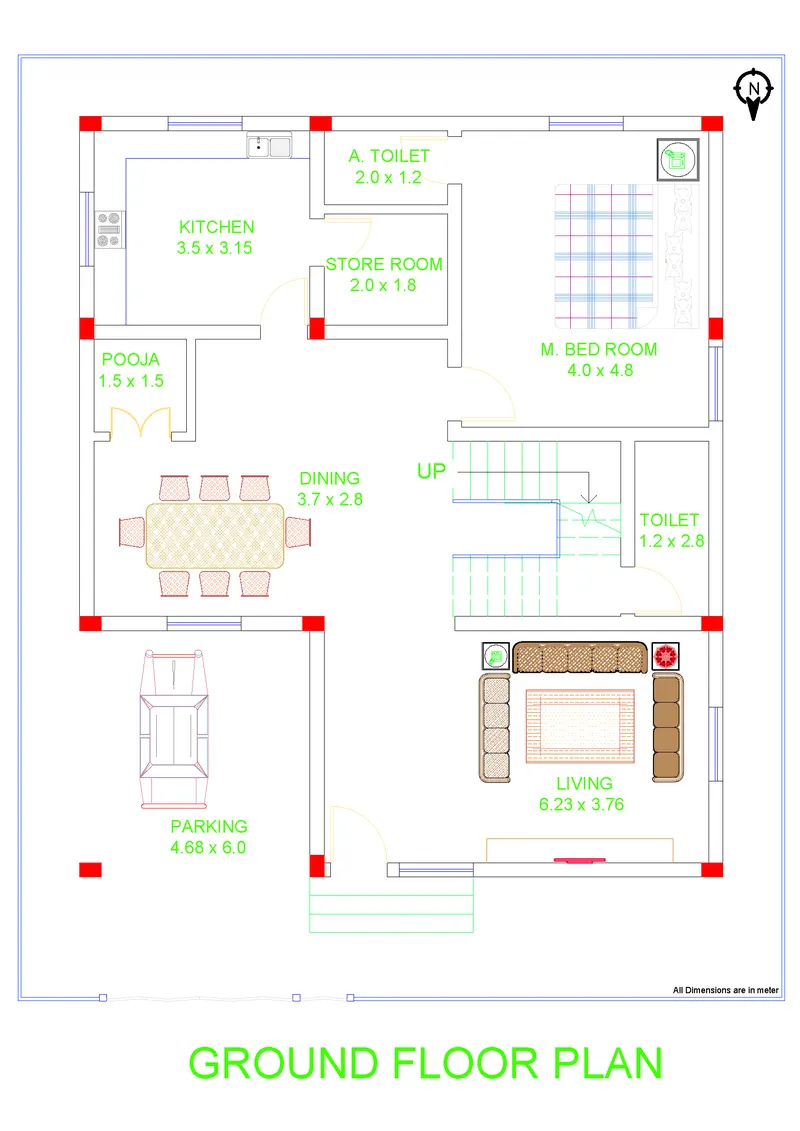
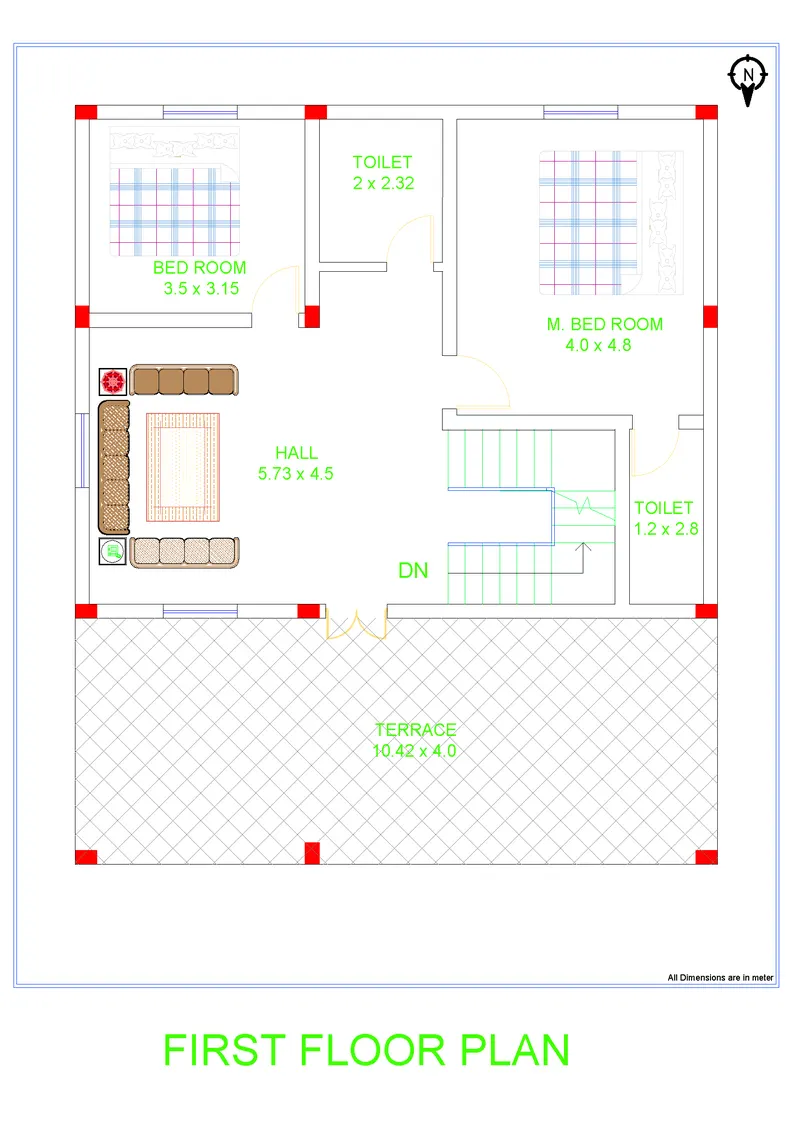
It is a 12 m X 15 m Duplex House with 3BHK built in an area of 2000 square feet, with a car parking, living room, pooja room, dining room, kitchen, store room, staircase, one master bedroom with attached toilet, and common toilet on the ground floor. And two bedrooms are made on the first floor, which also has attached toilet for master bed room and a common toilet. Hall is provided to sit-out in the first floor. Where the car parking is made on the ground floor, the same terrace has been made above with wide area for terrace gardening.
GROUND FLOOR:
The plan starts from the parking (porch), whose size is 4.68×6, here you can park vehicles. Wide parking space is provided it can accommodate two cars. After this, on entering the house, comes the living room, which is 6.23×3.76 in size, this is a very large area and it is a modular house plan. After living room there is a staircase so that one can go to the upper floor. The common toilet is provided attached to the stair case which is accessible under stair. Ongoing from there, comes dining hall whose size is 3.7×2.8. There is also a pooja room which is attached to the dining hall, whose size is 1.5×1.5, now after this comes the kitchen, which is 3.5×3.15 in size and it is a modular kitchen in which all types of facilities are available and cabinet for storage. The store room is provided attached to kitchen for storage purpose. Inside you can also get interior decoration done, which increases the beauty of the house. Ongoing from there, comes the master bedroom, whose size is 4×4.8, in this you can keep a bed, you can also make a wardrobe, this room also has an attached washroom, whose size is 2×1.2.
FIRST FLOOR:
The hall or lobby area comes first on this floor, whose size is 5.73×4.5, this area can also be like a gallery because through this area you can go to the terrace and both the bedrooms. There are two bedrooms on this floor, out of which the size of one bedroom is 3.5×3.15. In this room you can keep a bed, you can make a wardrobe, there is no attached washroom in this room, a window is also provided for fresh air and light. After this comes the second bedroom whose size is 4×4.8 which is a master bedroom same as in the ground floor with attached toilet of size 1.2×2.8. In this room, you can have a double bed, you can make a wardrobe, a TV cabinet can also be made if you want, Ongoing from hall there is terrace area, here you can also do gardening, you can plant a few small trees.
This plan is made by following Vaastu Shastra rules.
INTRODUCTION:
Vaastu Shastra is the basics that needs to be follow for every home. It is an ancient Indian science of architecture and it acts as a guideline to design your home in the way that enhances the positive energy.
Our nature is abundant with powerhouses of energy sources like the sun, wind, moon, water, earth and fire. The effect of sunrays, flow of winds, pull of earth’s magnetic field and other such cosmic energies influence our life in a very unfact way.
We can make the most of nature gifts and live a life replete with wealth, health, success by learning to balance is five elements earth, water, fire is space around us.
Vaastu Shastra an ancient science founds such theories based on directions, architecture, astronomy and even astrology. So, if you see the positive for house to become home it needs to radiate the right kind of energy.
According to number of traditional beliefs each home comes with its own energy type. A person dwelling in a house comes under the influence of a specific energy field which in turn influences him one way or the other.
Therefore, it is very crucial to understand the link between the healing art of Vaastu, our homes in horning positivity and good vibes.
Keeping in mind the ready to moving houses where architectural changes are not possible follow lifestyles and its own way to bring balance to your home.
IDEAL DIRECTIONS:
It’s better that we have entrance on the north that is the most preferable direction.
The living should come in the north west placing of idols / diety of workship or you have an yoga, meditation in your homes then north-east is idol place.
You can have dining here at south-east idol for kitchen and south-west idol for storage.
So this all cannot be satisfied in apartment building. Its better that you follow some basic vaastu concepts that covers and doesn't have major defects in your life.
BASIC PRINCIPLES OF VAASTU SHASTRA:
- Shape: All the rooms should be preferably a square or rectangle.
- Room Basics: That is room should be airy, well light, bright and clean.
- Home Center: These rules also extend to the corners of each room from center (center of the house). The center of the house should be an empty space.
- Stairs and Furniture: Heavy furniture like almirah should be kept in the south-west direction. If you are planning to build a duplex house buildings stair in the direction is very good idea. In the flat it is not a problem if you are planning for a duplex house then plan the stair case in the south-west direction.
- Water: So where should have the water elements avoid keeping plants and water features in the bedroom. Water elements means water fountain, aquarium, painting the water wall etc. in the bedroom should not be kept. So that brings on negative energy.
- Dining Table: Ensure that your dining space is near the kitchen and not near the main door that is the only criteria you have to check.
- Mirror Placement: Placing a mirror in the bedroom that reflects the bed is strict not allowed. If at all place a mirror in the bedroom. Ensure the bed cannot be see in it that is the reflection of the bed should not fall on the mirror that is very negative energy that creates in the house. It brings in quarrels between the couples and all those things. So, it is better that the mirror should not be placed facing the bed position. That is the reason we should not see a mirror sleeping.
- Auspicious directions as per Vaastu shastra: For all rooms we provide in a house
- Kitchen: South-East is the best. North-East should be avoided.
- Stair case: South-West is the best. North-East to be avoided.
- Toilet: North-West is the best. North-East to be avoided.
- Underground Tank: North-East is the best. South-West to be avoided. This should take care when underground tanks come from soil. So, we should need to provide footing deepening on that.
- Gateway (entrance) of the house: Positive energy can be attached to the right entrance of the house. The main entrance is not only the entry point for the family but also for energy. The main door should be stronger and bigger than the other doors in the house.
Thumb rules that needs to be followed to make the Vaastu compliant:
Living room
- Living room should be cluster free and it is the place where the family spends most time together
- Living room should face East, North or North-east. North-west facing living room is also favorable
- Heavy furniture should be kept in the West or South-west direction of the living room
- Electronic appliances should be installed in the South-east section of the living room
- If planning for a mirror in this room, ensure you place in the North wall
- An aquarium on the North or East wall for prosperity
- A bright picture of sunrise in the southern wall
- Shades of Yellow, Green, Beige or Blue on walls to infuse liveliness and vibrancy
Bed room
- Bedroom in south-west direction brings good health and prosperity
- Avoid bedroom in North-east as it may cause health issues
- Avoid in South-east zone as it may cause quarrel among couples
- Bed should be placed in the South-west corner of the bedroom with head facing west Avoid placing a mirror or television in front of the bed, because reflection causes fight and other domestic disruptions
- Avoid having paintings depicting water or a fountain as it could cause emotional outbursts Using of aromatic oils create an oasis of calm
- Never sleep with your head in the North
- Avoid overhanging beams in the room to enjoy good health
- Use solid wooden beds instead of hollow wrought-iron beds
- Paint the bedroom walls in neutral or earthy shades that radiates positive energy Bedrooms are the place for rest and repose and it's good to have soothing wall colours for a peaceful aura
Pooja room
- Rooms in a house for meditation and prayers will ensure spiritual growth
- East or North-east part of your home is perfect for meditation, Yoga and spiritual pursuits Facing East when you meditate will increase positivity
- White, Beige or a light yellow or Green are great colour options for meditation room Create a sacred altar and decorate with candles or incense sticks
Kitchen
- Following Vastu for kitchen ensures a healthy life for your family growth
- Keep water sink away from the gas stove
- Fridge needs to be placed at South-west corner
- Never let your kitchen face a washroom wall nor share a common wall with it
Study room
- Select a square or rectangle shape for the study table
- Don't place the table facing a blank wall or Window
- Placing a table in the North-east, East or West direction is ideal Hanging book shelves are best avoided
Courtyard
- Brahmasthan is a unique feature of ancient Architecture based on Vastu Shastra It is the center of your residence and the holiest and most powerful zone
- A traditional home in Kera la, the courtyard is always at the center of the house This part should be perfect and clutter-free
- The placement of Kitchen, bathroom or pillar/beam attracts negative energy
IMPORTANT STRUCTURAL DRAWING FOR THE PROJECT:
- Centre line drawing
- Footing and column layout with reinforcement details
- Column schedule with reinforcement details
- Plinth beam layout with reinforcement details
- First floor beam layout with reinforcement details
- First floor slab layout with reinforcement details
- Lift pit and headroom reinforcement details.
Dimensions:
Thickness of Wall = 230mm
Thickness of internal wall = 150 mm
Thickness of Slab = 125mm
Size of Column = 230 mm x 350 mm
Size of Beam = 230 mm x 350 mm
Height of the Wall = 3m
LOAD CALCULATIONS:
Dead Load calculation:
- Columns:
Unit weight of RCC = 25 kN/m3
Height of the column (H) = (Slab thickness x 2) + (Height of wall x 2)
H = (0.125 x 2) + (3 x 2) = 6.25 m
Total Dead Load acting on column = Unit weight of RCC x Volume of column
Volume of column = Size of column x Height of the column = L x B x H
Volume of column (V) = 0.23 x 0.35 x 6.25 = 0.503 m3
Total Dead Load acting on column = 25 x 0.503 = 12.57 kN
- Beams:
Dimensions of the beam = 0.23 m x 0.35 m
Total volume of concrete per meter length = 0.23 x 0.35 x 1 = 0.081 m3
Unit weight of RCC = 25 kN/m3
Self -weight of beam per meter length = 25 x 0.081 = 2.025 kN/m
- Slab:
Slab is always designed for the span of 1m2. Hence, Assume Size of Slab= 1m x 1m.
Size of the slab = 1 m x 1 m
Thickness of slab = 125 mm
Total volume of concrete = 1 x 1 x 0.125 = 0.125 m3
Unit weight of RCC = 25 kN/m3
Self-weight load of slab = 25 x 0.125 = 3.125 kN
- Walls:
Internal wall
Thickness of wall = 150 mm
Height of wall = 3 m
Unit weight of brick masonry = 20 kN/m3
Dead load of wall per meter length = 20 x 0.15 x 3 = 9 kN/m
External wall
Thickness of wall = 230 mm
Height of wall = 3 m
Unit weight of brick masonry = 20 kN/m3
Dead load of wall per meter length = 20 x 0.23 x 3 = 13.8 kN/m
Live Load calculation:
To calculate live load acting on the proposed given plan. As per IS- 875 (part-2)-1987(clauses 3.1,3.1.1 and 4.1.1) for residential building Live loads (UDL) are taken as:
Living Room = 2 KN/m2
Bed Room = 2 KN/m2
Kitchen = 2 KN/m2
Dining = 2 KN/m2
Pooja Room = 2 KN/m2
Toilet = 2 KN/m2
Staircase = 3 KN/m2
Terrace = 3 KN/m2
Wind Load calculation:
As per IS 875:1987 (Part-3) the Wind loads are calculated where building height wall is greater than 10m. So, the total height of the building is 7.5m which means it is less than 10m. Therefore, it is not applicable to calculate the wind load acting on a residential building.
RESULT:
The plan of G+1 residential building is prepared according to the concept of Vaastu Shastra.
The load calculations are done as per the I.S 875:1987 (part -1, part -2, part -3) and I.S 456:2000 considerations.
REFERENCES AND IS CODES USED FOR THIS PROJECT:
IS 875:1987 (Part-1) for Dead Load
IS 875:1987 (Part-2) for Live Load
IS 875:1987 (Part-3) for Wind Load
IS 456:2000 for Reinforced Concrete