Project on Concrete Mix Design for various grades of Concrete
Introduction
The process of selecting suitable ingredients of concrete and determining their relative amounts with the objective of producing a concrete of the required, strength, durability, and workability as economically as possible, is termed the concrete mix design. The proportioning of ingredient of concrete is governed by the required performance of concrete in two states, namely the plastic and the hardened states. If the plastic concrete is not workable, it cannot be properly placed and compacted. The property of workability, therefore, becomes of vital importance.
Concrete Mix Design for M35 grade concrete with fly ash
Aim: To calculate the Concrete Mix Design for M35 grade concrete with fly ash
In this project concrete mix design has been prepared for M35 grade means concrete will have compressive strength of 35Mpa after 28 days of curing period. To obtain this desired strength how much quantity of cement, fine aggregate, coarse aggregate must be mixed with water depends upon design mix. Properties of all the ingredients need to be checked before working on design mix as they have huge impact on design mix and the ultimate mix proportion required to attain desired properties of concrete. In present project, basic properties of ingredients have been assumed within the range specified in various codes.
Procedure and calculations:-
- Stipulations for proportioning:
- Grade designation: M35
- Type of cement: OPC 43 grade conforming to IS 8112
- Type of mineral admixture: Fly ash conforming to IS 3812 (Part1)
- Maximum nominal size of aggregate: 20 mm
- Exposure condition: Severe (for reinforced concrete)
- Minimum cement content: 320 kg/m3 (From Table 5 of IS 456:2000 – Severe exposure condition)
- Maximum water-cement ratio: 0.45 (From Table 5 of IS 456:2000 – Severe exposure condition)
- Workability: 100 mm (slump)
- Method of concrete placing: Pumping
- Degree of supervision: Good
- Type of aggregate: Crushed angular aggregate
- Maximum cement content: 450 kg/m3 as per IS 456
- Chemical admixture type: Superplasticizer confirming to IS 9103
-
Test data for materials
- Cement used: OPC 43 grade conforming to IS 8112
- Specific gravity of cement: 3.15
- Fly ash: Conforming to IS 3812 (Part 1)
- Specific gravity of fly ash: 2.2
- Chemical admixture: Superplasticizer conforming to IS 9103
- Specific gravity of:
- Coarse aggregate: 2.74
- Fine aggregate: 2.74
- Water absorption:
- Coarse aggregate: 0.5%
- Fine aggregate: 1.0%
- Free Surface moisture:
- Coarse aggregate: Nil
- Fine aggregate: Nil
- Sieve Analysis:
- Coarse aggregate: Conforming to Table 2 of IS 383
- Fine aggregate: Conforming to grading Zone l of Table 4 of IS 383
- Target strength for mix proportioning:
f'ck = fck + 1.65 x S
Where,
f'ck = Target average compressive strength at 28 days
fck = 35 N/mm2 (Characteristic compressive strength at 28 days)
S = Standard deviation from Table 2 of IS 10262:2019, standard deviation, S = 5 N/mm2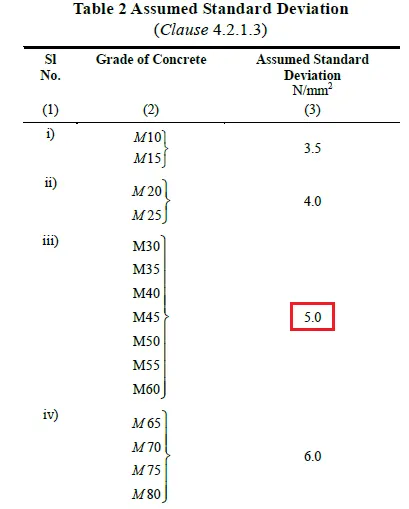
Target Strength = 35 + 1.65 x 5 = 43.25 N/mm2
- Selection of water-cement ratio:
From Table 5 of IS 456:2000 for severe exposure, Maximum water-cement ratio=0.45.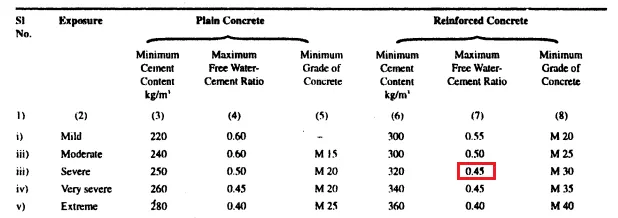
Based on experience, adopt water-cement ratio as 0.4
0.40 < 0.45, Hence OK - Selection of Water Content
From Table 4 of IS 10262:2019, Maximum water content for 20 mm size of aggregate = 186 liters (for 25mm to 50mm slump range). Clause 5.3 recommends increasing the water content by 3% to obtain an additional slump of 25 mm from the 50 mm slump.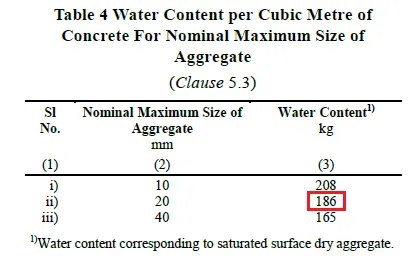
Estimated water content for 100 mm slump = `186 + (6/100) *186`
= 197 liters
As superplasticizer is used, the water content can be reduced up to 30%.
Based on trials water content reduction of 29% is achieved with plasticizer.
Hence the arrived water content = 197 x 0.71 = 140 liters - Calculation of Cement Content:
water-cement ratio = 0.4
Cementitious material (Cement + fly ash) content = 140/0.4 = 350 kg/m3
From Table 5 of IS 456 minimum Cement content for 'severe' exposure condition= 320Kg/m3
350 kg/m3 > 320 kg/m3, Hence OK
To proportion the mix containing fly ash the following steps are suggested:
- The percentage of fly ash need to be decided based on project requirement and quality of materials.
- In some cases, increase in cementitious materials can be warranted. Increase in cementitious material content and its percentage may be based on experience and trial. In this case increase of 10% cementitious material content is considered.
Cementitious material content = 350 x 1.1 = 385kg/m3
Water content = 140 kg/m3
So, Water-cement ratio = 140/385 = 0.364
Fly ash @ 30% total cementitious material content = 385 x 30% = 115 kg/m3
Cement (OPC) = 385-115 = 270 kg/m3
saving of cement while using fly ash = 350 – 270 = 80 kg/m3
Fly ash being utilized = 115 kg/m3
- Proportion of Volume of Coarse aggregate and Fine aggregate content:
From Table 5 of IS 10262:2019, the proportionate volume of coarse aggregate corresponding to 20 mm size aggregate and fine aggregate (Zone I) for water-cement ratio of 0.50 = 0.60.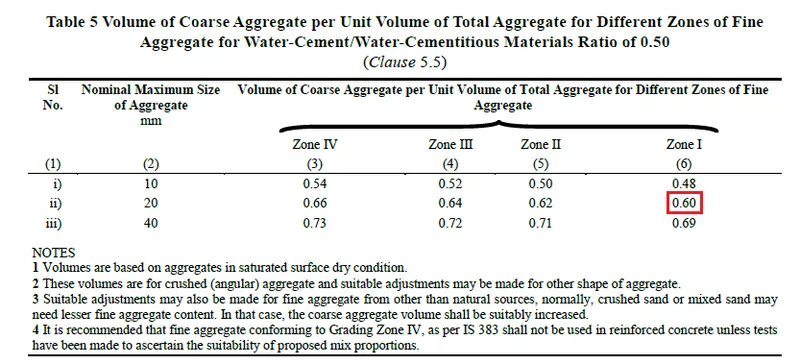
In the present case the water cement ratio is 0.4
Therefore, the volume of coarse aggregate needs to be increased to decrease the fine aggregate content. As water-cement ratio is lower by 0.10, the proportion of volume of coarse aggregate is increased by 0.02 (at the rate of -/+ 0.01 for every +-0.05 change in water-cement ratio).Therefore, corrected volume of coarse aggregate for the water-cement ratio of 0.4 = 0.62
(Note: If coarse aggregate is not of angular type, then also the volume of coarse aggregate may be required to be increased suitably, based on experience)For pumpable concrete these values are reduced by 10%. Here, 10 percent reduction is considered.
Therefore, volume of coarse aggregate = 0.62 x 0.9 = 0.558 say 0.56 m3
Volume of fine aggregate content = 1 - 0.56 = 0.44 m3 - Mix calculations:
The mix calculation per unit volume of concrete shall be as follows: - Volume of Concrete = 1 m3
- Volume of Cement = (Mass of Cement/Specific gravity of cement) x (1/1000)
= (270/3.15) x (1/1000)
= 0.086 m3 - Volume of Fly ash = (Mass of Fly ash/Specific gravity of Fly ash) x (1/1000)
= (115/2.2) x (1/1000)
= 0.052 m3 - Volume of Water = (Mass of Water/Specific gravity of Water) x (1/1000)
= (140/1) x (1/1000)
= 0.140 m3 - Volume of Chemical admixture = (Mass of Chemical admixture/Specific gravity of Chemical admx) x (1/1000)
= (7.6/1.145) x (1/1000)
= 0.006 m3 - Volume of aggregate (FA & CA) = (a - (b + c + d+ e))
= (1 - (0.086 + 0.052 + 0.140 + 0.006))
= 0.716 m3 - Mass of Coarse aggregate = f x Volume of coarse aggregate x Specific gravity of coarse aggregate x 1000
= 0.716 x 0.56 x 2.74 x 1000
= 1099 kg/m3 - Mass of fine aggregate = f x Volume of fine aggregate x Specific gravity of fine aggregate x 1000
= 0.716 x 0.44 x 2.74 x 1000
= 863 kg/m3 - Mix proportions for Trial Number 1:
Cement = 270 kg/m3
Fly Ash = 115 kg/m3
Water = 140 kg/m3
Fine aggregate = 863 kg/m3
Coarse aggregate = 1099 kg/m3
Chemical admixture = 7 kg/m3
Water-Cement ratio = 0.364
Trial Mix ratio = 1: 2.24: 2.85
- This trial mix ratio should match the workability, durability, Strength of M35 grade concrete. The slump shall be measured and the water content and dosage of admixture shall be adjusted for achieving the required slump based on trial, if required. The mix proportions shall be reworked for the actual water content and checked for durability requirements.
- Two more trials having variation of ±10 percent of water-cementitious materials ratio in Step - 9 shall be carried out and a graph between these water cementitious materials ratios and their corresponding strengths shall be plotted to work out the mix proportions for the given target strength for field trials. However, durability requirement shall be met.
--------------------------------------------------------------------------------------------------------------------------
Concrete Mix Design for M50 grade concrete without fly ash
Aim: To calculate the Concrete Mix Design for M50 grade concrete without fly ash
In this project concrete mix design has been prepared for M50 grade means concrete will have compressive strength of 50Mpa after 28 days of curing period. To obtain this desired strength how much quantity of cement, fine aggregate, coarse aggregate must be mixed with water depends upon design mix. Properties of all the ingredients need to be checked before working on design mix as they have huge impact on design mix and the ultimate mix proportion required to attain desired properties of concrete. In present project, basic properties of ingredients have been assumed within the range specified in various codes.
Procedure and calculations:
- Stipulations for proportioning
- Grade designation: M50
- Type of cement: OPC 43 grade conforming to IS 8112
- Type of mineral admixture: Fly ash conforming to IS 3812 (Part1)
- Maximum nominal size of aggregate: 20 mm
- Exposure condition: Severe (for reinforced concrete)
- Minimum cement content: 320 kg/m3 (From Table 5 of IS 456:2000 – Severe exposure condition)
- Maximum water-cement ratio: 0.45 (From Table 5 of IS 456:2000 – Severe exposure condition)
- Workability: 100 mm (slump)
- Method of concrete placing: Pumping
- Degree of supervision: Good
- Type of aggregate: Crushed angular aggregate
- Maximum cement content: 450 kg/m3 as per IS 456
- Chemical admixture type: Superplasticizer confirming to IS 9103
- Test data for materials
- Cement used: OPC 43 grade conforming to IS 8112
- Specific gravity of cement: 3.15
- Chemical admixture: Superplasticizer conforming to IS 9103
- Specific gravity of:
- Coarse aggregate: 2.74
- Fine aggregate: 2.74
- Water absorption:
- Coarse aggregate: 0.5%
- Fine aggregate: 1.0%
- Free Surface moisture:
- Coarse aggregate: Nil
- Fine aggregate: Nil
- Sieve Analysis:
- Coarse aggregate: Conforming to Table 2 of IS 383
- Fine aggregate: Conforming to grading Zone l of Table 4 of IS 383
- Target strength for mix proportioning:
f'ck = fck + 1.65 x S
Where,
f'ck = Target average compressive strength at 28 days
fck = 50 N/mm2 (Characteristic compressive strength at 28 days)
S = Standard deviation from Table 2 of IS 10262:2019, standard deviation, S = 5 N/mm2
Target Strength = 50 + 1.65 x 5 = 58.25 N/mm2 - Selection of water-cement ratio:
From Table 5 of IS 456:2000 for severe exposure, Maximum water-cement ratio=0.45.
Based on experience, adopt water-cement ratio as 0.4
0.40 < 0.45, Hence OK
- Selection of Water Content
From Table 4 of IS 10262:2019, Maximum water content for 20 mm size of aggregate = 186 liters (for 25mm to 50mm slump range). Clause 5.3 recommends increasing the water content by 3% to obtain an additional slump of 25 mm from the 50 mm slump.
Estimated water content for 100 mm slump = `186 + (6/100)*186`
= 197 liters
As superplasticizer is used, the water content can be reduced up to 30%.
Based on trials water content reduction of 29% is achieved with plasticizer.
Hence the arrived water content = 197 x 0.71 = 140 liters
- Calculation of Cement Content:
water-cement ratio = 0.4
Cementitious material content = 140/0.4 = 350 kg/m3
From Table 5 of IS 456 minimum Cement content for 'severe' exposure condition= 320Kg/m3
350 kg/m3 > 320 kg/m3, Hence OK
- Proportion of Volume of Coarse aggregate and Fine aggregate content:
From Table 5 of IS 10262:2019, the proportionate volume of coarse aggregate corresponding to 20 mm size aggregate and fine aggregate (Zone I) for water-cement ratio of 0.50 = 0.60.
In the present case the water cement ratio is 0.4
Therefore, the volume of coarse aggregate needs to be increased to decrease the fine aggregate content. As water-cement ratio is lower by 0.10, the proportion of volume of coarse aggregate is increased by 0.02 (at the rate of -/+ 0.01 for every +-0.05 change in water-cement ratio).
Therefore, corrected volume of coarse aggregate for the water-cement ratio of 0.4 = 0.62
(Note: If coarse aggregate is not of angular type, then also the volume of coarse aggregate may be required to be increased suitably, based on experience)
For pumpable concrete these values are reduced by 10%. Here, 10 percent reduction is considered.
Therefore, volume of coarse aggregate = 0.62 x 0.9 = 0.558 say 0.56 m3
Volume of fine aggregate content = 1 - 0.56 = 0.44 m3 - Mix calculations:
The mix calculation per unit volume of concrete shall be as follows:
- Volume of Concrete = 1 m3
- Volume of Cement = (Mass of Cement/Specific gravity of cement) x (1/1000)
= (350/3.15) x (1/1000)
= 0.111 m3 - Volume of Water = (Mass of Water/Specific gravity of Water) x (1/1000)
= (140/1) x (1/1000)
= 0.140 m3 - Volume of Chemical admixture = (Mass of Chemical admixture/Specific gravity of Chemical admx) x (1/1000)
= (7.6/1.145) x (1/1000)
= 0.006 m3 - Volume of aggregate (FA & CA) = (a - (b + c + d))
= (1 - (0.111 + 0.140 + 0.006))
= 0.743 m3 - Mass of Coarse aggregate = f x Volume of coarse aggregate x Specific gravity of coarse aggregate x 1000
= 0.743 x 0.56 x 2.74 x 1000
= 1140 kg/m3 - Mass of fine aggregate = f x Volume of fine aggregate x Specific gravity of fine aggregate x 1000
= 0.743 x 0.44 x 2.74 x 1000
= 896 kg/m3
Results
9. Mix proportions for Trial Number 1:
Cement = 350 kg/m3
Water = 140 kg/m3
Fine aggregate = 896 kg/m3
Coarse aggregate = 1140 kg/m3
Chemical admixture = 7 kg/m3
Water-Cement ratio = 0.4
Trial Mix ratio = 1: 2.56: 3.26
- This trial mix ratio should match the workability, durability, Strength of M35 grade concrete. The slump shall be measured and the water content and dosage of admixture shall be adjusted for achieving the required slump based on trial, if required. The mix proportions shall be reworked for the actual water content and checked for durability requirements.
- Two more trials having variation of ±10 percent of water-cementitious materials ratio in Step - 9 shall be carried out and a graph between these water cementitious materials ratios and their corresponding strengths shall be plotted to work out the mix proportions for the given target strength for field trials. However, durability requirement shall be met.