Underbody Coating
Underbody coating:
Vehicle undercoating is a process of rust proofing and protecting a vehicle from damage due to sand, gravel, road salts, and other grime, while helping reduce road noise. In areas of extreme climate changes, the lives of vehicles can be extended with proper undercoating. However, it is recommended that all vehicles be undercoated regardless of where you live.
- The primary objective of getting underbody coating done is preventing metal components that are exposed on the bottom side of the car to damage from rust and corrosion. You can shut out the Adverse effects of corrosion on your car by simply applying a rubberised anti-rust coating all over the belly of your car.
- Our country is filled with roads having uneven patches and potholes and while we manoeuvre our cars through such sections, the unpaved crumbs, and pebbles hit the car from underneath or get stuck in the wheel wells. The underbody coating’s consistency is so thick that the layer it creates absorbs all the unpleasant noises and vibrations and marginally improves the driving experience.
- Prevents paint chipping Running on the highway or while pacing through a city road, you will often encounter sharp gravel or any other unattended object hitting the belly of your car with high momentum. This scrapes and chips off the metal from down below. A thick layer of Underbody Coating definitely comes to aid and minimises the effects of such contacts on the body
- Underneath a car is somewhere a lot of indispensable parts of a car are left exposed like the Engine, silencer, etc. One simply can’t afford to let these parts go bad due to rusting and hence in order to save yourself from a hefty repair bill, a considerably less expensive Anti-Rust Coating is a must.
Process of Underbody coating:
Pretreatment:
The first sequence in preparing the BIW forsubsequent coating is pretreatment sees Preatramentremoves & clean excess metal & forms an appropriatesurface structure enabling bonding of a corrosion protectionlayer. It consists of cleaning the body surface to removeremaining oils from the staming process & welding residuesthrough three primary liquid dip processes of degreasing,conditioning, & phosphating. Pretreament helps the primer to bond onto themetal. A phosphate treatment applies an inert layer of metalphosphate, providing resistance to corrosion spread. Thedegreasing solution is composed of alkaline salts &surfactants & can include caustic soda, sodium carbonate.The surfactants are types of detergents for emulsifying oils &lubricants on the BIW. In surface conditioner which createsnucleation sites for phosphate crystal growth. It increases thenumber of crystallization nuclei on the metal surface thatenchance bonding mechanism for the subsequent phosphatesequence. Finally, the liquid dip phosphate ions, nitrate ions,zinc & hydrogen ions. The free acid etches the steel surface,causing hydrogen to be released while metal phosphate ionsare precipitated onto the surface in a crystalline form.
ElectrodePosition:
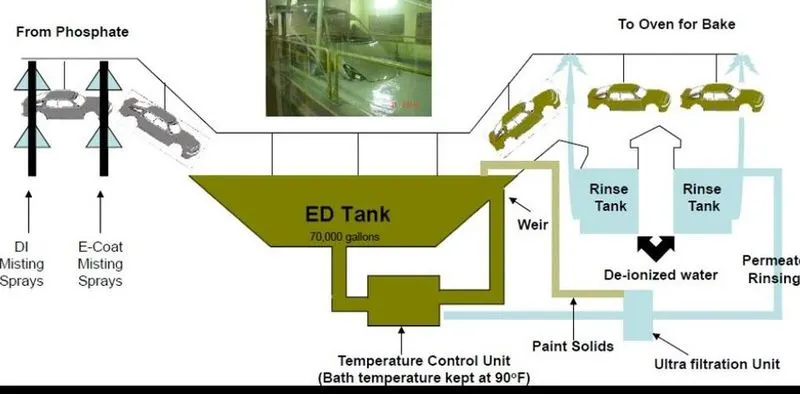
E-coating involves dipping automobile bodies intothe coating solution & passing an electric current through the body & the liquid ED paint solution. Because of the charged nature of this coating process, the ED paint penetrates intoplaces a spray would not reach.During operation, a mixture of resin, binder, & apaste containing the pigments is fed into the ED tank. Theautomobile body is lowered into the tank, & an electriccurrent applied; the solution in the tank consists of 80-90%deionised water & 10-20% paint solids.The resin is thebackbone of the final paint film & provides corrosionprotection, durability, & toughness. Pigments are used toprovide color & gloss. After E-coat, the automobile body enters a bakeoven, in which heating & keeping at a temperature of 160_Cfor 10 min causes film curing to promote maximumperformance properties. The oven temperature & heatingtime primarily enchance chip resistance & film adhesion tothe body; corrosion protected is affected less by theseconditions. Because surface roughness influences thesmoothness & brilliance of the topcoat, some sanding of thesurface is usually performed to remove or eliminate defectsbefore the body enters the next application step. A common challenge in the cureent E-coatingprocess is that of water spots that contaminate coatedsurfaces. If water spots are present, they have removed nysanding. Hence, it is necessary to use well-deionoised water& routinely monitor its conductivity. Alternstely, operatorsalso add surfactants or ultrafiltrates to the water rinse zone toeliminate or manage water spots.
Sealer:
During this third step, it is also typical to apply asoft tip primer coat that improves the chipping resistance .This layer is applied to the front edge of the hood , which isan area prone to chipping shock, using a high elastic resinthat resides between the ED & primer coats. Also, during the third step, the radiator supports, wheel housing, & under rarareas of the body are coated with a relatively dull blackpigment called a blackout coating.
Primer:
The fourth coating step is the primer. It can bewater-borne, solvent-borne, or a powder. The primer fills &smoothes minor imperfections & scratches that may becreated during prior steps & by the intermediate sanding orgrinding used to remove small imperfections. It also providesadditional protection against corrosion & maximizesadhesion between it & the E-coat & basecoat; thereby, theprimer incrases paint durability. Primer coating operations in an automobileassembly plant are usually implemented in three stages:Interior coating, Exterior coating, & then cutting in an oven.Manual spray painting is used for the interior coating of thedoors, engine compartment, & luggage or trunk space. Someof the areas are not sprayed with basecoat. It is importantthat are primer color matches the basecoat to be able toimpart uniform coating appearances between interior & exterior costs.
Topcoat:
The final step in the body coating process is toapply the topcoat, which consists of two layers the basecoat
& clearcoat. Basecoat: It contains the primary coloringpigments. As part of the topcoat, the basecoat is third layradded to the car after the primer & before the clearcoat. Itimparts the automobiles color; roughly 40,000 base coatcolor are known today , & approximately 1000 new colorsare added to this list each year. Three different types ofbasecoats are used for automobiles, including solvent-bornemedium solids (MS), solvent-borne high solids (HS), &water-borne.Clearcoat: The final coating on an automobilesurface is the clearcoa; it provides durability, environmentaletch, & scratch resistance to the overall coating. It protectsagainst damage such as fading that is caused by UV raysfrom the sun & imparts a gloss & depth that otherwise are not as vivid. The clearcoat also makes repairs & maintenanceeasier. Environmental etch is an appearance issue associatedwith the formation of permanent water spots or non-removable marks from bird droppings, tree resin, or otherchemicals after contact with an automobiles surface. Thephysical damage resulting from etchi=ng is associated with alocalized loss of material & deformation or pitting of the clarcoat surface.
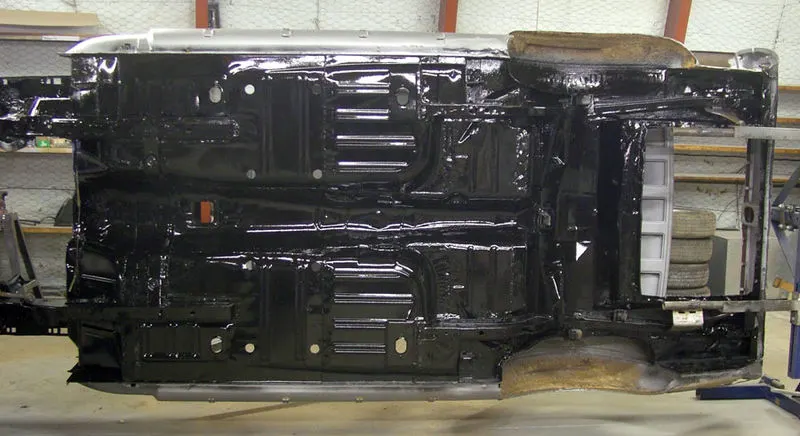
The image below shows an example of Underbody coating
The image below shows the difference between before and after Underbody Coating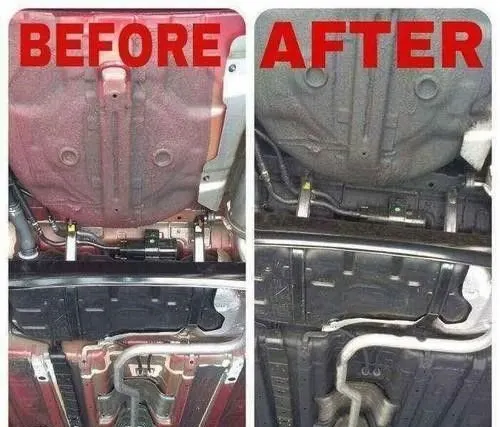
Types of Underbody coating
1.) Rubber or Petroleum -based undercoatings are made from oil and have greater deflective abilities for road salts and grime. The petroleum base helps repel water and ice better than paraffin- or water-based undercoatings. Petroleum-based undercoatings are available through professional services and can be purchased when buying the vehicle. This type of undercoating also needs to be replaced once a year at the owner's expense. Rubber-based undercoating is the second strongest undercoating available for vehicles. This type of undercoating allows for more flexibility in the undercarriage, and holds up better to rough terrains. Rubber-based undercoatings are available in spray and paint-on applications. Due to the thickness of the application, it is advisable to let a professional apply rubber-based undercoating to ensure maximum coverage. Rubber-based undercoating also can be bought as an option when purchasing a vehicle.
2.)Wax based underbody coating:
This – more or less – ephemeral undercoating will wear away in a few months’ time. On the upside, wax-based undercoating puts up a big fight against moisture. It is also the most affordable option out there.
3.)Water and paraffin-based undercoatings are the most popular for do-it-yourselfers. These undercoatings can be found in automotive parts stores in aerosol formats. Water-based undercoatings are thin set and have quick drying times. This type of coating can be done by automotive shops that offer undercoating services inexpensively. The downside to water-based undercoatings is the frequency in which they need to be repeated. Often the smallest abrasion that breaks through the undercoating can result in the need for a new coat. Repetitive undercoating can get expensive even if the product does not cost much. Paraffin-based undercoatings have a wax inclusion that makes them stronger than water-based undercoatings. Paraffin-based undercoatings can be purchased through an automotive store in spray and paint-on formats. This type of coating is also thin set and relatively fast drying. A vehicle owner can get this as an option when purchasing a new vehicle, or it can be professionally applied through an automotive service. Paraffin-based undercoating needs to be replaced at least once a year at the vehicle owner's expense.
4.)Asphalt-based undercoating is the strongest undercoating available. It is used on all-terrain and military vehicles. Asphalt-based undercoating will last longest and is the best option for vehicles that endure heavy road use. Asphalt-based undercoating is the thickest coating with the most damage-resistant properties. It can be bought through professional services and is the only type of undercoating with a limited warranty. Asphalt-based undercoating can be purchased when buying a new vehicle.
Pros:
- Protects from rust and Corosion.
- Dampens sound Vibrations.
- Insulates against cold and heat.
- Hides welds and joints.
Cons:
- High cost.
- Risk of damage while applying.