Underbody Coating
In Indian road conditions, a cars underbody is most prone to corrosion. Especially during monsoon when heavy precipitation causes the roads to become mini-rivers and our cars are left stranded there. This makes them prone to heavy corrosion in the underbody region. Underbody coating provides long term protection from corrosion to car’s underbody. It also protects parts like internal body panels, frame rails and other inner cavities that are not physically accessible but are prone to corrosion.
Under body protective coatings (UBC) is used to protect the vehicle chassis from the external environment, to ensure the integrity and safety of cars. In general, it is required to spray such a protective coating in the manufacturing of the new car. The use of UBC plays a very important role in the service life of the vehicle. The below image shows the before and after effect of using UBC on the bottom of the car.
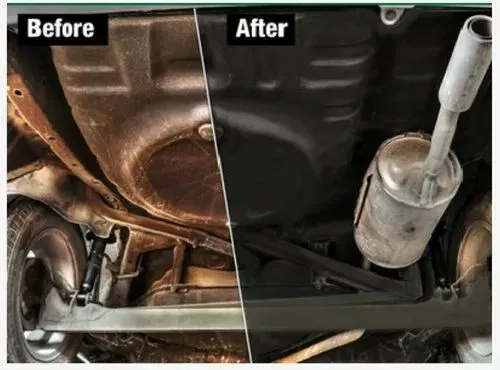
Pros:
- Minimizes Sound: Our country is filled with roads having uneven patches and potholes and while we manoeuvre our cars through such sections, the unpaved crumbs, and pebbles hit the car from underneath or get stuck in the wheel wells. The underbody coating’s consistency is so thick that the layer it creates absorbs all the unpleasant noises and vibrations and marginally improves the driving experience. It minimizes the sound from underneath the car resulting a noiseless, smooth driving experience.
- Protects Against Rust & Corrosion: The primary objective of getting underbody coating done is preventing metal components that are exposed on the bottom side of the car to damage from corrosion. One shut out the Adverse effects of corrosion on your car by simply applying a rubberised anti-rust coating all over the belly of your car.
- Heat Insulation: It insulates the interior of the car from extreme temperatures from beneath the vehicle providing a comfortable cabin experience.
- Anti-chipping property: If any stone hits the coating it does not get chipped away hence protects the underbody from exposure to water. Running on the highway or while pacing through a city road, one often encounters sharp gravel or any other unattended object hitting the belly of your car with high momentum. This scrapes and chips off the metal from down below. A thick layer of Underbody Coating definitely comes to aid and minimises the effects of such contacts on the body
- Protects Vital Components: Underneath a car is somewhere a lot of indispensable parts of a car are left exposed like the Engine, silencer, etc. One simply can’t afford to let these parts go bad due to rusting and hence in order to save yourself from a hefty repair bill, a considerably less expensive Anti-Rust Coating is a must.
Cons:
- Poor coating quality: Depending upon the circumstance and the degree to which rust is present on a vehicle's underbody, the results greatly vary, especially after months and months of unpredictable weather. Most of the brands (Rustoleum, 3M, Eastwood) produce rubberized versions of undercoating in a can. These types of coatings have a dried film that is often quite hard, arid, and brittle.
- Improper coating: The rubber characteristics of the dried films of these products makes the final product look exceptionally smooth and durable however, this same property (more often than not a heightened degree of cohesion) allows for air and moisture to seep underneath the coating.
- So while the coating is very durable, with its molecules bonded tightly to one another, the adhesive abilities of rubberized formulas are increasingly lacking. In fact, the added cohesion can exasperate the problem, allowing rust to spread at alarmingly fast rates when it is designed to do the exact opposite.
- Rubberized undercoatings do a great job of keeping existing rust all covered up and looking sharp, but it does absolutely nothing to slow down the spread of rust and corrosion sometimes the trapped air and moisture may even contribute to rust formation