Underbody Coating
Aim,
- Write a one-pager about Under-Body Coating and its purpose, its types in detail, and its pros and cons.
Underbody coating,
- Underbody coating is usually a dense cladding (often based on rubber) applied uniformly to the undercarriage of the automobile. It is normally sprayed or painted on when the car is just out of the dealership and is clean.
- Underbody coating provides long term protection from corrosion to car's underbody. It also protects parts like internal body panels, frame rails and other inner cavities that are not physically accessible but are prone to corrosion. Protecting the underbelly of the car should be our top priority.
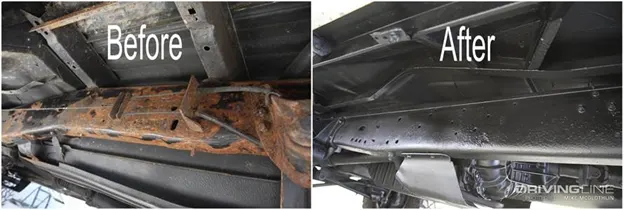
- Here the Picture that explains before and after under coating process.
Types of Under body coating,
Rubberised Underbody coating,
- Rubberized undercoating is easy to apply, and generally offers the best protective coating for your car’s undercarriage. It cushions surfaces against moisture, rust, dings, and dents. Rubberized undercoating is safe to use on quarter panels and wheel wells and dries with a soft rubbery finish.
- This Undercoating is generally the best option for protecting your vehicle's undercarriage, as it provides the simplest and best protective measures against rust and moisture.
Asphalt-based underbody coating,
- Asphalt-based undercoating offers a higher level of protection suitable for large trucks, recreational vehicles, and heavy machinery. It’s formulated with some bits of rubberized material to aid in noise reduction. It offers extra protection against chips and moisture but is not paintable and, therefore, only suitable for undercarriages.
- This type of vehicle undercoating is a little bit quicker and easier to apply.
Polyurethane under body coating,
- Polyurethane coating is easy to apply and works by sealing up cracks and seams. The compound displaces salt and moisture and protects the unoxidized metal from rust. It’s often sold in canisters that are ready to preload into an application gun. It, however, requires some surface prep work before application, like degreasing, and applying an etching primer to the bare metal.
- A paraffin-based undercoating will be the cheapest and quickest option available with which to protect the undercarriage of your vehicle. However, keep in mind that it will wear off quicker than other types of undercoating and will need to be stripped and reapplied at least once every year.
Wax or paraffin-based underbody coating
- Wax or paraffin-based undercoating sprays are the cheapest and quickest options available. However, their results don’t last long, and you may have to apply a fresh coat after only a few months. In addition, the wax isn’t very adhesive on a metal surface.
- Its main advantage is that it seeps quickly into cracks and seams, and offers moderate protective properties against moisture.For standard vehicles, any of the aforementioned types of undercoating will provide sufficient protection.
- For large trucks and heavy machinery, asphalt-based undercoating provides a bit of extra durability against rocks, chips, and moisture.
Process,
- When it comes to updating your vehicle or using any sort of coating, remove the rust completely first and then proceed. Rust removal is easily achieved by sandblasting or sanding, depending on the area and the extent of the rust.
- Once you've removed the rust and prepped your undercarriage for coating, give it a quick rinse and let it dry to ensure you aren't further trapping any contaminants on your vehicle's underbelly.
- Using a degreaser to clean the metal first is also recommended.Most undercoating is generally applied with a spray gun. A disposable spray gun will work best; once the undercoating hardens, it becomes very difficult to clean the gun even with a lot of thinner.
- A Schutz disposable spray gun is the best option.No matter what type of vehicle undercoating you've selected, two coats will provide the optimum protection. Allow ample dry time between coats.
- Let the undercoating cure completely (usually overnight) before driving your vehicle on the road.
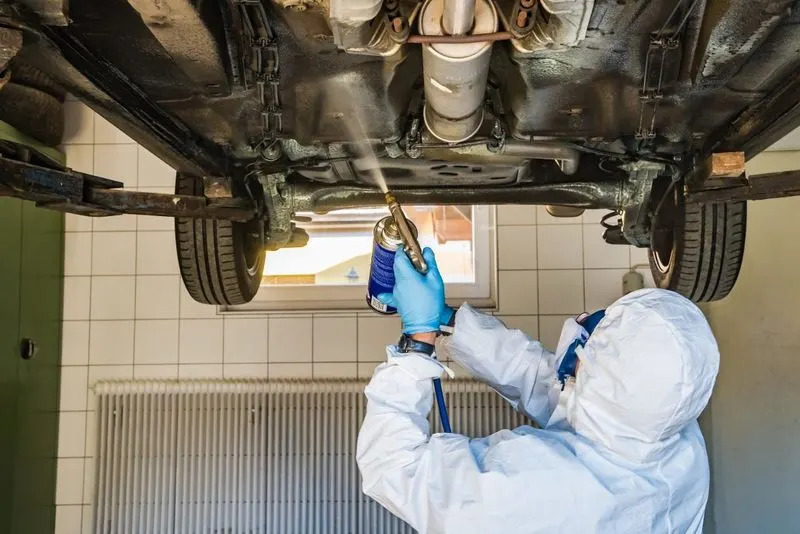
Below Picture explains how it will be processed,
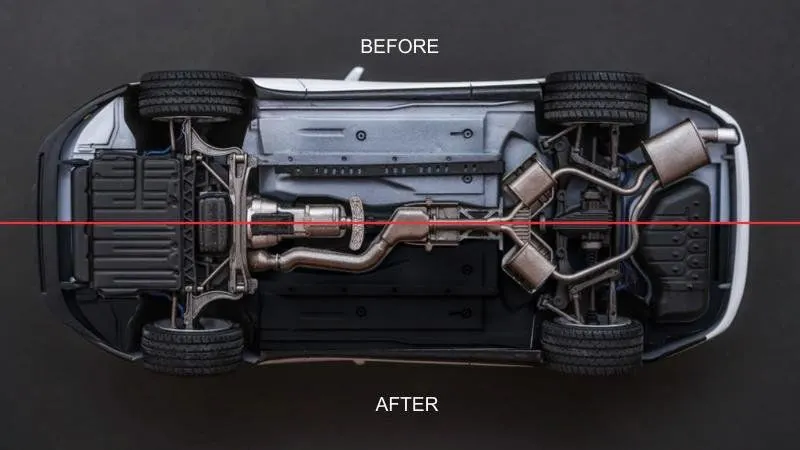
A simple Image explains Why under body coating is important of our vechicle,
Pros,
- Highly resistant to rust and corrosion.
- Forms a fully paintable layer.
- Suitable for all vehicle types.
- Protects your vehicle from natural wear.
- Sprays on easy.
- Dries quickly.
- Cheaply priced.
- Helps reduce road noise when applied on wheel wells.
- Shows no bleed-through when painted over.
- Can also be used for minor roof and gutter repairs.
Cons,
- More expensive than other undercoats.
- Doesn’t have great adhesion when used on an old undercoat or a greased surface.
- Short shelf life once opened.
- Needs many coats to get the job done.
- Doesn’t stick on greased surfaces.
- Takes too long to dry when sprayed on a car’s underbody.