Transfer Function
Aim:
- How hybrid electric cars can be operated more efficiently by autonomous driving system?
- Derive transfer function of suspension system of a car and convert it state space format.
- Are the transfer functions of RC and CR (output across R) circuits same?
1. How hybrid electric cars can be operated more efficiently by autonomous driving system?
The Hybrid electric cars the future of the Automotive Industries.
A self driving car is a vehicle that can sense the environment and can navigate itself through the environment without a human input.
Selfdriving cars does have many sensors linke LIDAR, RADAR, Ultrasonic, GPS etc that helps navigation.
Autonomous driving cars:
The Society of Automotive Engineers (SAE) has classified self-driving vehicles into stages, which range from Level 0 to 5. Let’s take a brief look at each stage.
Level 0 does not feature any self-driving tech at all.
Level 1 cars offer at least one system that helps the driver brake, steer, or accelerate, but if there are multiple systems, they are not capable of communicating with each other.
Level 2 cars can simultaneously control steering and speed, even if the driver is not driving, for short periods of time. Think lane-centering technology combined with advanced cruise control, as an example.
Level 3 vehicles are fully autonomous but require driver attention. These cars aren’t yet available but are being tested by some tech startups.
Level 4 cars, once programmed to a destination, will not need driver input, but the controls are available should the driver wish to intervene.
Level 5 cars will be fully autonomous without any driver input whatsoever.
Currently very few vehicles offer Level 3 technologies, and no Level 4 or Level 5 systems have been commercially deployed.
Hybrid Electric cars:
A hybrid electric vehicle (HEV) has two types of energy storage units, electricity and fuel. Electricity means that a battery is used to store the energy, and that an electromotor will be used as traction motor.
Fuel means that a tank is required, and that an Internal Combustion Engine is used to generate mechanical power, or that a fuel cell will be used to convert fuel to electrical energy. In the latter case, traction will be performed by the electromotor only. In the first case, the vehicle will have both an engine and a motor.
Depending on the drive train structure (how motor and engine are connected), we can distinguish between parallel, series or combined HEVs.
Depending on the share of the electromotor to the traction power, we can distinguish between mild or micro hybrid (start-stop systems), power assist hybrid, full hybrid and plug-in hybrid.
Depending on the nature of the non-electric energy source, we can distinguish between combustion (ICE), fuel cell, hydraulic or pneumatic power, and human power. In the first case, the ICE is a spark ignition engines(gasoline) or compression ignition direct injection(diesel) engine. In the first two cases, the energy conversion unit may be powered by gasoline, methanol, compressed natural gas, hydrogen, or other alternative fuels.
Hybrid electric cars can be operated more efficiently by autonomous driving system:
Applying hybrid-electric technology to our self-driving vehicles delivers several benefits, including maximum mileage to keep the vehicle on the road. Plus, hybrids help provide the significant amount of electrical power required for self-driving sensors and computing systems without having a significant impact on the mileage.
Computer efficiency is at the top of mind for everyone involved in the race to develop self-driving cars.
The location is detected by the Global Positioning System (GPS). It is new and promissing technology, which uses real time geogeaphical data received from several GPS satellites to calculate coordinates, speed and course to help navigate the car. GPS integrates the data received from tachometer, gyoscope, and aitimeters to provide more accurate positioning.
For identifyning the lanes marking and the edges of roads, LIDAR(Light Dtecting and Ranging) sensors are used. These sensors use the pulses of light off the surroungings. LIDAR consists of emitter, mirrorand receiver. The emitter emitter sends a laser beam bouncesof the mirror 10-15 revolutions per min. After bouncing off objects, the laser beam reutrns through the mirror to the receiver. The data of such points is stored as a point cloud data (pcd).
RADAR sensors used as the adaptive cruise control(ACC) system to monitor the position of in-front vehicles. Also, Ultrasonic sensors are used to measure the position of objects very close to the vehicle such as speed-brakers and other vehicle parking. Cameras are also mounted to detect traffic signals, keep track of other vehicles and look out for pedestrains and obstacles on the road. The infromation from all of the sensors is analysed by the central computer that maipulates the steering, accelerator and brakes.
In the autonomous cars the switching of fuel system to battery system and vice-versa can be done by the car only with out human assitance. By that the car can be work more efficiently.
Other benifits of autonomous cars are,
- Reduce Accidents
- Reduce Traffice congestion
- Reduce CO2 Emissions
- Increased lane capacity
- Lower fuel consumption
- Transportation accessibility
- Reduce travel tie and transportation cost
- More effective and affordable taxis
- More efficient parking
2. Derive transfer function of suspension system of a car and convert it state space format.
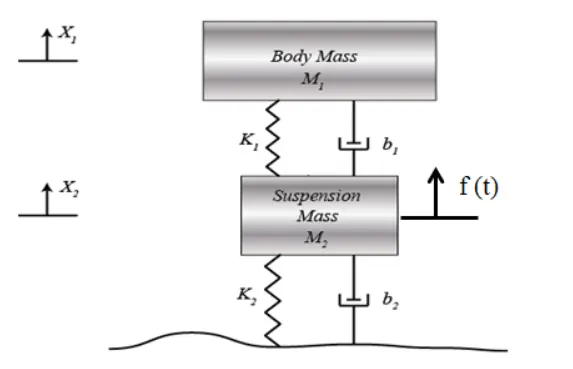
m1= sprung mass of 1/4th of vehicle
m2= un-sprung mass of the vehicle
k1= Spring constant of suspension system
k2= Spring constsnt of wheels and tire
b1= Damping constant of suspension
b2= Damping constsnt of wheels and tire
f(t)= Control force
Transfer function of suspension system of a car:
By Newton's 2nd law of motion,
`m_1 ddotx_1+k_1x_1-k_1x_2+b_1dotx_1-b_1dotx_2=0`
`m_2 ddotx_2+k_2x_2+b_2dotx_2+k_1(x_2-x_1)+b_1(dotx_2-dotx_1)=f(t)`
Now applying Laplace Transform (assuming initial coditions =0) on both sides of equations,
`s^2m_1X_1+k_1X_1-k_1X_2+sb_1X_1-sb_1X_2=0` ----------------------(i)
`s^2m_2X_2+k_2X_2+K1(X_2-X_1)+sb_1(X_2-X_1)=F(s)`-----------------(ii)
From equation (i)
`X_2(s)=((s^2m_1+k_1+sb_1)X_1(s))/(k_1+sb_1`
Putting `X_2` in the equation (ii) we get the transfer function
`(X_1(s))/(F(s))= (k_1+sb_1)/(m_1m_2s^4+(m_1b_1+m_1b_2+m_2b_1)s^3+(m_1k_1+m_1k_2+m_2k_1+b_1b_2)s^2+(k_1b_2+k_2b_1)s+k_1k_2)`
`(X_2(s))/(F(s))= (s^2m_1+k_1+sb_1)/(m_1m_2s^4+(m_1b_1+m_1b_2+m_2b_1)s^3+(m_1k_1+m_1k_2+m_2k_1+b_1b_2)s^2+(k_1b_2+k_2b_1)s+k_1k_2)`
Now, we have to form State space representation
By Newton's 2nd law of motion,
`m_1 ddotx_1+k_1x_1-k_1x_2+b_1dotx_1-b_1dotx_2=0` -----------------------------------(iii)
`m_2 ddotx_2+k_2x_2+b_2dotx_2+k_1(x_2-x_1)+b_1(dotx_2-dotx_1)=f(t)` -------------(iv)
Let us assume the state variables
`x_1=X_1, x_2=X_2, dotx_1= X_3, ddotx_2=X_4`
putting this state variables in equation (iii) & (iv)
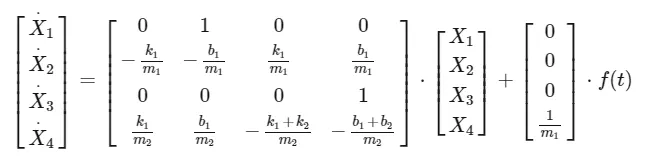
`X_2= -(k_1)/(m_1)X_1-(b_1)/(m_1)X_2+k_1/m_1X_3+b_1/m_1X_4`
`X_4=k_1/m_2X_1+b_1/m_2X_2-(k_1+k_2)/m_2X_3+(b_1+b_2)/m_2X_4+(f(t))/m_2`
Putting these in the form of the state-space model
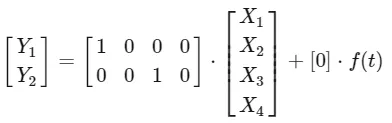
`dotX=AX+BU and Y=CX+DU`
`Y_1=X_1=x_1 and Y_2=X_3=x_2`
3. Are the transfer functions of RC and CR (output across R) circuits same?
The transfer function of RC output accross capacitor:
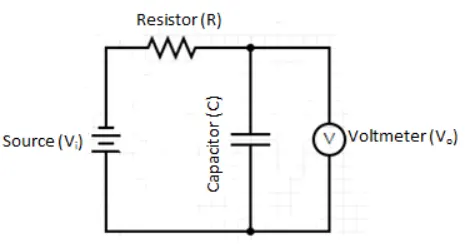
`V_i(t)=`Input voltage in time domain
`i(t)=` Current in the domain
`V_o=`Input voltage in s-domain
`I(s)=`Current in s-domain
`C=`Capacitance of capacitor
`R=`Resistance of resistor
`t=` Time
`s=`Complex variable
`V_o=` Output voltage in time domain
`V_o(s)=` Output voltage in s-domain
Current is flowing in the counter clockwise direction
By applying Kirchhoff's voltage law,
`V_i(t)= R_i(t)+1/Cinti(t)dt ------------(1)`
`V_o(t)= 1/Cinti(t)dt ---------(2)`
Now applying L.T on both sides of equations (1) & (2)
`therefore V_i(s)= RI(s)+1/C_sI(s) -----------(3)`
`V_o(s)= 1/C_sI(s)--------(4)`
`i.e.; I(s) = V_o(s)C_s-------(5)`
Putting equation (5) in equation (3) we get,
`therefore V_i(s)= RV_o(s)C_s+1/C_sV_o(s) C_s`
`therefore V_i(s)= RV_o(s)C_s+V_o(s)`
`therefore V_i(s)= V_o(s)(RC_s+1)`
`(V_o(s))/(V_i(s))=1/(RC_s+1)`
The transfer function of CR output accross Resistor:
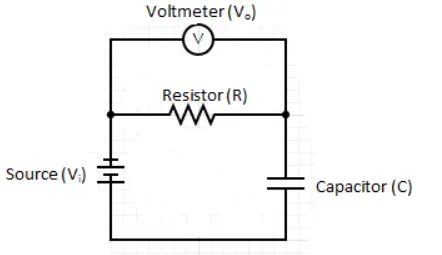
Current is flowing in the counter clockwise direction
By applying Kirchhoff's voltage law,
`V_i(t)= R_i(t)+1/Cinti(t)dt ------------(1)`
`V_o(t)= 1/Cinti(t)dt ---------(2)`
Now applying L.T on both sides of equations (1) & (2)
`therefore V_i(s)= RI(s)+1/C_sI(s) -----------(3)`
`V_o (s)= RI(s) ----------(4)`
`I(s)=(V_o(s))/R ------(5)`
Putting equation(5) in (3) we get,
`therefore V_i(s)= V_o(s)+1/C_s(V_o(s))/R`
`therefore V_i(s)=(RC_s+1)/(RC_s)V_o(s)`
`(V_o(s))/(V_i(s))=(RC_s)/(RC_s+1)`
Hence, The transfer function of RC output accross capacitor and The transfer function of CR output accross Resistor are not same.