Structural dynamics
1Q). Differentiate Static analysis and Dynamic analysis with proper representing pictures (30 marks)
Ans:
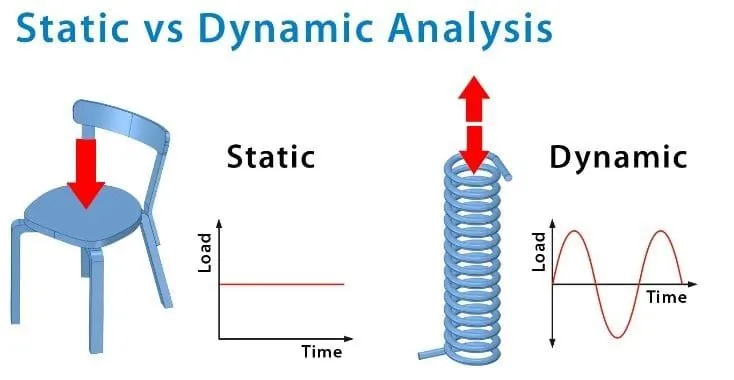
The main difference between static and dynamic analysis is Time. If the load is applied so slowly, that inertia effects won’t play a role, all you need is static analysis. Dynamic analysis handles impacts and other fast happening situations, but also vibrations (which happen in time).
Static analysis
A static analysis can only be performed if the system being simulated does not depend on time, and if the loads being applied are constant.
Dynamic analysis
In a dynamic analysis, the system itself, the load application, or both might change with time.
Static analysis
Static analyses don’t consider inertia.
Dynamic analysis
In a dynamic analysis, the inertial loads developed by the system due to acceleration are taken into account.
Static analysis
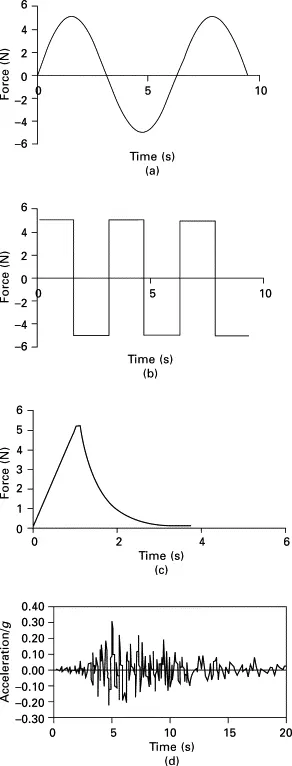
Static Loads are the loads which varies very slowly (the acceleration of load is very very less than the natural frequency of the structure)
Dynamic analysis
Dynamic Loads are the loads which changes with time fairly quickly in comparison to the structure's natural frequency.
Static analysis
Mathematically,a static analysis, only the stiffness matrix of the FEA model is solved.
Less accurate.
Fast ,Exhaustive , no stimulus required
Can report false errors.
Dynamic analysis
Mathematically,In a dynamic analysis, in addition to the stiffness matrix, the mass matrix (and damping matrix, if not zero) is solved as well. That is one of the reasons why dynamic analyses require more computational time than static analyses, for the same structure.
It Can be very Accurate.
Analysis Quality depends on stimulus vector.
Does Not report False Error.
2Q). Explain the following with relevant force-displacement graph (40 marks)
Ans:
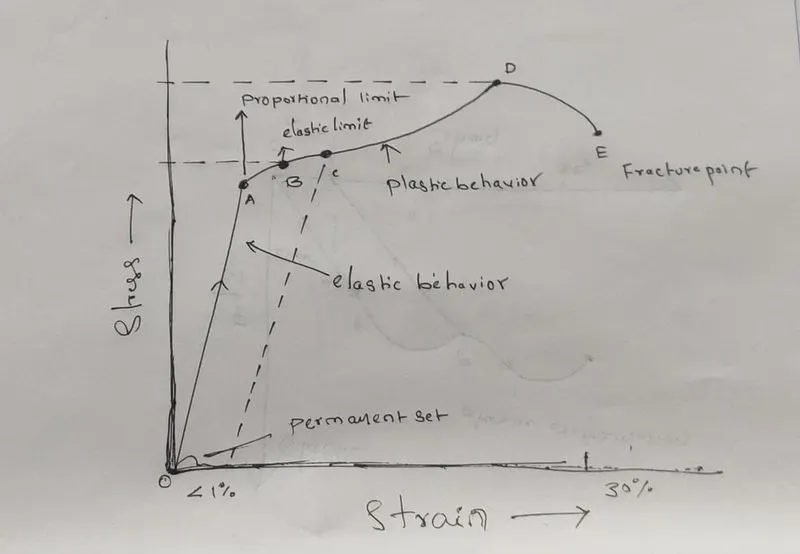
1.Elastic behavior:
Elasticity is the ability of a body to resist any permanent change to it when stress is applied.
When stress application ceases, the body regains its original shape and size.
Different materials show different elastic behaviour.
The study of the elastic behaviour of a material is of much importance.
2.Inelastic behavior:
Deformation of a material that does not disappear on removal of the force that produced it.
When stress application ceases, the body don't regains its original shape and size.
3.Plastic behavior:
The material deforms irreversibly and does not return to its original shape and size, even when the load is removed.
When stress is gradually increased beyond the elastic limit, the material undergoes plastic deformation.
It will occure when the material loss it ductility
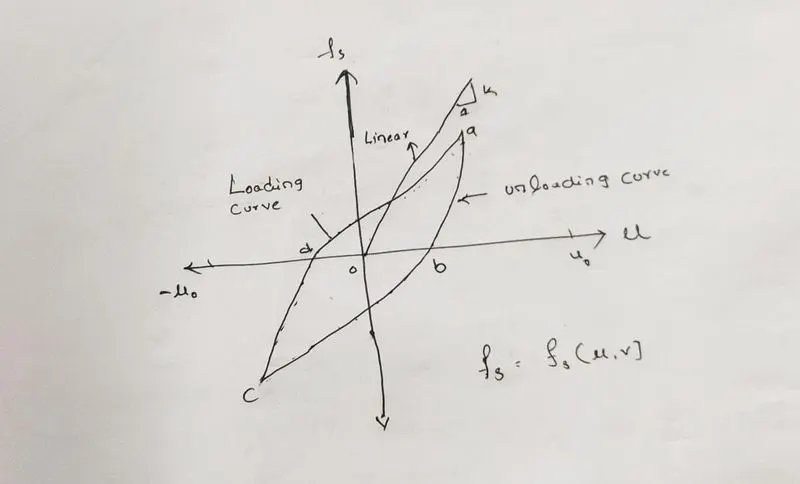
4.Non-linear Inelastic behavior:
where both elastic and viscous effects are always present and coupled, and of elasto-viscoplastic or elasto-plastic constituents for which there exists a domain in stress space where the material behaves in a purely elastic manner, and more generally of most engineering materials
3Q). Explain Mass, Stiffness & Damping components in the equation of motion (30 marks)
Ans:
EQUATION OF MOTION: EXTERNAL FORCE
The differential equation governing the displacement u(t) of an idealized single story frame subjected to an externally applied force p(t) can be derived using Newton's Second Law of Motion.
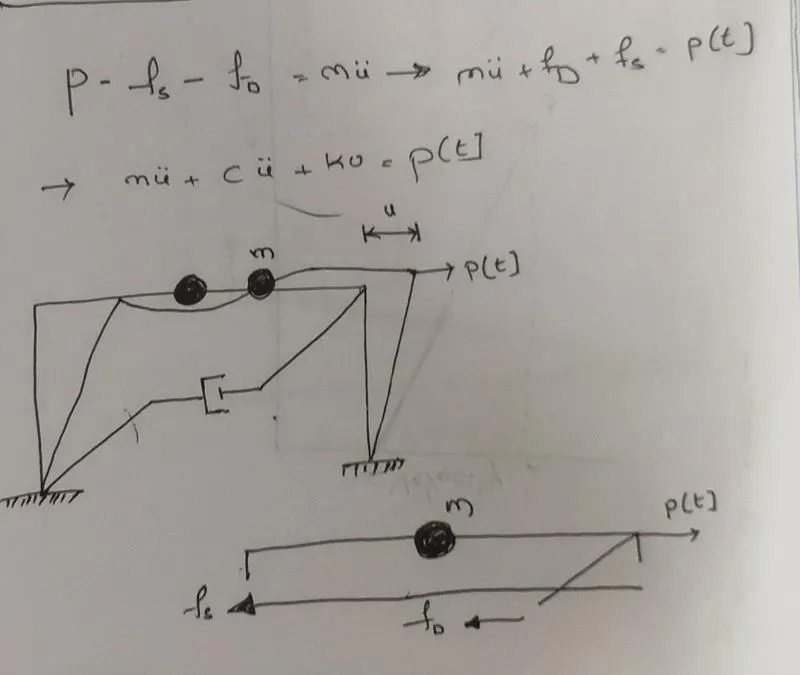
An alternative point of view for structural engineers wherein principle of static can be used to develop the equation of motion.
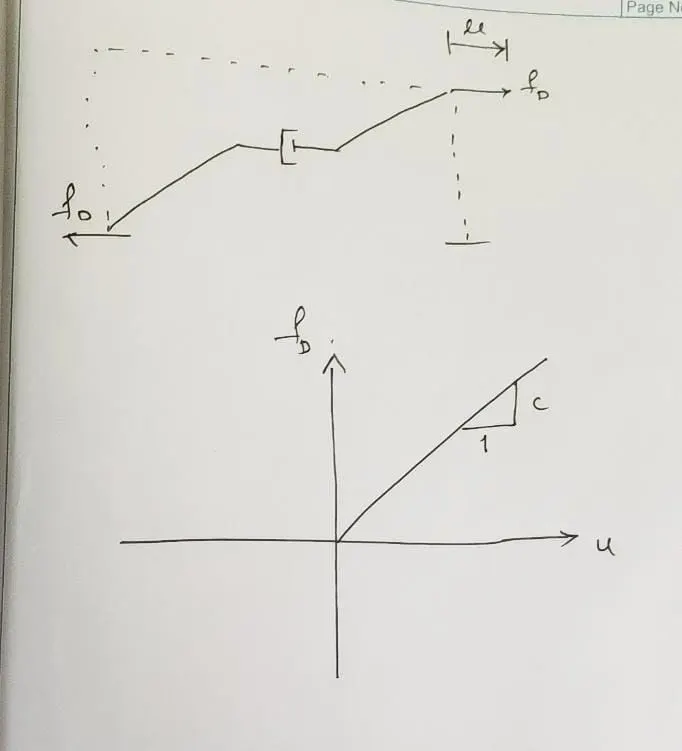
The damping force fd is related to the velocity across the liner viscous damper by fd= cu
Where the constant c is viscous damping.
It has units of force x time/length
MASS STIFFNESS AND DAMPINGCOMPONENTS
The SDOF system can be viewed as a combination of three pure, independant systems:
The stiffness component:
The frame without damping or mass. The external force fs on the stiffness component is related to displacement u by fs = ku if the system is linearly elastic.
The damping component:
The frame with its damping property but no stiffness or mass. The external force on the damping component is related to velocity by fd = cv
The mass component:
The roof mass without the stiffness or damping of the frame. The external force fi on the mass component is related to the acceleration by fI =mü
mü+fd+ fs = p(t)
mü +cû + ku = p(t)
4Q). Provide relationship between Natural period (Tn) & Natural frequency (f) and provide their definitions (25 marks)
Ans:
Natural period of vibration of the system (Tn) :
The time required for the undamped system to complete one cycle of free vibration.
It is related to the natural circular frequency of vibration ω, in units of radians per second: Tn = 2𝝅 / ωn or ωn = 2𝝅 / Tn
Natural cyclic frequency of vibration of the system:
The number of cycles (or one complete revolution) executed by system in 1 second.
fn = 1 / Tn
The natural vibration properties ωn Tn and fn depend only on the mass and stiffness of the structure
k = mω^2
The stiffer of two SDF systems having the same mass will have the shorter natural period and the higher natural frequency
Similarly, the heavier (more mass) of two structures having the same stiffness will have the longer natural period and the lower natural frequency.
ωn= sqrt(k/m)
5Q). Explain in detail about Response spectrum & its Graph (25 marks)
Ans:
RESPONSE SPECTRUM
A central concept in earthquake engineering, response spectrum is a practical means of characterizing ground motions and their effects on structures of different
It provides a convenient means to summarize the peak response of all possible linear SDF systems to a particular component of ground motion.
It also provides a practical approach to apply the knowledge of structural dynamics to the design of structures and development of lateral force requirements in building codes.
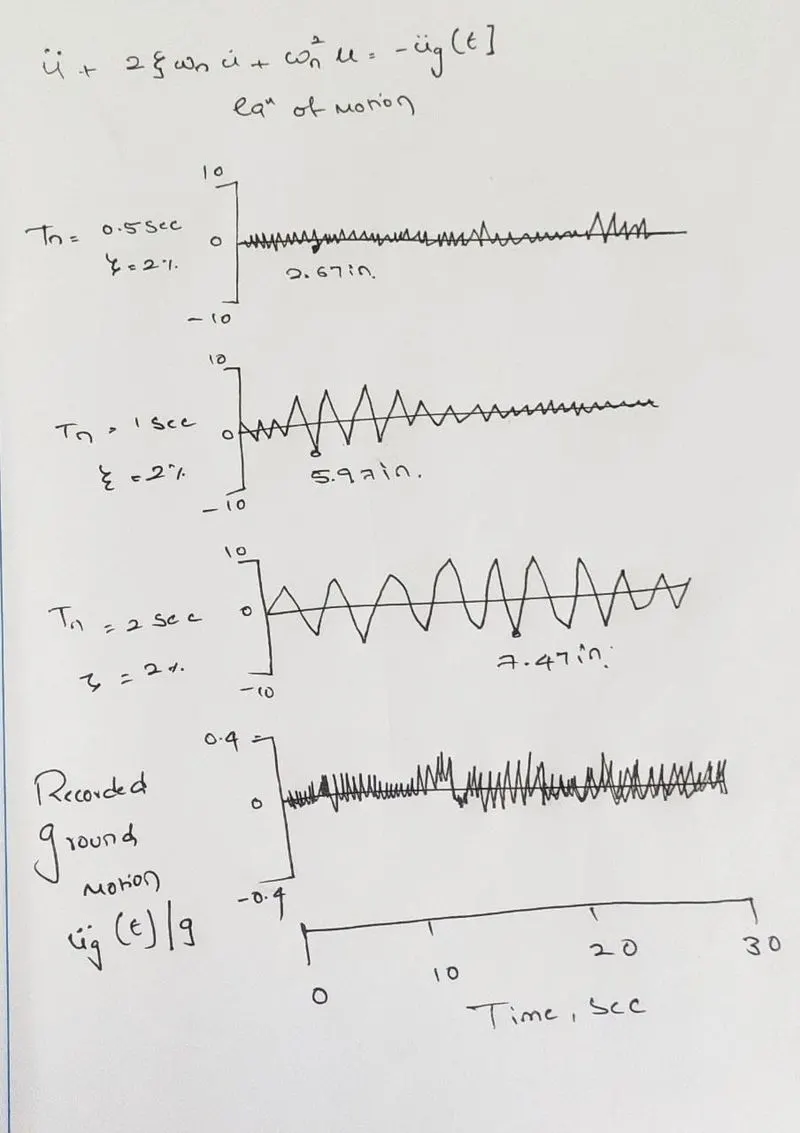
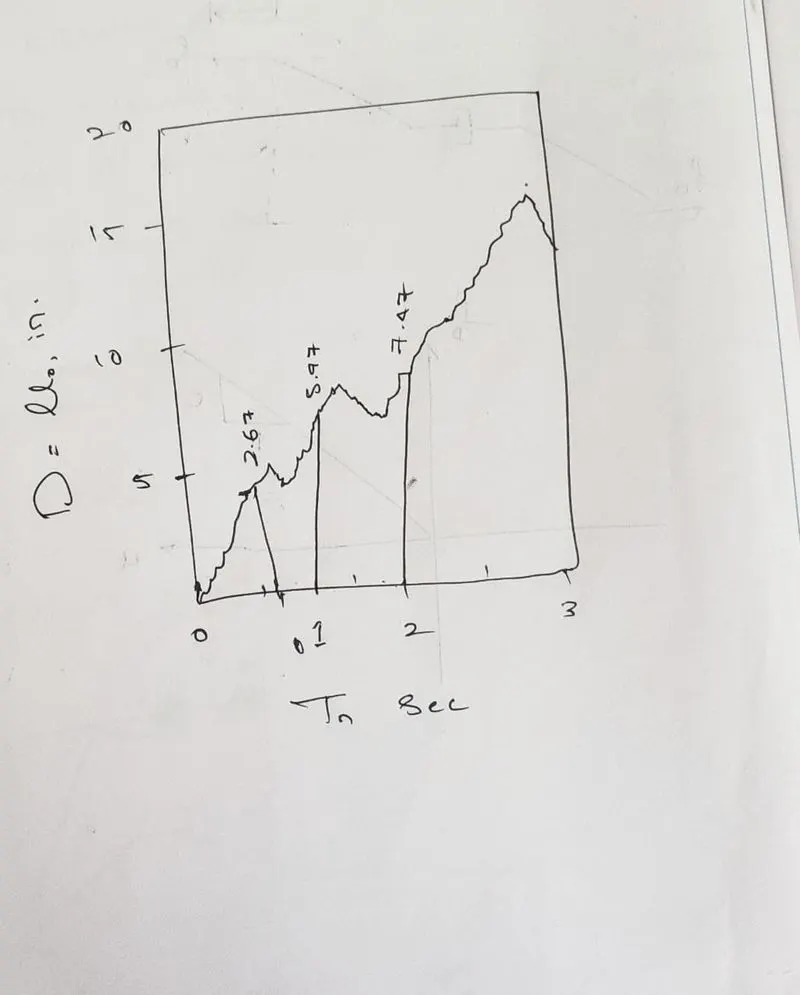
A plot of the peak value of a response quantity (u, v, and a) as a function of the natural vibration period T, of the system, is called the response spectrum for that quantity.
Each such plot is for SDF systems having a fixed damping ratio ( and several such plots for different values of Care included to cover the range of damping values encountered in actual structures.
The response spectrum can be of 3 types. The deformation response spectrum is a plot of peak u, against Tn, for fixed Z. A similar plot for peak ú, is the relative velocity response spectrum, and for peak ü^T, is the acceleration response spectrum.