Structural dynamics
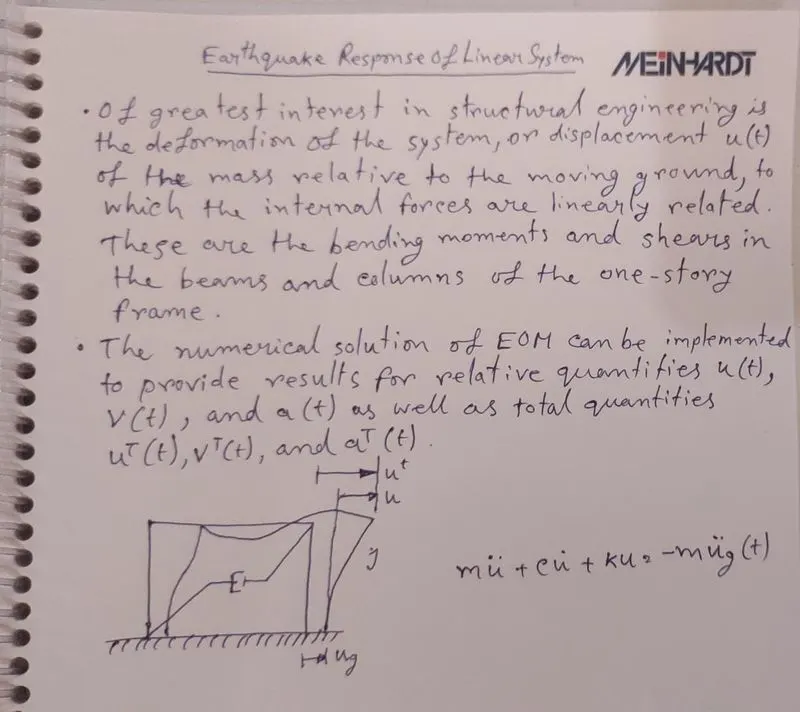
Q.1. Differentiate Static analysis and Dynamic analysis with proper representing pictures.
Ans=
| STATIC ANALYSIS | DYNAMIC ANALYSIS |
| 1. Load is not variable with time and neglected due to slow applying of load. | 1. Load is variable with time due to fast applying of load and vibration. |
| 2. Motion of the structure can be disregarded. | 2. Motion can not be disregarded (can't be considered as static). |
| 3. There is no necessity to count Inertia and damping forces in case of static analysis, but the elastic force should be accounted. | 3. Inertia and damping forces should be accounted for the calculation of dynamic analysis. |
| 4. There is no inertia effect on static analysis. | 4. Inertia effect is considered in dynamic analysis. |
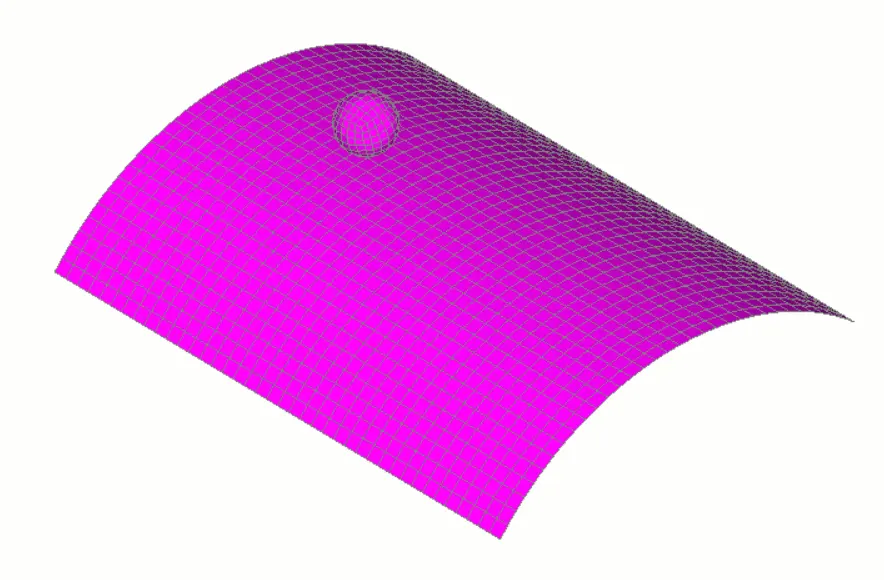
Inertia effects-
Q.2. Explain the following with relevant force-displacement graph.
- Elastic behavior
- Inelastic behavior
- Plastic behavior
- Non-linear Inelastic behavior
Ans=
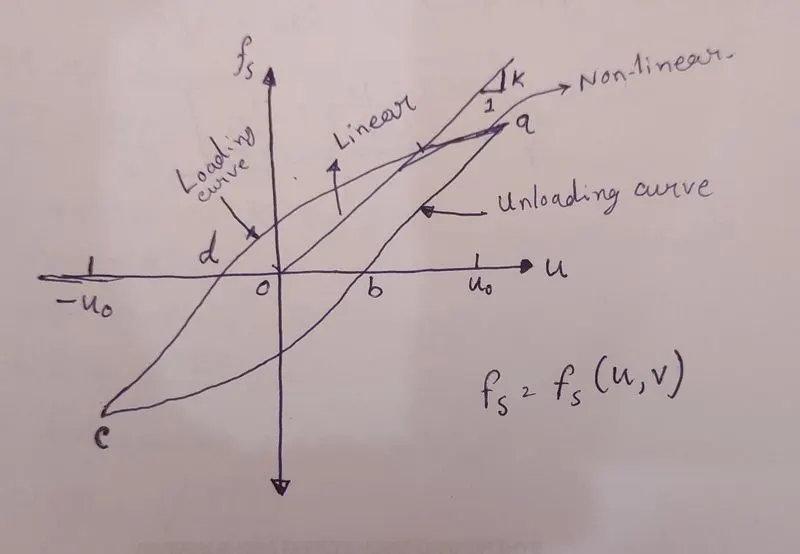
1. Elastic Behavior:-
Elastic behavior is the property of the material upto which the material can retain it's shape. From the aforementioned graph it is clearly mentioned that upto a certain point from "O" the graph is linear and shown its elastic properties.
2. Inelastic Behavior:-
Inelastic behavior is the property of the material when the material can't retain it's previous shape after a certain deformation. In the aforementioned graph inelastic behavior has been shown in the upper shape of the curve upto point "a".
3. Plastic Behavior:-
Plastic behavior occurs when the material completely lost it's ductility. In the aforementioned graph plastic behavior occurs during unloading after point "a".
4. Non-linear Inelastic Behavior:-
Non-linear inelastic behavior occurs after the line from "O" tends to bend towards point"a".
Q.3. Explain Mass, Stiffness & Damping components in the equation of motion.
Ans=
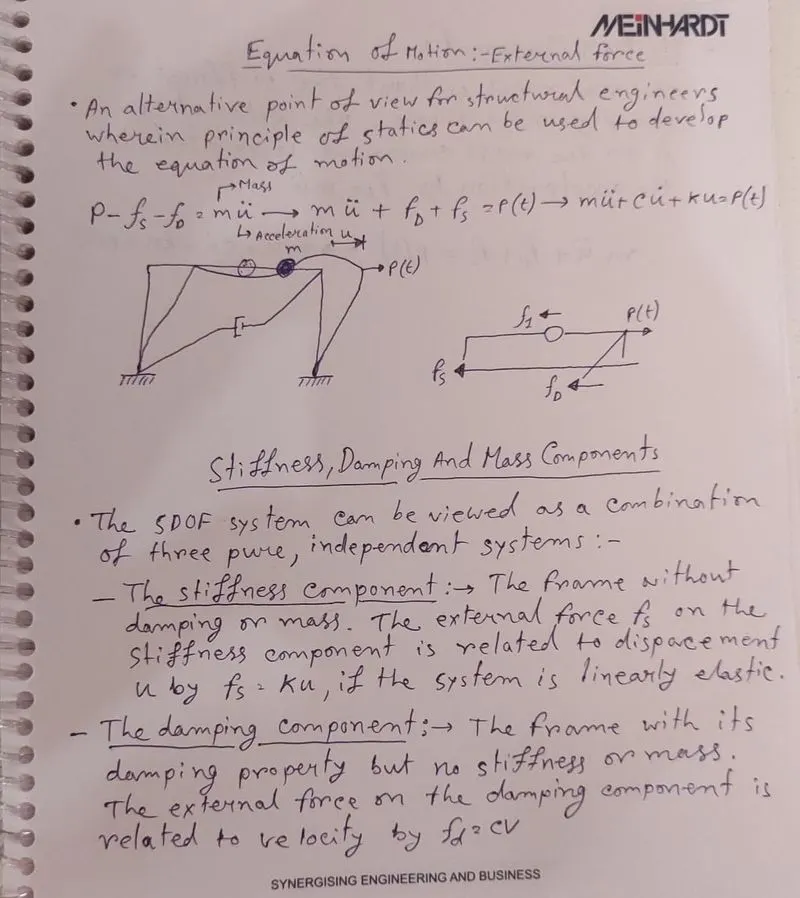
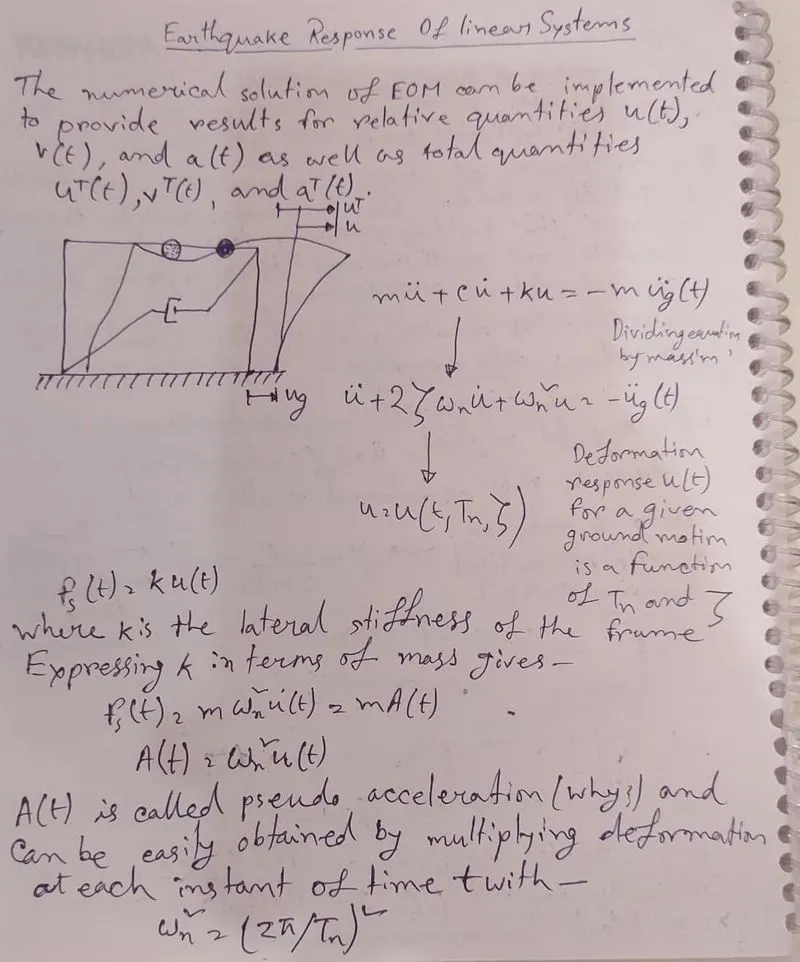
- The Stiffness Component:- The frame is without damping or mass. The external force fs on the stiffness component is related to displacement u by fs= Ku, if the system is linearly elastic.
- The Damping Component:- The frame with its damping properties but no stiffness or mass. The external force on the damping component is related to velocity by fd=CV.
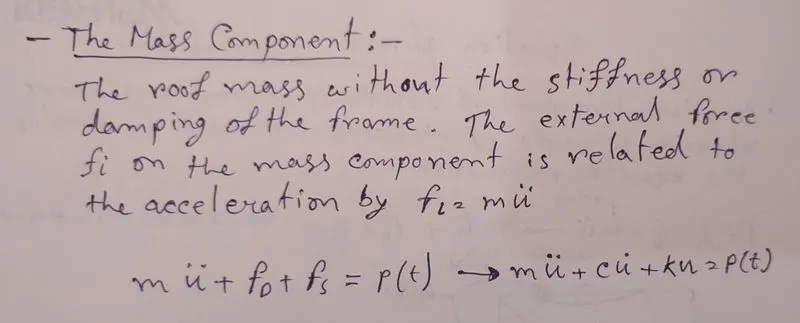
- The Mass Component:- The roof mass without the stiffness or damping of the frame. The external force fi on the mass component is related to the acceleration by fi=m(u^double dot).
Q.4. Provide relationship between Natural period (Tn) & Natural frequency (f) and provide their definitions.
Ans=
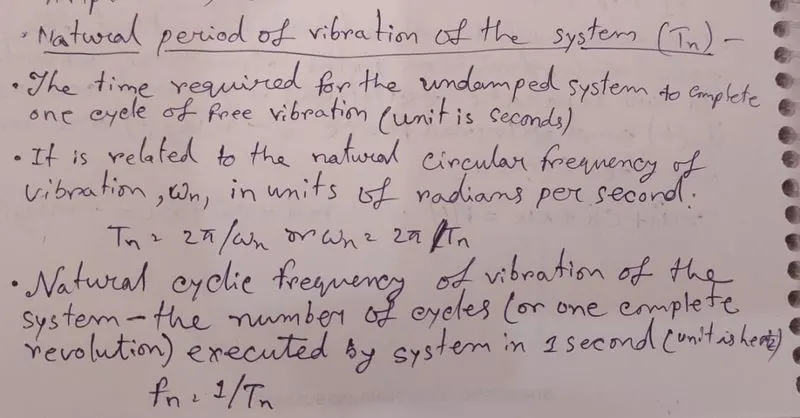
- Natural Period of vibration (Tn):- The time required for the undamped system to complete one cycle of free vibration (unit is seconds)
- It is related to the natural circular frequency of vibration, Wn, in units of radians per second.
Tn= (2`π`/Wn)
- Natural cyclic frequency (f):- The number of cycles (or one complete revolution) executed by system in one second (unit is hertz)
fn =(1/Tn)
Therefore, the relation between natural period of vibration of the system(Tn) and natural frequency(`fn`)
is fn=(1/Tn)
Q.5. Explain in detail about Response spectrum & its Graph.
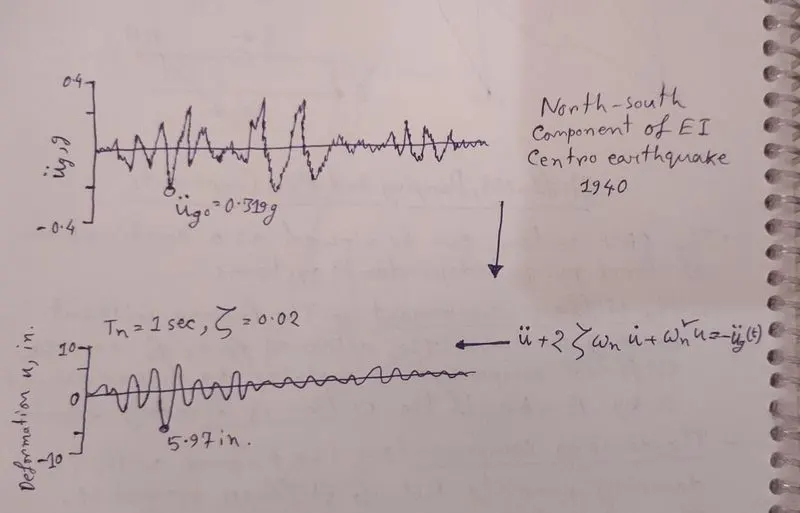
Ans=