Project on Concrete Mix Design for various grades of Concrete
Project on Concrete Mix Design for M35 grade concrete with fly ash & M50 grade concrete without Fly ash-
- INTRODUCTION-
The concrete mix produced under quality control keeping in view the strength, durability, and workability is called the design Mix. Others factors like compaction equipment's available, curing method adopted, type of cement, quality of fine and coarse aggregate etc. have to be kept in mind before arriving at the mix proportion.The design mix or controlled mix is being used more and more in variety of important structures, because of better strength, reduced variability, leaner mixed with consequent economy, as well as greater assurance of the resultant quality. Here, I have designed M35 grde of concrete using fly-ash and M50 grde of concrete without using fly-ash, which are designed according to Indian standard codal specifications like- IS 10262 (2009), IS 456 (2000) etc., During the calculation of mix-design, I have assumed various data accordingly.
- AIM OF THE MIX DESIGN-
The purpose of concrete mix design is to ensure the most optimum proportions of the constituent materials to fulfill the requirement of the structure being built. Mix design should ensure following objectives.
1) To achieve the designed/ desired workability in the plastic stage.
2) To achieve the desired minimum strength in the hardened stage.
3) To achieve the desired durability in the given environment conditions.
4) To produce concrete as economically as possible.
Calculate the Concrete Mix Design for M35 grade concrete with fly ash-
I. Stipulation for Proportioning-
a) Grade of designation= M35
b) Type of cement= OPC43 grade conforming to IS 8112
c) Type of mineral admixture: Fly ash conforming to IS 3812 (part 1)
d) Maximum nominal size of aggregate:- 20mm
e) Minimum cement content:- 340 kg/m3 (From Table-5 of IS 456, 2000 - Exposure condition)
f) Workability :- 100mm (Slump value for pumpable concrete)
g) Exposure condition:- Very Severe (For reinforced concrete)
h) Method of concrete placing:- Pumping.
i) Degree of supervision:- Good.
j) Type of aggregate:- Crushed angular aggregate.
k) Maximum cement concrete:- 450 kg/m3
l) Chemical admixture type:- Superplasticizer
II. Test data for Materials:-
a) Cement used:- OPC 43 grade conforming to IS 8112.
b) Specific gravity of cement:- 3.15
c) Fly Ash:- Conforming to IS 3812(Part 1)
d) Specific gravity of fly ash:- 2.2
e) Chemical admixture:- Specific gravity of chemical admixture- 1.145 (Superplasticizer conforming to IS 9103.)
f) Specific gravity of coarse aggregate:- 2.74 and specific gravity of fine aggregate:- 2.74.
g) Water absorption:-
- Coarse aggregate- 0.5%
- Fine aggregate- 1.0%
h) Free surface moisture:-
- Coarse aggregate- Nil.
- Fine aggregate- Nil.
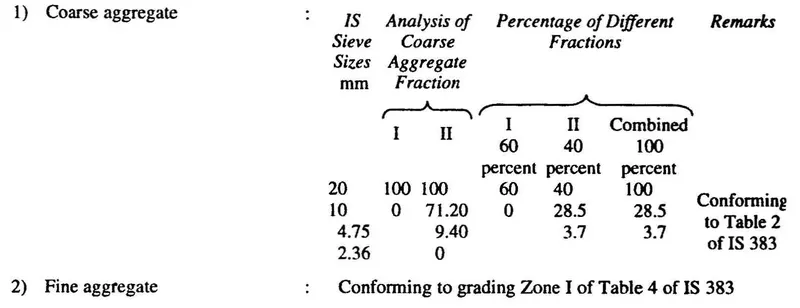
i) Sieve analysis conforming to Table-2 of IS 383:-
#Here are various steps incuded in concrete mix design for M35 grade of concrete-
STEP-1-
Target mean strength of concrete for M35 grade of concrete-
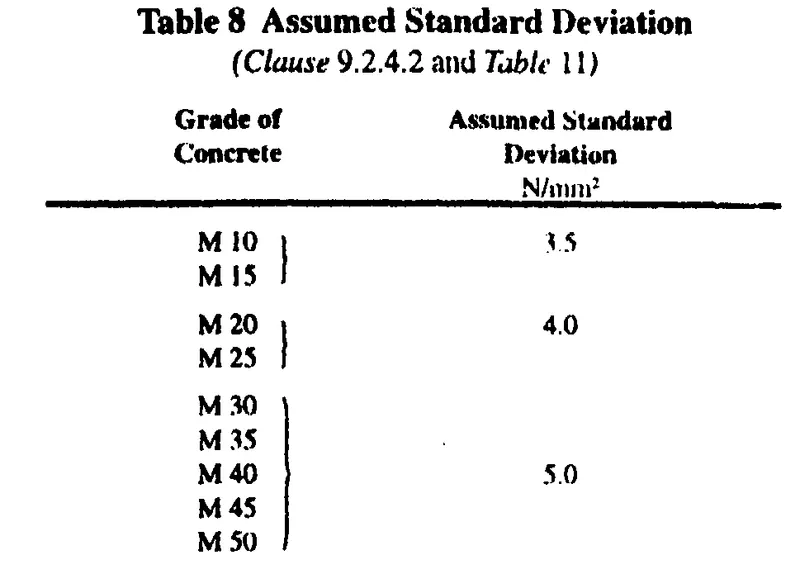
f'ck= fck+1.65S
[Where, S= Standard deviation, f'ck= Target mean strength of concrete, fck= Characteristeristic strength of concrete]
f'ck= 35+(1.65X5) = 43.25 N/mm2 [S=5 according to table-8 of IS-456]
STEP-2-
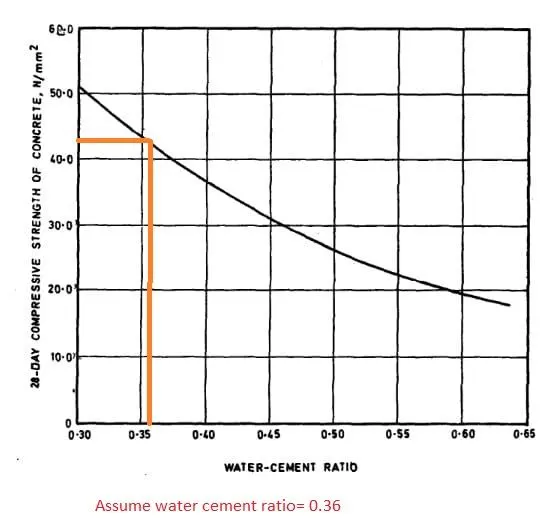
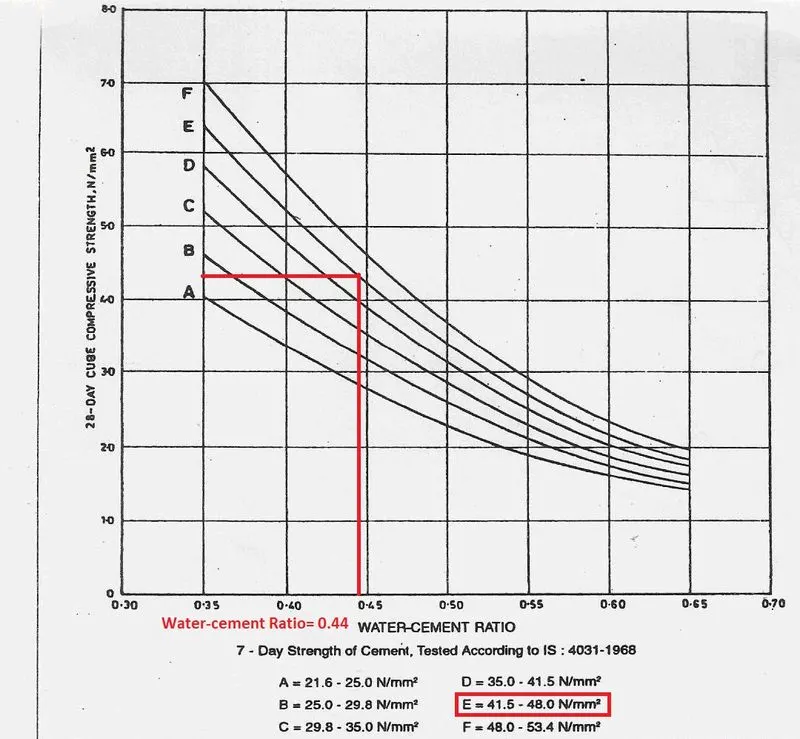
To calculate water/cement ratio from the grapph-2 of IS 10262-2009 we get that value 0.36(Approximate).
STEP-3-
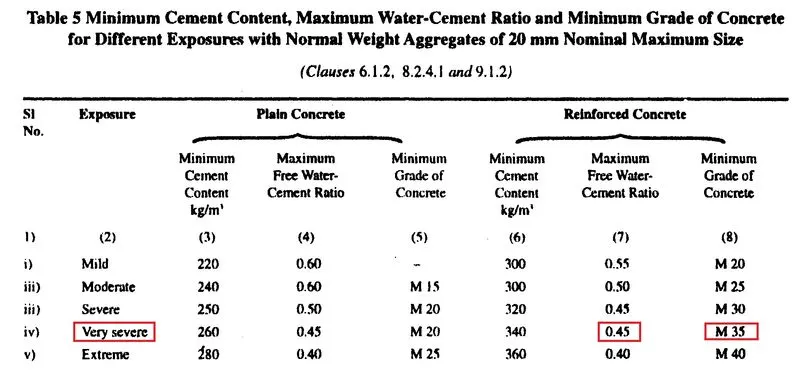
Assume weather condition is very severe then water/cement ratio is 0.45 according to table-5 of IS 456.
STEP-4-
According to another graph of IS 10262-2009 water cement ratio is 0.46 (Approximate) [where C curve intersect at that point and value of C=29.8 - 35.0 N/mm2]
STEP-5-
Now consider all the above water/cement ratio 0.36,0.45,0.44 and the lowest value is adopted as water/cement ratio is 0.36.
STEP-6-
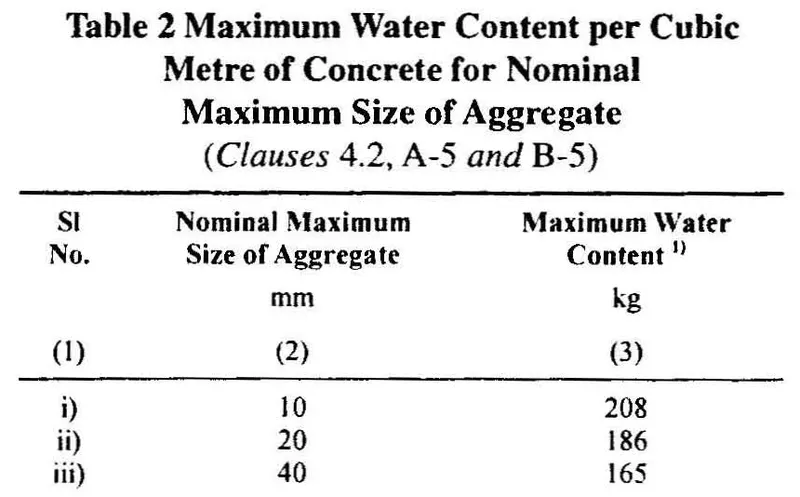
consider the size of aggregate is 20mm, then according to Table-2 of IS 10262 the maximum water content will be 186 kg or litre.
* Estimate the water content for 50mm slump= 186X[(6/100)X186]= 197.16~ 197 kg or litre (For additional slump 3% may be added for every every 25mm slump)
As superplasticizer is used, the water content can be reduced up 20 percent and above.
Based on trials with superplasticizer water content reduction of 29 percent has been achieved. Hence, the
arrived water content =197 x 0.71 =139.87 ~ 140 litre
STEP-7-
W/C=0.36 [w=140 kg]
[cement content] C=388.89 ~ 389 kg
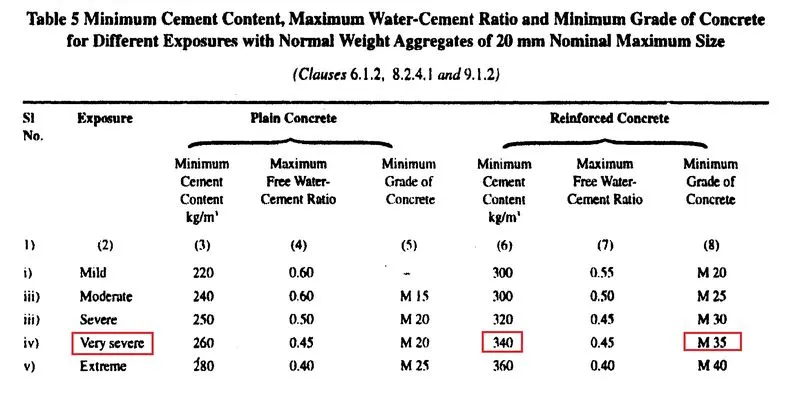
From Table-5 of IS 456 minimum cement content for very severe exposure condition is 340 kg/m3.
** 389 > 340 [Hence ok]
Therefore we use cement content 389 kg/m3
STEP-8-
## In some cases increase in cementitious material can be warranted. Increase in cementitious material content and its percentage based on experience ( This example is with increase of 10% cementitious material content)
Cementitious material content= 389 X 1.10 = 427.9 ~ 428 kg/m3
Water content= 140 kg/m3 ; So, Current water-cement ratio= (140/428)= 0.327
STEP-9-
We are using Fly-ash @ 30% total material content= 428 X 30% = 128.4 ~ 129 kg/m3
Cement (OPC) = (428 - 129) = 299 kg/m3
So, saving of cement while using fly ash= 389-299= 90 kg/m3.
STEP-10-
The proportion of volume of coarse aggregate and fine aggregate can be determined from Table-3 of IS 10262 :- 2009 From Table-3 of IS 10262: 2009, Volume of coarse aggregate corresponding to 20mm size aggregate (Zone-I) for water cement ratio of 0.5=0.6
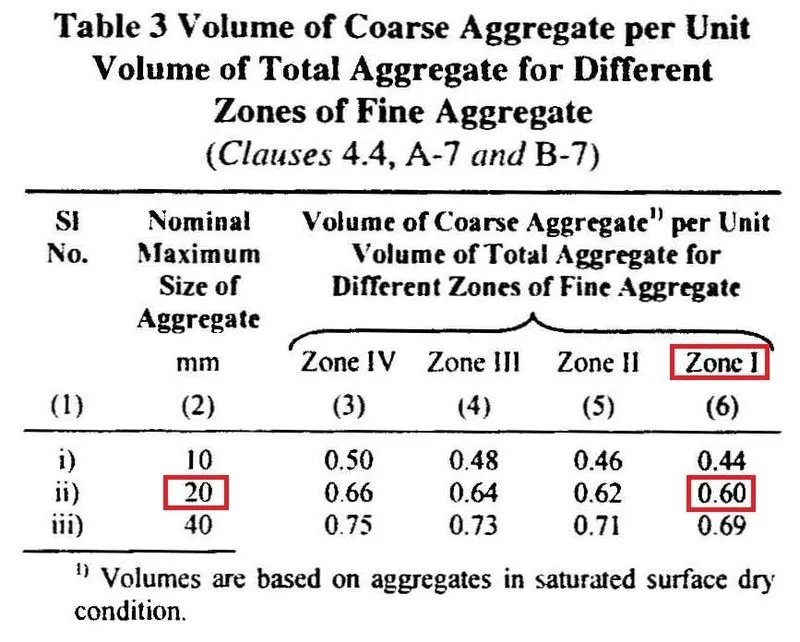
# In the present case water-cement ratio is 0.36. Therefore. volume of coarse aggregate is required to be increased
to decrease the fine aggregate content. As the water-cement ratio is lower by 0.10. the proportion of volume of
coarse aggregate is increased by 0.02 (at the rate of -/+ 0.01 for every ± 0.05 change in water-cement ratio). ** Calculation of water-cement ratio according for aforementioned equation= [{(0.5-0.36)X0.01}/0.05] = 0.028 Therefore, corrected proportion of volume of coarse aggregate for the water-cement ratio of 0.36 = 0.62.
Hence volume of coarse aggregate= 0.62 and volume of fine aggregate= (1-0.62)= 0.38
##For pumpable concrete these values are reduced by- 10%
Therefore, volume of coarse aggregate= 0.62X0.9=0.56
Volume of fine aggregate= 1-0.56= 0.44
STEP-11-
a) Volume of concrete = 1 m3
b) Volume of cement= (Mass of cement/specific gravity of cement)X(1/1000) = (299/3.15)X(1/1000) =0.112 m3
c) Volume of fly-ash = (Mass of fly-ash /specific gravity of fly-ash)X(1/1000) = (129/2.2)X(1/1000) =0.058 m3
d) Volume of water= (Mass of water/specific gravity of water)X(1/1000) = (140/1)X(1/1000) = 0.140 m3
e) Volume of chemical admixture (superplasticizer) (@ 2.0 percent by mass of cementitious material) =(Mass of Chemical admixture/specific gravity of admixture)X(1/1000) = (5.98/1.145)X(1/1000) = 0.005 m3
f) Volume of aggregate(Coarse aggregate + Fine aggregate)= [a-(b+c+d+e)] = [1-(0.112+0.058+0.140+0.005)] =0.685 m3
g) Mass of coarse aggregate= f X Volume of coarse aggregate X Specific gravity of coarse aggregate X 1000 = 0.685X0.56X2.74X1000 = 1051 kg/m3
h) Mass of fine aggregate= f X Volume of fine aggregate X Specific gravity of fine aggregate X 1000 = 0.685X0.44X2.74X1000 = 825.836 ~ 826 kg/m3
Final Report of Mix-design for M35 grade of concrete using Fly Ash-
Mix proportion for trial number-1=
- Cement= 299 kg/m3
- Fly Ash= 129 Kg/m3
- Water= 140 kg/m3
- Fine aggregate= 826 kg/m3
- Coarse aggregate= 1051 kg/m3
- Chemical admixture= 5.98 kg/m3
- Water cement ratio= 0.327
- Trial mix Ratio= 1 : 2.76 : 3.51 ( Cement : Fine Aggregate : Coarse Aggregate)
Remarks for Mix-design of M35 grade of Concrete using Fly Ash-
- The slump shall be measured and the water content and dosage of admixture shall be adjusted for achieving the required slump on trial. The mix proportion shall be reworked for the actual water content and checked for durability requirements.
- Two more trials having variation of 10% of water-cement ratio in aforementioned paragraph shall be carried out and a graph between three water-cement ratios and corresponding strength shall be plotted the mix proportion for the given target strength for field trials. However, durability shall be met.
Calculate the Concrete Mix Design for M50 grade concrete without using fly ash-
I. Stipulation for Proportioning-
a) Grade of designation= M50
b) Type of cement= OPC43 grade conforming to IS 8112
c) Maximum nominal size of aggregate:- 20mm
e) Minimum cement content:- 320 kg/m3 (From Table-5 of IS 456, 2000 - Exposure condition)
f) Workability :- 100mm (Slump value for pumpable concrete)
g) Exposure condition:- Severe (For reinforced concrete)
h) Method of concrete placing:- Pumping.
i) Degree of supervision:- Good.
j) Type of aggregate:- Crushed angular aggregate.
k) Maximum cement concrete:- 450 kg/m3
l) Chemical admixture type:- Superplasticizer
II. Test data for Materials:-
a) Cement used:- OPC 43 grade conforming to IS 8112.
b) Specific gravity of cement:- 3.15
c) Chemical admixture:- Specific gravity of chemical admixture- 1.145 (Superplasticizer conforming to IS 9103.)
d) Specific gravity of coarse aggregate:- 2.74 and specific gravity of fine aggregate:- 2.74.
g) Water absorption:-
- Coarse aggregate- 0.5%
- Fine aggregate- 1.0%
h) Free surface moisture:-
- Coarse aggregate- Nil.
- Fine aggregate- Nil.
i) Sieve analysis conforming to Table-2 of IS 383.
#Here are various steps incuded in concrete mix design for M50 grade of concrete without using fly ash-
STEP-1-
Target mean strength of concrete for M35 grade of concrete-
f'ck= fck+1.65S
[Where, S= Standard deviation, f'ck= Target mean strength of concrete, fck= Characteristeristic strength of concrete]
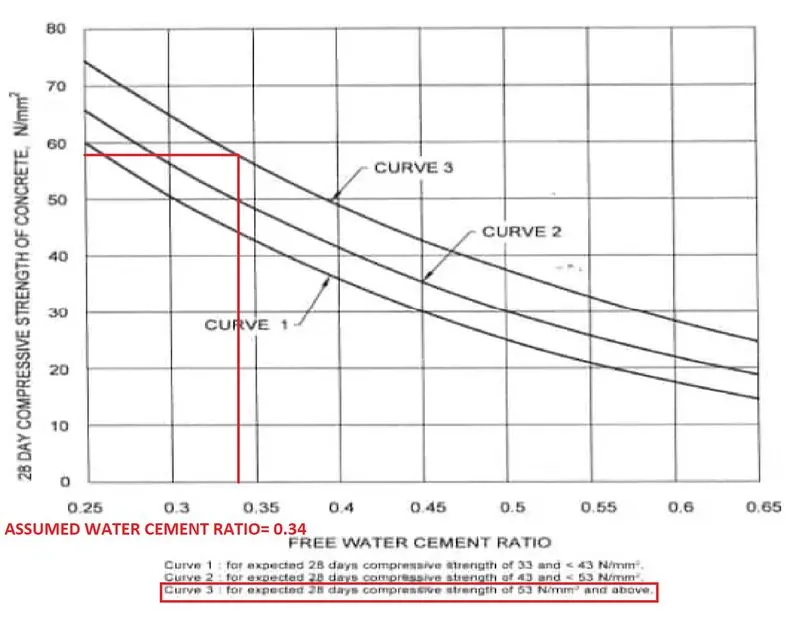
f'ck= 50+(1.65X5) = 58.25 N/mm2 [S=5 according to table-8 of IS-456]
STEP-2-
To calculate water/cement ratio from the grapph-2 of IS 10262-2019 we get that value 0.34(Approximate).
STEP-3-
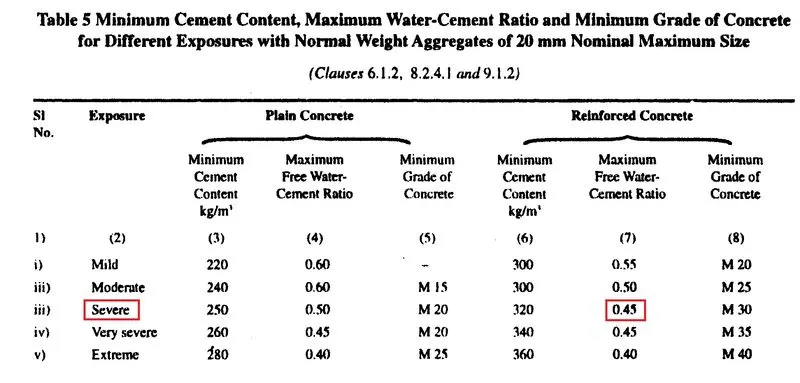
Assume weather condition is very severe then water/cement ratio is 0.45 according to table-5 of IS 456.
STEP-4-
From Table 5 of IS 456 : 2000, for severe exposure maximum water-cement ratio= 0.45, but from Graph-2 of IS 10262 we got water-cement ratio as 0.34.
Therefore 0.34<0.45 , Hence, we adopt 0.34 as water-cement ratio.
STEP-5-
consider the size of aggregate is 20mm, then according to Table-2 of IS 10262 the maximum water content will be 186 kg or litre.
* Estimate the water content for 50mm slump= 186X[(6/100)X186]= 197.16~ 197 kg or litre (For additional slump 3% may be added for every every 25mm slump)
As superplasticizer is used, the water content can be reduced up 20 percent and above.
Based on trials with superplasticizer water content reduction of 29 percent has been achieved. Hence, the
arrived water content =197 x 0.71 =139.87 ~ 140 litre
STEP-6-
W/C=0.34 [water content (W=140 kg)]
[cement content] C=411.76 ~ 412 kg
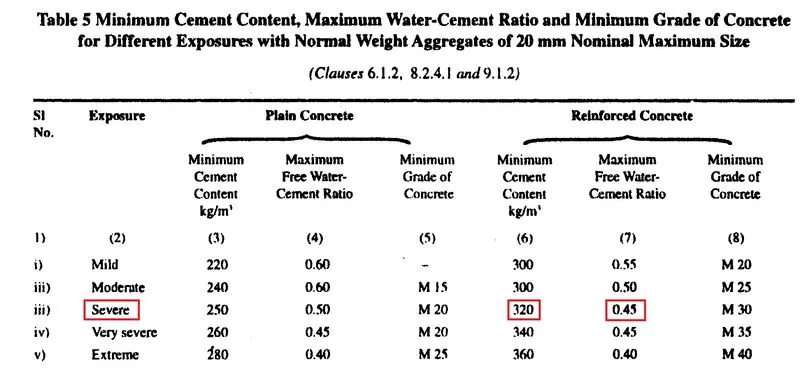
From Table-5 of IS 456 minimum cement content for very severe exposure condition is 320 kg/m3.
** 412 > 320 [Hence ok]
Therefore we use cement content 412 kg/m3
STEP-7-
The proportion of volume of coarse aggregate and fine aggregate can be determined from Table-3 of IS 10262 :- 2009 From Table-3 of IS 10262: 2009, Volume of coarse aggregate corresponding to 20mm size aggregate (Zone-I) for water cement ratio of 0.50=0.60
# In the present case water-cement ratio is 0.34. Therefore. volume of coarse aggregate is required to be increased
to decrease the fine aggregate content. As the water-cement ratio is lower by 0.10. the proportion of volume of
coarse aggregate is increased by 0.02 (at the rate of -/+ 0.01 for every ± 0.05 change in water-cement ratio). ** Calculation of water-cement ratio according for aforementioned equation= [{(0.5-0.34)X0.01}/0.05] = 0.032 Therefore, corrected proportion of volume of coarse aggregate for the water-cement ratio of 0.34 = 0.63.
Hence volume of coarse aggregate= 0.63 and volume of fine aggregate= (1-0.63)= 0.37
##For pumpable concrete these values are reduced by- 10%
Therefore, volume of coarse aggregate= 0.63X0.9=0.57
Volume of fine aggregate= 1-0.57= 0.43
STEP-8-
a) Volume of concrete = 1 m3
b) Volume of cement= (Mass of cement/specific gravity of cement)X(1/1000) = (412/3.15)X(1/1000) =0.131 m3
c) Volume of water= (Mass of water/specific gravity of water)X(1/1000) = (140/1)X(1/1000) = 0.140 m3
d) Volume of chemical admixture (superplasticizer) (@ 2.0 percent by mass of cementitious material) =(Mass of Chemical admixture/specific gravity of admixture)X(1/1000) = (8.24/1.145)X(1/1000) = 0.007 m3
e) Volume of aggregate(Coarse aggregate + Fine aggregate)= [a-(b+c+d)] = [1-(0.131+0.140+0.007)] =0.722 m3
f) Mass of coarse aggregate= e X Volume of coarse aggregate X Specific gravity of coarse aggregate X 1000 = 0.722X0.57X2.74X1000 = 1127.619 ~ 1128 kg/m3
g) Mass of fine aggregate= e X Volume of fine aggregate X Specific gravity of fine aggregate X 1000 = 0.722X0.43X2.74X1000 = 850.660 ~ 851 kg/m3
Final Report of Mix-design for M35 grade of concrete using Fly Ash-
Mix proportion for trial number-1=
- Cement= 412 kg/m3
- Water= 140 kg/m3
- Fine aggregate= 851 kg/m3
- Coarse aggregate= 1128 kg/m3
- Chemical admixture= 8.24 kg/m3
- Water cement ratio= 0.34
- Trial mix Ratio= 1 : 2.06 : 2.73 ( Cement : Fine Aggregate : Coarse Aggregate)
Remarks for Mix-design of M50 grade of Concrete without using Fly Ash-
- The slump shall be measured and the water content and dosage of admixture shall be adjusted for achieving the required slump on trial. The mix proportion shall be reworked for the actual water content and checked for durability requirements.
- Two more trials having variation of 10% of water-cement ratio in aforementioned paragraph shall be carried out and a graph between three water-cement ratios and corresponding strength shall be plotted the mix proportion for the given target strength for field trials. However, durability shall be met.