Section Modulus calculation and optimization
Section Modulus & its significance
The moment carrying capacity of an object is directly dependent on geometrical property (I) and material property (E) of an object, which is collectively termed as flexural rigidity(EI).Geometry of an object plays an important role in load bearing capacity of an object which is indicated by moment of inertia of a section. Therefore section modulus is the predominant factor which evidences the strength of an object and is defined as the ratio of the moment of inertia of the object about its centroidal axis to the distance of the extreme fibers of the object from the neutral axis.
Section modulus is generally denoted by Z.
Therefore , Z = I / Ymax
where, I = Moment of inertia of a section.
Ymax = Distance of the outer most fiber of the object from the neutral axis.
Section modulus can also be defined by using the simple bending theory as,
M / I = σ / Y
Therefore, Z = M / σ , M – bending moment, σ – bending stress
i.e, section modulus is also expressed as the ratio of bending moment to the bending stress of a given object within the elastic limit.
Note: The moment of inertia considered here is the area moment of inertia. The area moment of inertia is a property of a two-dimensional plane shape which characterizes its deflection under loading.
Calculation of section modulus of Hood
Step1
Selection of designed Hood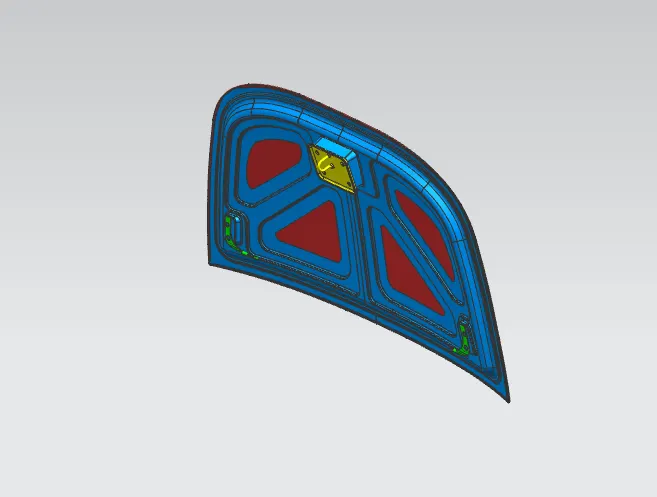
Step2
Selection of section for section modulus calculation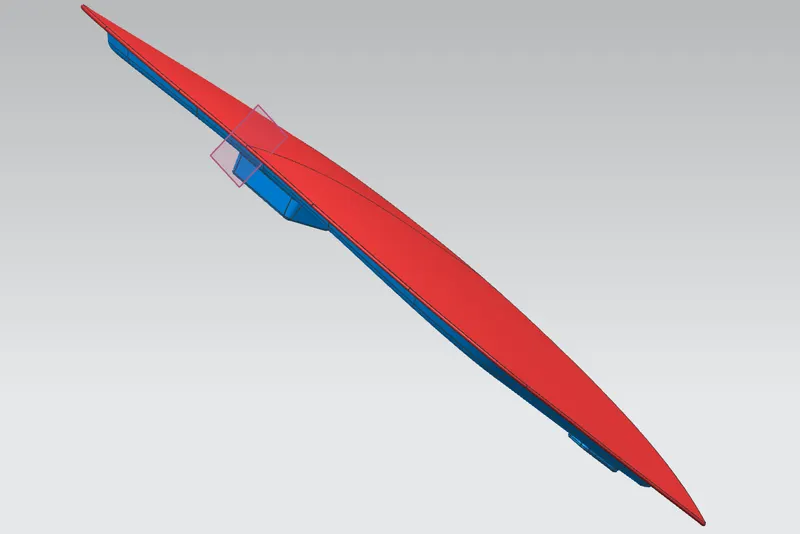
Section view of inner panel and outer panel is considered and for creationor extraction of section plane from the hood, a datum plane is created at the midsection using point and direction method.
Step3
The cross section of hood at midsection is obtained using intersecting curve on outer panel and inner panel with datum plane, in a sketch created through datum plane.
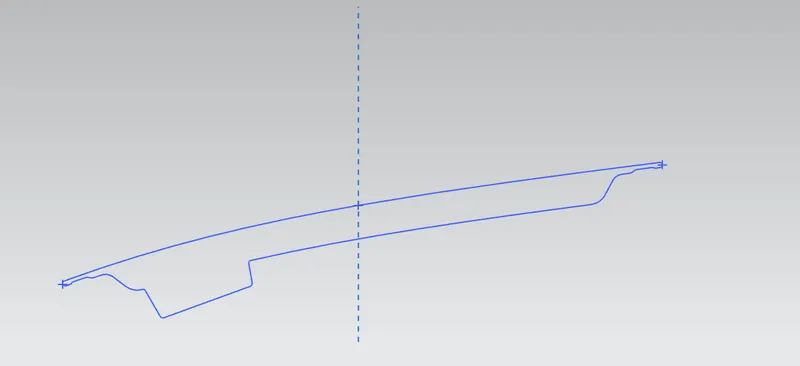
The section modulus about Y axis(vertical axis at centre of section in the figure) is considered for calculation and analysis.
The top edge represents the outer panel and the bottom edge represents the inner panel. Both are separated by a distance of 0.8277 as seen from the below figure.
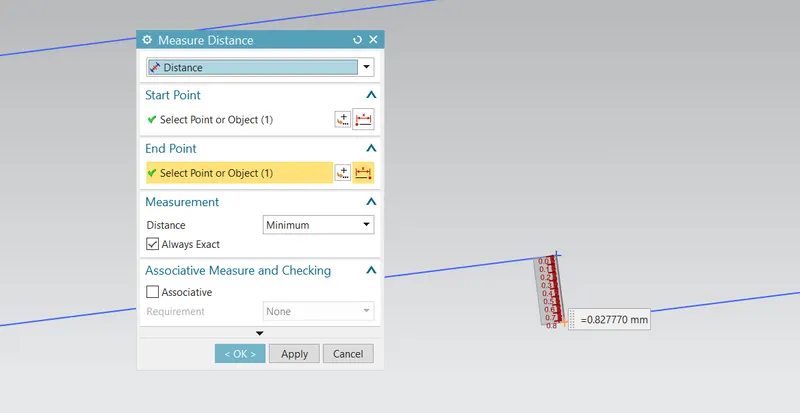
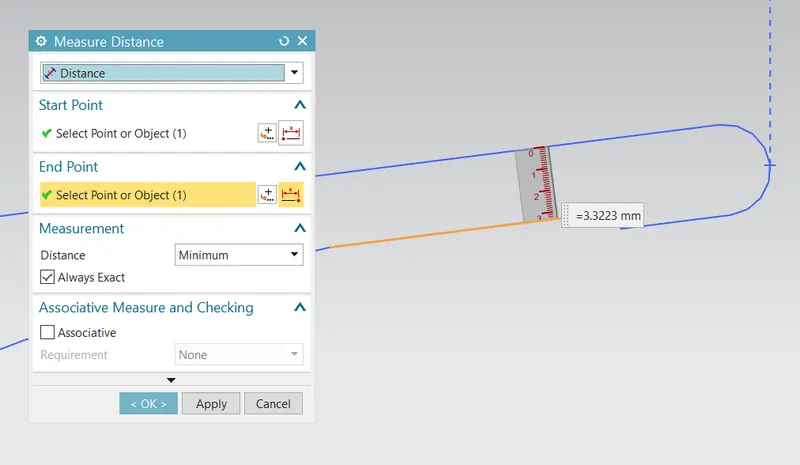
The depth hood cross section obtained is 3.3223mm
Step4
Calculation of Section modulus of cross section of Hood
For section modulus calculation, Section inertia analysis is applied on cross section to obtain moment of inertia about CG axes, and max and min MOI.
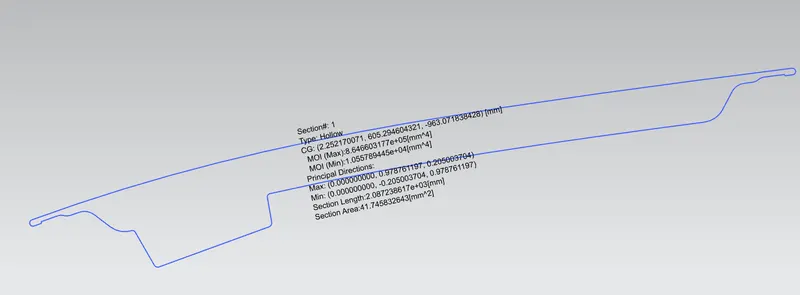
Considering min MOI for analysis
MOI (min) = 1.055789445e+04mm4
Calculation of Ymax - Ymax is calculated by measuring the distance between end points of cross section along direction parallel to outer edge of the panel and dividing the obtained value by 2.
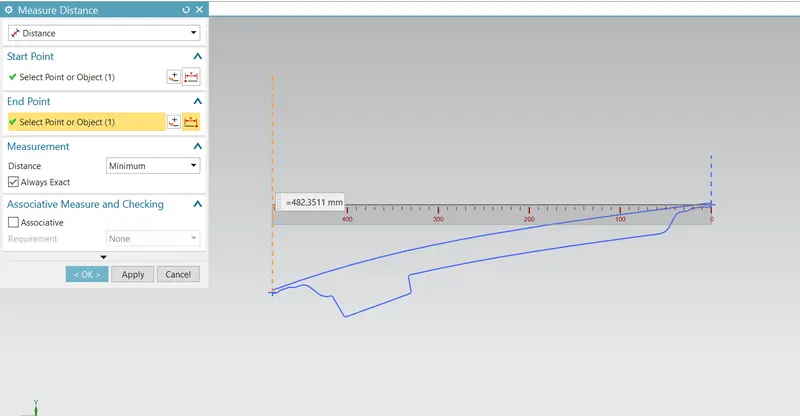
Ymax = 482.3511/2 = 241.1755mm
Section modulus Z_cross section1 = MOI(min1)/Ymax = 1.055789445e+04/241.1755 = 43.7768mm3
Optimization
An attempt has been made to increase the section modulus so that the moment carrying capacity of the hood cross section increases.
The distance between the outer panel and inner panel edge is increased by 0.6mm using offset curve.
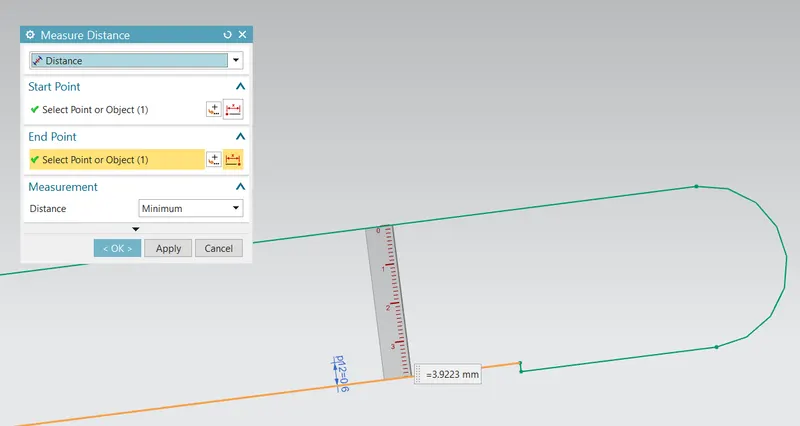
The depth hood cross section increased to 3.9223mm
Section modulus is calculated for the new cross section to observe the strength variation.
Applying section inertia analysis to obtain MOI(min)
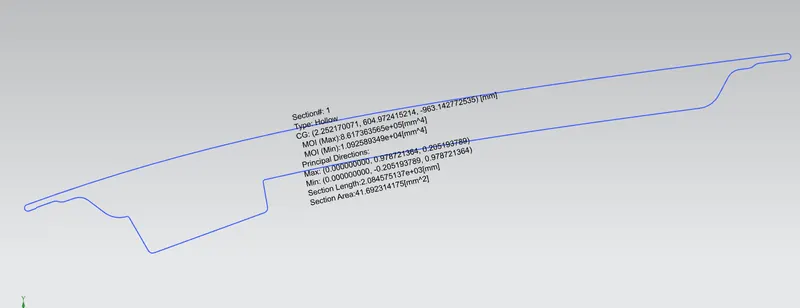
MOI (min) = 1.092589349e+04mm4
Ymax = 241.1755mm
Section modulus Z_crosssection2 = MOI(min2)/Ymax = 1.092589349e+04/241.1755 = 45.3026mm3
Conclusion
From the results of section modulus of the two cross sections, it can be observed that the section modulus of cross section 2 is more than cross section1. This is due to the increased area moment of inertia moment of inertia. As the distance between the outer panel edge and inner panel edge (i.e. depth of the hood cross section)increased, the area moment of inertia increased and therefore, section modulus increased. The cross section 2 of the Hood can be considered as an improved one as it has better moment carrying capacity than the previous one. it can concluded that the increase in depth of the cross section leads to better geometric property of the hood cross section that can impove the strength against moments under loading condition.