Section Modulus calculation and optimization
section modulus calcultion and design optimization for better section modulus for hood assembly
section modulus
concept defenition
section modulus is value used to understand at a particular section of body the force taking abily before the yielding and we can also say that section modulus is the ability of a section to withhold the applied force without deforming permanently or is a elastic deformation
types
section modulus is of two types i.e elastic section modulus (Se) and plastic section modulus(Sp)
formula
Se = I/Y
Se - elastic section modulus(mm3)
I - area moment of inertia(mm4)
Y - max distance between netral axis and outermost fiber
Elastic section modulus:
this is the section modulus value upto the yielding point where the object can retrive to the original shape and size
Platic section modulus:
This is the section modulus value upto the ultimate point where the object will start to rupture and in this region the object will go into permanent deformation where it will not retrive back to its original shape and size
there is also a two subtypes they are symmentric and assymmentric and the first one is for the variant where the section is symmentric about the centroid axis
and the another one is where the section is assymmentric about the neutral axis and the symmentric variant has a single moment of inertia (I) whereas the assymmentric type has
max ans min moment of inertia (I)
SECTION MODULUS FORMULA DERIAVATION
M/I = SIGMA/Y (bending equation)
where
M - bending momemt
I - area moment of inertia
SIGMA - bending stress
Y - max distance between centroid and neutral axis
Se = I/Y
therfore
M/SIGMA = Se = I/Y
AREA MOMENT OF INERTIA
as we can see from the above derivation the section modulus varies directly as the moment of inertia of an object and the moment of inertia is from the concept that the object with min material available deflect more than object with max material at the particular section and the
moment of inertia = differential of area * distance in x axis from centroid axis
this moment is find out by dividing the section into smaller shapes and then the final inertia is found out by
intergration of the differential from the low limit of height to upper limit
SECTION MODULUS CALCULATION OF ACTUAL DESIGN
since the section modulus is calculated for the hood of the car and where the impact is as shown blelow the section is taken perpendicular to the force applied
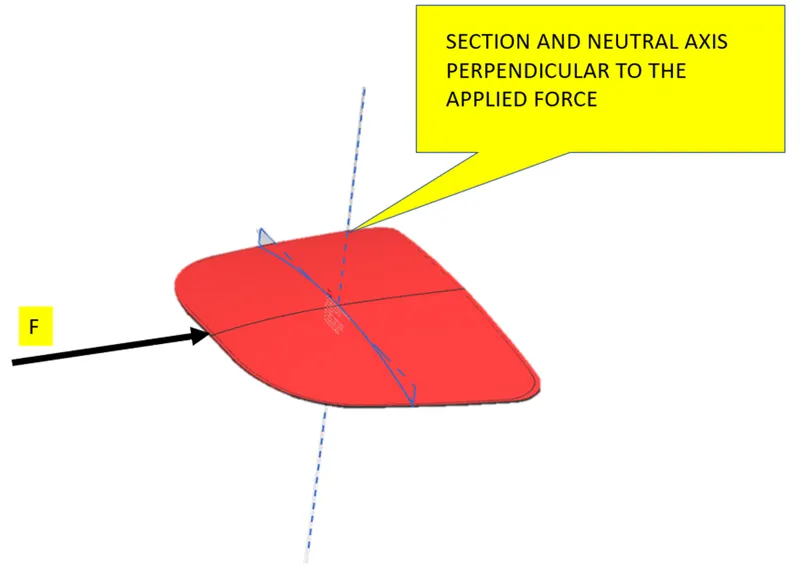
the section is therfore taken in x direction and the open ends are connected through a sketch and then section inertia analysis is done on the closed profile
as the created section is assymmentric we got max and min area moment of inetia and we have taken the max condition the section and inertia analysis given below

the y value is give above
Y =429.5 = 430mm
detailed view of inetia value
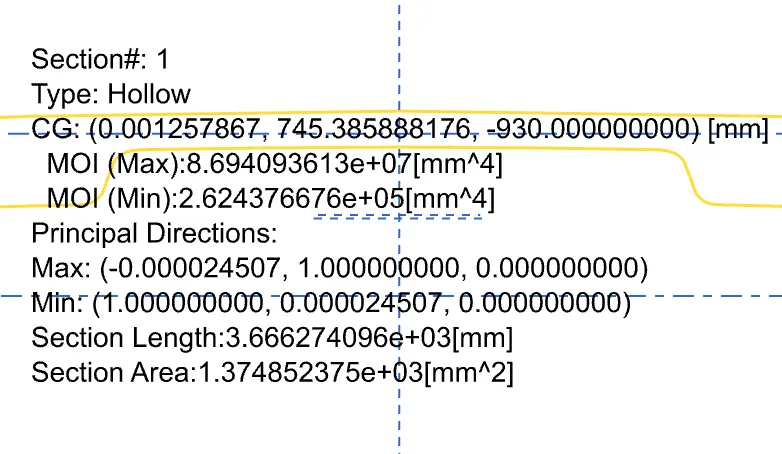
we got the value of
Imax = 8.69*10^7mm4
section modulus
Se = 8.69*10^7/430
Se = 202*10^3mm3
SECTION MODULUS CALCULATION FOR MODIFIED DISIGN
as we have already seen the section modulus can be increased by increasing the inertia value or by decreasing the Y value
- decreasing the Y value is not feasible as the width is constrained by the styling team
- only varinng the inertia is possible
- here i have increased the inertia value by locally increasing the emboss value to about 3mm and also by varying the thickness of the section to about 5mm
new section

Y value is same
detailed view
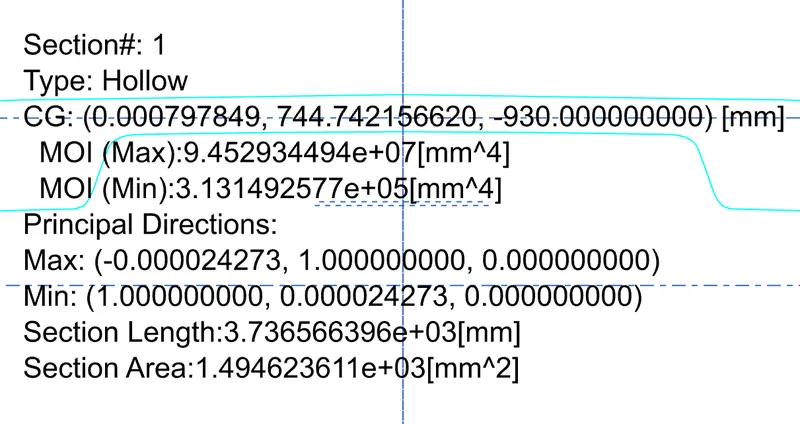
we obtain
Imax = 9.45*10^7mm4
Se = 9.45*10^*/430
Se = 220*10^3mm3
comparision of two sections
| S NO | VALUE | EXISTING | MODIFIED | CHANGE IN % |
| 1 | Y | 430 | 430 | 0 |
| 2 | Imax | 8.69*10^7 | 9.45*10^7 | 8.75 |
| 3 | T | 0.75 | 0.8 | 6.66 |
| 4 | Se | 202*10^3 | 220*10^3 | 8.9 |
CONCLUSION
we can see from the above calculation and comparision the section modulus increase by almost 9% by varing the inertia by varying the area and by varing the thickness of the object and we have also understood the concept of section modulus and its significance in design