Section Modulus calculation and optimization
Aim :
To calculate the section modulus of the already outlined hood for analyzing its quality additionally optimizing the plan to see the distinction within the bowing quality of the hood. Higher the area modulus of a structure, the more the resistive it gets to be to bending.
Section modulus :
Section modulus may be a coordinate degree of quality of any sectional region of an question around an reference axis(neutral pivot). Quality is nothing but, competent of supporting greater loads, so higher the quality it contains a tall competent of supporting more prominent loads. This quality can measured specifically from Segment modulus equation, and characterized by underneath formula.
section modulus of various cross section are given below in thefollowing table,
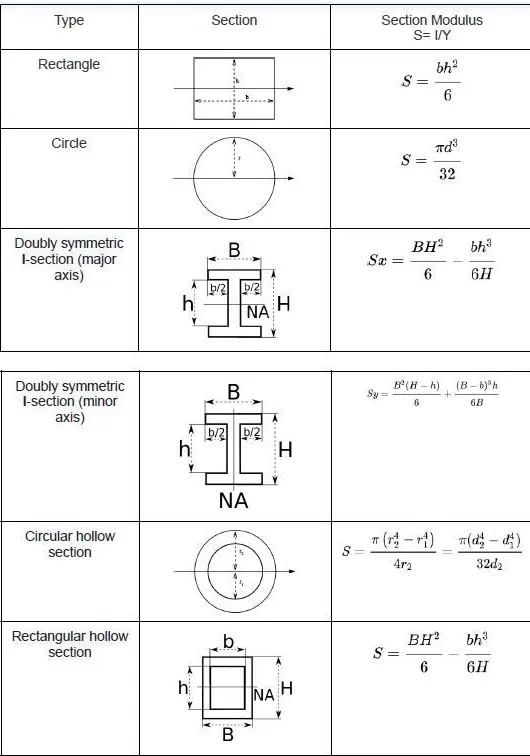
Formula of Section Modulus
It may be defined as the ration of total moment resisted by the section to the stress in the extreme fibre which is equal to yield stress.
Therefore ; S = I/Y, Where
S = Section modulus (mm^3)
I = Moment of Inertia of the section about the bending axis. (mm^4)
Y = Distance between the neutral axis and extreme end of the object (mm)
Moment of inertia is nothing but advertising resistance against of minute, bending or turning, i.e on the off chance that we connected any outside stack on the body, how much resistance its advertising to tend to deform. So, higher the esteem of minute of inactivity , have higher resistance to misshape beneath certain stack, consequently we will say that minute of inactivity straightforwardly corresponding to the quality of the fabric , and strength of the fabric can be calculated with the assistance of segment modulus. If we change the unbiased hub towards positive or negative side the by and large quality of the body will diminish , since when neutral hub line lies on the center of the area as it were have higher quality at specific point, so, here 'Y' esteem was contrarily relative to section modulus.
The area moment of inertia of a beams cross sectional area measures the beam ability to resist bending. The larger the moment of inertia less will be the bend.
Where,
M = Bending moment
I = Area moment of Inertia
E = Youngs modulus
R = Radius of gyration
Neutral axis: When beam is subjected to pure bending the top most fibres of the beam are subjected to maximum compression, while the bottom most fibres of the beams are subjected to maximum tension.
Calculation:
CASE 1: Before Optimization
The Hood which was as of now made is imported and the segment idleness investigation is done. We got to make beyond any doubt that the bend gotten could be a single/closed bend.
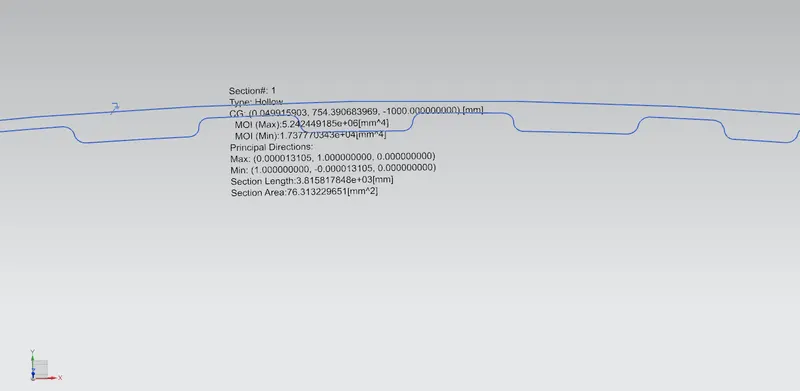

MOI (max) =5.242449185e+06(mm^4)
MOI (min) = 1.737770343e+04(mm^4)
As per the section modulus equation,
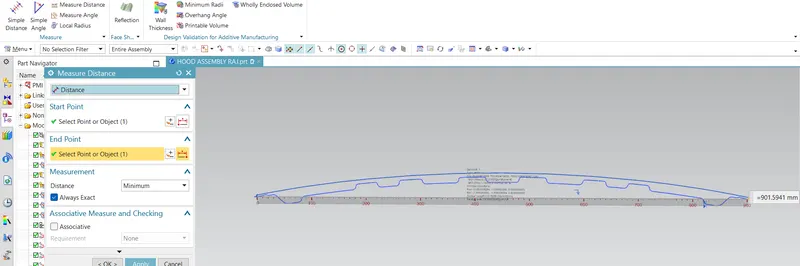
Y = Total distance /2, Total distance = 901.5941/2
= 450.79
S max = I max/Y
= 5.242449185 x 10^06/450.79
= 0.011626633 X 10^06 mm^3
S min = I min/Y
= 1.737770343 X 10^04/450.79
= 3.854944304 X 10^01 mm^3
CASE 2 : after optimization
the inner pannel was offsetted 1 mm for its original position
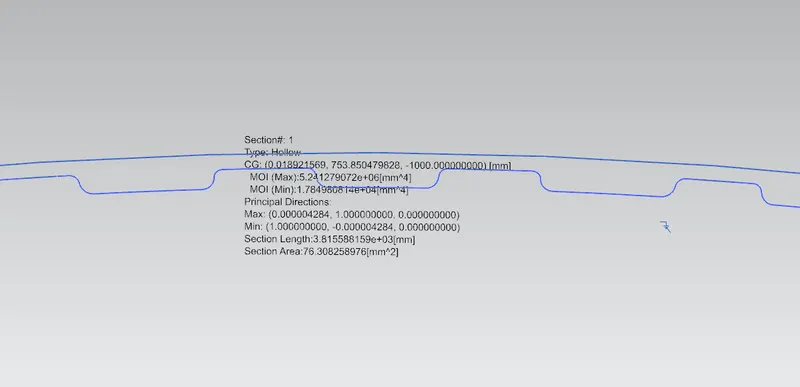
MOI (max) =5.241279072e+06 mm^4
MOI (min) =1.784980814e+04 mm^4
As per the section modulus equation,
Y = Total distance /2, Total distance = 901.5941/2
= 450.79
CALCULATION OF case 2:
Smax=Imax/Y
= 5.241279072 x 10^6/450.79
= 0.11626875 x 10^6 mm^3
S min = I min/Y
= 1.784980814 x 10^4
= 3.959672606 x 10^01 mm^3
conclusion
- By comparing the values ready to say that area modulus of the optimized hood is increased.
- If we increment the crevice between the internal and external board of hood inevitably segment length will increment in this way MOI will increase.
- MOI increments with the increment of segment length.
- MOI increments with the increment of area zone.