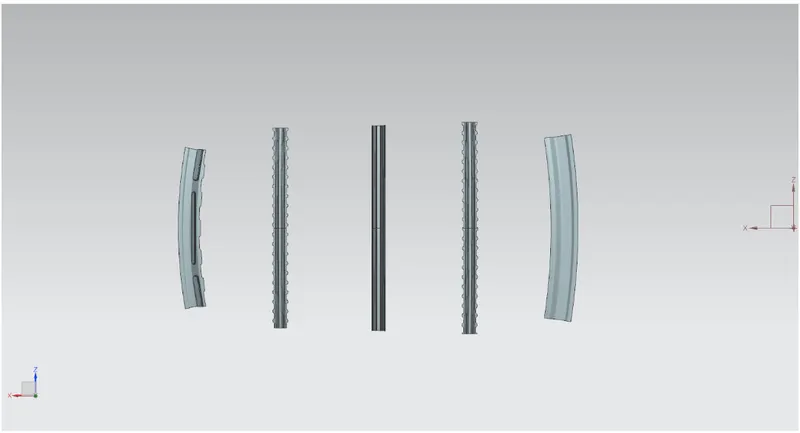
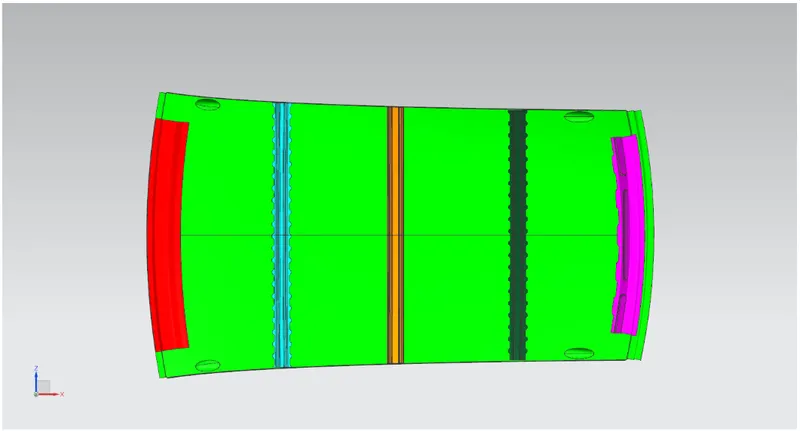
Roof challenge
OBJECTIVES:
• Create a roof of the car by the given styling surface based on the master section provided.
• To validate the designed roof is satisfy the heat distortion criteria and snow load condition.
• To familiar about the tools and operations involved in creating the roof of the car.
• To prepare section modulus for the bow roof 1 c centre reinforcement and bow roof 2 on the 0-Y cross section
• Draft analysis for all the part for checking the tools feasibility.
ROOF INTRODUCTION:
The roof is an important part of an automobile as it protects the occupants from various environmental conditions like Heat, Snow, Rain, and winds. There are many types of the roof which differs based on the variants of the car and the region. The roof must be designed in such a way that it would able to withstand any load or impact due to accidents or objects falling on it and other environmental factors. So, the design done is based on the standards and design intent which makes the roof to withstand the above said conditions. Also, other factors Headroom, aesthetics play a role in the design. The roof is an assembly of many parts like Front roof rail, Bow roof, Bow roof center, and reinforcement center. The number of bow roofs is based on the length of the roof and sometimes even the bow roof center is avoided in cases like small cars. The roof is attached to the body of the car using mastic sealants provided between bow roofs and the front and rear rails. Roof is connected to -pillar, B-Pillar and C-Pillar to cover the Front and rear door. Roof is supported by reinforcement bow-roof with front and back roof rail.
Types of roof reinforcements are as follows: -
• Front roof rail reinforcement (FR)
• Centre roof rail reinforcement (CR)
• Bow roof 1 rail reinforcement (BRI)
• Bow roof 2 rail reinforcement (BR2)
• Rear rail enforcement (RR)
Ditch Area:
It is the extended portion of the main roof concealed by other BIW panels and not a styling surface. Headroom clearance, visibility criteria, clearance for windshield and backdoor are some of the factors to be considered while designing the ditch area.
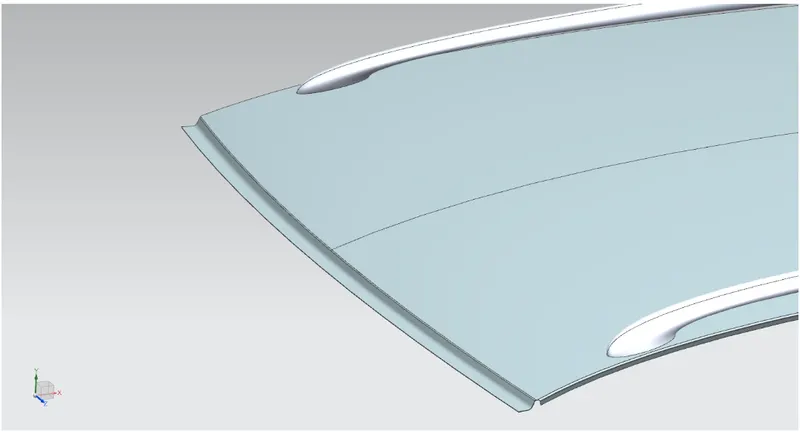
Front Roof Rail:
It is the support that is joined with the windshield glass, bodyside outer and the inner panels. It is usually made from body side outer scrap and therefore the thickness of the rail is 0.65 mm. A draft angle of 3-5 degrees is provided for deep-drawing operation. The visibility criteria and the headroom clearance of the passenger are taken into consideration for the bottommost flange. Windshield end and the roof end are spot welded and the other end of the front roof rail is joined with the roof using mastic sealants for increased strength.
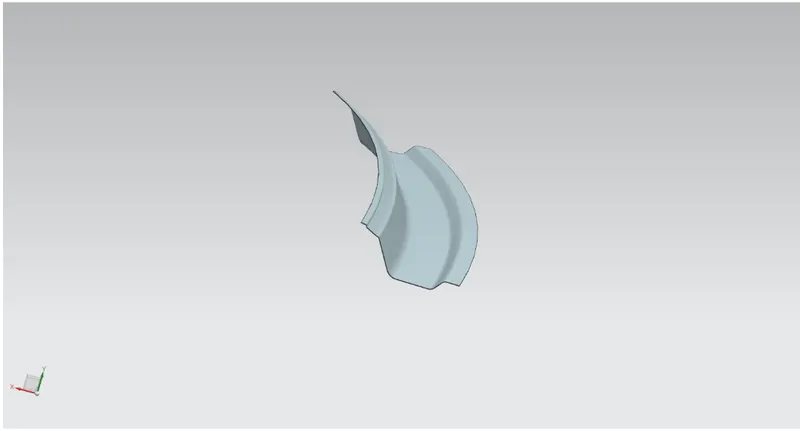
Rear Roof Rail:
It is the support that is joined to the backdoor, the bodyside outer and the inner panels. Inputs from the backdoor design is also taken to accommodate the required clearance along with headroom clearance and the rear visibility criteria while designing the rear roof rail. Spot welds are applied at the backdoor end of the rail and the other end is oined with the roof using mastic sealants.
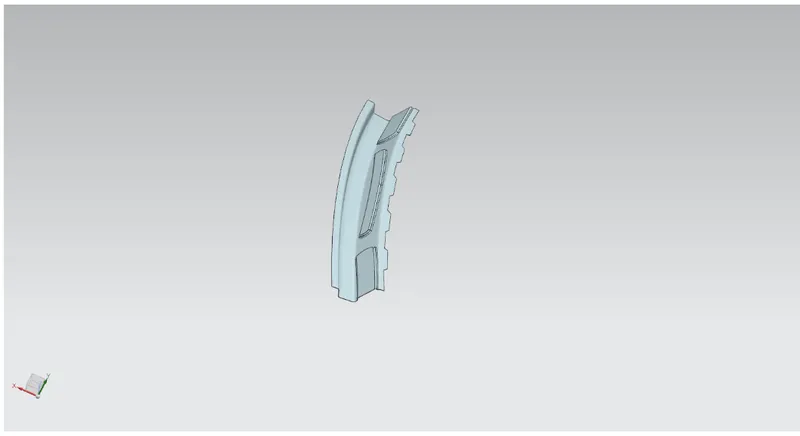
Centre Roof Rail and Bow Roofs:
Similar to other rail designs, we have to take into consideration the headroom clearance and the visibility criteria while designing the centre roof rail and bow roofs. Unlike the front and rear roof rails, spot welds are not applied for joining these rails to the roof. Mastic sealants are introduced at both the ends instead of spot welds since centre roof rail and row roofs are fully positioned under the styling surface of the roof.
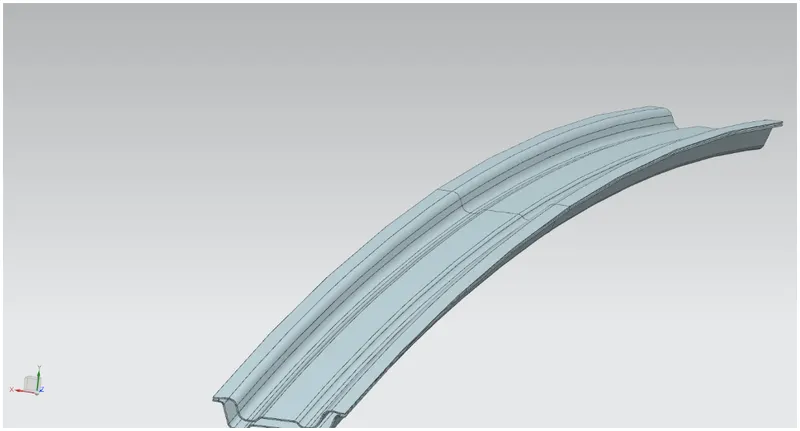
CENTRE REINFORCEMENT
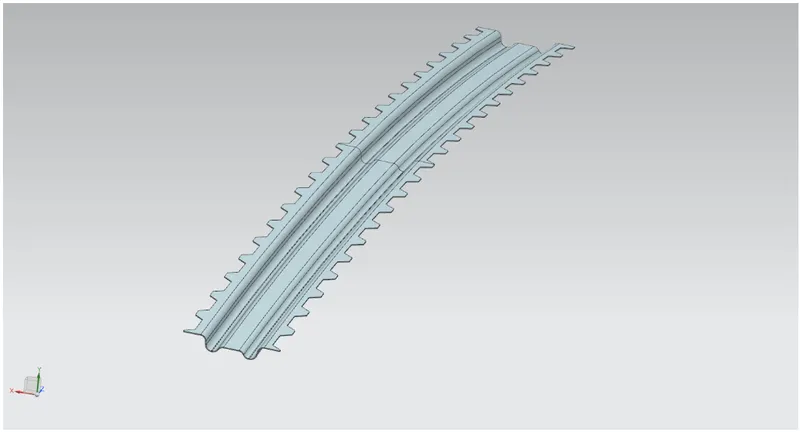
BOW ROOF 1
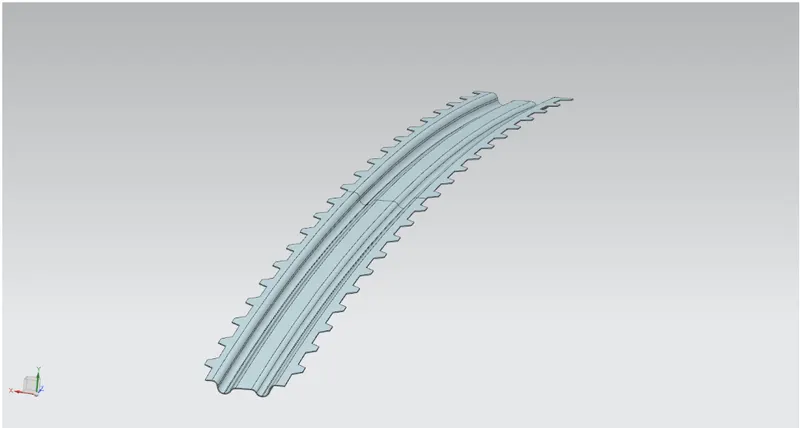
BOW ROOF 2
Calculations to determine bow position:
1. Heat Distortion Criteria:
Heat distortion temperature is the temperature at which the metal softens and deforms under a specific load. This study is done to check the ability of the roof to withstand high temperature with respect to the positioning of the reinforcements which contribute to increased strength.
W = [1.73 x 10^(-3) x L] + [1.85 x 10^(-8) x (R^2)/t] + [ 1.10х10 ^ (-3) x I] - 2.68
Judgement Condition : OK<2.7 Where, 2. Snow Load Criteria: Snow load criteria study is done to check the ability of the roof to withstand snowfall and bounce back to its original shape without any permanent deformation once the load is removed. Snow load Prediction formula Qr = [ly x t^2]/[ α x s x [(Rx+Ry)/2]^2 x 10^-8] Note: The Qr value given over here is correct. There was a typo error in the formula given in the video. Where a = My x Lx^2 x 10^-12, My = Y(Ly-Y) Judgement condition = Qr >= 3.1 250 <= s <= 5 380 t = Roof plate thickness [mm] Ly = Distance between the front and rear roof Rails on the Vehicle along with 0Y [mm] Length of Roof panel with the center point between Roof rail Front /Rear as the reference point of the front and the rear. Lx = Distance between the Left and Right end of the roof on the Roof BOW [mm] Width of the roof panel exposed on the surface. Y = Distance front Front Roof Rail to Roof BOW[mm] From the above table, it is concluded that the designed roof satisfies the snow load criteria. SECTION MODULUS OF MASTER SECTION: FRONT ROOF RAIL: BOW ROOF 1: CENTRE REINFORCEMENT:
L = Roof Length in X-Direction [mm] (Roof dimension in 0-y)
R = Roof curvature
R = 2(Rx'Ry)/(Rx+Ry)
Rx = X curvature
Ry = Y curvature
t = Roof plate thickness [mm]
I = Bow Roof Span [mm]
From the above table, it is concluded that the designed roof satisfies the heat distortion criteria.
s = Distance for which Roof BOW bears divided load [mm]
s = L1/2 + 12/2
ly = Geometrical moment of inertia of Roof BOW (Y cross-section )[mm4]
Rx = Lateral direction curvature radius of roof panel Y cross-section on Roof BOW [mm]
Roof panel curvature Radius of the Length Lx in Front view
Ry = Longitudinal Direction curvature radius of the Roof panel X cross-section on Roof BOW [mm]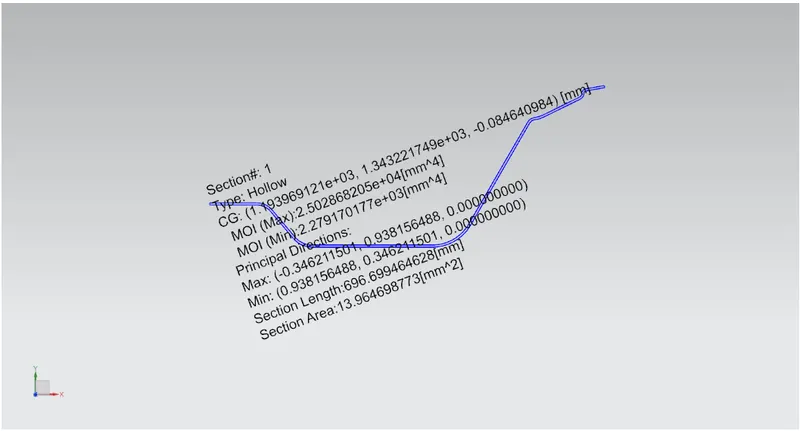
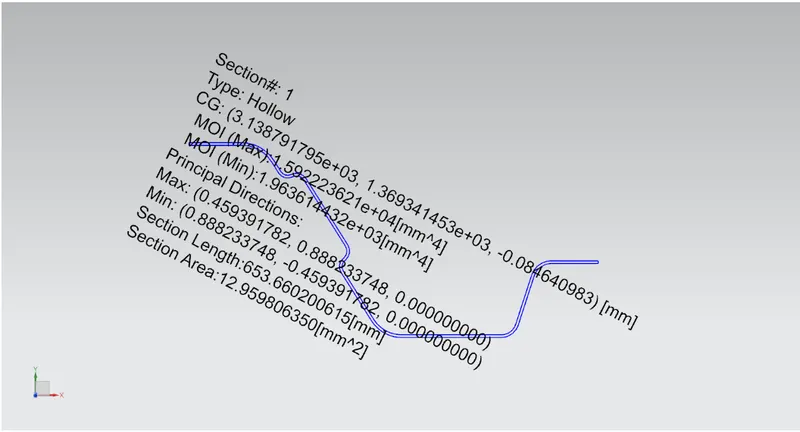
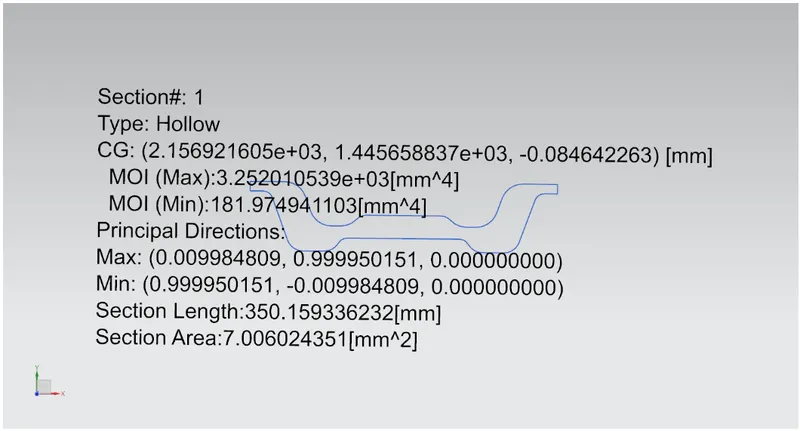
BOW ROOF 2: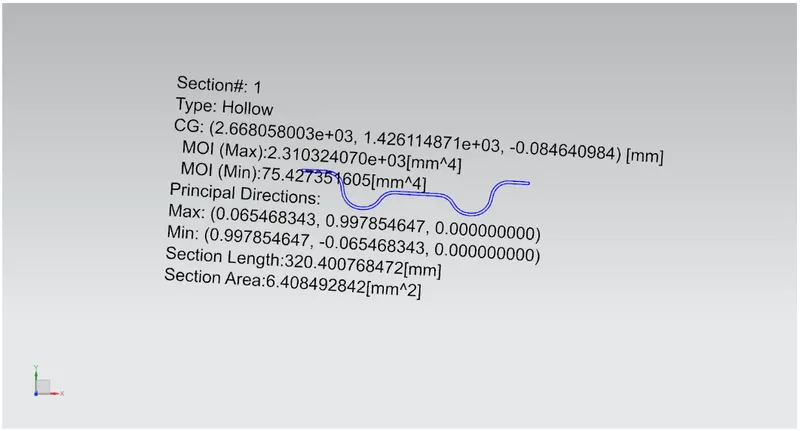
REAR ROOF RAIL: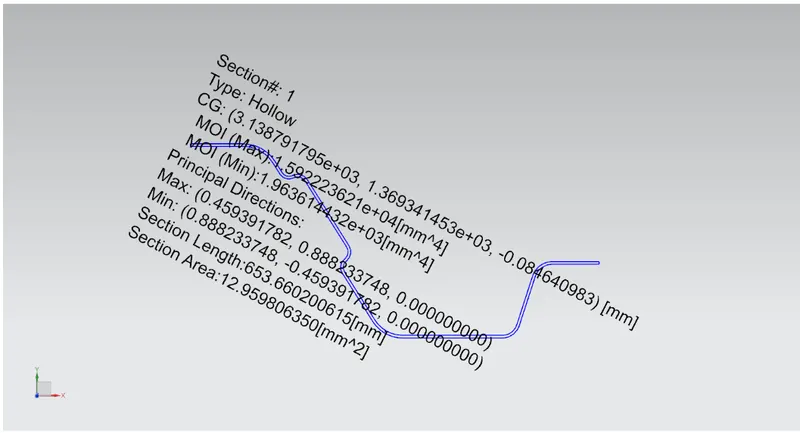
FINAL IMAGES OF THE ROOF: