Roof challenge
Aim:
To Design Bow roofs for the given Roof and reinforcements surface using the master section received from the styling team.
Explanation:
An automobile roof or car top is the portion of an automobile that sits above the passenger compartment, protecting the vehicle occupants from sun, wind, rain, and other external elements. Types of roofs are convetible roofs, hard tops, Sunroofs, vinyl roofs and etc.
Procedure:
Before designing a roof there are certain things to be kept in mind they are visibility criteria, heat distortion, snow load effect and headroom inside the car.taking all these into consideration we design a roof.
We received Class A surfcae from the styling team and we take one portion of this class A as it could be symmetry after working on one side alone.
Class A surface:
- The given Class A is initially splitted since we are working only on one side and later well be symmetrying it .
- One half is extracted and untrimmed and splitted using the clas A boundary to get a neat surface.
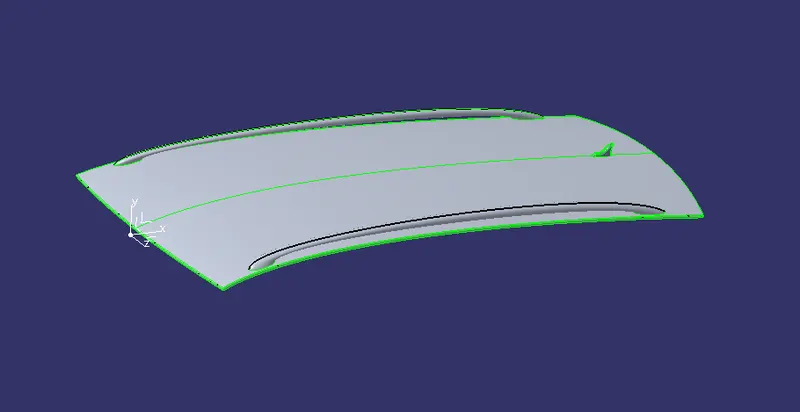
- Then the ditch area is created at the front and backside of the roof.
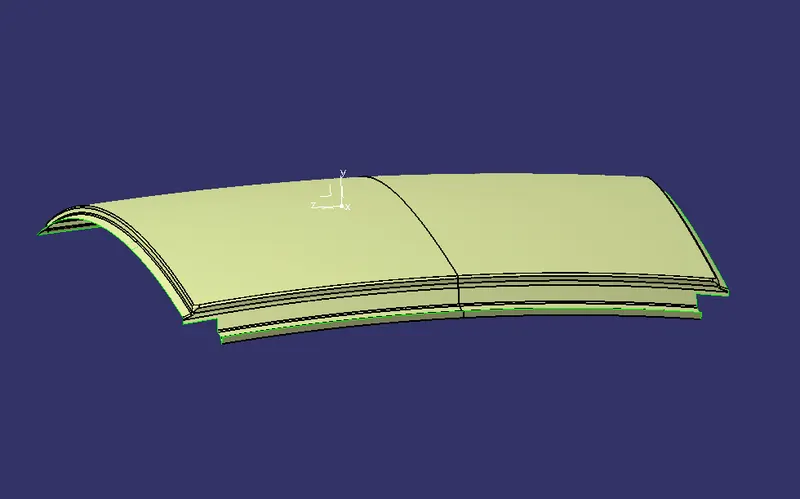
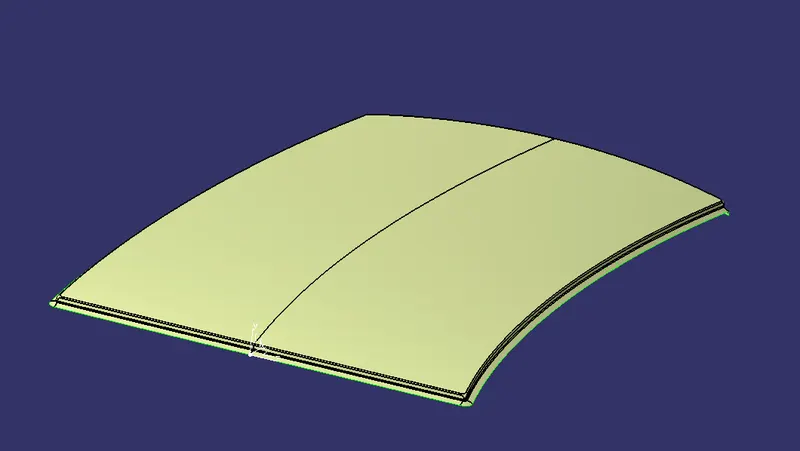
- Now we create the Bow roofs and reinforcements using the Master section shown below.
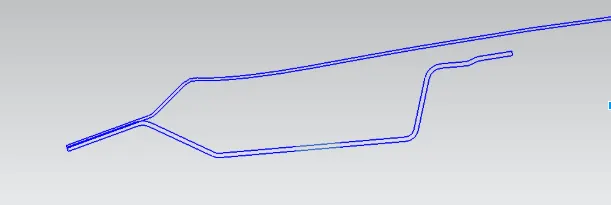
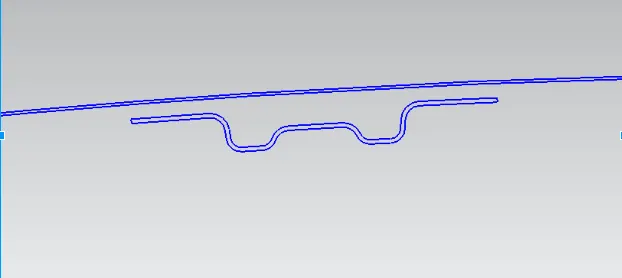
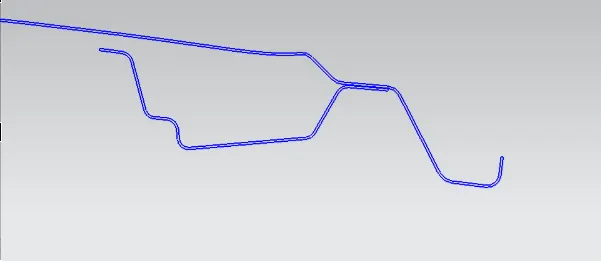
- The the extracted surface is offseted initially for 32mm on the down side to create front roof rail and from that offseted surface we split the front end portion and then sweep and form surfaces as per the master section and we do emboss over it and necessary flanges and convert it into a closed body.
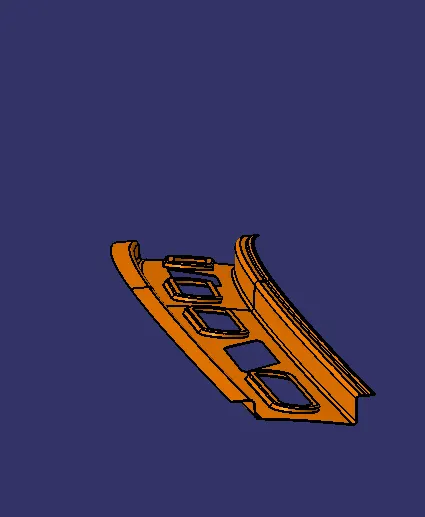
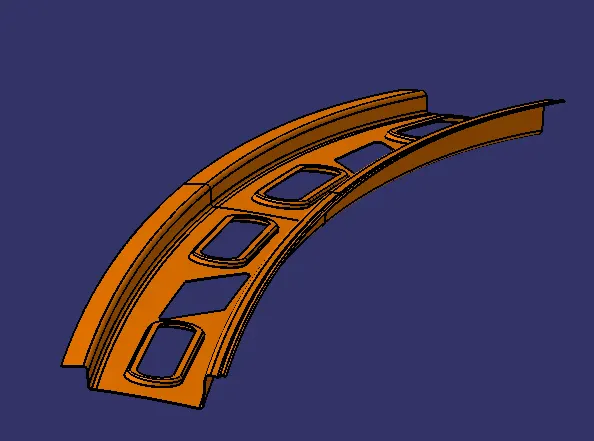
- And we carry the same procedure for the Bow roofs and the centre Bow roofs, we offset the extracted class A surfcae to the said distance and by using sweep and extrude we create surfaces according to the master section and finally convert it into closed surface.
Back roof rail
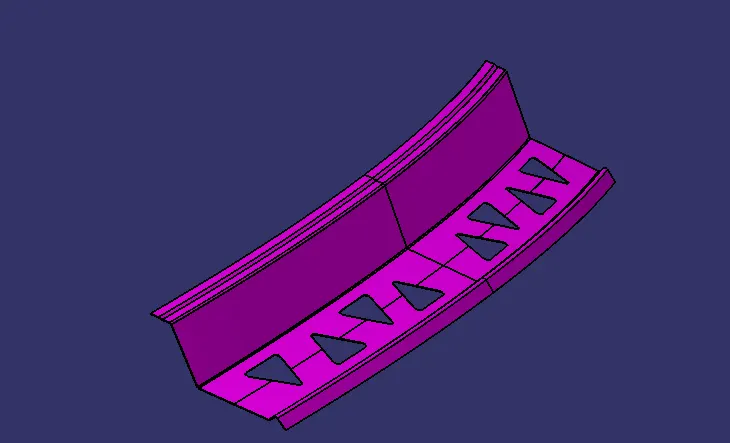
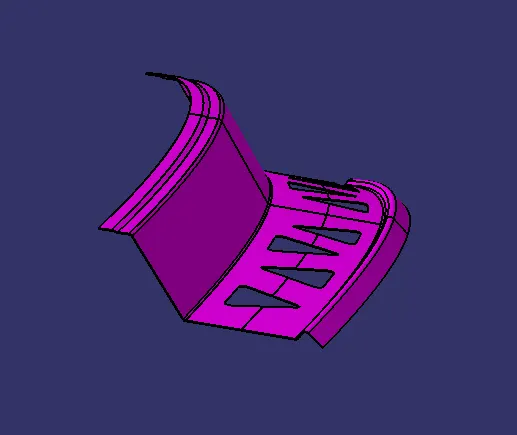
Bow roof 1 and 2

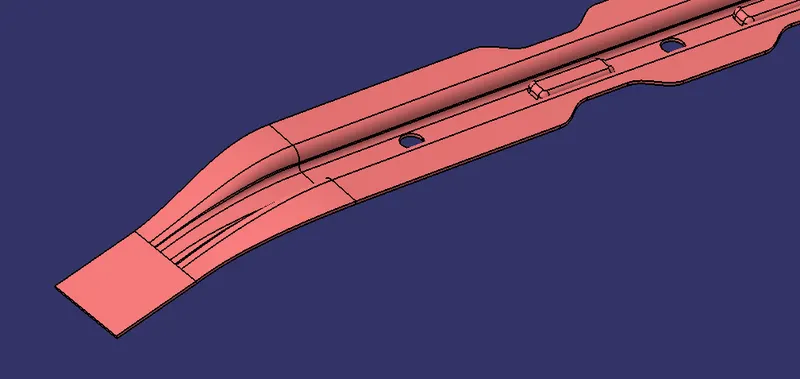
Centre Bow roof
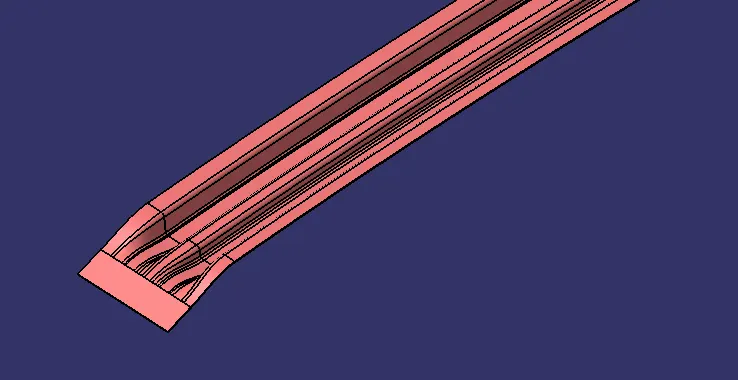

Centre Bow roof Reinforcement
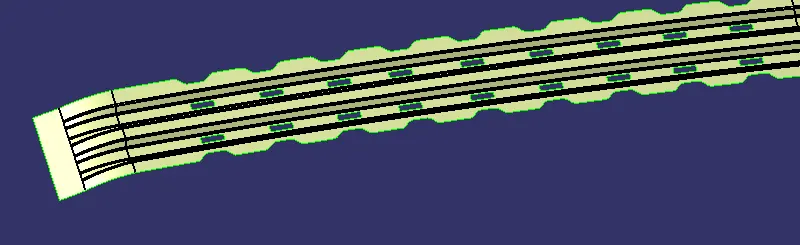
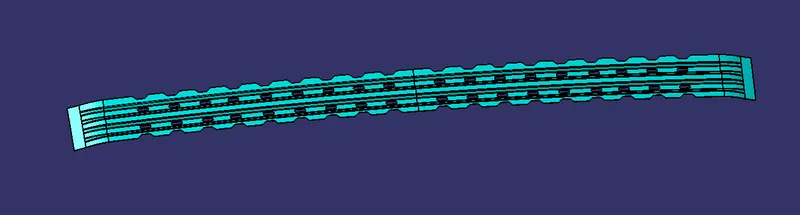
All the Bow roofs are shown together below,
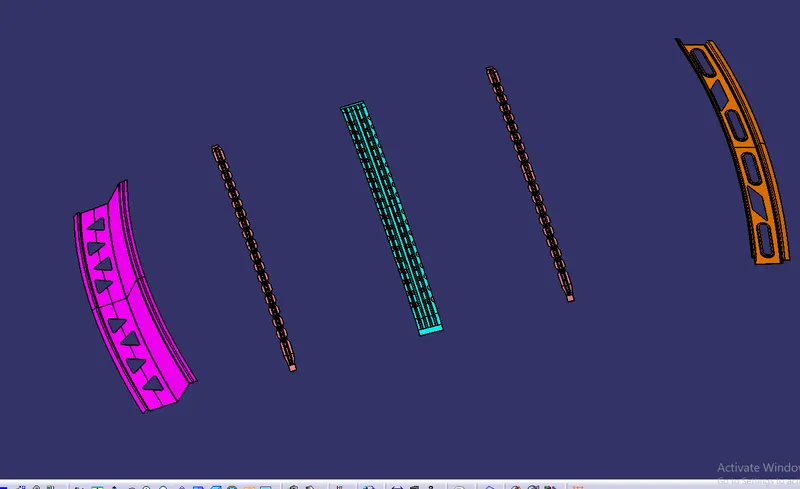
- And after all the Reinforcements and the Bow roofs are created we claculate the Heat distortion and Snow load effect on the created roof design.
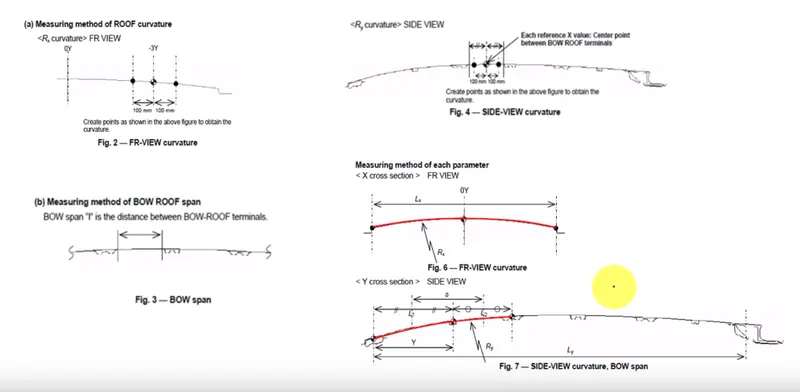
Now we do a curvature study on the roof and perform calculations to determine the position of the Bow-roof,
Measuring procedure for Bow roof Span:
Heat Distortion Calculation:
W = [1.73 x 10^(-3) x L] + [1.85 x 10^(-8) x (R^2)/t] + [ 1.10x10^(-3) x l] - 2.68
Judgement Condition : OK< 2.7> 3.1
Where
L = Roof Length in X-Direction[mm](Roof dimension in 0-Y)
R = Roof curvature
R = 2(Rx*Ry)/(Rx+Ry)
Rx = X curvature
Ry = Y curvature
t = Roof plate thickness [mm]
l = Bow Roof Span [mm]
Initially the midpoint of the roof is taken and the midline is drawn on the roof surface and next a line at a distnace of 300mm is taken and 100 mm from that line on both sides in drawn and now a bisecting line between midpoint of the front roof rail and the Bow roof 1 is also taken and similar 100 mm from the that line on both sides is taken and the point where these lines intersect are plotted and then projected on the roof now a spline is drawn connecting the the points and Rx and Ry value is noted which is nothing but the radius of curvature at y axis and x axis.
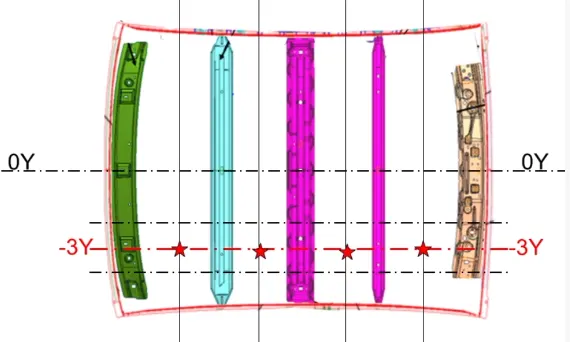
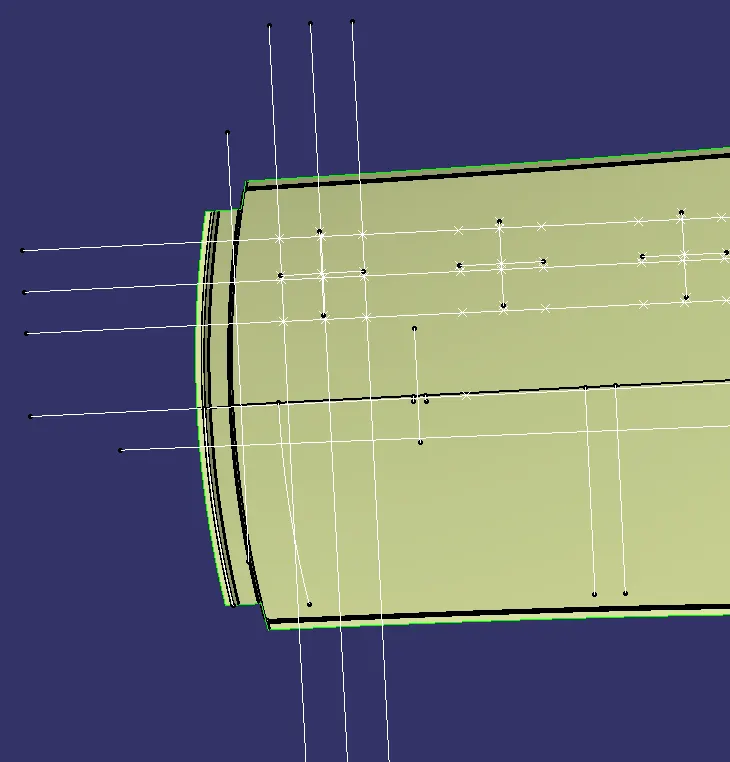
The same way is done inbetween Bow roof 1 and Centre bow roof simillarly centre bow roof and Bow roof 2 and bow roof 2 to Rear bow roof. and using the above shown formula the value of W is noted and this value W should not be more than 3.1 , below this is fine and it means it is good area of Bow roofs.

Snow load Prediction formula:
Qr = [Iy x t2] / [α x s x [(Rx + Ry)/2]2 x 10-8]
Note: The Qr value given over here is correct. There was a typo error in the formula given in the video.
Where
α = My x Lx2 x 10-12 , My = Y(Ly-Y)
Judgement condition = Qr ≥ 3.1
250 ≤ s ≤ 380
t = Roof plate thickness [mm]
Ly = Distance between the front and rear roof Rails on the Vehicle along with 0Y[mm]
Length of Roof panel with the center point between Roof rail Front /Rear as the front and rear reference point.
Lx = Distance between the Left and Right end of the roof on the Roof BOW [mm]
Width of the roof panel exposed on the surface.
Y = Distance front Front Roof Rail to Roof BOW[mm]
s = Distance for which Roof BOW bears divided load [mm]
s = L1/2 + L2/2
Iy = Geometrical moment of inertia of Roof BOW (Y cross-section )[mm4]
Rx = Lateral direction curvature radius of roof panel Y cross-section on Roof BOW [mm]
Roof panel curvature Radius of the Length Lx in Front view
Ry = Longitudinal Direction curvature radius of the Roof panel X cross-section on Roof BOW [mm]
Roof panel X curvature radius of length s in Side view