Roof challenge
AIM: To design a roof of the car from the given styling data with appropriate reinforcement.
OBJECTIVE:
- To design a front roof rail according to given master section.
- To desing a rear roof rail according to given master section.
- To design bow roofs.
- To perform curvature study of the designed components.
ROOF
Roof of a car is the component which safegaurds the occupants from harsh exterior conditions. Over the period of time there are different types of roofs according the constructions. Few of them are listed below.
- Convertible roof
As the name suggests roof can be retracted and the car can be made into open top and close top according to the need.
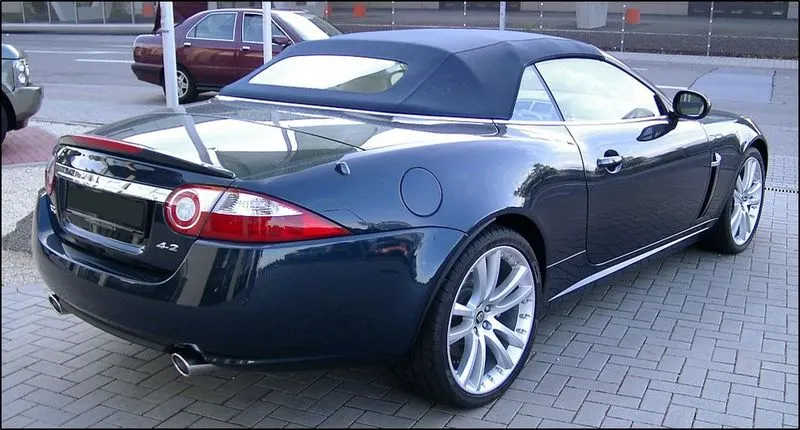
| Fig 1: A Jaguar XK convertible |
- Hard Top
Rigid roofs which can be removed and retracted when needed. This are usually without a B pillar.
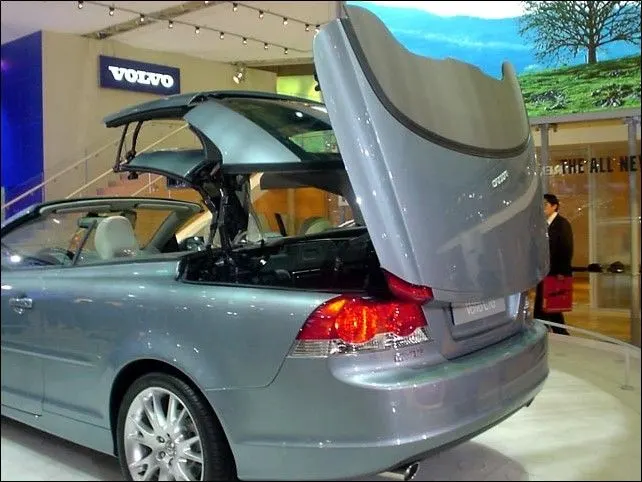
| Fig 2: A Volvo C70 with retractable hard top |
- Targa Top
A targa top is a semi convertible car.
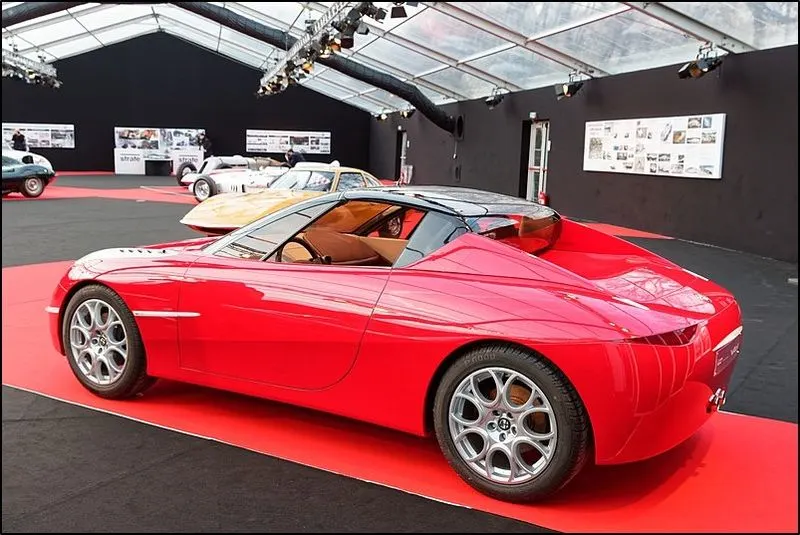
| Fig 3: A targa top Alfa Romeo Vola |
A roof is not as simple as it seems, it has various components which acts support to the roof and ensures the safety of the occupant from objects which may impact the roof and cause crushing.
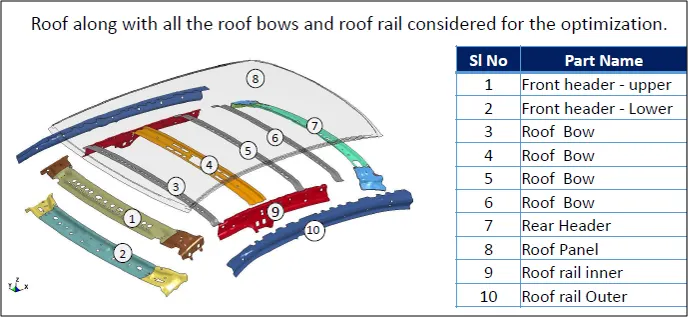
| Fig 4: Roof with different components (modi et al,. CAR) |
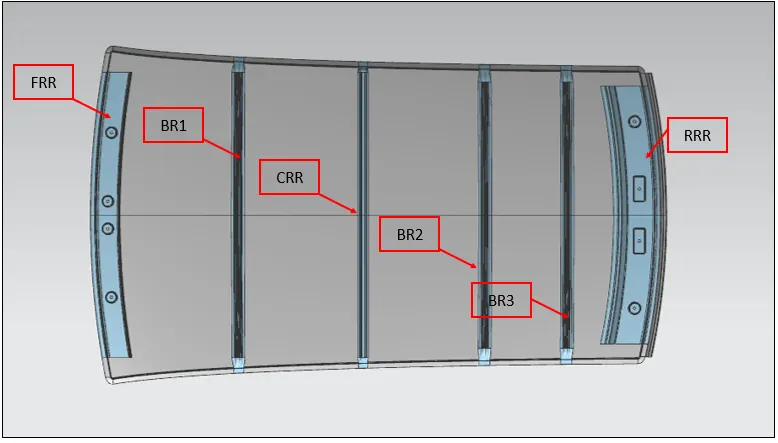
| Fig 5: Roof with different designed components |
Important componenets of the roof are
- Front roof rail (FRR)
As the name suggests this is located towards the front of the roof. FRF connects the roof with the front wind shield takeing the visibility into account. This is designed according the master section provided.
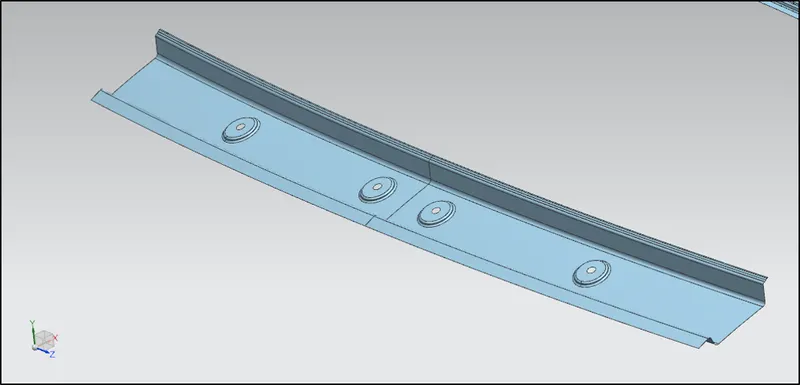
| Fig 6: Front roof rail |
- Bow roof (BR)
Bow roof acts as support in a long roof where a center roof rail, FRF and RRF aren't sufficient. In the given 3 bow roofs are designed BR1, BR2 and BR3.
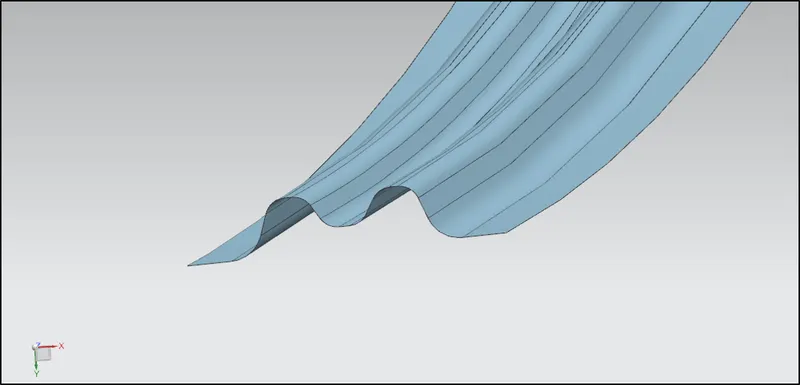
| Fig 7: Bow roof section |
- Center roof (CRR)
This is a kind of bow roof which supports the mid section of the roof. This is joined to the roof by adhesives usually at mastic points.
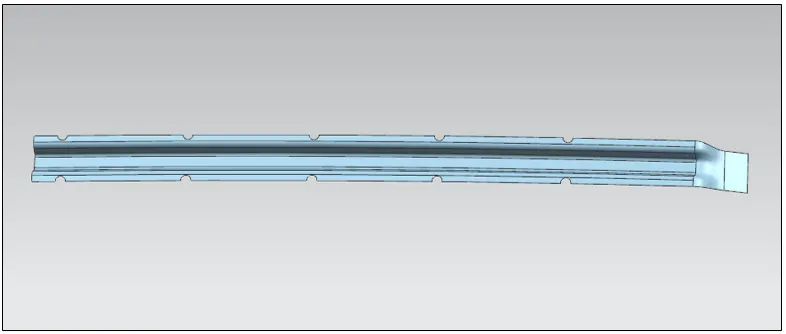
| Fig 8: Center roof rail |
- Rear roof rail
Rear roof rail is located at the rear of the roof. it acts as the hinge point for the back door.
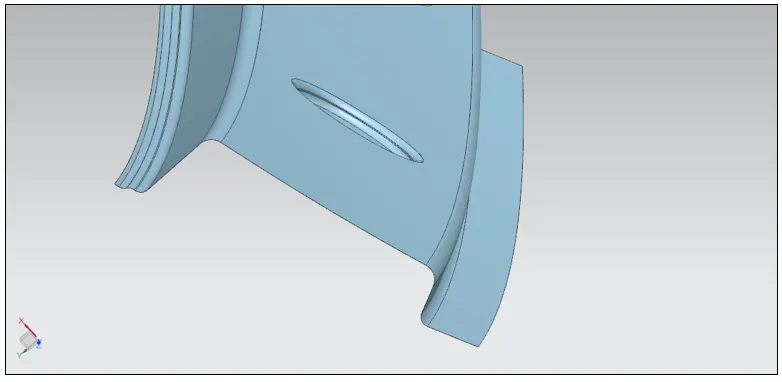
| Fig 9: Rear roof rail section |
After the roof is designed various studies are carried out to optimize the curvature and increase strength of the roof.
- Roof crush test
Used to determine the strength of the roof after it is manufactured and can also be done using FEA. This study is not under the scope of present project.
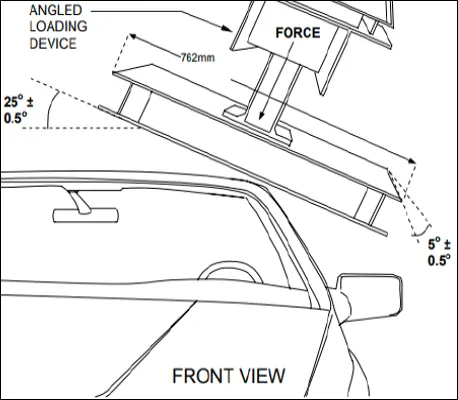
| Fig 10: Roof crush test (Modi et al,. CAR) |
- Head distortion criteria
It is the temperature at which the material starts softening when exposed to a fixed load at elevated temperature. Above this temperature the material can’t be used. In order to know whether the material is in safer zone according the positioning of bow roofs, the test is performed by considering the below given formula (Basavaraj, march 2020)
W = [1.73 x 10^(-3) x L] + [1.85 x 10^(-8) x (R^2)/t] + [ 1.10x10^(-3) x l] - 2.68
Judgement Condition : OK< 2.7> 3.1
Where
L = Roof Length in X-Direction[mm](Roof dimension in 0-Y)
R = Roof curvature
R = 2(Rx*Ry)/(Rx+Ry)
Rx = X curvature
Ry = Y curvature
t = Roof plate thickness [mm]
l = Bow Roof Span [mm]
| Table 1: Heat Distortion Criteria |
|
Sl no |
Distance B/w |
Rx (mm) |
Ry (mm) |
R (mm) |
l (mm) |
L (mm) |
t (mm) |
R^2/t (mm) |
W |
|
1 |
FR & BR1 |
5524 |
1506 |
2367 |
410 |
2045 |
0.70 |
8003841 |
4.13 |
|
2 |
BR1 & CRR |
4857 |
4372 |
4602 |
412 |
2045 |
0.70 |
30254862 |
4.54 |
|
3 |
CRR & BR2 |
3895 |
8239 |
5830 |
402 |
2045 |
0.70 |
48555571 |
4.87 |
|
4 |
BR2 & BR3 |
3439 |
12931 |
5433 |
253 |
2045 |
0.70 |
42167841 |
4.59 |
|
5 |
BR3 & RRR |
3102 |
16469 |
5220 |
145 |
2045 |
0.70 |
38926285 |
4.41 |
From the above table it is clear that for the given roof curvature of the roof needs to be changed.
- Snow load criteria
It is used to test the load on roof when the snow fall occurs on the roof and it tests the ability of the roof to retain its original shape after the snow is removed. It is given by the following formula.
Qr = [Iy x t2] / [α x s x [(Rx + Ry)/2]2 x 10-8]
Note: The Qr value given over here is correct. There was a typo error in the formula given in the video.
Where
α = My x Lx2 x 10-12 , My = Y(Ly-Y)
Judgement condition = Qr ≥ 3.1
250 ≤ s ≤ 380
t = Roof plate thickness [mm]
Ly = Distance between the front and rear roof Rails on the Vehicle along with 0Y[mm]
Length of Roof panel with the center point between Roof rail Front /Rear as the reference point of the front and the rear.
Lx = Distance between the Left and Right end of the roof on the Roof BOW [mm]
Width of the roof panel exposed on the surface.
Y = Distance front Front Roof Rail to Roof BOW[mm]
s = Distance for which Roof BOW bears divided load [mm]
s = L1/2 + L2/2
Iy = Geometrical moment of inertia of Roof BOW (Y cross-section )[mm4]
Rx = Lateral direction curvature radius of roof panel Y cross-section on Roof BOW [mm]
Roof panel curvature Radius of the Length Lx in Front view
Ry = Longitudinal Direction curvature radius of the Roof panel X cross-section on Roof BOW [mm]
Roof panel X curvature radius of length s in Side view
| Table 2: Snow load criteria |
|
Sl no |
Bows |
Iy (mm^4) |
α |
Lx (mm) |
Ly (mm) |
s |
Y(mm) |
Rx (mm) |
Ry (mm) |
t(mm) |
Qr |
|
1 |
FR & BR1 |
2632 |
0.912274764 |
1137 |
1940 |
470 |
485 |
3298 |
1500 |
0.7 |
52.2634349 |
|
2 |
BR1 & CRR |
2701 |
1.11029085 |
1087 |
1940 |
447 |
935 |
3064 |
4476 |
0.7 |
18.7626285 |
|
3 |
CRR & BR2 |
3829 |
0.877658556 |
1064 |
1940 |
370 |
1377 |
3738 |
8242 |
0.7 |
16.1027662 |
|
4 |
BR2 & BR3 |
3300 |
0.489057198 |
1048 |
1940 |
262 |
1674 |
3670 |
12835 |
0.7 |
18.5301104 |
|
5 |
BR3 & RRR |
N/A |
1046 |
1940 |
112 |
N/A |
3219 |
16465 |
0.7 |
N/A |
From the above table it is evident that the roof needs embosses. Depending on whether the roof has a sun roof or not appropriate embosses should be provided.
CONCLUSION
- Front roof rail according to given master section is designed
- Rear roof rail according to given master section is designed
- Appropriate bow roofs are designed
- Curvature study of the designed components are performed