Rayleigh Taylor Instability Challenge
1. The aim, Introduction, Theory:
The prime objective of this challenge is to investigate and catch the behaviour of two immicible fluids among which one fluid is denser and other one is lighter. At the interface of both the fluids the lighter fluid tries to push the denser fluid which creates an instability at the line of contact where the two fluids meet, and such instability was first time observed by Rayliegh and Taylor and hence called as Rayleigh Taylor Instability (RTI). Such type of phenomenon are necessary to be analyzed as such instability has been observed in water and oil, supernova explosion, volcano explosion, Nuclear explosion and many more naturally occuring Phenomenon.
A two dimensional instability analysis is carried out by using ansys fluent in order to find out the interfacial behaviour of two fluids having different densities. In the present case,initailly water and air are taken as two fluids with different density and further the simulation is extended by using water and user defined material.
The other similar models for instability avialble in CFD are as follows.
a) Staffman-Taylor Instability: This type of instability is observed when less viscous fluid is injected in porous more viscous fluid. Example flow of water through soil.
b) Mushroom Cloud: This type of instability phenomenon is observed during the nuclear explosion resulting in the formation of high volume of low density fluid at certain altitude from the ground.
c) Plateau-Rayleigh Instability:This instability model tells about how a stream of fluid falling vertically breaks into small droplets of same volume but small surface area.
d) Richmyer-Meshkov instability:This type of instability phenomenon is observed whaen two fluids having different densities are accelrated impulsively. A small bubbles were formed during this instability when lighter fluid penetrates havier fluid.
e) Kelvin Helmholtz instabiliry: When a velocity difference exists between the interface of the two fluids an instability is observed which is called as Kelvin-Helmholtz instability, example the blow of wind over the surface of water.
2. Solving & Modelling approach:
A two dimensional two square planes placed one above the other of size 20mm by 20mm is constructed in space claim. The upper sqaure surface is for water which is having high density while the lower square surface is for Air which is having less density.Both the fluids are seprated by an interfacial line where they meet.
One important point to be remembered during the construction og geometry in spaceclaim is that it is mandatory to put on share commond in workbench tab in order to get conformal mesh.
After constructing the geometry as per the requirement the next step is to perofrm meshing operation, for this challenge two different cases of mesh size are considered.
Case-1: Mesh element size=0.5mm
Case-2: Mesh element size=0.2mm
Case-1 and Case-2 are used for water and Air while the case-2 is again repeated with Water and user defined material as fluids.
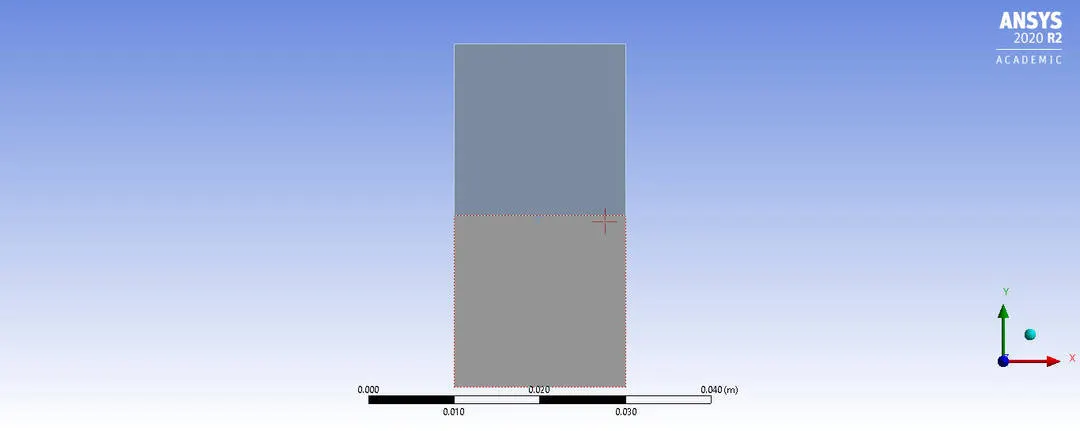
Figure1. Geometry.
3. Pre-processing and solver setting:
After generating mesh of required element size for both the cases the next step is to set the required boundary and physical conditions for the problem.
As the geometry is square plane it is better to use quadrilateral mesh (2-D mesh) to perfectly match the geometry.
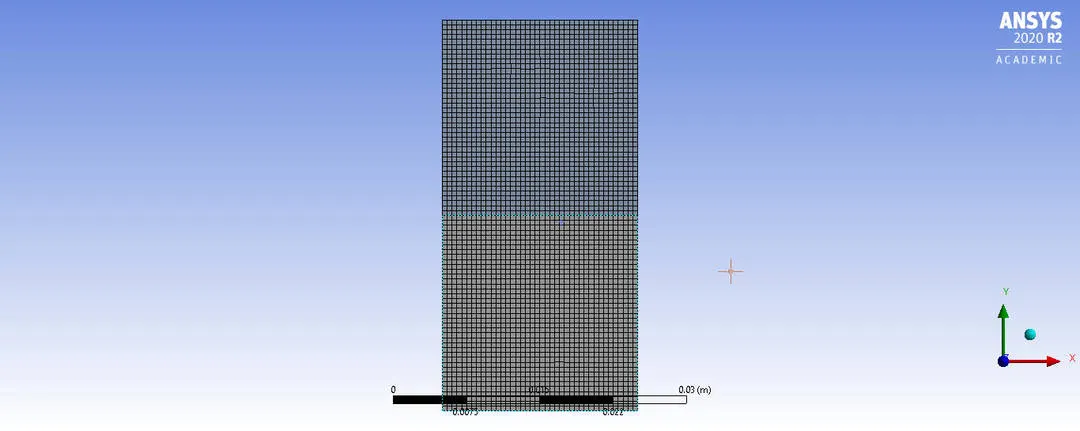
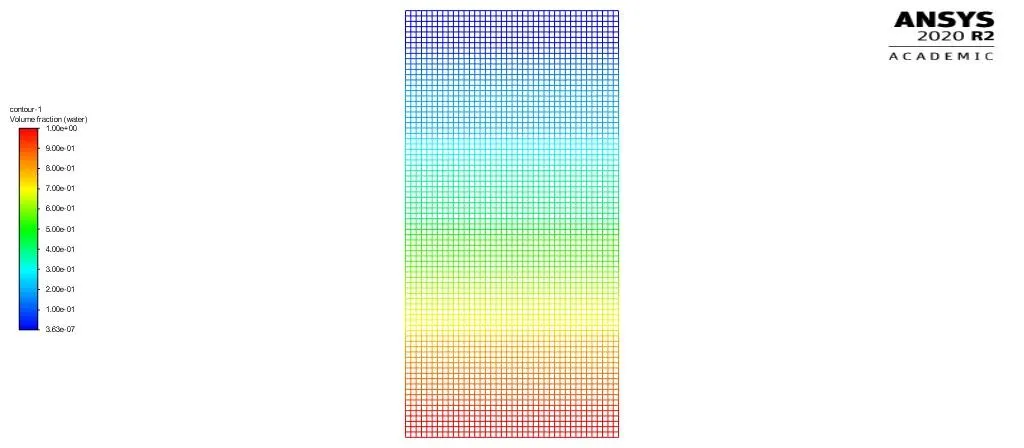
Figure2. Case-1 Mesh element size 0.5mm, Number of nodes=3321 , Number of elements= 3200
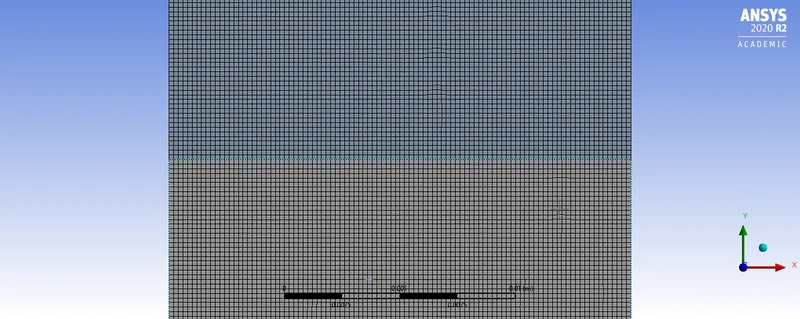
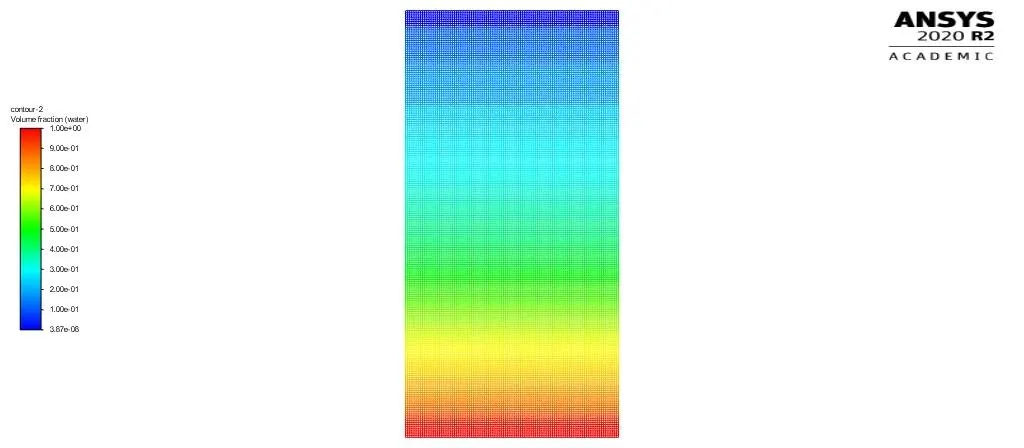
Figure 3. Case-2 Mesh element size =0.2mm, Number of nodes= 20301 , Number of Elements= 20000
After sucessfuly creating the required mesh the next step is to set up the required solving method and boundary conditions.
Set up:
Solver: Pressure based solver, Transient condition, gravity in negative Y direction
Method: Coupled scheme with first order upwind method, use implicit method
Use implicit body forces, try to set relaxation factor=0.6, Use hybrid initialization.
Multiphase model: Volume of fluid (VOF)approach.
Patch the water and Air fluid at the interface using patch commond.
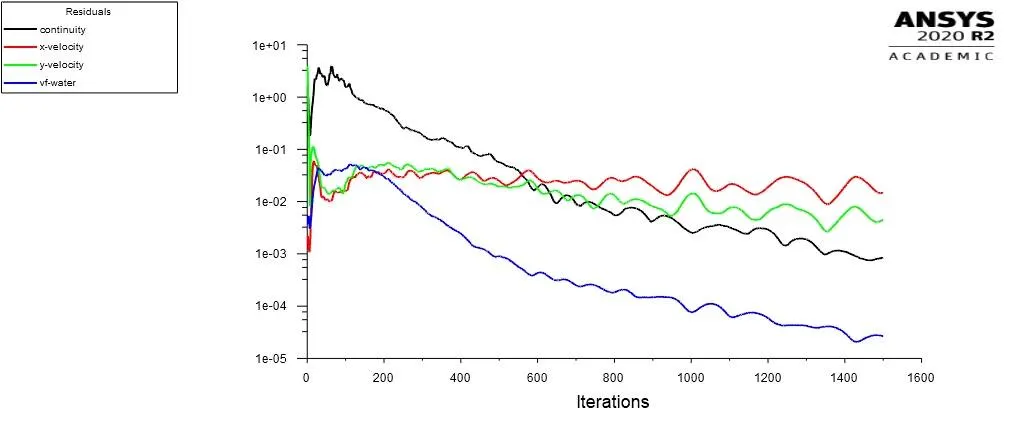
While calculating the solution use time step size =0.005 or less
Number of time steps=2000 or more to get converged solution.
4. Results:
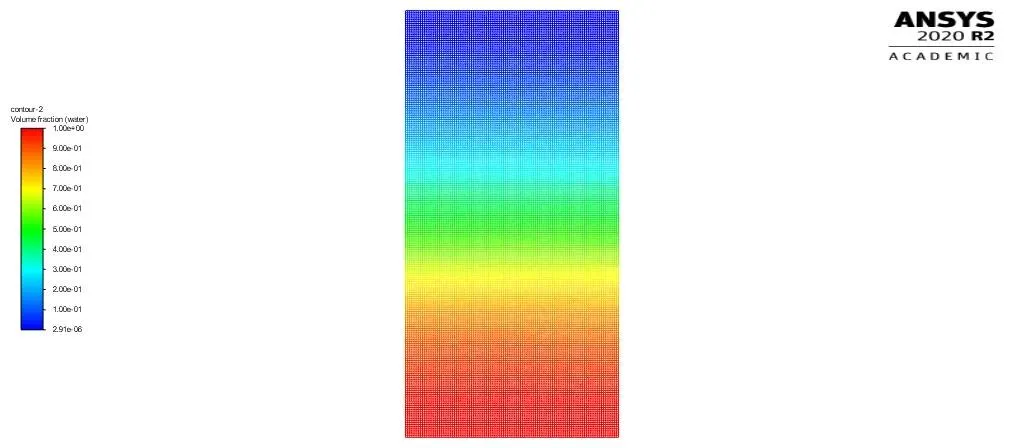
The results were plotted for two different cases of fluid combinations.
i. Water (High density) and Air (Low density) For mesh size of 0.2mm and 0.5mm
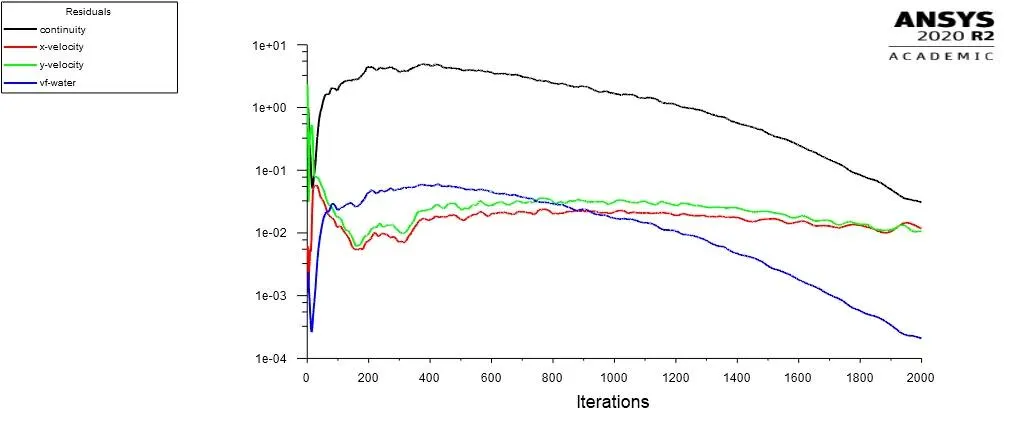
ii. Water (High density) and User material (Low density, Density=400 Kg/m^3, Viscosity= 0.001 Kg/m-s) for mesh size of 0.2mm.
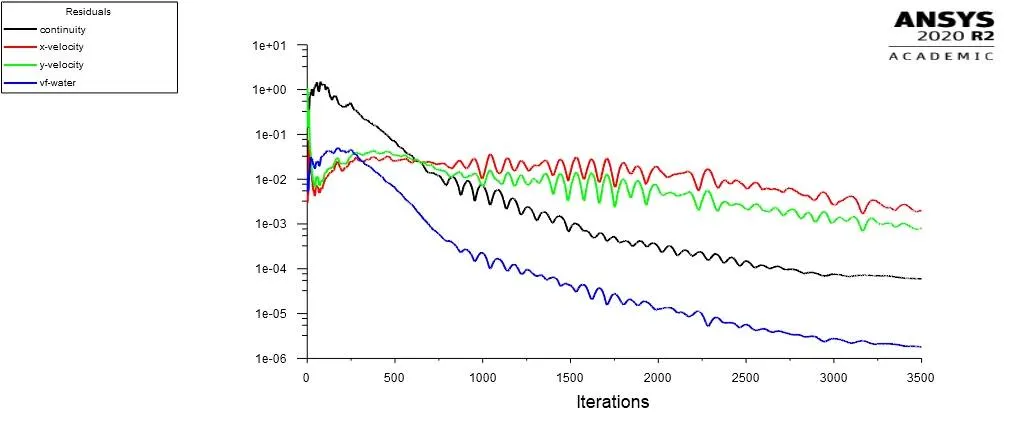
i. Water and Air (Mesh size 0.5mm):
Water and Air (Mesh size=0.2mm)
ii. Water and User Material (Mesh size=0.2mm)
Atwood Number (A):
It is a dimensional number which defines the density difference ratio between the two fluids sharing the same interface.
A= density of Havier fluid-density of lighter fluid/ density of havier fluid+density of lighter fluid
i. Water and air
A= 1000-1.2/1000+1.2= 0.99
ii. Water and user material
A=1000-400/1000+400= 0.42
5. Conclusion:
From the above obtained results the following conclusions can be made:
- The instability between the two immcible fluids mainly depends on their density.
- The instability also depends on the viscosity of the fluids.
- The use of implicit method with hybrid intialization helps to reach the desired results for volume of fluid (VOF) approach, with lower relaxation factor.
- In order to achieve more accurate results for such VOF problem the lower order upwind scheme is more suitable.
- The inetrface layer between the two fluids breaks under the influence of gravity and it mainly depends on the density and viscosity of the fluids.
- The penetration of heavy fluid into Lighter fluid is the function of Atwood number, and time.
- More resistance to peneration of heavy fluid in lighter fluid is offered by user material as compared to air.
- The larger Atwood number indicates shorter penetration distance while the lower Atwood number indicated the longer penetration distance.