RADIOSS PROJECT 3: Roof-crush analysis of NEON dodge model using HYPERMESH and RADIOSS
OBJECTIVE: To simulate a roof crush of an impactor on a reduced BIW model of Neon Dodge car. To plot a force vs displacement graph and discuss the results obtained.
PROCEDURE:
To simulate a roof crush, the following steps have to be followed:
1. Import the impactor and reduced-BIW car model onto Hypermesh
2. Adjust the impactor to the desired location
3. Assign contact interface
4. Check for connectivity of the model and check for penetrations
5. Impose displacement on impactor
6. Create appropriate engine file with required animations, outputs and time steps
7. Apply the necessary boundary conditions
8. Run model quality checker
Initially, the reduced BIW model was imported onto Hypermesh along with the impactor. The impactor was transformed to the desired location by using rotate and translate tools.
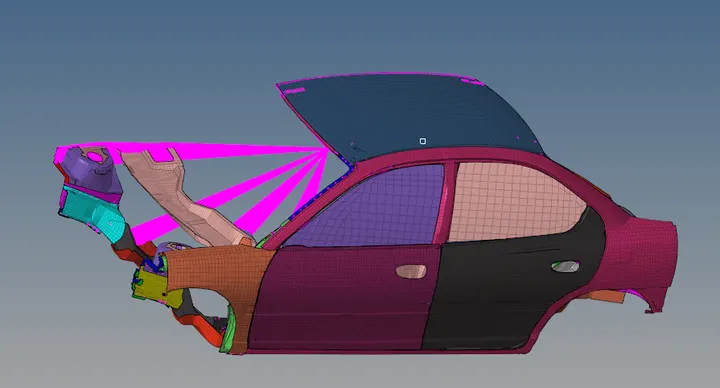
The reduced BIW model of the car is given below:
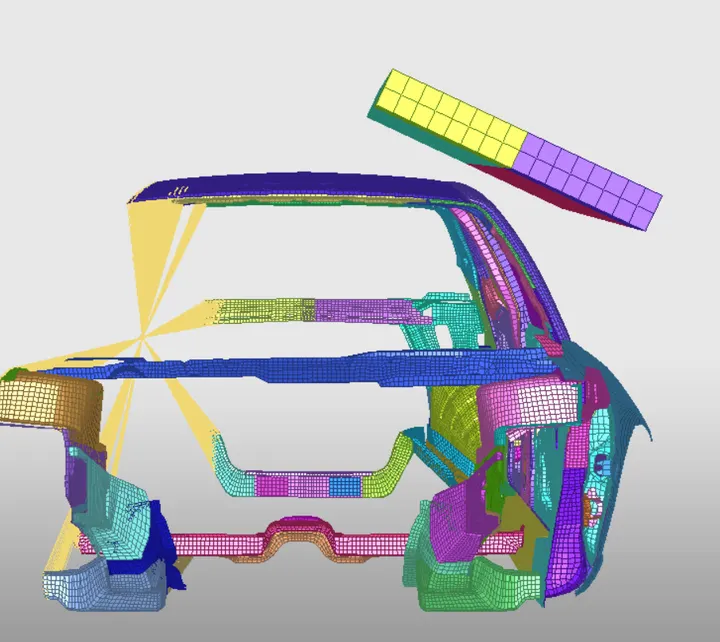
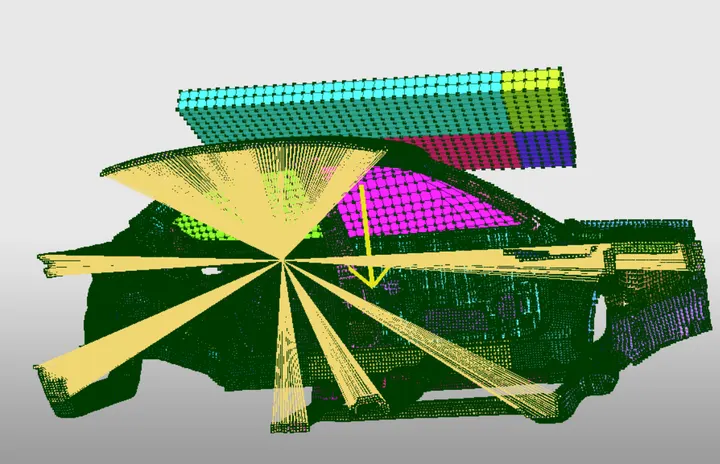
The impactor is shown below alongside the car model:
The unit system used was [kg mm ms].
CONTACT INTERFACE:
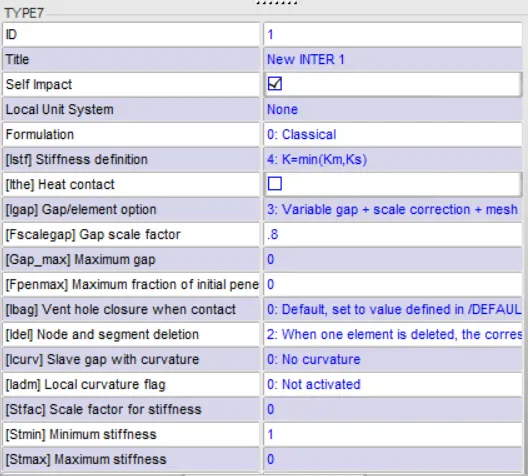
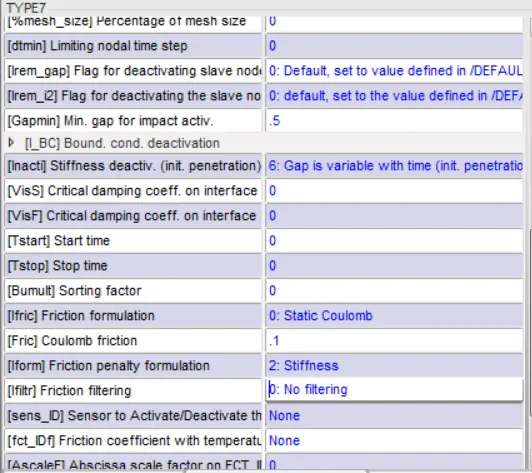
The contact interface selected was type 7 which is node to surface contact. Nodes are slaves and surfaces are masters. Two interfaces had to be used for this case. One for impactor and BIW model. The second one was for self-impact of the BIW model.
In the first contact interface, the nodes of the car were slaves and surfaces of the impactor were masters. In the second contact interface, the nodes of the car were slaves and the surfaces of the car were masters. The properties used in both cases are shown below and are following the recommendations for crash analysis:
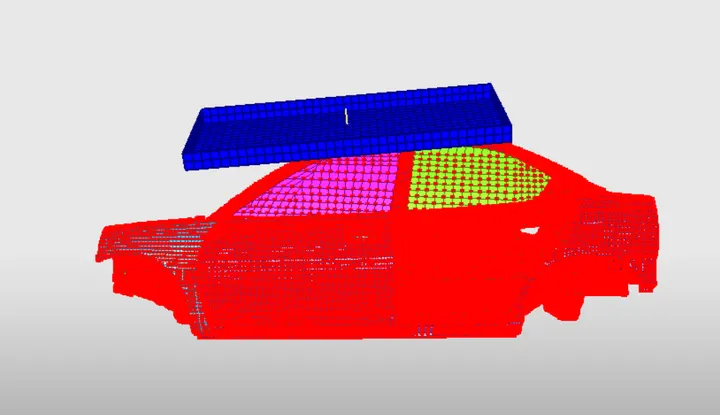
The red nodes are the slaves and the blue surfaces are masters.
CONNECTIVITY:
Following the addition of contact interfaces, the connectivity and penetrations were checked. While there was no penetration in the model, the connectivity was not present for many components. This was fixed by applying 1D rigid connectors at appropriate locations. This can be applied by using Hypermesh and going to 1D => Rigids => Create.
IMPOSED DISPLACEMENT:
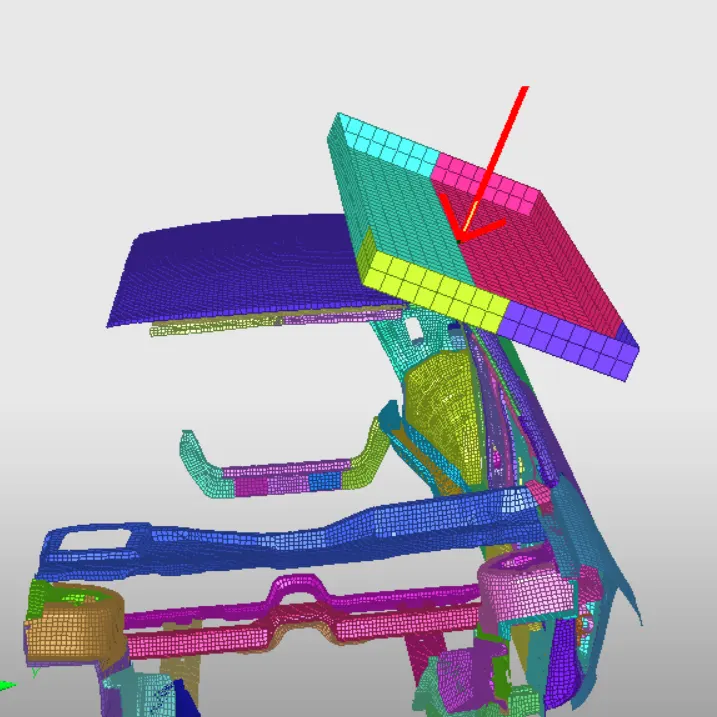
Displacement was imposed on the master node of the impactor with a linear function which goes from 0 mm to 200 mm in 200ms. This was added in Hypercrash by going to LoadCase => Imposed => Imposed Displacement. Displacement was imposed onto the master node in local z-direction. For this, a local skew was made by going to RADIOSS Tools => Skew/Frame. The displacement was given in direction of the car as shown in below diagram:
BOUNDARY CONDITIONS:
The necessary boundary conditions had to be given to the car. The rigid elements representing the opposite door had to be given rigid conditions i.e restriction in all 6 degrees of freedom. Similar boundary conditions were given to the master nodes at the rear cross member. Also, rigid elements had to be created to simulate shock absorbers and restrict motion about translational z-direction as shown below:
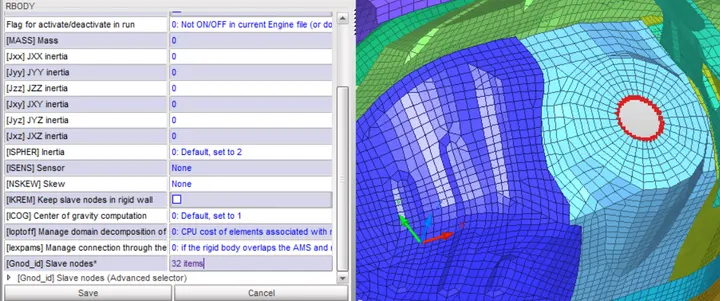
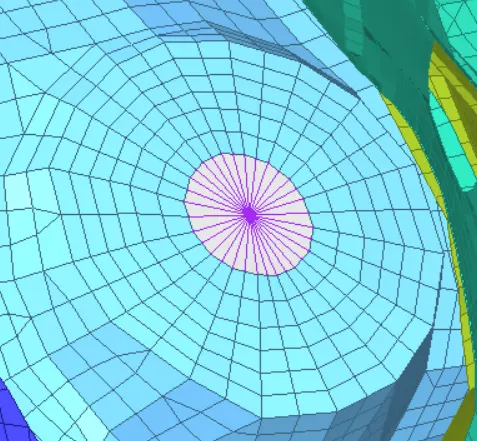
This was done to three shock absorbers present in the model. The master node of the impactor was also given boundary conditions. All motions except for translation in local z-axis were restricted. The top of the impactor spring was restricted for all 6 degrees of freedom. The below figure shows all the 8 applied degrees of freedom:
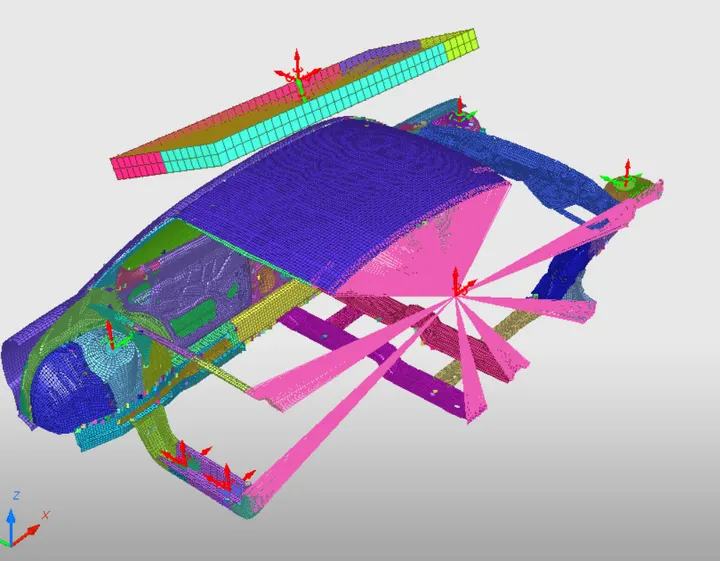
Boundary conditions can be applied in Hypercrash using LoadCase => Boundary Conditions.
Gravity of -0.0098 mm/ms^2 was also applied.
Model checker was run finally by going to Quality => Model Checker => Run. Below is the final check after all warnings and errors were corrected:
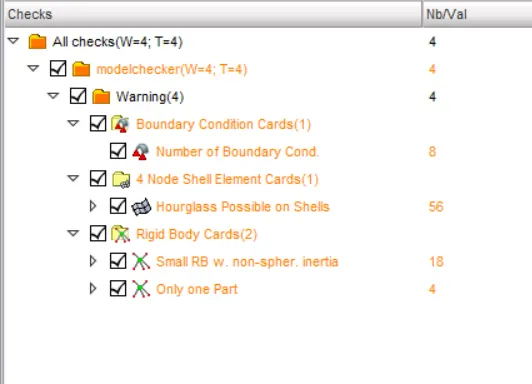
These warnings can be ignored. The engine file was created in Hypermesh using Tools => Engine File Assistant. The time of simulation was set to 200 ms with a timestep of 0.5 microseconds. Some animation control cards were adjusted to display variation in energy, hourglass energy, mass, etc as shown below in the control cards browser:
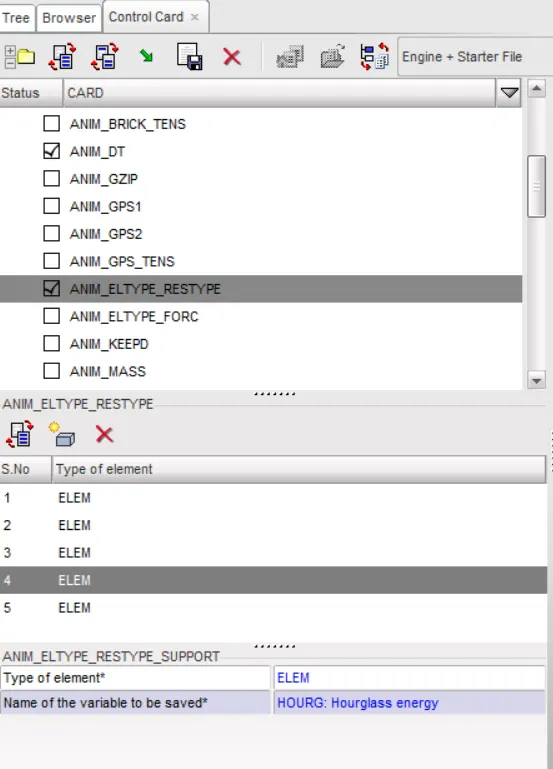
ANIM_MASS was also ticked.
RESULTS:
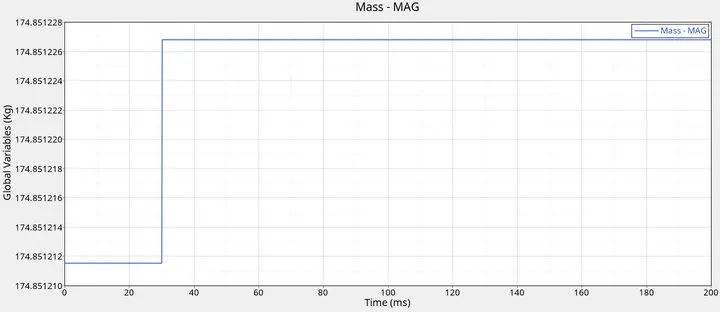
The simulation ended with a runtime of 19990.35 s with maximum energy error of -8.6% and mass error of 0.1437 E-04. These values are within the accepted limits and therefore the results can be accepted.
Below are the different orientations of the roof crush simulation:
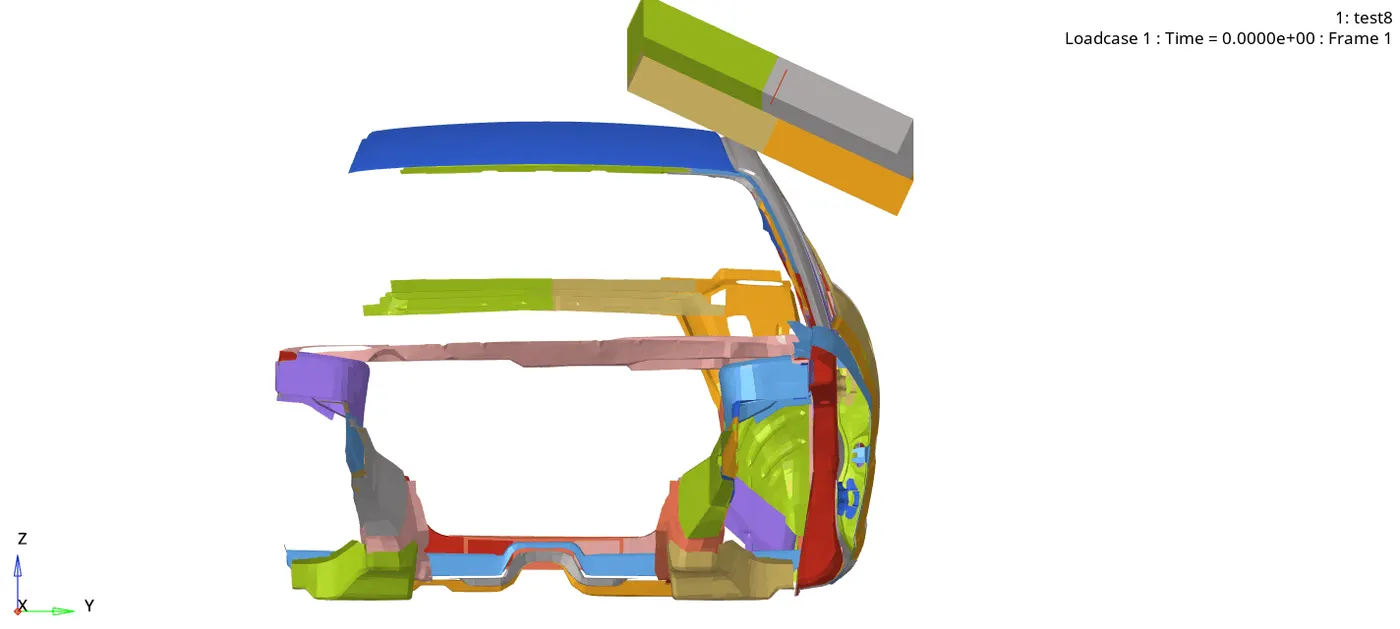
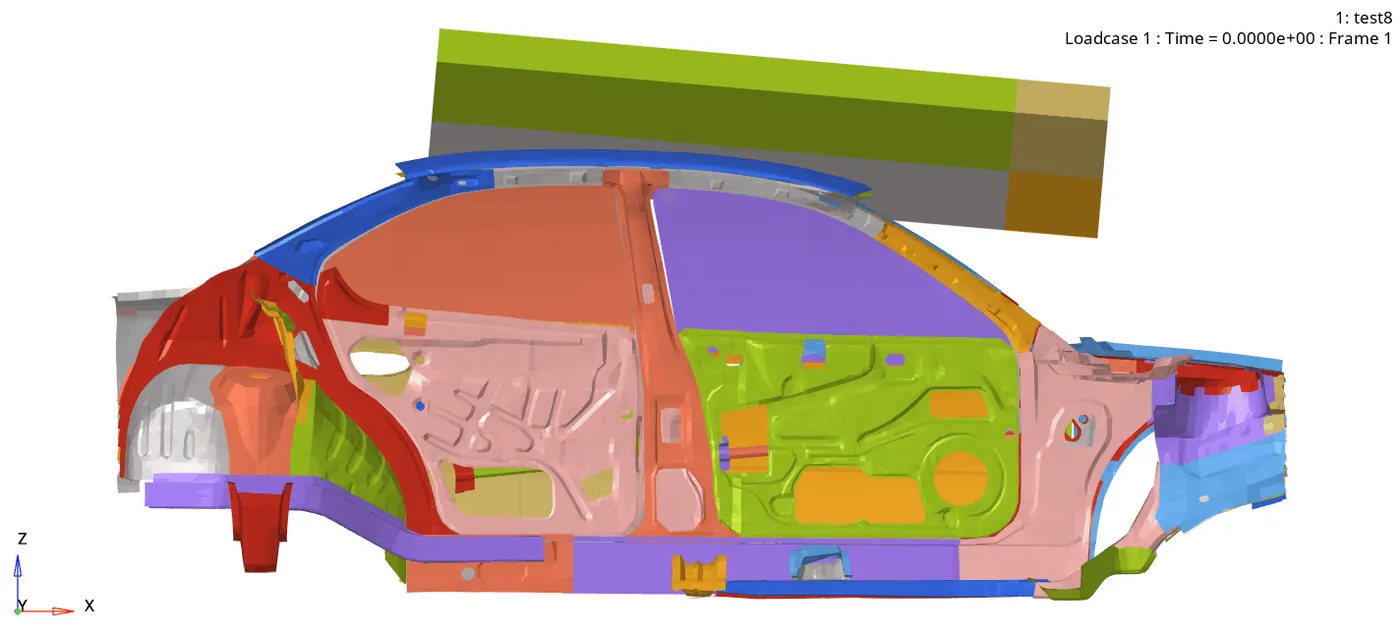
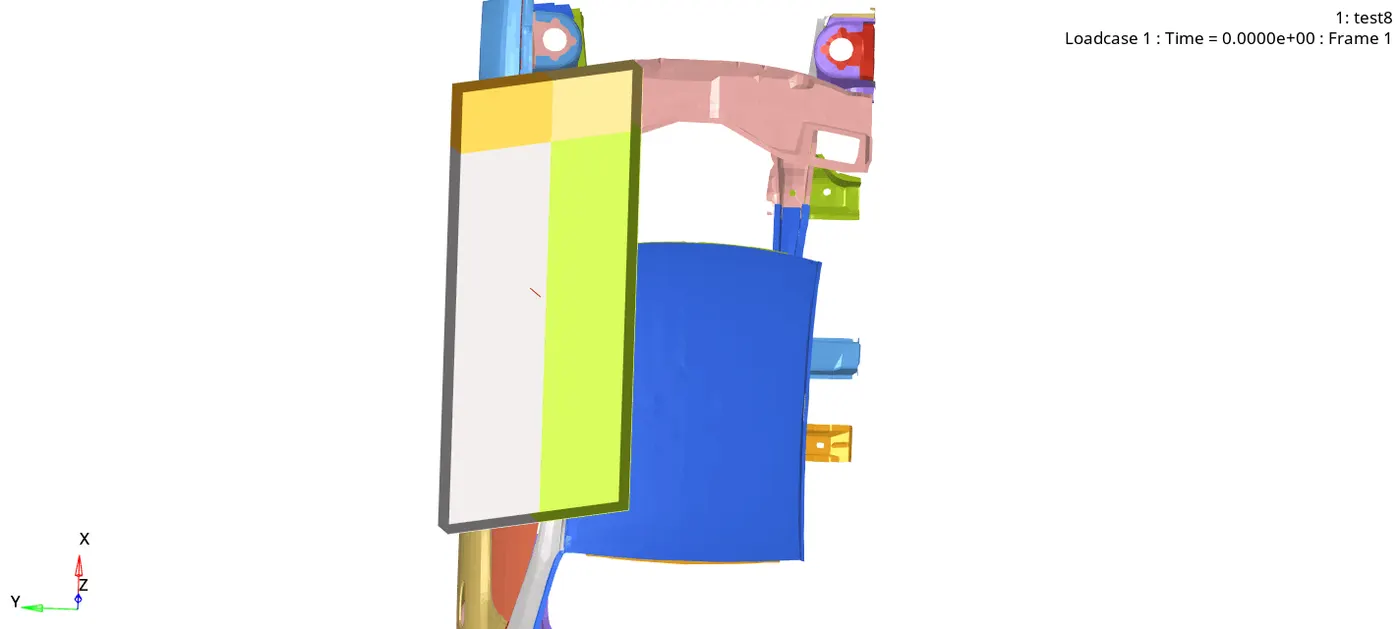
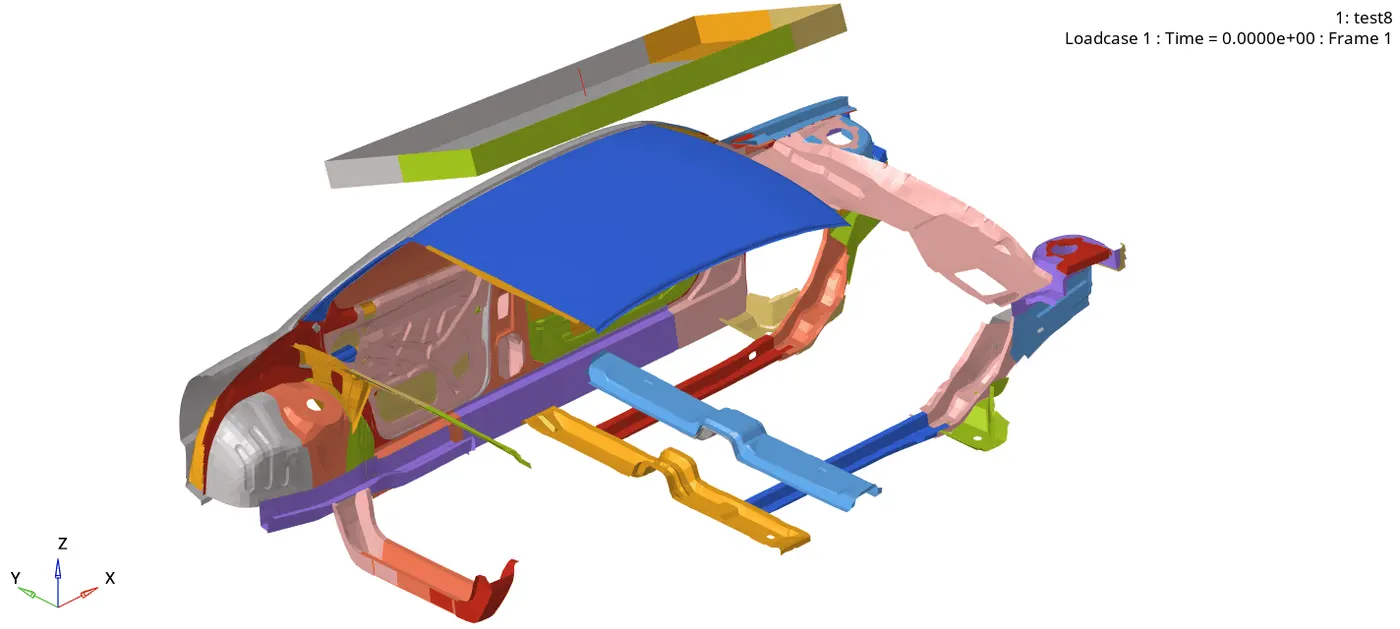
The impactor hit the side of the car and creates a deformation which peaks at the side doors of the car.
The various animations that were requested are given below.
Displacement:
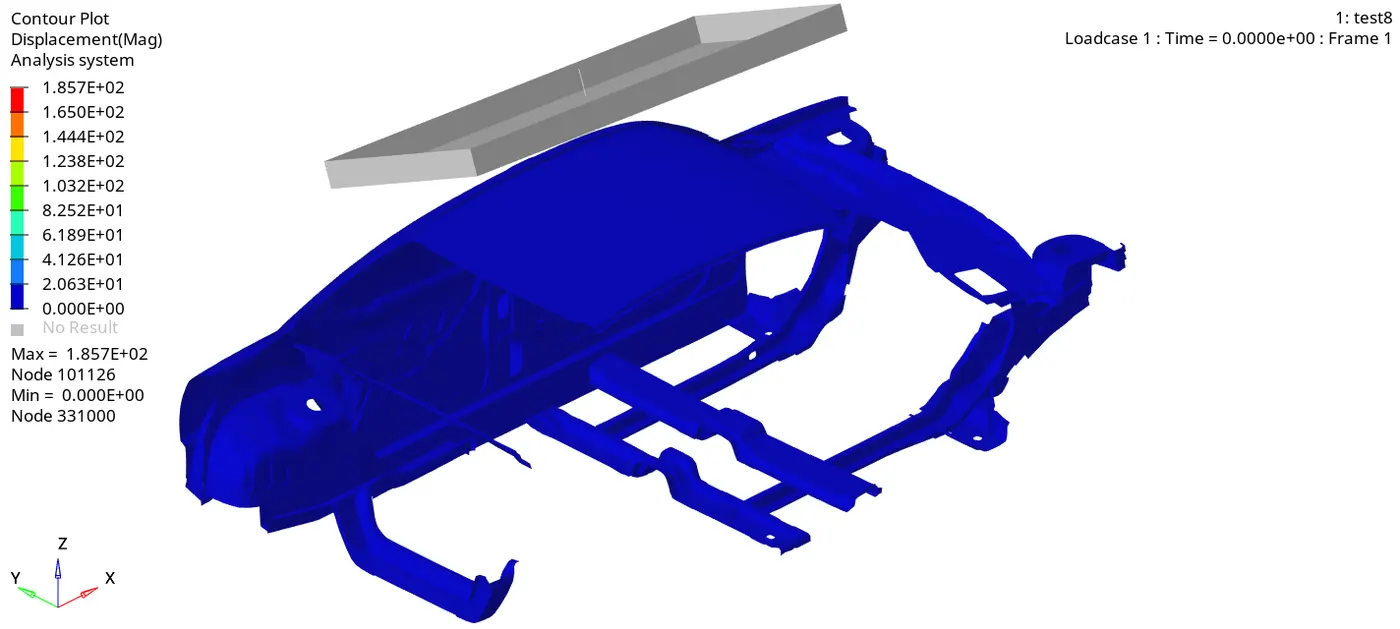
The maximum displacement was 185.5 mm in the car model.
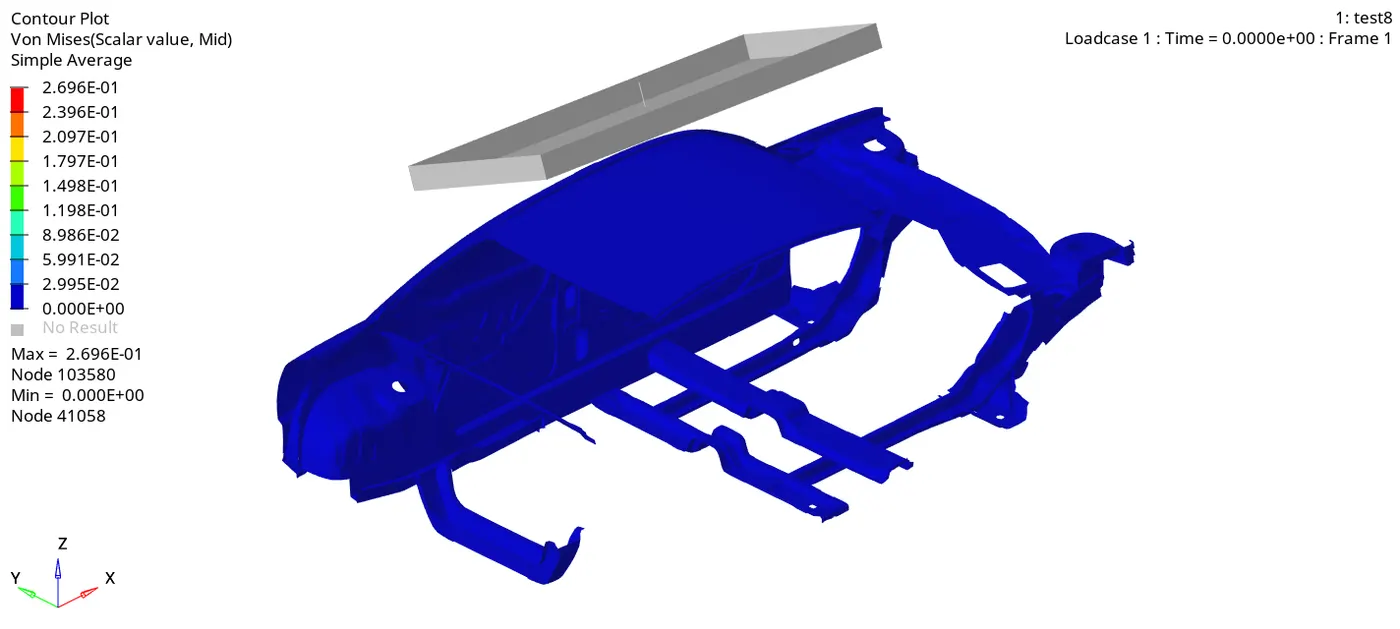
Von-Mises Stress:
The maximum von-mises stress was observed to be 0.2696 MPa.
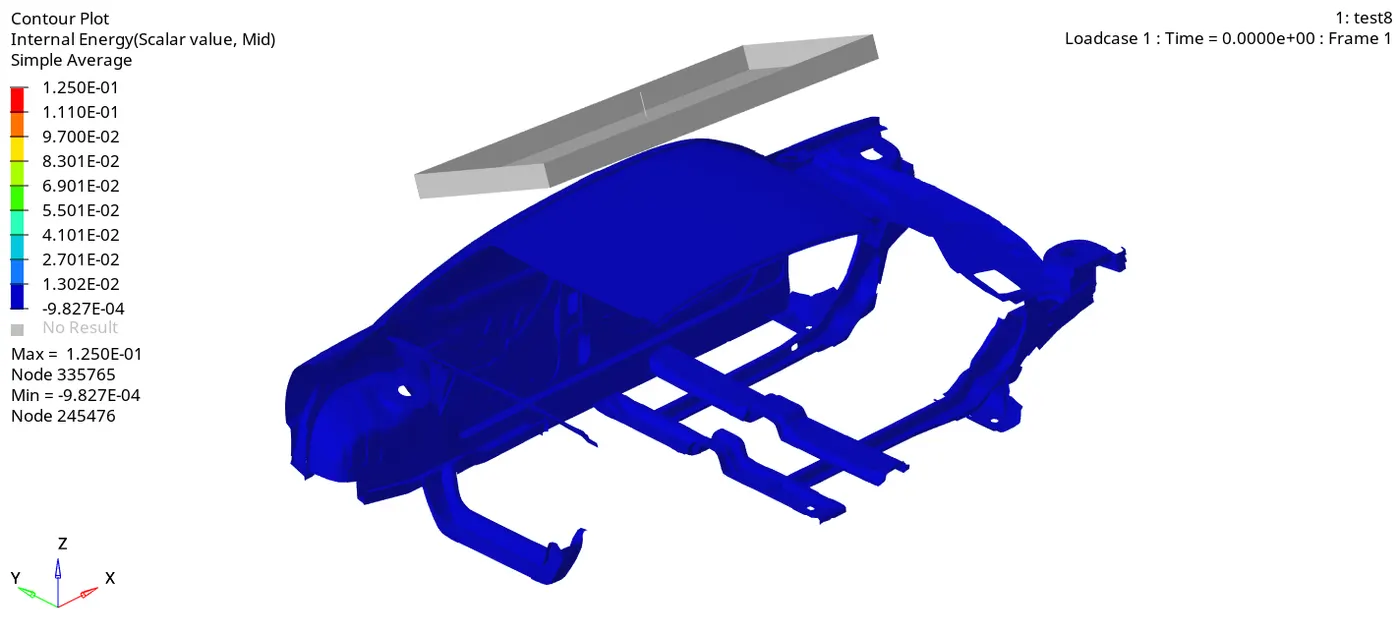
Internal Energy:
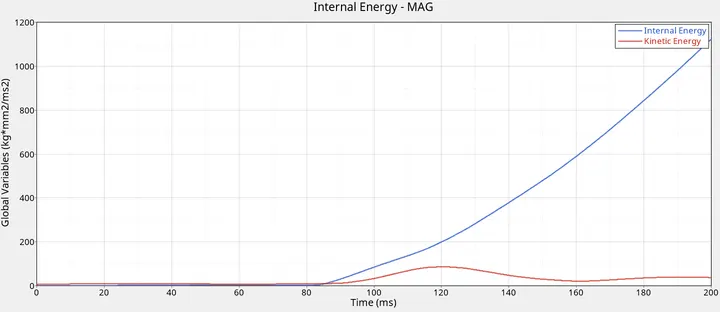
The graph of Internal and Kinetic energy varying with time is shown below:
Mass:
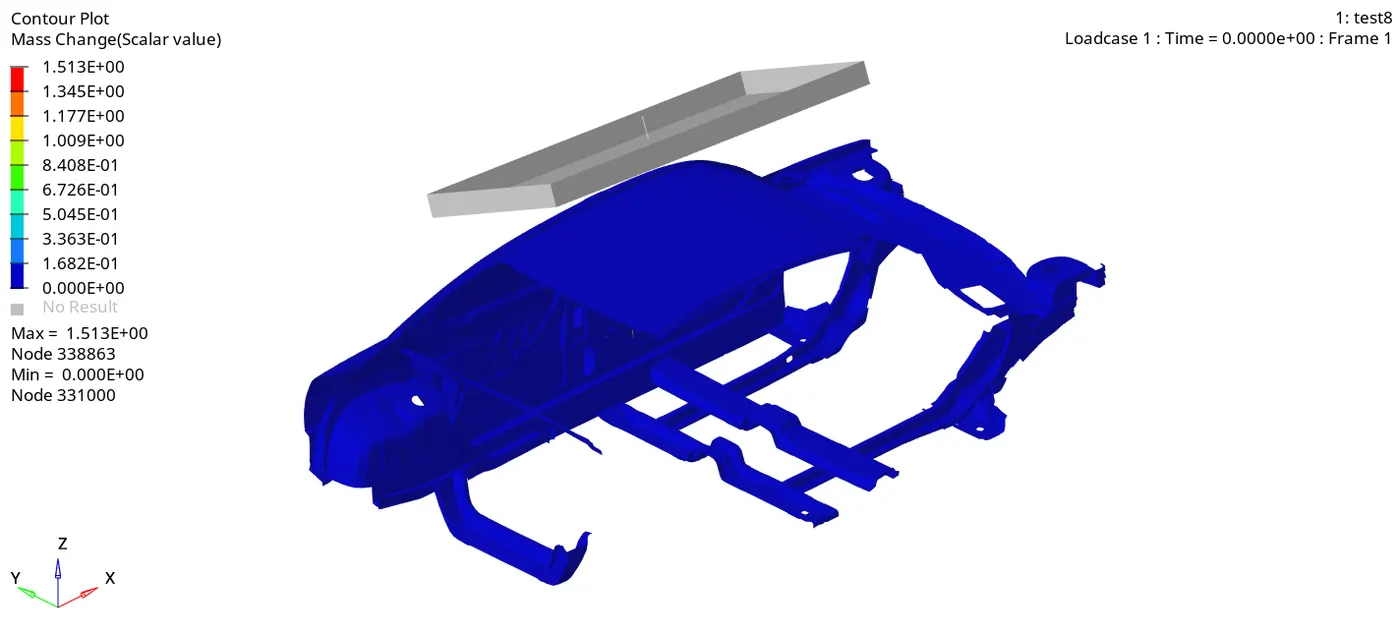
The graph of Mass varying with time is shown below:
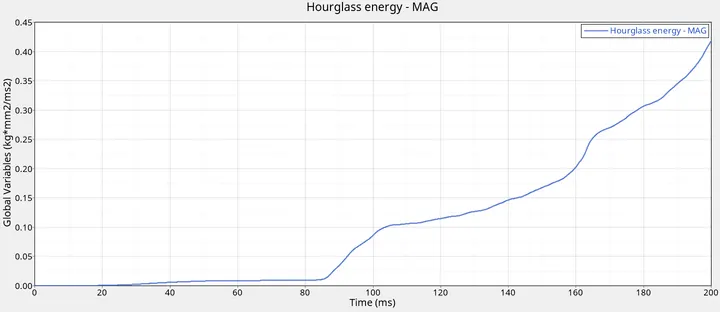
Hourglass energy:
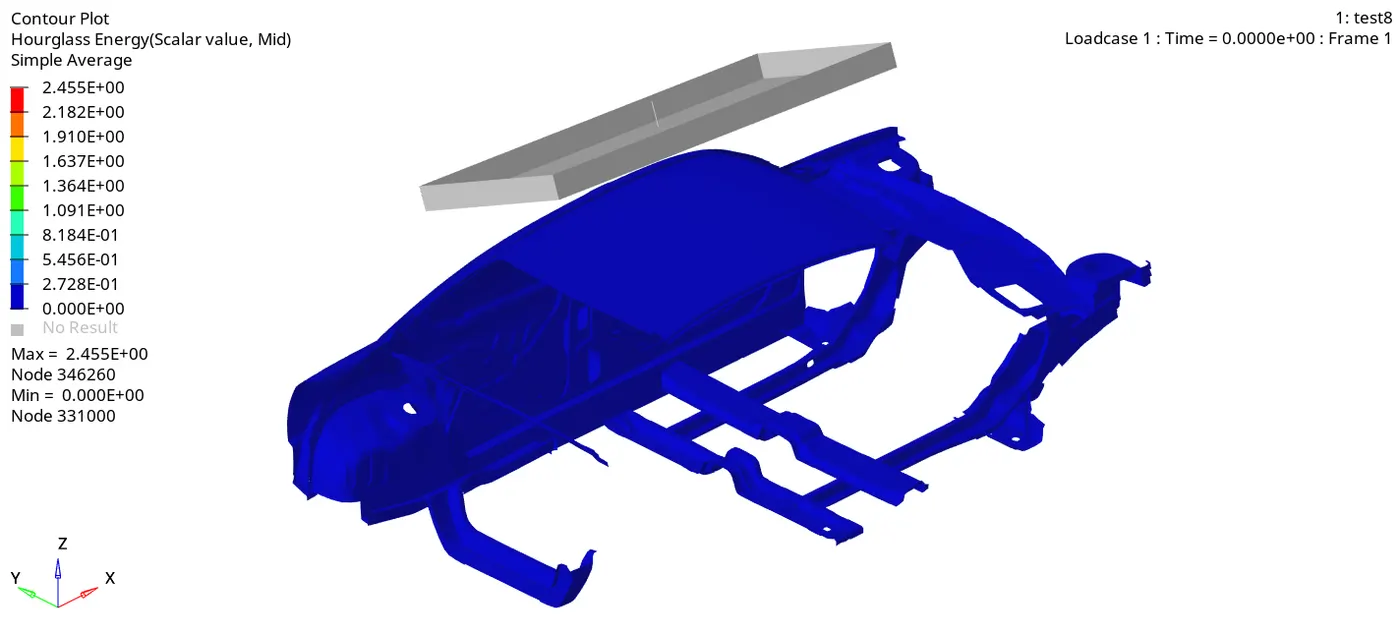
The graph of Hourglass energy varying with time is shown below:
Plastic Strain
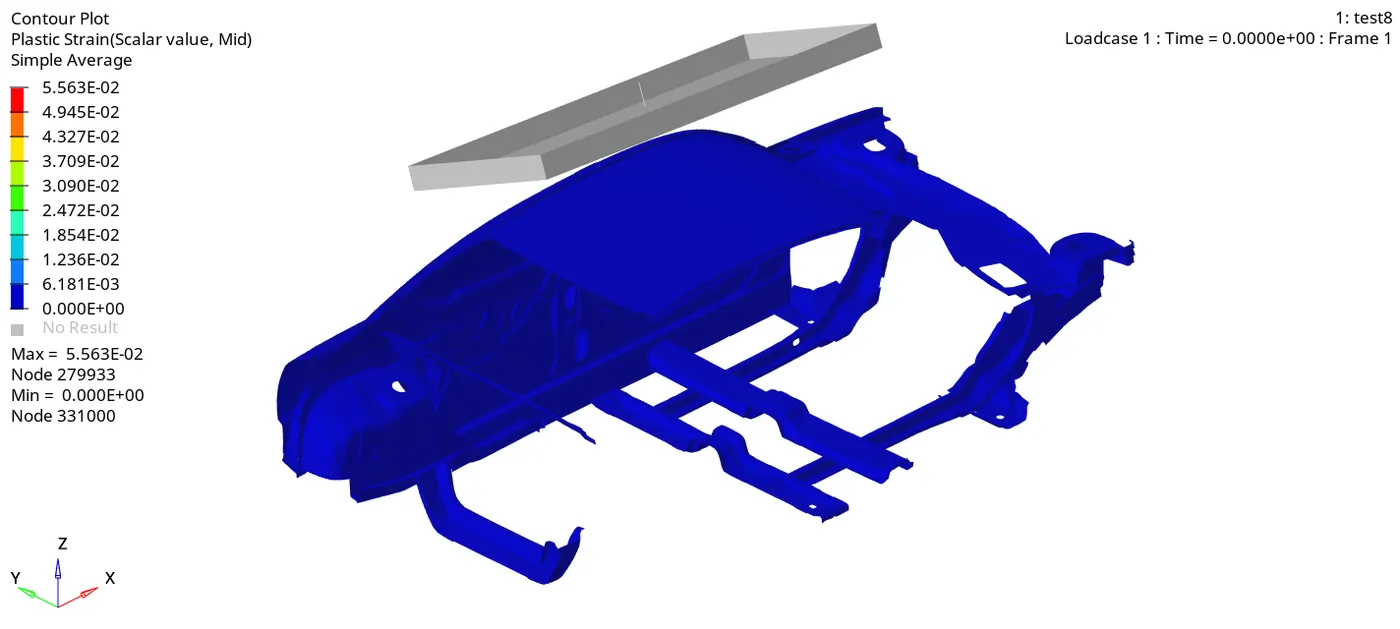
The maximum plastic strain was observed to be 0.125.
Force vs Displacement:
The force vs displacement graph is given below:
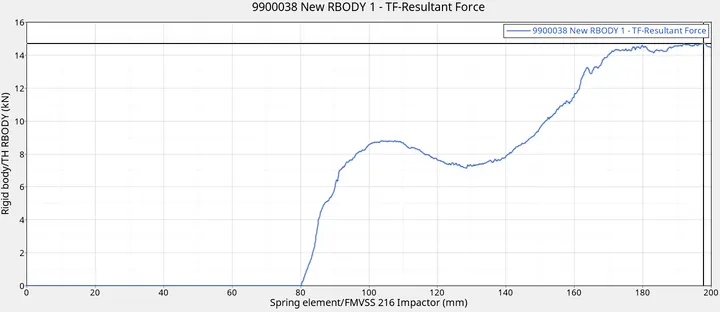
The maximum force reaches a value of 14.717 KN. If the mass of the reduced BIW model is taken, then the weight is 1.715 KN and from the FMVSS requirement, the force of 3*weight = 5.145 KN is passed significantly by the present model.
However, if the gross vehicle weight is taken then the value of 47 KN has to be reached. This value is not reached by the present model.
The below table summarizes the findings of the present simulation:
|
PARAMETER |
VALUES |
|
Elapsed Time |
19990.34 s |
|
Maximum plastic Strain |
0.125 |
|
Maximum Displacement |
185.7 mm |
|
Maximum Von-Mises stress |
0.2696 MPa |
|
Final Internal Energy |
1120 J |
|
Maximum Kinetic Energy |
86.02 J |
|
Maximum Energy Error |
-8.6% |
|
Maximum Mass Error |
0.1427 E-04 |
|
Maximum Hourglass Energy |
2.455 J |
|
Peak Force |
14.717 KN |
CONCLUSION: The roof crush simulation was successfully conducted and the results were discussed in depth.