Project on Concrete Mix Design for various grades of Concrete
- Calculate the Concrete Mix Design for M35 grade concrete with fly ash?
Aim:
- To calculate the Concrete Mix Design for M35 grade concrete with fly ash.
Introduction:
Concrete mix design may be define as the art of selecting suitable ingredients of concrete and determining their relative proportions with the object of producing concrete of certain minimum strength and durability as economically as possible.
Objectives of mix design:
- To achieve the designed/ desired workability in the plastic stage
- To achieve the desired minimum strength in the hardened stage
- To achieve the desired durability in the given environment conditions
- To produce concrete as economically as possible
Procedure:
- Mix design for M35 grade of concrete with fly ash:
Assumed concrete Mix proportioning:
- Grade designation: M35
- Type of cement: OPC 43 grade conforming to IS 8112
- Type of mineral admixture: Fly ash
- Maximum nominal size of aggregate: 20mm
- Exposure condition: Severe (reinforced concrete)
- Minimum cement content: 320 kg/m3 (from table-5 of IS 456:2000)
- Maximum water-cement ratio: 0.45 (from table-5 of IS 456:2000)
- Workability: 75mm
- Method of concrete placing: Normal
- Degree of supervision: Good
- Type of aggregate: Crushed angular aggregate
- Chemical admixture type: Super plasticizer
- Specific gravity of cement: 3.15
- Specific gravity of coarse aggregate & fine aggregate: 2.74
- Specific gravity of fly ash: 2.2
- Specific gravity of super plasticizer: 1.145
- Water absorption of fine aggregate and coarse aggregate: NIL
- Free surface moisture: NIL
- Fine aggregate: conforming to grading Zone-1 of table 4 of IS 383
1. Target mean strength of concrete:
- As per IS 10262:2009 the assumed standard deviation:
|
Grade of concrete |
Assumed standard deviation(N/mm2) |
|
M10 M15 |
3.5 |
|
M20 M25 |
4.0 |
|
M30 M35 M40 M45 M50 |
5.0 |
The above values corresponding to the site control having proper storage of cement, weigh batching of all materials, controlled addition of water, regular checking of materials, aggregate grading and moisture content, periodically checking workability and strength. Where there is any deviation from the above values the table should increase by 1N/mm2.
Target mean strength ft = fck + 1.65*S
Fc = 35
Standard deviation S = 5
Ft = 35+1.65*5
Target mean strength = 43.25 N/mm2
2. Calculation of water-cement ratio:
- As we get the value of target mean strength with that value we calculate the value of water-cement ratio.
a. To calculate the w/c ratio from graph-1 from code IS 10262:2009.
- Compressive strength vs W/C ratio graph
- Compressive strength after 28 days of curing N/mm2.
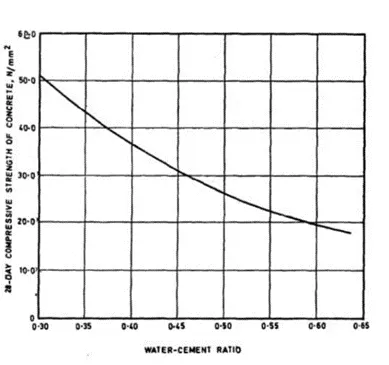
We can assume w/c ratio graph, by taking ft(target mean strength) as compressive strength .
- W/C ratio from graph-1 = x.
b. To calculate the w/c ratio from graph-2 from code IS 10262:2009.
- A to F curve lines indicate the 7- day compressive strength of cement and 28 days of compressive strength of concrete.
- 28 days compressive strength vs 7 days compressive strength of cement.
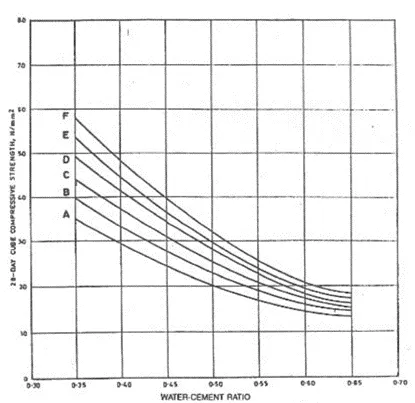
7-day strength of concrete, tested according to IS 4031:1968
A = 21.6 – 25.0 N/mm2
B = 25.0 – 29.8 N/mm2
C = 29.8 – 35.0 N/mm2
D = 35.0 – 41.5 N/mm2
E = 41.5 - 48.0 N/mm2
F = 48.0 – 53.4 N/mm2
By taking ft(target mean strength) as compressive strength, we can assume w/c ratio by curved lines A to F.
- W/C ratio from graph-2 = y.
c. Calculate w/c ratio from the maximum free w/c ratio according to environment exposure condition as per table-5 0f IS 456:2000.
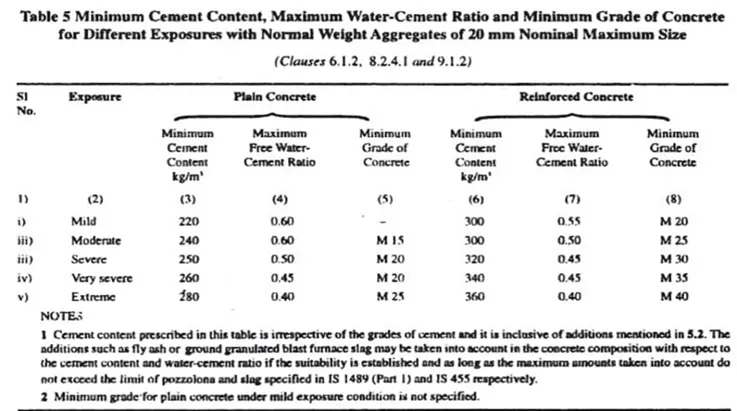
We can take w/c ratio as per given exposure condition.
- W/C ratio from table = z.
Now compare all above the three values (x, y z), then take the lower value is adopted as W/C ratio for mix design.
For M35 grade the water-cement ratio is:
From the graph-1 28 days compressive strength vs w/c ratio:
- The water cement ratio W/C = 40.
From graph-2 28 days compressive strength vs 7 days compressive strength of cement:
- The water-cement ratio W/C = 41.
From the table-5 of IS 456:2000 for severe condition:
- The water-cement ratio W/C = 45.
So, we take the water-cement ratio W/C = 0.40.
3. Selection of water content:
- From table-2 of IS 10262:2009,
- The maximum water content for 25mm to 50mm slump is =186kg = 186lit.
- For additional slump 3% may be added for every 25mm slump.
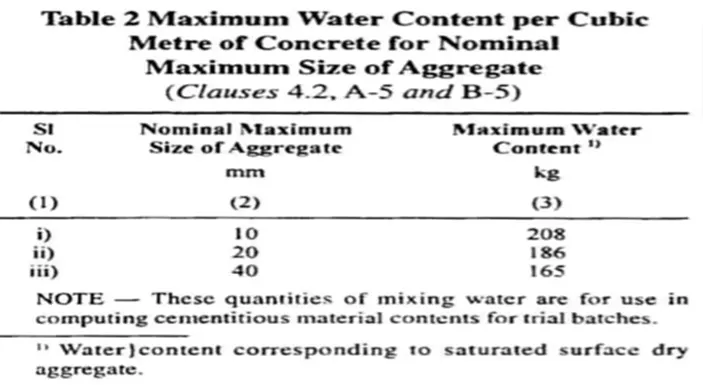
Maximum water content for 20mm aggregate = 186 litre,
Estimated water content for 100mm slump = 186 + 3/100 * 186
= 186 + 5.58
= 191.58 = 192.
As superplasticizer is used, the water content can be reduced up to 30%, based on the trails water content reduction of 29% is achieved with plasticizer.
Hence the water content = 192*0.71 = 136.32
Water content W = 136 litres.
4. Calculation of cement content:
Water-cement ratio = 0.40,
Cementitious material (cement + fly ash) content = 136/0.40
= 340 kg/m3
From table-5 of IS 456:2000 the minimum cement content for ‘Extreme’ condition = 320kg/m3.
Hence ok.
Now, to proportion a mix containing fly ash the following steps are suggested:
- The percentage of fly ash needs to be decided based on the project requirement and quality of material.
- In some case increase the cementitious material can be warranted. Increase in cementitious material content and its percentage may be based on experience and trail (this example is with increase of 10% cementitious material content).
Cementitious material content = 340 * 1.10 = 374 kg/m3
Water content = 136 kg/m3
So, water-cement ratio = 136/374 = 0.363
Fly ash @ 30% total cementitious content = 374 * 0.3 = 112 kg/m3
Cement (OPC) = 374-112 = 262 kg/m3.
5. Proportion of volume of coarse aggregate and fine aggregate content:
- The proportion of volume of coarse aggregate and fine aggregate can be determined from table-3 of IS 10262:2009.
- Selected depending upon the fine aggregate zone.
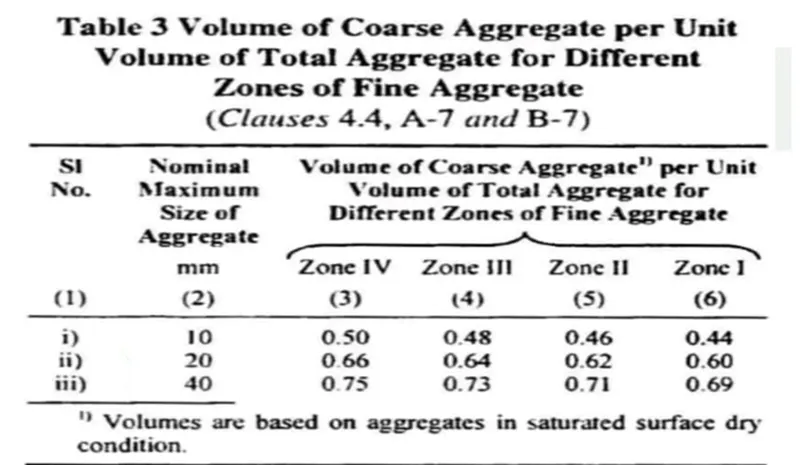
Nominal maximum size of aggregate is 20mm and fine aggregate
(Zone 1) for water cement ratio of 0.5=0.6.
In present case the water-cement ratio is = 0.36.
Therefore, the volume of coarse aggregate needs to be increased to decrease in the fine aggregate content (at the rate of -/+ 0.01 for every +/- change in water-cement ratio).
As the w/c ratio decrease by 0.14, then volume of coarse aggregate increase by 0.03.
The corrected volume of coarse aggregate is for w/c ratio 0.36 = 0.63.
Volume of fine aggregate = 0.37.
6. Mix calculations:
a. Volume of concrete = 1m3
b.Volume of cement = [(mass of cement)/ (specific gravity of
Cement*1000)]
= 262/3.15*1000
= 0.083 m3.
c. Volume of fly ash = [(mass of fly ash)/ (specific gravity of
Fly ash*1000)]
= 112/2.2*1000
= 0.05 m3.
d. Volume of water = [(mass of water)/ (specific gravity of
Water*1000)]
= 136/1*1000
= 0.136.
e. Volume of chemical admixture = [(mass of chemical admixture)/ (specific
Gravity of Chemical admixture*1000)]
= 7.6/1.145*1000
= 0.006 m3.
f. Volume of aggregate (C.A & F.A) = [a-(b+c+d+e)]
= [1-(0.083+0.136+0.05+0.006)]
= 0.725 m3.
g. Mass of coarse aggregate = f*volume of C.A*specific gravity of C.A*1000
= 0.725*0.63*2.74*1000
= 1251 kg/m3.
f. Mass of fine aggregate = f*volume of F.A*specific gravity of F.A*1000
= 0.725*0.37*2.74*1000
= 735 kg/m3.
7. Mix proportion for trail:
Cement = 262 kg/m3
Fly ash = 112 kg/m3
Water = 186 kg/m3
Fine aggregate = 695 kg/m3
Coarse aggregate = 1133 kg/m3
Chemical admixture = 7 kg/m3
Water-cement ratio = 0.362
Result:
Trail mix ratio = 1 : 1.85 : 3.0
Conclusion:
- The trail mix design results are satisfactory
- The design mix is totally based on the practical value of material properties
- Note that if your concrete will be reduced because we design concrete constituents should be in dry condition.
- calculate the concrete mix design for M50 grade?
Aim:
- To calculate the concrete mix design for M50 grade of concrete.
Introduction:
Concrete mix design may be define as the art of selecting suitable ingredients of concrete and determining their relative proportions with the object of producing concrete of certain minimum strength and durability as economically as possible.
Objectives of mix design:
- To achieve the designed/ desired workability in the plastic stage
- To achieve the desired minimum strength in the hardened stage
- To achieve the desired durability in the given environment conditions
- To produce concrete as economically as possible
Procedure:
- Mix design for M50 grade of concrete.
Assumed concrete Mix proportioning:
- Grade designation: M50
- Type of cement: OPC 43 grade conforming to IS 8112
- Maximum nominal size of aggregate: 20mm
- Exposure condition: Extreme (reinforced concrete)
- Minimum cement content: 360 kg/m3 (from table-5 of IS 456:2000)
- Maximum water-cement ratio: 0.40 (from table-5 of IS 456:2000)
- Workability: 100mm
- Method of concrete placing: Pumping
- Degree of supervision: Good
- Type of aggregate: Crushed angular aggregate
- Chemical admixture type: super plasticizer
- Specific gravity of cement: 3.15
- Specific gravity of coarse aggregate & fine aggregate: 2.74
- Specific gravity of super plasticizer: 1.145
- Water absorption of fine aggregate: 1.0%
- Water absorption of coarse aggregate: 0.5%
- Free surface moisture: NIL
- Fine aggregate: conforming to grading Zone-1 of table 4 of IS 383
1. Target mean strength of concrete:
- As per IS 10262:2009 the assumed standard deviation:
|
Grade of concrete |
Assumed standard deviation(N/mm2) |
|
M10 M15 |
3.5 |
|
M20 M25 |
4.0 |
|
M30 M35 M40 M45 M50 |
5.0 |
The above values corresponding to the site control having proper storage of cement, weigh batching of all materials, controlled addition of water, regular checking of materials, aggregate grading and moisture content, periodically checking workability and strength. Where there is any deviation from the above values the table should increase by 1N/mm2.
Target mean strength ft = fck + 1.65*S
Fc = 50
Standard deviation S = 5 (as per IS 10262:2009)
Ft = 50+1.65*5
Target mean strength = 58.25 N/mm2
2. Calculation of water-cement ratio:
- As we get the value of target mean strength with that value we calculate the value of water-cement ratio.
a. To calculate the w/c ratio from graph-1 from code IS 10262:2009.
- Compressive strength vs W/C ratio graph
- Compressive strength after 28 days of curing N/mm2.
We can assume w/c ratio graph, by taking ft(target mean strength) as compressive strength .
- W/C ratio from graph-1 = x.
b. To calculate the w/c ratio from graph-2 from code IS 10262:2009.
- A to F curve lines indicate the 7- day compressive strength of cement and 28 days of compressive strength of concrete.
- 28 days compressive strength vs 7 days compressive strength of cement.
7-day strength of concrete, tested according to IS 4031:1968
A = 21.6 – 25.0 N/mm2
B = 25.0 – 29.8 N/mm2
C = 29.8 – 35.0 N/mm2
D = 35.0 – 41.5 N/mm2
E = 41.5 - 48.0 N/mm2
F = 48.0 – 53.4 N/mm2
By taking ft(target mean strength) as compressive strength, we can assume w/c ratio by curved lines A to F.
- W/C ratio from graph-2 = y.
c. Calculate w/c ratio from the maximum free w/c ratio according to environment exposure condition as per table-5 0f IS 456:2000.
We can take w/c ratio as per given exposure condition.
- W/C ratio from table = z.
Now compare all above the three values (x, y z), then take the lower value is adopted as W/C ratio for mix design.
M50 grade the water-cement ratio is:
From the graph-1 28 days compressive strength vs w/c ratio:
- The water cement ratio W/C = 35.
From graph-2 28 days compressive strength vs 7 days compressive strength of cement:
- The water-cement ratio W/C = 35.
From the table-5 of IS 456:2000 for extreme condition:
- The water-cement ratio W/C = 40.
So, we take the water-cement ratio W/C = 0.35.
3. Selection of water content:
- From table-2 of IS 10262:2009,
- The maximum water content for 25mm to 50mm slump is =186kg = 186lit.
- For additional slump 3% may be added for every 25mm slump.
Maximum water content for 20mm aggregate = 186 litre,
Estimated water content for 100mm slump = 186 + 6/100*186
= 197.
As superplasticizer is used, the water content can be reduced up to 30%, based on the trails water content reduction of 29% is achieved with plasticizer.
Hence the water content = 197*0.71 = 140lit.
Water content W = 140 litres.
4. Calculation of cement content:
Water-cement ratio = 0.35,
Cement content = 140/0.35
= 400
Cement content = 400 kg/m3.
From table-5 of IS 456:2000 the minimum cement content for ‘Extreme’ condition = 360kg/m3.
Hence ok.
5. Proportion of volume of coarse aggregate and fine aggregate content:
- The proportion of volume of coarse aggregate and fine aggregate can be determined from table-3 of IS 10262:2009.
- Selected depending upon the fine aggregate zone.
Nominal maximum size of aggregate is 20mm and fine aggregate
(Zone 1) for water cement ratio of 0.5=0.6.
In present case the water-cement ratio is = 0.35.
Therefore, the volume of coarse aggregate needs to be increased to decrease in the fine aggregate content (at the rate of -/+ 0.01 for every +/- change in water-cement ratio).
As the w/c ratio decrease by 0.15, then volume of coarse aggregate increase by 0.03.
The corrected volume of coarse aggregate is for w/c ratio 0.35 = 0.63.
For pumpable concrete these values are reduced by 10%,
Therefore, volume of coarse aggregate = 0.63 * 0.9 = 0.57
Volume of fine aggregate = 1-0.57 = 0.43.
6. Mix calculations:
a. Volume of concrete = 1m3
b. Volume of cement = [(mass of cement)/ (specific gravity of
Cement*1000)]
= 400/3.15*1000
= 0.127 m3.
c. Volume of water = [(mass of water)/ (specific gravity of
Water*1000)]
= 140/1*1000
= 0.140.
d. Volume of chemical admixture = [(mass of chemical admixture)/ (specific
Gravity of Chemical admixture*1000)]
= 7.6/1.145*1000
= 0.006 m3.
e. Volume of aggregate (C.A & F.A) = [a-(b+c+d)]
= [1-(0.127+0.140+0.006)]
= 0.727.
f. Mass of coarse aggregate = e*volume of C.A*specific gravity of C.A*1000
= 0.727*0.57*2.74*1000
= 1156 kg/m3.
g. Mass of fine aggregate = e*volume of F.A*specific gravity of F.A*1000
= 0.727*0.43*2.74*1000
= 872 kg/m3.
7. Mix proportion for trail:
Cement = 400 kg/m3
Water = 140 kg/m3
Fine aggregate = 872 kg/m3
Coarse aggregate = 1156 kg/m3
Chemical admixture = 7 kg/m3
Water-cement ratio = 0.354
Result:
Trail mix ratio = 1 : 2.18 : 2.9
Conclusion:
- The trail mix design results are satisfactory
- The design mix is totally based on the practical value of material properties
- Note that if your concrete will be reduced because we design concrete constituents should be in dry condition.