Project - Analysis of a practical automotive wiring circuit
Q.1)
i) Battery
ii) Starter
iii) Voltage regulator
iv) Generator
v) Ignition coil
vi) Fuse
vii) Junction box
viii) Lamps/Indicators: Tail light, Parking light, Scaled beam, turn indicators
ix) Distributor
x) Foot selector switch
Q.2)
i) Generator:
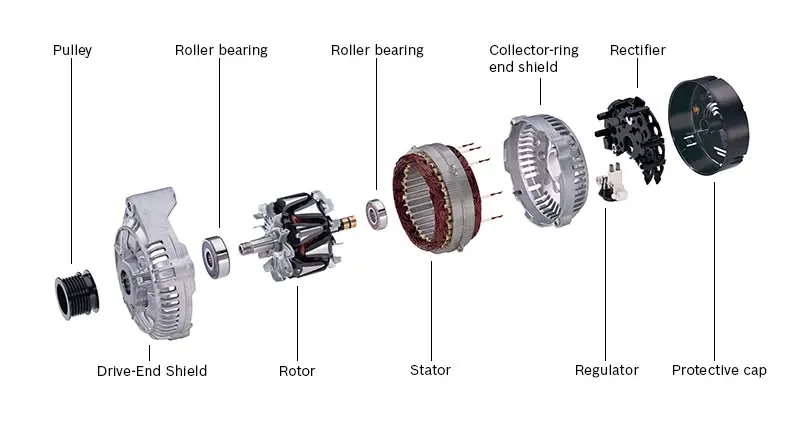
Purpose: The generator converts the mechanical energy of the vehicle into electrical energy. This energy is used to charge the battery. Which is used to start the vehicle, and power electrical accessories even when the engine is off.
Working: Generator works on the principle of electromagnetic induction. When the electrical conductor is placed in changing or varying magnetic field EMF is induced in it. The generator is connected to the engine when the engine starts it rotates the coil inside the generator. The rotating coil is placed in the magnetic field produced by the field coil in the stator. Due to the rotation of the coil emf is induced in the coil, this induced emf is then applied to a voltage regulator circuit to charge the battery and power the electrical components of the vehicle.
ii) Voltage and current regulator:
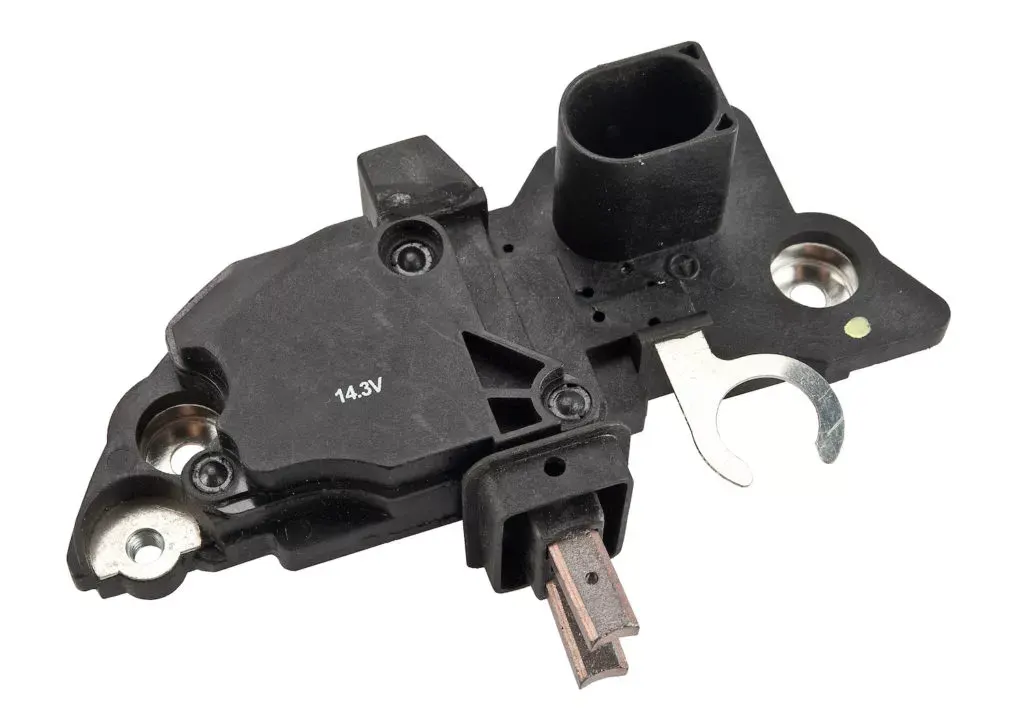
Purpose: Voltage and current regulators are provided in the vehicle to regulate the voltage and current. The EMF generated by the generator is not consistent as the speed of the engine varies. this fluctuation in the generator speed will produce fluctuating voltage to regulate the voltage, regulators are provided. There are 3 types of voltage regulators 1) Electromechanical 2) Electronic 3) Computer controlled voltage regulators
Most modern vehicles use electronic or computer-controlled voltage regulators. Electronic voltage regulators use Zenor diode and transistors to control the output voltage. Computer-controlled voltage regulators use PCM (Powertrain Control Module) to control on-time current flow through the field coil. This change in the current flow changed the magnetic field of the field coil to get a constant output voltage.
iii) Fuse:
Purpose: Fuse is used in the vehicle to protect the electrical components from Short-circuit and excessive levels of current.
Working: The fuse is made up of a thin strip or strand of metal, whenever an excessive current flow is in an electrical circuit, the fuse melts and opens the circuit and disconnects it from the power supply.
Q.3) The fuse should be high enough that it should work fine under steady conditions but open during an overload or short circuits. Usually, it is kept between 150-200% of the maximum steady-state input current.
I=10A
150% of I = 1.5*10
I=15A
The fuse should be rated for 15A current.
Q.4) The voltage should be 12V as most of the bulbs and other accessories which are powered by the battery are easily available in 12V
Assuming that the battery should be able to power the electrical components for 2-3 hrs when the engine is turned off.
Power= 500W
I=P/V
I=500/12
I= 41.6667A
t= 2hr
Battery Capacity=I*t
B.C= 41.6667*2
B.C= 83.3334 Ah
A battery of capacity, 85Ah can be used.
Q.5)
i) Sealed beam
ii)Tail stoplights
These elements are connected in parallel because if they are connected in series their resistance will add up and increase the resistance of the circuit. This increase in resistance will lead to a loss in the intensity of the lights so they are connected in parallel to reduce the resistance hence increasing the intensity of light.
Q.6)
i) Fuse
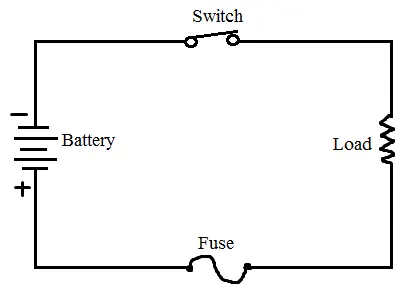
The fuse is connected in series with the circuit so, if the circuit encounters any kind of overload or short circuit it could protect the components from excessive current. If the fuse is connected in parallel the current will flow through that parallel path and damage the component.
ii) Fuel gauge:
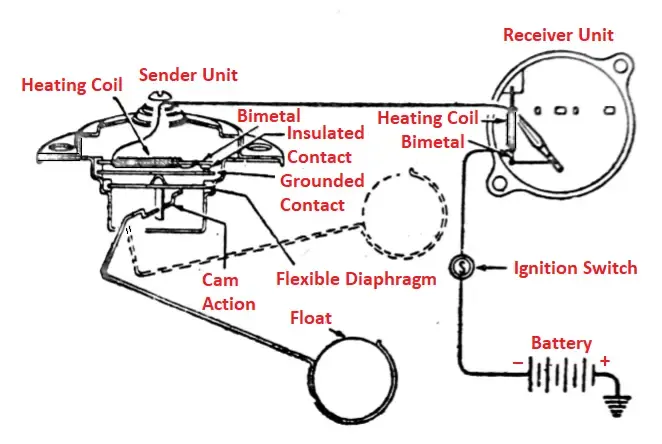
The fuel gauge is connected in series with the gas tank unit. The resistance of the potentiometer changes when the arm attached to a bimetallic strip moves due to the fluid level in the tank. The fuel indicator then measures the current flowing through the circuit and indicates the reading of the fuel in the tank. As it is sensitive to the resistance it is connected in series so changes in the fuel level can be observed.