Project 4
Aim-
For a vehicle of gross weight 300 kg, the motor ratings are 1200Wh, 65V. The range is 225km and the maximum speed is 60kmph. Calculate the capacity of the battery pack required and the number of series-parallel connections. Give a stepwise discussion on how a battery pack is built.
Note: Choose any relevant lithium ion datasheet
Aim of the Project : The battery pack calculation & Steps how to build the battery pack .
Theory: We know battery is the food of EV, So by using EV we go towards the green energy sources. So we need to know about actually how the EV battery pack design for given capacity.
To design a battery pack we have to considered all possible losses which may occure in battery pack & motor & also we have to consider the efficiency.
The battery has 85-95% efficiency so we need to use all the battery pack capacity for propulsion of vehicle so it can be done by using a proper motor which has maximum conversion efficiency & less loss.
Lets see by calculation how actually a battery pack build.
Formulae used:
1. Motor energy capacity = Power * time
2. Motor power capacity = Motor Voltage (v) * Motor Current(i)
Current rating i = Motor power capacity / voltage
3. Travel factor = Total range / maximum speed
4. Cells in series = Motor voltage / cell nominal voltage
5. Cells in parallel = Motor continuous current / cell capacity
Mathematical calculations:
Given data,
Vehical weight = 300 kg
Motor ratings = 1200 Wh
Motor Voltage(v) = 65 V
Range = 225 km
Maximum speed = 65 kmph
We have the formula for Motor energy capacity,
Motor energy capacity = Power * time
Motor power = Motor energy capacity/1 = 1200/1 = 1200 W.
Motor power capacity = Motor Voltage (v) * Motor Current(i)
Current rating i = Motor power capacity / voltage
Current rating i = 1200 / 65 = 18.46 A.
Consider losses is 5-10%
So, New Motor current = 18.46 * (10% of 18.46)
New Motor current i(new) = 18.46 * 1.846 = 34.07 A = 34 A.
Power required at maximum speed of 60 kmph is calculate as below,
P(60kmph) = v * i(new)
Power(60kmph) = 65 * 34 = 2210 W.
Travel factor = Total range / maximum speed
Travel factor = 225 / 60 = 3.75.
So, the energy required = Power(60kmph)*travel factor
Energy required = 2210 * 3.37 = 8287.5 Wh = 8.287 KWh.
Assuming battery pack efficiency to 85-95%
for lithium iron battery it is 90%.
Required battery capacity = 8.287 / 0.90 = 9.207 KWh.
Assuming motor efficiency to 85-95%
we take 90% efficiency
Total battery pack capacity = 9.207 / 0.90 = 10.23 KWh.
Now consider a lithium ion battery datasheet for series & parallel calculations of cells.
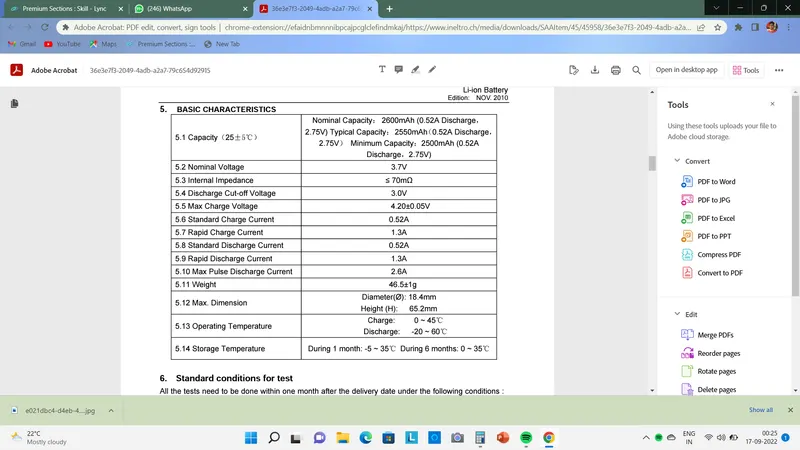
Cell nominal voltage = 3.7 V
Battery capacity = 2.5 Ah
Cells in series = Motor voltage / cell nominal voltage
cells in series = 65 / 3.7 = 17.56 = 18
By rounding off 18 cells in series required to get motor voltage to 65 V.
cells in parallel = Motor continuous current / cell capacity
cells in parallel = 34 / 2.5 = 13.6 = 14
By rounding off 14 cells in parallel required to get motor current to 34 A.
So, the battery pack required is 18s14p or 14p18s.
Steps to Build the battery pack
The assembly process of a high voltage EV battery pack has a strong impact on the performance, safety and durability of the battery. Choosing the right joining technology, as the special prerequisites of battery manufacturing demands, and aiming for an efficient joining process is crucial.
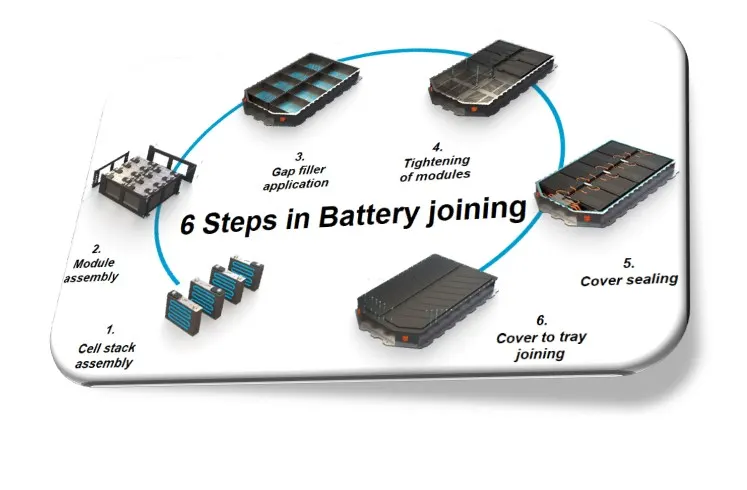
In order to make your battery pack, you’re going to need quite a few items. They are the following:
- Battery cells
- BMS (Battery Management System that charges & discharges the batteries)
- Nickel-plated strip for the joining the cells
- Battery level indicator for battery voltage & current measurement
- Rocker switch (basically a switch)
- Spot welder
- Wire cutter
- Gloves
- Safety goggles
The total cells in battery pack is 252 & we have series & parallel cells is 18, 14. so we cannot pack 252 cells in single one so following steps may follow.
Step1- The way we connect the battery cells needs to ensure they reach the correct capacity (defined as mAh) and voltage.
Check the each cell voltage, whether it match with nominal cell voltage if not charge the cell.
Do it for all cells.
step2- select the correct choice of battery pack configuration like msnp & npms(18s14p or 14p18s.) & fix the cells in cell holder.
we select the later one i.e. npms 14p18s because it has advantage like, Easy to maintenance, space use required for cooling is more.
For doing 14p18s configuration we use the module. each module consist of 14 cells in parallel make 18 such module & these 18 module may connect in series to get output voltage to 65 V.
place the cells in holder
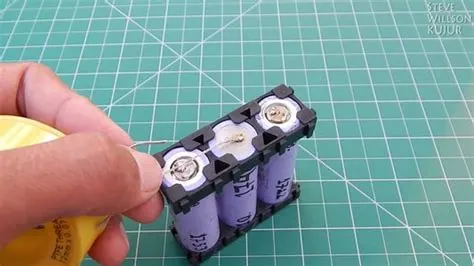
step3- Cut the Nickel Strips :
Take the pure nickel strip and put it on top of 14 cells. It needs to cover all the cell’s terminals and ensure you have about 10mm excess to connect them to the BMS.
Then, connect the all negative terminal to the one side & all positive to another side by different strips, make such 14 combination.
step3- Spot weld the strips
Here only use spot welding or welding method given for battery pack, do not use the heat welding it will affect the life cycle of cell by heating the cells.
Now you need to spot-weld your pure nickel strips. The welder needs to be pushed against the nickel strip and battery terminal before you press the foot switch.
Not sure if you’ve welded it correctly?
Try to pull the nickel strip. If it comes off easily, then it needs to be welded again but try using a stronger current.
When spot welding, always wear your safety goggles and protective gloves because spot welders create a lot of heat and you don’t want to get injured.
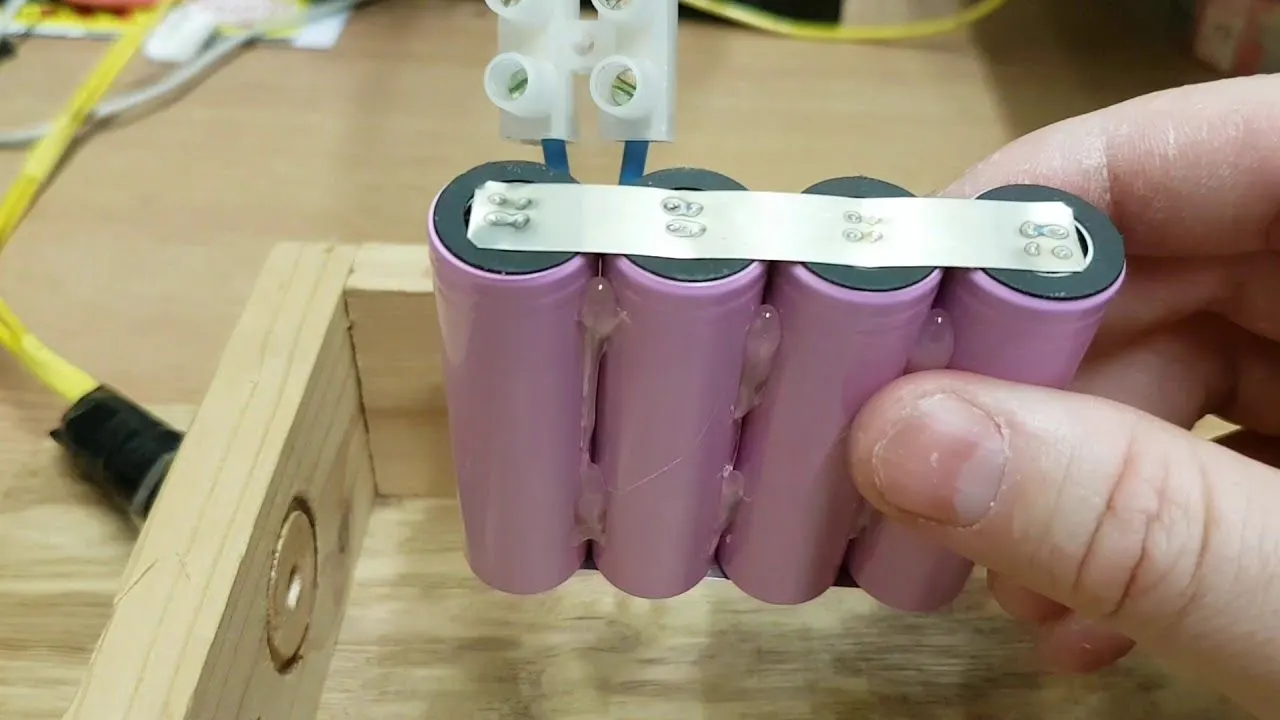

Connect the parallel modules in series with the nickel strip.
You may connect the enclosures for cooling its totally optional.
We uses fan cooling.
step7- Connect battery pack to BMS
Our BMS is important because it monitors the cells to ensure that they have the correct voltage and it also monitors the charging and discharging of the battery pack.
If you want to ensure your BMS is fit for this battery pack’s specifications, then you must ensure that it has the following criteria: It should have a voltage range of 65 volts ±0.05 volts. It should have a maximum operating current of 0~34A ±5%.
To connect our BMS to your battery pack, you should note the BMS’s soldering pads- B-, B1, B2, and B+.
Connect your first parallel group of cells’ negative terminal to the B- and the positive terminal to the B1.
Then, the next group needs to have its negative terminal connected to the B2 and positive terminal the B+.
To keep them together, simply spot weld the BMS to the nickel strips.
step8- Check the output voltage & capacity
If not getting properly then check the BMS connection make it correct.
step9- Assemble the this battery pack in with epoxy layer for protection
Step10- Connect the battery pack to EV.
Conclusion-
In this project a method is illustrated for battery pack design which is based on theorotical calculations first & then computed on practical basis. When the assume data is vary person to person by referring differnt datasheet of cells then variation may occure in battery pack building. I refer the datasheet as above & do the calculations & build the battey pack with given methods. We do the calculations correctly & the method/steps which i follow provides better accuracy Therefore this technique can be attaractive & effective approach for battery pack building.
References-
2. https://enviroinc.com/diy-lithium-batteries/
3. https://www.ineltro.ch/media/downloads/SAAItem/45/45958/36e3e7f3-2049-4adb-a2a7-79c654d92915.pdf