Project 2 Thermal modeling of battery pack
AIM:Thermal Modeling Of Battery Pack
OBJECTIVE:For a 10 cell series lithium ion battery model, simulate the thermal effects and compare life cycle performance at various temperatures, charge & discharge rates using MATLAB.
THEORY:
Thermal management of a battery is, in its most simple form, the integration of some form of heat exchange device into the battery system in order to maintain the battery cells at a near constant temperature. There are many potential methods that can be used to achieve this, but it typically involves moving heat through some medium away from the cells and out of the pack.
The complexity of the thermal management system will be highly dependent on three factors.
- The first is the duty cycle under which the pack will operate. If it is intended to be used as a high-power application, the battery cells will generate more heat than if it is used as an energy application.
- The second factor is the region where it will be used in. If the pack is intended to be used in a region of the world that frequently has very high ambient temperature, it means that the batteries will begin their cycle at an already elevated temperature level. Finally,
- the third factor is the cell itself. Different chemistries perform differently under high load and temperature operation.
- The thermal management system should be able to maintain a temperature difference of about 2–3 °C from the coolest cell to the warmest cell. At the worst-case condition, usually for larger packs the difference can be as much as 6–8 °C.
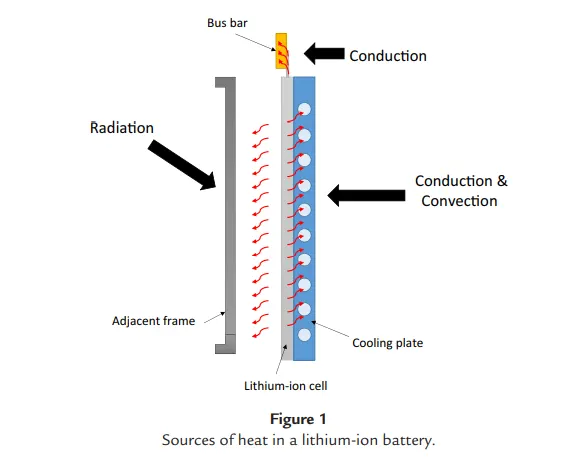
There are three different types of heat transfer that need to be considered in battery design:conduction, convection, and radiation.
- Conduction refers to a direct transfer of heat energy from two objects that are in direct contact.
- Convection occurs when heat is conducted through a liquid medium to a heat-sinking device.
- Radiative heat transfer refers to heat energy that generated through electromagnetically thermally charged particles of matter that radiate from one source to another, generally through the air.
- All three methods of heat transfer must be considered in the battery system design, but conduction and convection will have the greatest impact on the thermal system design.
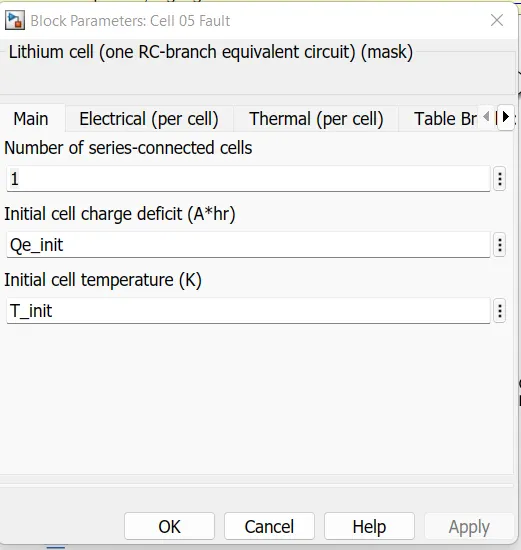
Below example shows how to simulate a battery pack consisting of multiple series-connected cells in an efficiently. It also shows how a fault can be introduced into one of the cells to see the impact on battery performance and cell temperatures. For efficiency, identical series-connected cells are not just simply modeled by connecting cell models in series. Instead a single cell is used, and the terminal voltage scaled up by the number of cells. Here The fault is represented by changing the parameters for the Cell 05 Fault subsystem, reducing both capacity and open-circuit voltage, and increasing the resistance values.Here the Changes are made in the base model according to our requirement to obtain the result.
The model for simulink is taken from the matlab lithium ion battery model:
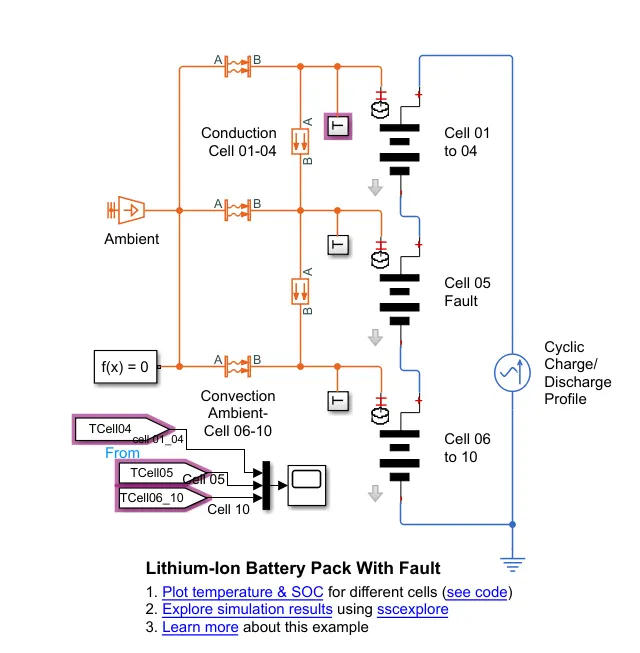
For Simulating thermal effect of module,Simulate a battery pack consisting of multiple series connected cells in an efficient manner.It also shows how a fault can be introduced into one of the cell to see impact on battery performance and cell temperature.For efficiency identical series connected cells are not just simply modeled by connecting cell modules in series.Instead a single cell is used ,and the terminal voltage scaled up by the number of cells.The fault is represented by changing the parameters for the 05 cell fault system,reducing both capacity and open circuit voltage and increasing the resistance values.
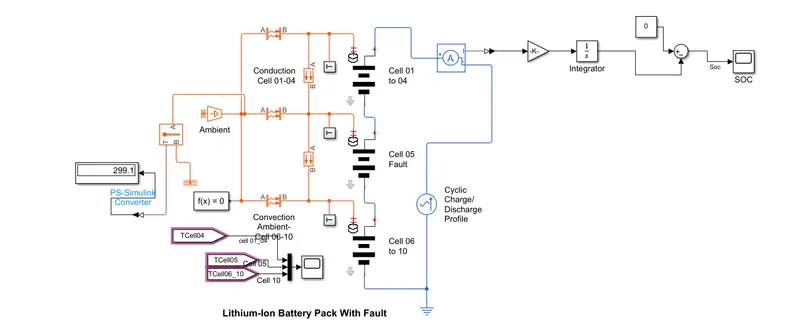
Simulink Model
The block Used in the Model
Temperature Sensor
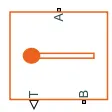
This block measures temperature in a thermal network. There is no heat flow through the sensor. The physical signal port T reports the temperature difference across the sensor. The measurement is positive when the temperature at port A is greater than the temperature at port B.
Temperature Source
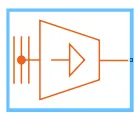
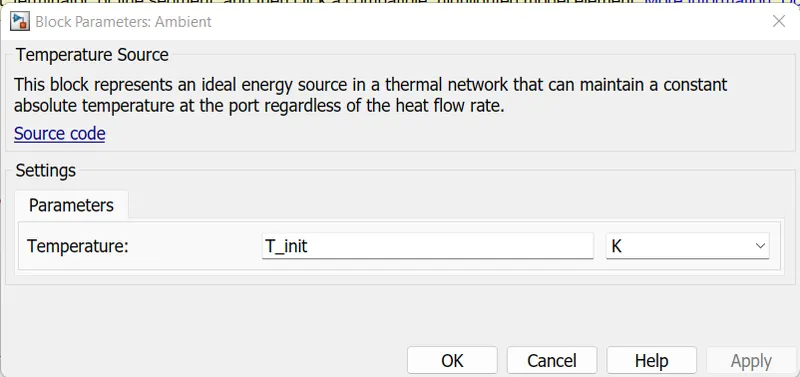
Convective Heat Transfer
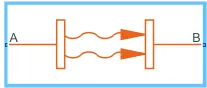
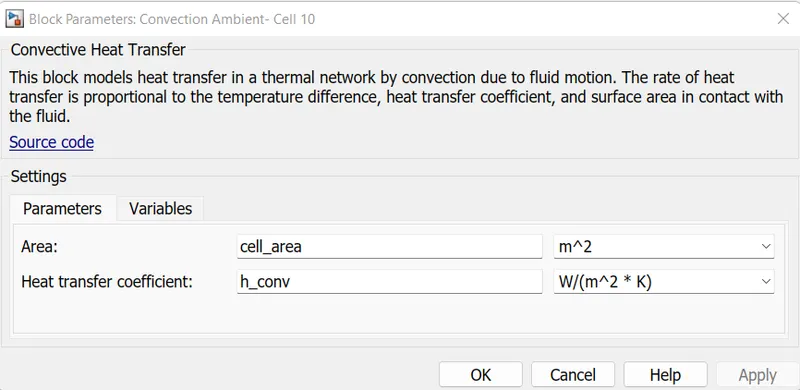
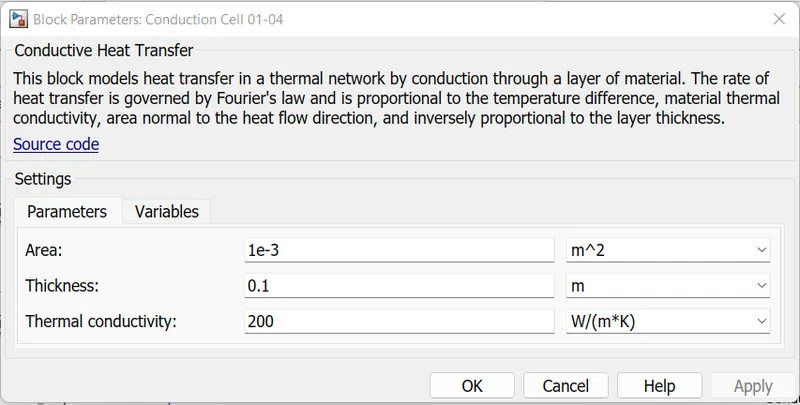
Conductive Heat Transfer

Battery Pack
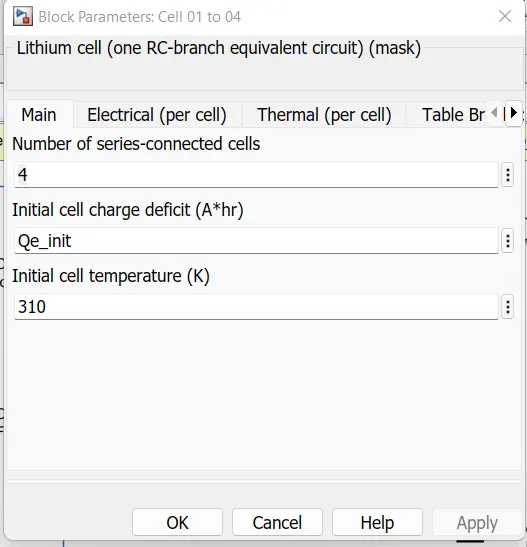
Battery pack Parameters
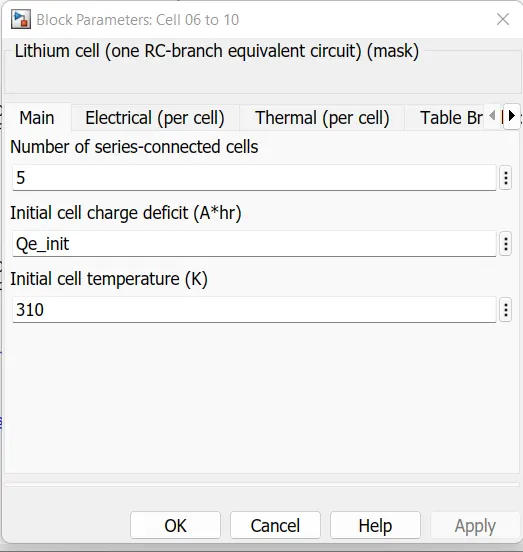
Battery Subsystem
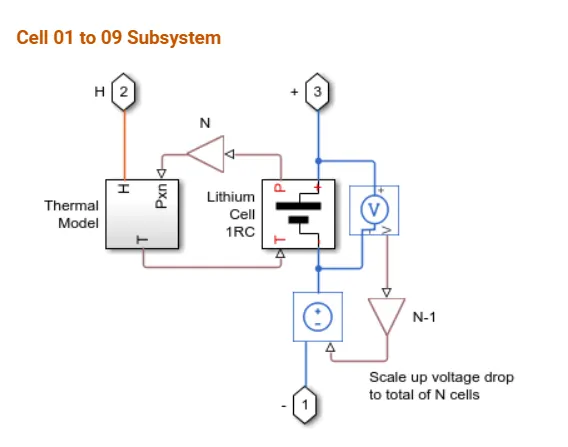
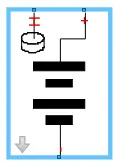
This consists of thermal model and lithium Cell 1RC block which Calculates temperature and thermal effect of cell and overall calculations of the battery pack.
The PS gain block multiplies the input Physical signal by a constant.other blocks used are voltage sensor and current sensor.
Litium Cell 1RC
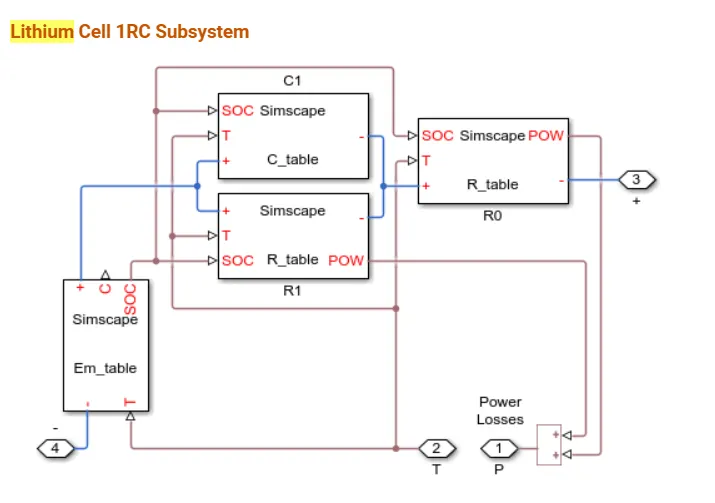
It consists of capacitor value table which depends upon the external physical signal input ,SOC and T.
Capacitor value varies with time and hence the equation i=C*Dv/dt
Resistance value depends on the external physical signal inputs,SOC and T
Voltage value (Em)implements the cell's main branch voltage source and determine values for capacity and SOC.
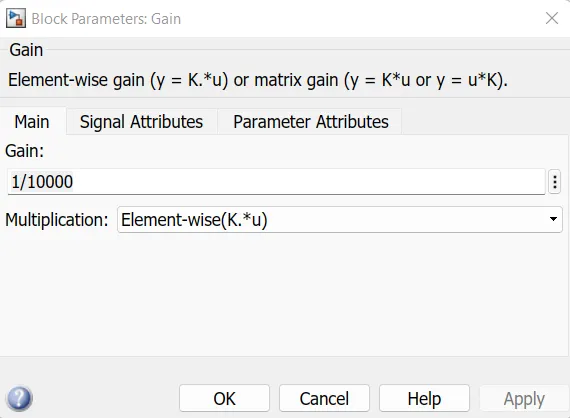
Gain block
Output Waveform:
For the Study we are getting results for different cell temperature
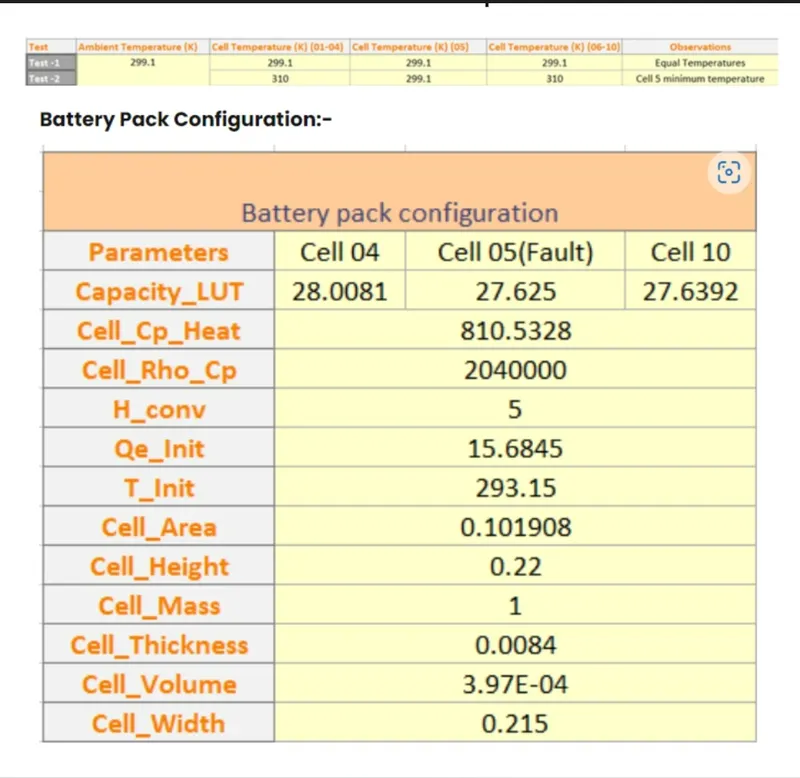
Here we have Ambient temperature of 299.1 K or 25 C
Test 1:
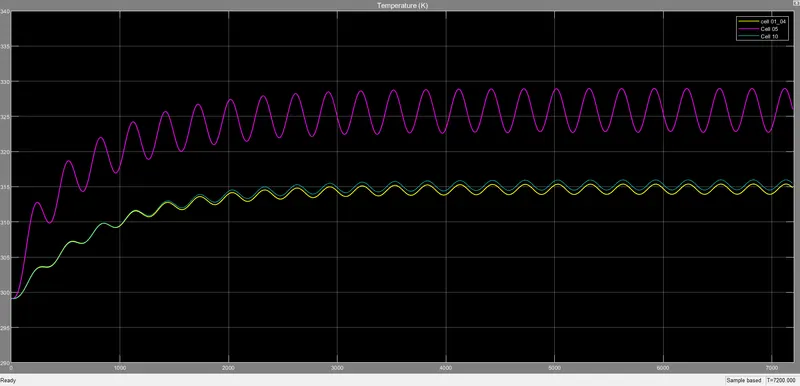
Here all the three cells having the same temperature at the starting that is 299.1 K but in the beginning few seconds of simulation cell no 5 oscillates with more the cell 4 and cell 10 because of its design with fault and ranging to higher temperature than cell 4 and 10.After a time period of around 1400 sec both the cells getting are unfollowing the temperature line which was following thw same temperature rate,Cell no 4 and 10 having aproximately 325 K.at the end of the simulation and cell no 5 is achieving the higher temperature of around 340 K
SOC
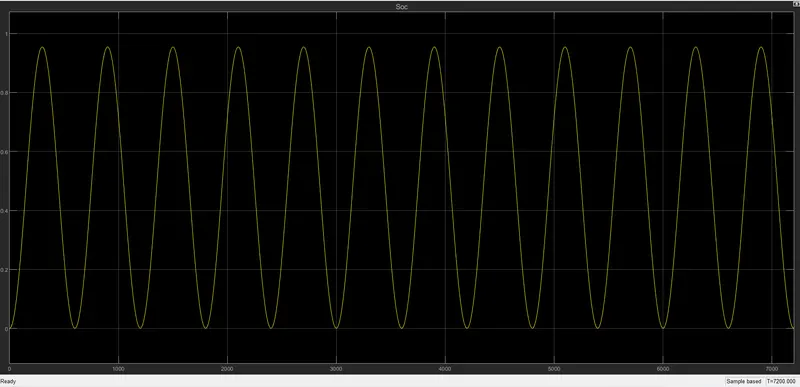
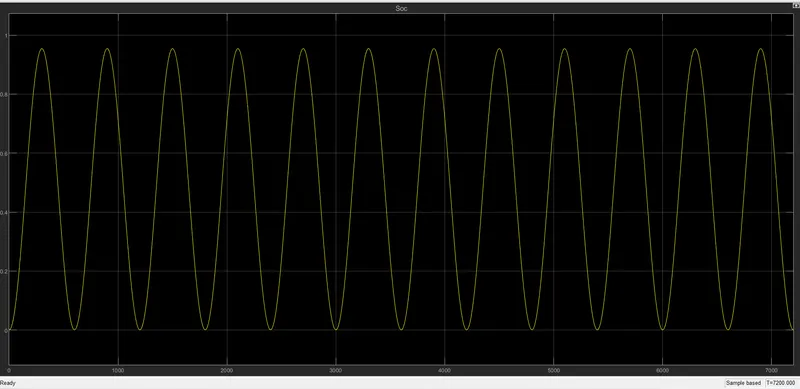
The Soc Graph following the Sinusidal waveform structure and fluctuating after 297 seconds and this waveform achieving around 0.98 Soc
Test 2
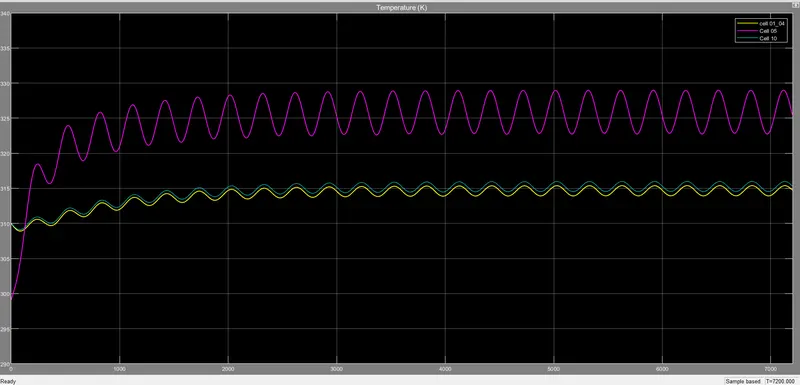
here the cell no 4 and cell no 10 starting from the temperature of 310 K at the start of simulationn and cell no 5 from 299.1 K with higher oscillation as compared to the other cell because of fault design hera at the end of simulation the cell no 4 and 10 having the final temperature of near by 315 k and cell no achieving the temperature of 328 K.
SOC
CONCLUSION:
- Lithium-ion chemistries tend to operate best between about 10 and 35 °C; this is referred to as the optimal temperature range. This is where you want the batteries to be at most of the time. However, most all lithium-ion chemistries will still operate down to about −20 °C and up to about 45 °C; this is known as the operational range. In this temperature range, no reduction in battery life would be expected to be experienced during normal operation. Between −20 and −40 °C the electrolytes may begin to freeze and the cold temperatures increase the impedance within the cell thereby resisting the flow of ions and reducing capacity and performance, and above 60 °C many lithium-ion cell chemistries begin to get more unstable; this is known as the survival temperature range.
- in high-temperature environments where the ambient air temperature is already in the 30–35°C range or higher, it becomes even more important to be able to reduce the temperature down below the ambient in order to ensure life, performance, and against catastrophic failure. Constant operation at high temperatures reduces cell life and speeds the aging process.
- from the above Model We can conclude that when the Battery cell operates under high temp with fault design the battery reduces theLife ,performance and the Speed aging process.