Project 2 - Design and Development of Pulse Oximeter (Medical Technology)
PROJECT 2- DESIGN AND DEVELOPMENT OF PULSE OXIMETER (MEDICAL TECHNOLOGY)
PULSE OXIMETER
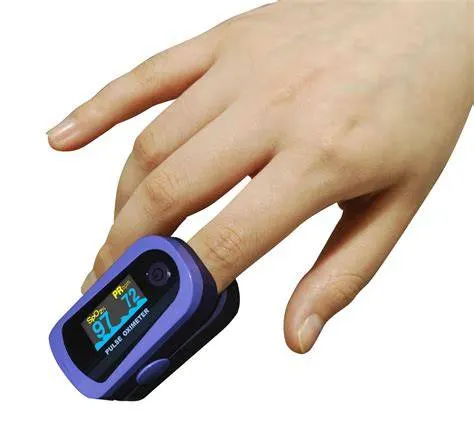
- Pulse oximetry is a noninvasive test that measures the oxygen saturation level of our blood.
- It can rapidly detect even small changes in oxygen levels. These levels show how efficiently blood is carrying oxygen to the extremities furthest from our heart, including our arms and legs.
- The pulse oximeter is a small, clip-like device. It attaches to a body part, most commonly to a finger.
- Medical professionals often use them in critical care settings like emergency rooms or hospitals. Some doctors, such as pulmonologists, may use them in office settings. We can even use one at home.
Purpose and uses
The purpose of pulse oximetry is to see if your blood is well oxygenated. Medical professionals may use pulse oximeters to monitor the health of people with conditions that affect blood oxygen levels, especially while they’re in the hospital.
These can include:
- lung cancer
- chronic obstructive pulmonary disease(COPD)
- asthma
- pneumonia
- anemia
- heart attack or heart failure
How to take a reading
To take a reading with a pulse oximeter, you will:
- Remove any jewelry or fingernail polish on your finger if measuring from this location.
- Make sure your hand is warm, relaxed, and below heart level if attaching the device here.
- Place the device on your finger, earlobe, or toe.
- Keep the device on for as long as needed to monitor your pulse and oxygen saturation.
- Remove the device once the test is over.
TASK 1
MARKET ANALYSIS
a-Addressable market size
- One of the primary factors driving demand for wearable pulse oximeter devices is the increased prevalence of chronic medical conditions, as well as the global elderly population. Patients' and healthcare professionals' growing desire for non-invasive medical equipment and treatments is also fueling market growth. The increased use of portable and wearable oximeter versions, particularly among patients with chronic obstructive pulmonary disease (COPD), is further driving product demand.
- Various technical innovations, such as advances in microprocessor technology, light-emitting diodes, and photoelectric sensors for improved accuracy and reliability of pulse oximeters, are boosting oximeter device demand. Other factors expected to drive the market during the forecast period include rising healthcare expenditures, the integration of oximeters with artificial intelligence (AI), and the introduction of variants compatible with Android and Apple operating systems for maintaining electronic medical records (EMR).
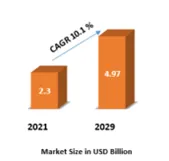
- Pulse Oximeter Market was valued at USD 2.3 Billion in 2021, and it is expected to reach USD 4.97 Billion by 2029, exhibiting a CAGR of 10.1 % during the forecast period (2022-2029). Rising awareness regarding applications of pulse oximeters in COVID-19 management and the increasing prevalence of target diseases is expected to drive the growth of the market.
b-Market segmentation
Research has segmented the global pulse oximeter market report on the basis of type, end-use, and region:
-
Type Outlook (Revenue, USD Million, 2016 - 2028)
-
Fingertip
-
Handheld
-
Others
-
-
End-use Outlook (Revenue, USD Million, 2016 - 2028)
-
Hospitals & Other Healthcare Facilities
-
Homecare
-
-
Regional Outlook (Revenue, USD Million, 2016 - 2028)
-
North America
-
U.S.
-
Canada
-
-
Europe
-
U.K.
-
Germany
-
France
-
Italy
-
Spain
-
-
Asia Pacific
-
China
-
Japan
-
India
-
Latin America
-
Brazil
-
Mexico
-
-
Middle East & Africa (MEA)
-
South Africa
-
-
c-Prominent players in the pulse oximeter market
-
Medtronic (Covidien)
-
Carefusion Corp.
-
GE Healthcare
-
Philips Healthcare
-
Masimo
-
CAS Medical Systems, Inc.
-
Opto Circuits India Ltd.
-
Nonin Medical, Inc.
-
Smiths Medical
-
Welch Allyn
-
Spacelabs Healthcare
-
Meditech Equipment Co.
-
Nihon Kohden Corporation
d-Key trends in the market
A pulse oximeter is a small device used to measure the concentration of oxygen in the blood in a painless and easy way. It is typically clipped to the third finger of the dominant hand to measure the oxygen level in the blood. Pulse oximeters are available with separate sensors and measuring units, as well as fingertip measuring devices. Readings from a pulse oximeter usually consist of two numbers, the pulse (heart) rate and SpO2. A normal SpO2 reading is expected to be 95% or above.
- After the COVID-19 pandemic, there is increased awareness regarding monitoring of oxygen levels as a key indicator of potential respiratory-related health issues, bolstering the demand for pulse oximeters by general users.
- Increasing prevalence of respiratory conditions such as asthma, pneumonia, and chronic obstructive pulmonary disease are expected to help in the growth of the market.
- Developing countries are investing largely to bring transformation and development in healthcare capabilities, such as pulse oximeters and other medical devices, which will fuel the market growth. Pulse oximeters are low-cost and effective, making them an excellent choice for healthcare systems with limited budgets.
- Increase in the hospitalisations and surgical procedure are also contributing to the growth of the pulse oximeter market as patients require careful monitoring of oxygen levels needs before and after surgeries or other medical procedures.
e-The state-of-the-art products
There are six main types of pulse oximeters:
- Fingertip
- Handheld
- Benchtop
- Phone-based
- Wearable (e.g. watches)
- Multimodal (e.g. integrated into other types of monitors)

| Q4 '22 | Q1 '23 | Q2 '23 | Q3 '23 | Q4' 23 |
|
|
|
|
|
Product Description:-Pulse oximetry measures the oxygen saturation level of our blood that gives an accurate and reliable readings. It is lightweight, portable, accomodates wide range of finger sizes and convenient.
Benefits Statement:- "STAY ON TOP OF YOUR HEALTH" – Regular monitoring of blood oxygen saturation & pulse becomes crucial when staying on top of your health, either because of heart problems, pulmonary diseases or asthma or simply during strenuous sports activity.
Business Objectives:- To build a healthy home by constantly monitoring the health.
Core Market:-The pulse oximeter market is segmented on the basis of product type, structure, size, application and distribution channel.
Stakeholders:-defines customers, shareholders, in-vestors, employees, suppliers, government agencies, research institutes and communities that directly and indirectly affect its business operations as its stakeholders.
c-Resource Requirements
Staffing requirements:
- Generally we require mechanical and electrical engineers.
- No. of staffs depends on the volume of production.
Budget requirements:
- To develop a headphone, requires lot many parts like Raw materials, Specialty chemicals, Battery components, Batteries, Technology components, Auto suppliers,Charging infrastructure and cost of these parts depends on the company that we buy from.
- the cost of the staff, depends on the volume of production, high production means requires many staff members.
- It also includes fixed cost like land, machines etc.
| Customer needs | Product specification |
| The Oximeter needs to have a better accuracy without any fluctuations. | Oximeter with accurate and reliable readings |
| The Oximeter should be easy to carry. | A portable and light weight oximeter |
| Oximeter should be able to accomodate any finger size. | Accomodates wide range of finger sizes and convenient |
| Oximeter should be easy to handle. | Non-Invasive Pulse Oximeter |
| Oximeter should not give any electrical shock. | A safe and reliable oximeter. |
| Oximeter should have long shell life and affordable. | Oximeter with 2 years warranty. |
TASK 3
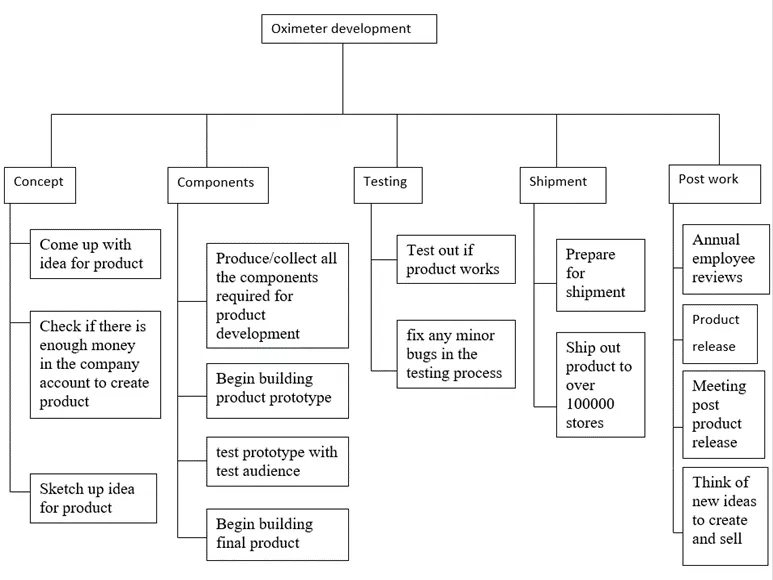
a-Work breakdown structure(WBS)
b-Product architecture
Integral architecture
- An integral architecture is best, as it does not consume much space, dont have to spend time in assembling the products, compact etc.
- Reduce Liability for Scaling
- Business Agility Increases
- Helps to Scale
- Increase the Chance to Earn More Profit
c-Pulse oximeter- 3D model, Rendering, 2D sketch- PDF ATTACHED
TASK 4
| Components/ process | Failure mode | Failure effects | SEV | Potential cause | OCC | Detection method | DET | RPN |
| Sensor |
damage/fracture,
yielding,
fluctuations.
|
Reduced performance
and in some cases not
operable at all.
Not sensing accurately
varying readings
|
8 |
High temperature, high charging rates,
overheating, inefficient battery casing, Spillage of water
|
5 |
Reduced performance,
varying readings,short circuit.
|
3 | 120 |
| Body |
Bending and
breakage.
|
difficulty in opening and closing, apprearence fault
|
4 |
spring failure, fall,Spillage of water
|
3 |
Bending, not opening
breakage
|
1 | 12 |
| Display |
Blur, blank screen.
|
Reduced performance
and in some cases not
operable at all, inaccurate readings display.
|
7 |
Damage to body and sensor, overheating, battery failure,Spillage of water.
|
4 |
Blur, blank screen.
|
3 | 84 |
| Battery |
Short circuit, electrolyte loss, electrolyte stratifaction
|
Reduced performance
and in some cases not
operable at all, inaccurate readings display.
|
9 |
Overheating, body damage, rusting, chemical leakage.Spillage of water
|
7 |
Oximeter not operable
|
3 | 189 |
| LED |
Not turning ON, Not showing indication
|
Improper indication and functioning
|
7 |
Battery damage, chemical leakage,Spillage of water
|
4 | Not turning ON, Not showing indication | 3 | 84 |
2)
| Components/ process | Recommended Actions | Responsibility | Target Date | Action Taken | SEV | OCC | DET | NEW RPN |
| Sensor | Replace new sensor | owner,manufacturer | immediate | new sensor replacement | 4 | 2 | 3 | 24 |
| Body |
Buy new product or replace the damaged parts
|
Owner | immediate |
Replace damaged parts
|
2 | 1 | 1 | 2 |
| Display | Check battery, Check circuit connections, give it for service | Owner | immediate |
Service, battery replacement
|
4 | 2 | 3 | 24 |
| Battery | Replace new batteries | Manufacturer,Owner | immediate | New batteries replacement | 4 | 3 | 3 | 36 |
| LED |
Check battery, replace LED's
|
Manufacturer, Owner | immediate | Change battery | 4 | 2 | 3 | 24 |
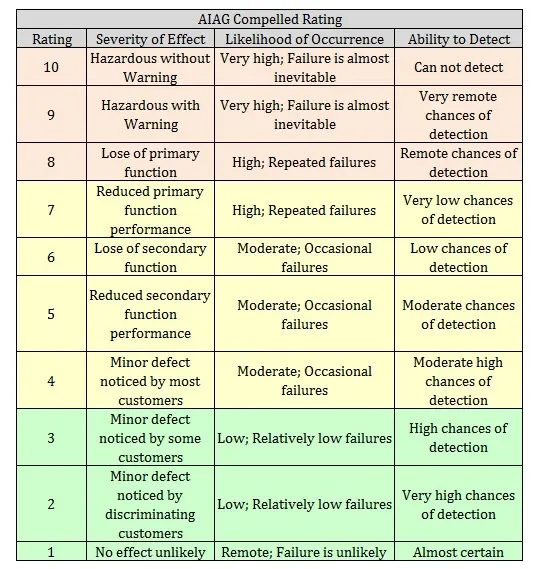
Reasons for selecting above ranks:-
b-FAULT TREE ANALYSIS
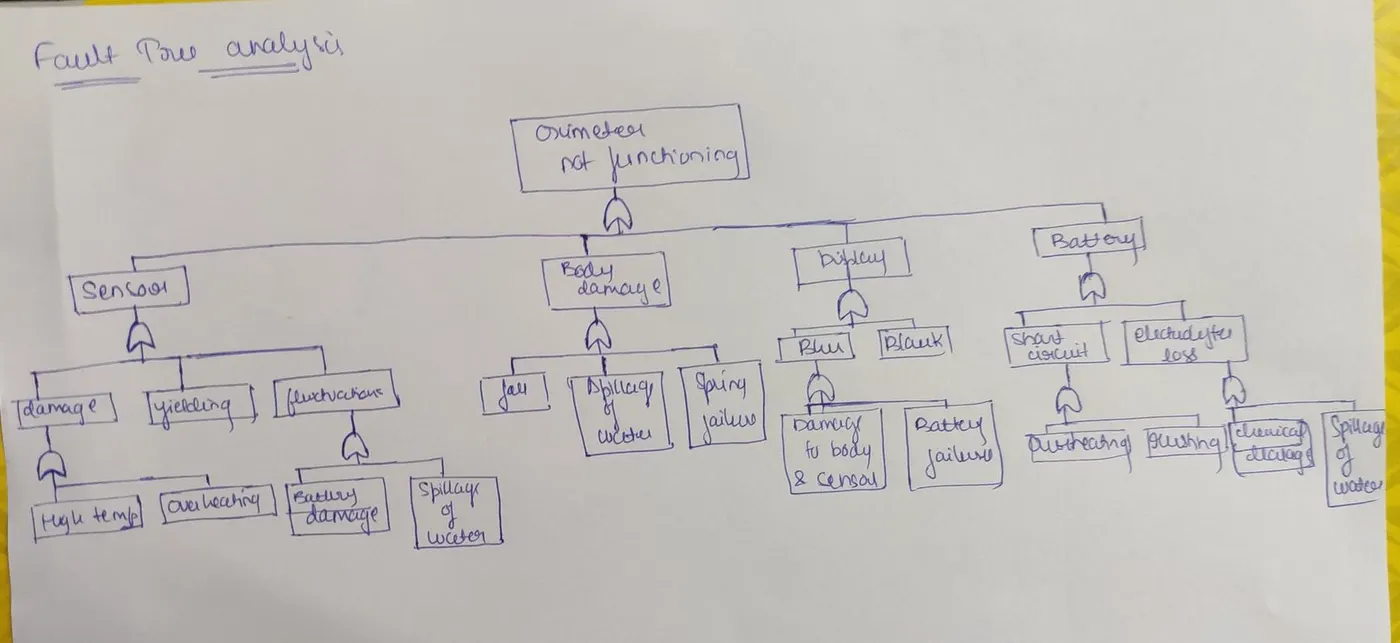
TASK 5
- Transmissive vs. Reflective:-A PPG signal can be obtained using a transmissive or reflective LED and PD configuration. A transmissive configuration measures the nonabsorbed light passed through a part of the body. This configuration is best suited to areas such as the finger and earlobe where measurement benefits from the capillary density of these body locations, which make the measurements more stable, repetitive, and less sensitive to variations in placement.
-
Sensor Positioning and Perfusion Index
Positioning on the wrist and chest require greater dynamic range in the PPG AFE as the DC signal is greatly increased due to the depth of the arteries below static reflective components such as skin, fat, and bone.Greater resolution in the PPG measurements will reduce the uncertainty in the SpO2 algorithm. With a typical PI of 1% to 2% for wrist-worn SpO2 sensors, the goal of pulse oximeter design is to increase the PI through mechanical design or to increase the dynamic range.
-
Motion Artifacts
Motion artifacts provide one of the greatest design challenges to a PPG measurement system. When motion is present, the width of the arteries and veins change due to pressure. The amount of light absorbed by the photodiode changes and this is present on the PPG signal because photons are absorbed or reflected differently than when a body is at rest.
For an infinitely wide photodiode area covering an infinitely long deep tissue sample, all photons will eventually be reflected to the photodiode. In this case, no artifact due to motion will be detected. This, however, cannot be achieved; the solution is to increase the photodiode area while taking capacitance into account—lowering AFE and providing filtering for motion artifacts.
-
Optical AFE
The positioning of the pulse oximeter generates several challenges. Wrist-worn SpO2 devices provide additional design challenges as the AC signal of interest is only 1% to 2% of the total received light on the PD. To achieve medical grade certification and distinguish between slight variations in oxyhemoglobin levels, a higher dynamic range on the AC signal is required. This can be achieved by reducing ambient light interference and decreasing LED driver and AFE noise.
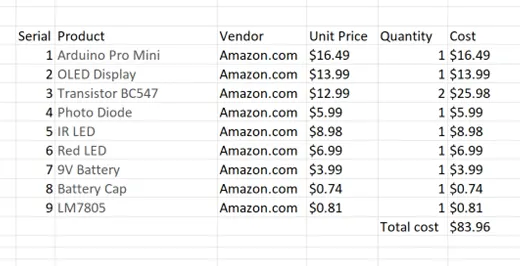
b-Estimated cost breakdown:-
| LIFE CYCLE | ENVIRONMENTAL IMPACTS |
| Materials |
|
| Production |
|
| Distribution |
|
| Use |
|
| Recovery |
|
Ways to reduce the environmental impact
Increase Recycling
One of the most obvious ways for a manufacturing business to reduce environmental impact is simply to increase recycling. Most businesses in this industry get through a tremendous amount of material, so it is important that this is all properly disposed of, meaning recyclable materials are put in the proper bins. This can be achieved by increasing the number of recycling bins available while also using a compactor to create easy-to-manage bundles of recycled material.
Custom Conveyors
A smart way to reduce energy consumption and to streamline the entire operation is with the use of custom-made conveyors. Having a conveyor built specifically for your operation and for your location can eliminate wasted time while ensuring that material is moved quickly and efficiently to reduce energy usage while also improving the performance of your business.
Alternative Energy
An increasing number of businesses are moving away from oil, gas, and traditional forms of electricity and instead, starting to use alternative energy, such as solar, wind, or geothermla energy. This can have a significant impact on the impact of your company, plus it can also help to drastically lower your running costs. Not only this, but switching to alternative energy can also help to enhance the reputation of your manufacturing business.
Local And/Or Green Suppliers
You must also look to the businesses that you use as suppliers and look at their own green credentials. Switching to a green supplier is an effective way to reduce your environmental impact, especially if this is a local supplier, as it will help to cut down on travel costs while also allowing you to support the local economy.
Be Paperless
Being a paperless business is another intelligent step to take and one which can improve the company in many ways. In addition to reducing environmental impact, going paperless can reduce running costs, cut down on storage space, and help to improve the efficiency of the operation.
Use Green Materials
You should consider the materials that you currently use in your manufacturing business and see if you could make a switch to something that is environmentally-friendly. This may not always be possible, but if it is an option, as functionality is often dependent on a material, then it should certainly be implemented.
- Manufacturing of every new vehicle starts with prototyping, but it can turn out to be a time-consuming and potentially expensive process if done the traditional way.
- The 3D printing software has revolutionized the product development process, allowing OEMs to fabricate a high-fidelity and representative prototype of a physical part, be it a simple interior element to a dashboard or even a scale made of the entire car within a matter of days.
- Leveraging 3D printing, auto manufacturers can print highly detailed, accurate, and smooth full-scale parts, which are essential for demonstrating new concepts and designs as well as performance testing and validation. Additionally, desktop 3D printers allow engineering and design teams to increase iteration cycles and strengthen their overall product development flows.
- Thus, the use of 3D printing in the automotive industry can reduce production time, and manufacturing costs, and create lighter and clean automotive designs.
- 3D printers allow manufacturers to produce low-volume and customized production parts on demand without high costs or long waiting times. Besides, the accuracy and reliability of 3D printers enable designers to meet the demands with consistent results without using production tooling.
- In a way, 3D printing technology empowers manufacturers with vast new capabilities in what they are able to offer to their customers.
- For small companies that place “custom” at their core, 3D printing of car parts has provided them the opportunity to enhance the creativity of their work and improve quality without worrying about the potential expense and time-intensive manufacturing process that comes with customization.
- Engineers utilize manufacturing aids for simple and reliable manufacturing and assembly processes, which provides added advantage of reduced cycle times and enhanced worker safety.
- The optimized product designs created via 3D printing processes perform more efficiently, cut the lead time to a few hours and reduce costs when compared to outsourcing parts from an external vendor. 3D printing also allows for more ergonomic tools for manufacturers, which can help prevent strain on assembly workers.
- One of the greatest benefits of using 3D printing in the automotive industry is the production of end parts with lower weight to manufacture vehicles that consume less fuel while improving or maintaining their functioning.
- Lighter parts of the ELECTRIC VEHICLE help to extend the battery life with improved distribution of weight on the axles. Since 3D printing is not restricted in terms of design freedom, it allows engineers to design end parts conveniently. Additive manufacturing also allows part simplification through the consolidation of multiple parts into a single design, which reduces or eliminates the need for assembling parts.
- With rapid advancements in additive manufacturing, the selection of materials for 3D printing has increased significantly over the years and continues to evolve.
- The increased options of custom materials with specific mechanical properties have opened doors for automotive manufacturers to transition from making components with polymer instead of metal.
- This has led to a further reduction in the weight of electric cars without sacrificing their strength, quality, or safety. Better thermal capabilities of 3D printing can be a game-changer for electric vehicles since managing the temperature of batteries can sometimes be tricky to keep under optimal conditions.
- The life of Li-ion batteries can be prolonged if they persistently operate at a mild temperature. Thus, EV batteries must remain at a temperature of around 25 ° Celsius. Producing encasings using 3D printing can further help regulate temperature and provide high performance with a low degree of machine work and a fast development cycle.
- Demand for spare parts in the automotive industry is sporadic and unpredictable, making their value a debatable financial decision in some instances. Producing spares in anticipation requires a great expenditure for storage and production. In the absence of readily available parts, the value of spares can become more precarious and make repairs more difficult.
- With 3D printing, manufacturers can design all parts that can be kept as digital copies, eliminating the need to keep the inventory obsolete. At the customer’s request, a spare part could potentially be produced in-store, thus enabling an easy supply of 3D-printed auto components and spare parts.
- Besides, 3D printing can help manufacturers better connect the physical supply chain with a digital thread and eliminate the cost of warehousing and inventory when it comes to housing spare parts. Besides, OEMs can optimize part designs for traditional manufacturing during high-demand phases as well as enable a more efficient and sustainable supply chain.
- Even parts that are no longer available can be produced with the help of 3D printing technology. People who have classic models can avail of spare parts required for any kind of restoration with the available scans of spare parts.
e-Consider how you can design your electric scooter to make it harder for people to do reverse engineering?
- Make sure the original documents are available.
- Integral architecture can be used.
- Design a complex structure, which makes it difficult to analyze the components design.
- Make sure the parts designed are unique and complex enough.