Project 2
Report on Wiring Harness Design & Flattening of Car Backdoor in CATIA V5
The wiring harness design of a car's backdoor plays a vital role in ensuring seamless electrical connections between various components, including tail lamps, central locking systems, rear wipers, and defoggers. Using CATIA V5, the design and development process is highly efficient, ensuring that all electrical requirements are met while considering space constraints, safety, and manufacturability.
1. 3D Model Import and Analysis
The design process starts with importing the 3D model of the car's backdoor into CATIA V5. This step allows for detailed spatial analysis to identify areas where the harness can be routed. The structure of the backdoor is reviewed to accommodate wire pathways without interfering with other mechanical components such as the latch, hinges, or the moving window mechanism.
2. Routing the Wiring Harness
In the Electrical Harness Assembly and Electrical Harness Routing workbenches, the harness path is defined. This routing ensures that wires are laid out in a way that prevents excessive bending, pinching, or exposure to mechanical wear. The wire bundles are guided along strategic paths, often using existing structural features for protection and support.
Careful consideration is given to factors such as vibration, door motion, and environmental exposure. Special mounting clips, clamps, and grommets are used to keep the wiring harness securely fastened in place during the opening and closing of the backdoor. By reducing sharp bends and allowing for some flexibility, the harness is designed to last longer under repetitive motion.
3. Bundle Segmentation and EMI Consideration
Wires are grouped into bundles based on their function (power, signal, and ground). Each bundle is routed separately, ensuring proper segregation to avoid cross-talk and electromagnetic interference (EMI). Shielding is applied where necessary to sensitive signal-carrying wires. The design also ensures easy access for installation and future maintenance.
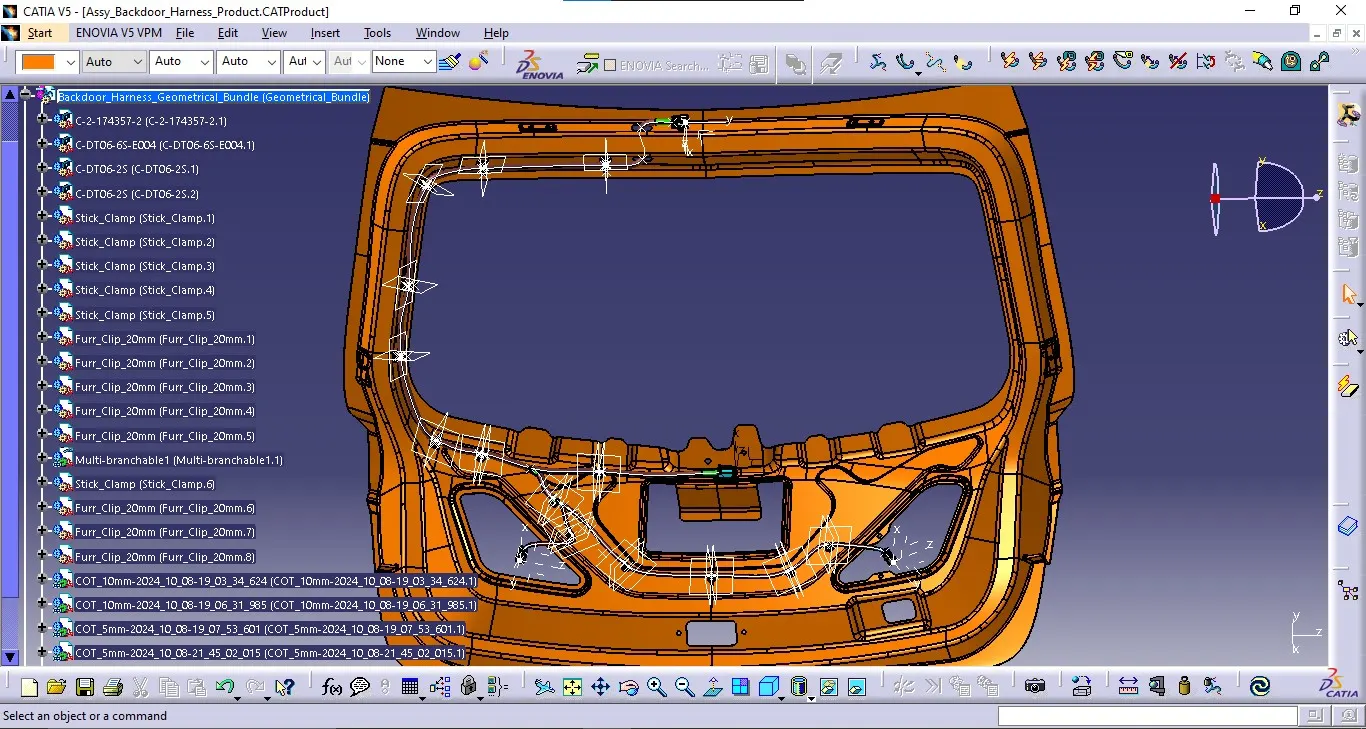
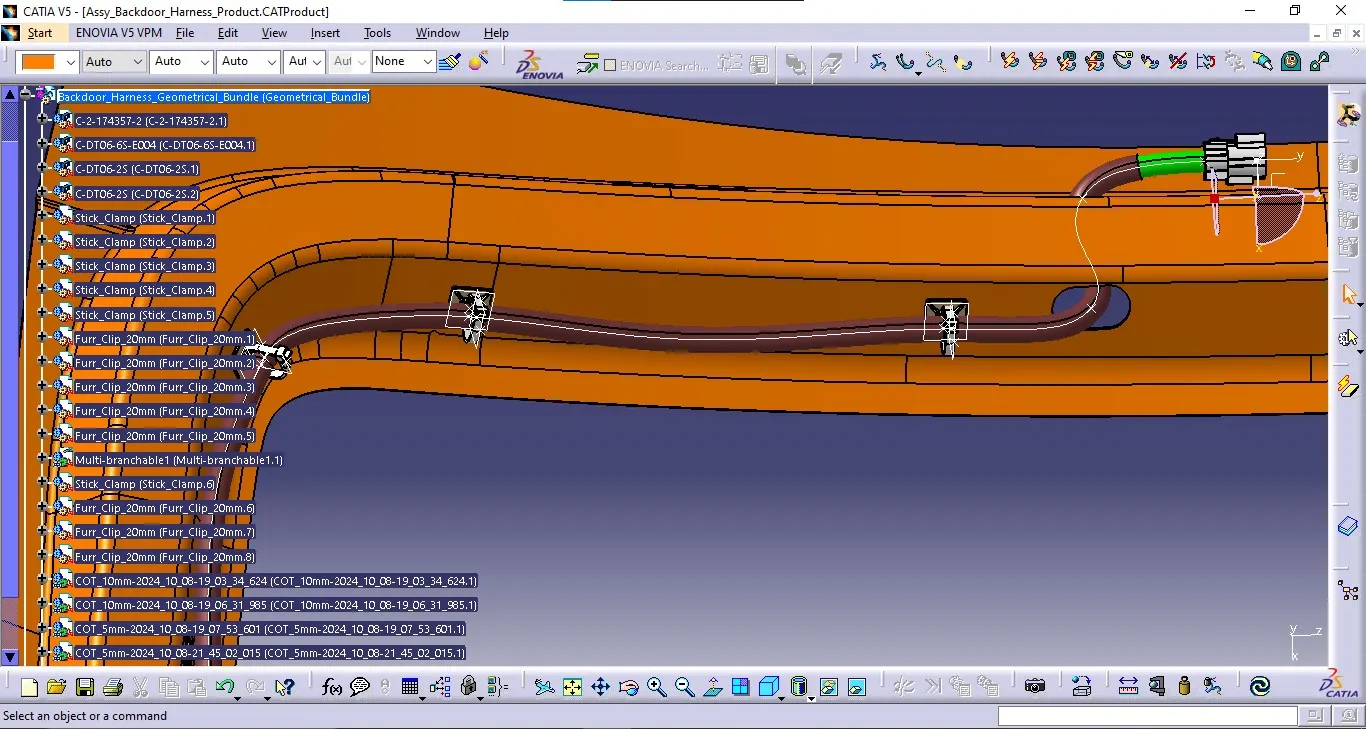
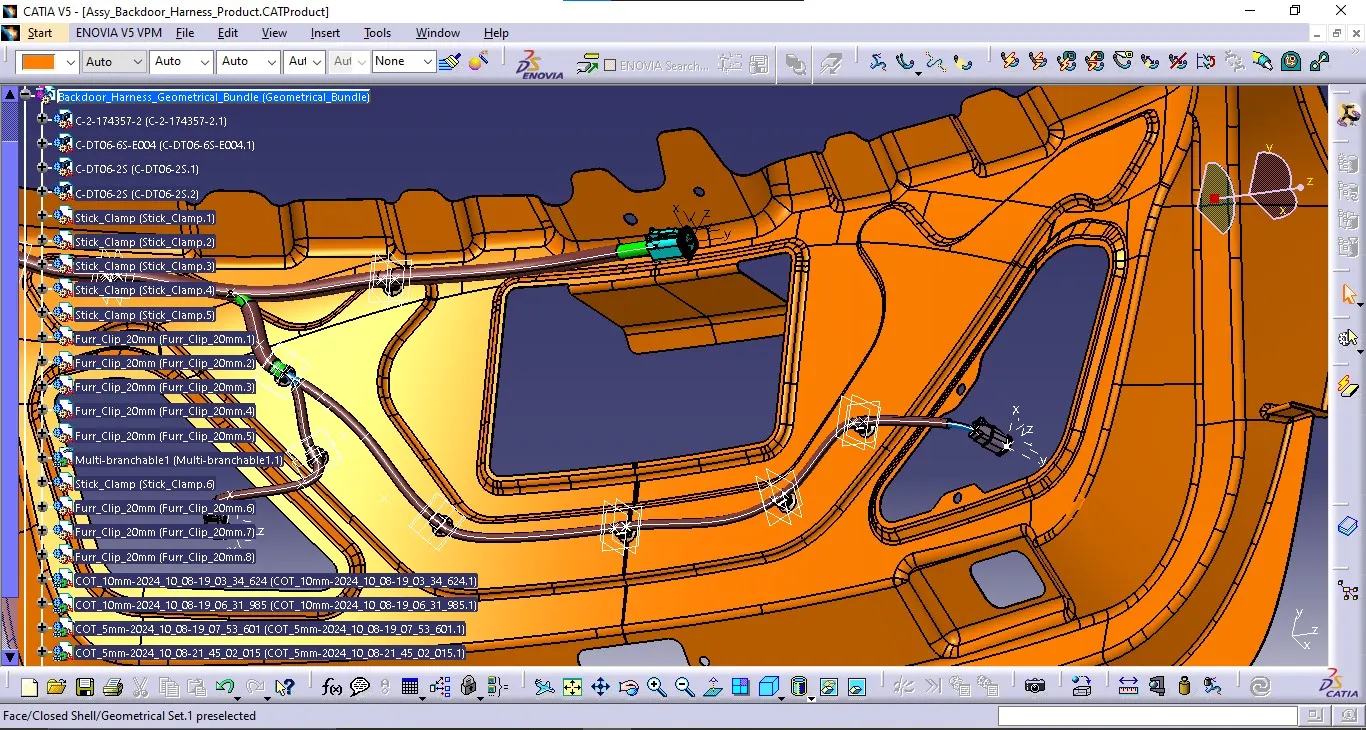
4. Flattening the Wiring Harness
Once the 3D harness routing is finalized, the Electrical Harness Flattening workbench is used to generate a 2D representation. Flattening the harness helps in creating a manufacturing-friendly layout. This process includes:
- Unfolding the 3D harness: Transforming the 3D design into a 2D layout, detailing each wire's length, connectors, and component positions.
- Dimensioning: Accurate dimensions are assigned to each segment to ensure precise production.
- Connector Details: The 2D layout specifies the types of connectors used, pin configurations, and orientation for proper assembly.
This flattened view is essential for the manufacturing team, as it provides clear guidance on the assembly process and ensures that the harness can be built exactly as designed.
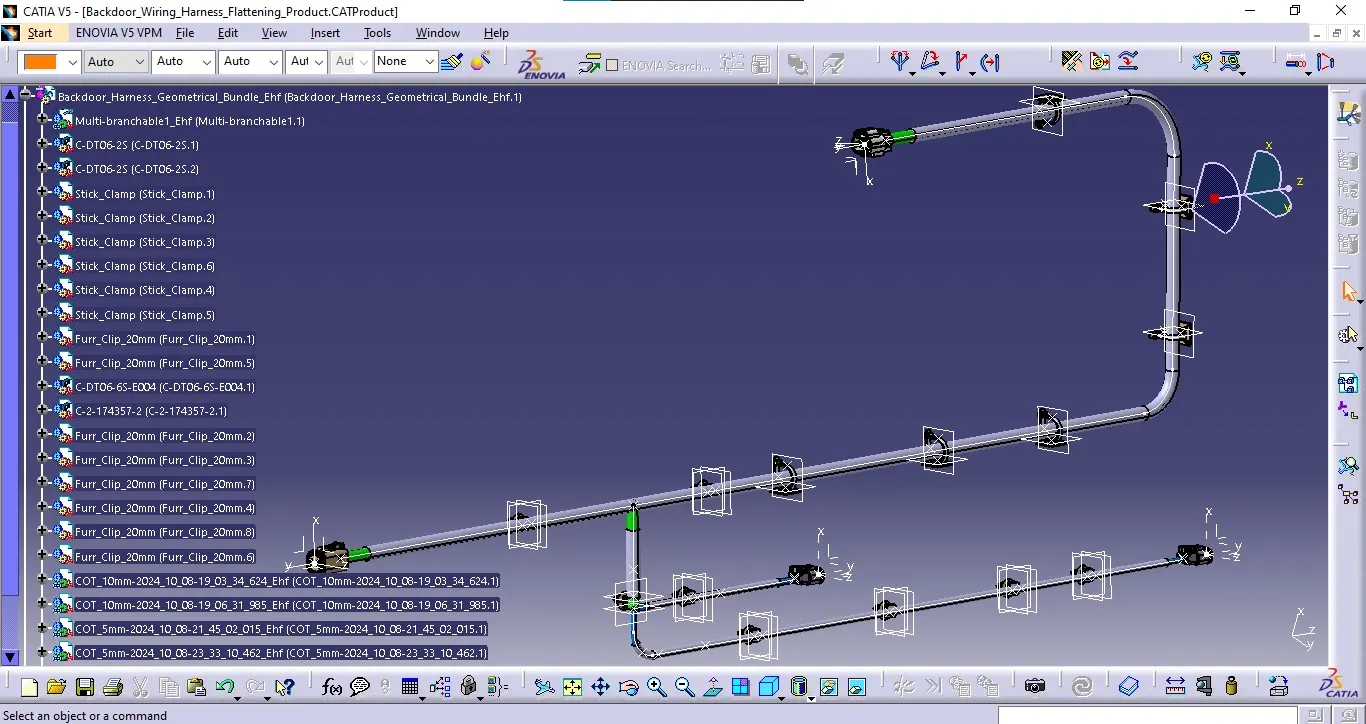
5. Validation and Simulation
After flattening, the design undergoes validation. CATIA V5's simulation tools verify that the harness can handle the mechanical stresses of backdoor operation, such as flexing during door movement. The design is checked for clearance issues, ensuring wires are not stretched, pinched, or damaged. Electrical continuity tests are also simulated to confirm that signals will be transmitted reliably.
6. Documentation and BOM Generation
Finally, CATIA V5 generates detailed documentation, including Bills of Materials (BOM), wire lengths, connector specifications, and routing instructions. This ensures that all stakeholders, from designers to manufacturers, have access to accurate and up-to-date information.
Conclusion
The wiring harness design and flattening process in CATIA V5 for the backdoor of a car ensures a robust, efficient, and manufactural solution. By utilizing the 3D and 2D tools within CATIA, designers can optimize harness routing, validate the mechanical and electrical functionality, and produce a detailed layout that streamlines the manufacturing process. The end result is a reliable wiring harness that meets the complex requirements of modern automotive backdoor systems.