Project 2
Design and development of Pulse Oximeter:
Heart is the most important part in human body. Thus, it is important to follow-up and monitor its condition. Heart rate (HR) and blood oxygen saturation (SpO2) are important indicators directly related to heart-pulmonary system. Monitoring of HR and SpO2 offers us a good indication of heart functionality. Therefore, it is crucial to design and develop a homemade inexpensive device for measuring HR and SpO2. Pulse Oximeter (PO) is an opto-electronic non-invasive medical instrument capable of measuring and recording the changes of HR and SpO2 at the finger tip.
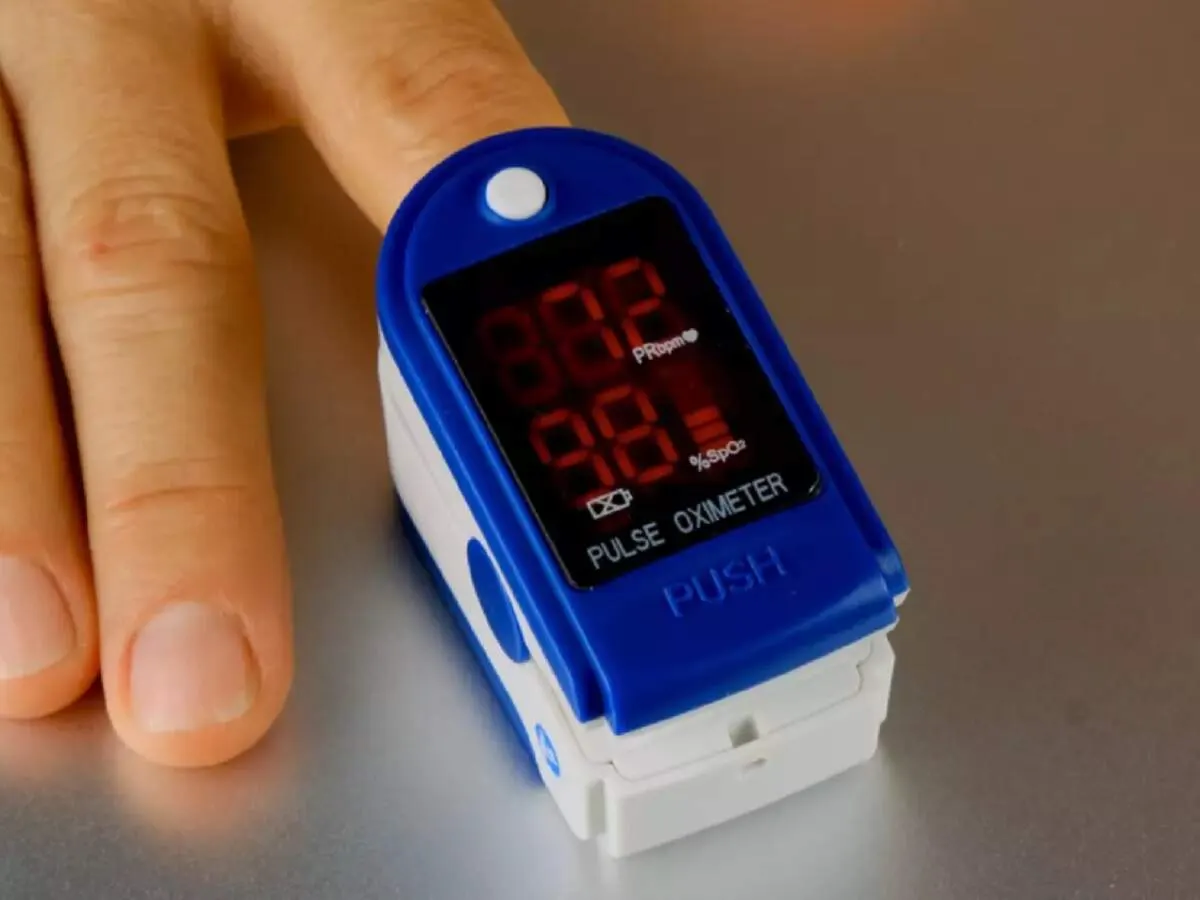
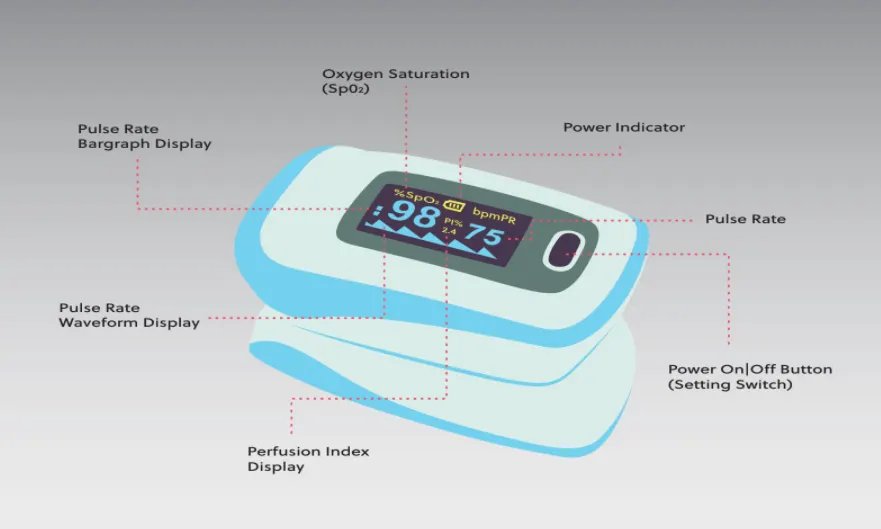
Pulse oximetry measures peripheral oxygen saturation (SpO2), which reflects the effectiveness of the cardiopulmonary system to provide oxygen-rich blood to the body. Athletes use SpO2 measurements to gauge their level of effort in workouts, but these measurements have gained greater importance during the COVID-19 pandemic. Healthcare providers watch for a decrease in SpO2 as an early warning sign of damage to lung tissue caused by the SARS-CoV-2 virus that causes COVID-19.
For affected individuals with mild symptoms told to quarantine at home, ready access to a low-cost pulse oximeter can help gauge the course of their infection and provide the warning needed to escalate healthcare.
A typical pulse oximeter design comprises three major subsystems:
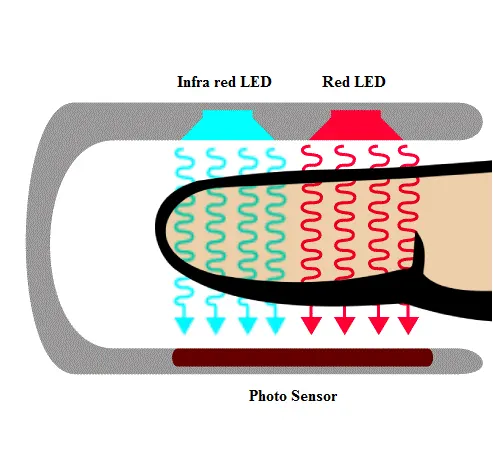
- A light delivery subsystem including analog switches and drivers along with light emitting diodes (LEDs) at red (660 nm) and infrared (IR) (950 nm) wavelengths. Some systems also include green (530 nm) sources for use with photoplethysmography (PPG) methods that determine heart rate by monitoring changes in volume in skin blood vessels.
- A light detection subsystem including a photodiode, signal conditioning chain, and analog-to-digital converter (ADC).
- A DSC or microcontroller to coordinate the light delivery and detection subsystems as well as calculate SpO2 from the measured data.
Although these basic subsystems exist in any pulse oximeter, their implementation can vary significantly. In transmissive pulse oximeters, the photodiode is placed on the opposite side of the user's finger or earlobe from the LEDs. Commonly available finger clip units combine red, IR, and optional green LEDs on one side of the clip with a photodiode on the other. In reflectance pulse oximeters, the photodiode and LEDs are placed on the same side of the skin with some optical barrier placed between them to reduce artifacts. For example, OSRAM's SFH7060 is a drop-in reflectance measurement device that packages LEDs and a photodiode in a single 7.2 x 2.5 x 0.9 millimeter (mm) package.
Whether using these optical packages for transmissive or reflectance methods, designers require relatively few additional components to implement a low-cost pulse oximeter design capable of providing home users with information suggesting the need for further evaluation by healthcare professionals. An example design built around a Microchip Technology DSPIC33FJ12GP802 DSC uses the microcontroller's integrated peripherals to control illumination of the skin by red and IR LEDs and to digitize the conditioned photodiode output signal
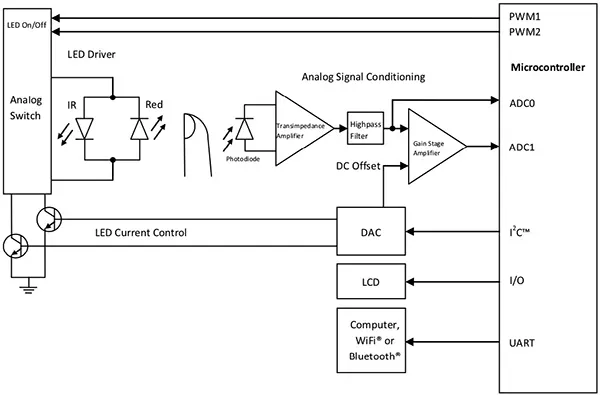
Pulse oximeter designs typically rely on a single photodiode with a broad spectral response curve to capture the transmitted or reflected signal regardless of the illumination source. To ensure that the received signal corresponds to just red or IR wavelengths, hardware or software control logic presents only the red or IR illumination source at a given time, alternating between the two sources to complete a sequence of measurements.
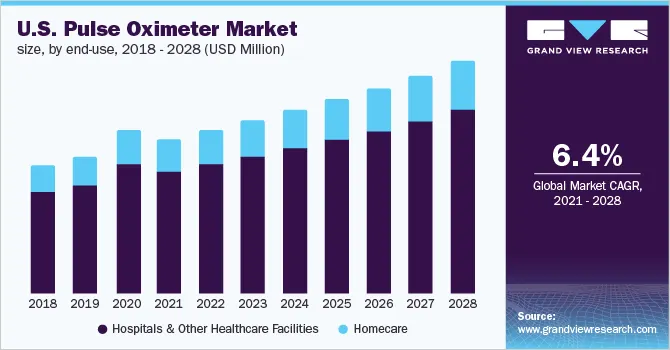
Availability of new products and high unmet needs in developing and least-developed economies are expected to boost market growth over the forecast period. Around 43 states in the U.S. have made pulse oximetry mandatory for newbron screening and is gaining popularity in other countries due to applications in the detection of Congenital Heart Defects (CHD) and other heart and respiratory conditions.
The growing prevalence of target diseases such as asthma, hyperlipidemia, hypertension, diabetes, ischemic conditions, cardiac arrhythmia, sleep apnea, and COPD is expected to be a major market driver over the forecast period. According to the WHO, around 64 million patients are currently living with COPD worldwide with approximately 90% of deaths due to COPD occurring in low- and middle-income countries.
High-quality pulse oximeters are critical for the early diagnosis and treatment of patients with COVID-19. The manufacturing and supply chains of pulse oximeters are expected to witness challenges during this period, as most of the companies are working at half their production capacities. Furthermore, trade restrictions across highly impacted countries are expected to limit the timely distribution of products. However, manufacturers are working to ensure an adequate supply of fingertip and handheld pulse oximeters to countries in dire need, as cases of COVID-19 continue to increase at an exponential rate.
Purchase of raw material and services:
A typical pulse oximeter uses an electronic processor and a pair of small light-emitting diodes (LEDs) facing a photodiode through a translucent part of the patient's body, usually a fingertip or an earlobe. One LED is red, with wavelength of 660 nm, and the other is infrared with a wavelength of 940 nm.
Materials Selection:The principles of light transmittance/absorbance through an arterial bed is used in this project, so we need a light source in order to transmit the light through a small area (such as the finger). we also need a detector that can convert the transmitted light into an electrical signal which would be my desired sig-nal. Due to the fact that we are operating in a small area, we need small light sources and detectors. This can be accomplished via LED’s and smallphotodetectors. These photodetectors can be either photodiodes or phototransistors, which are optoelec-tronic devices that work off the principle of detection of incident light which is then converted into an electrical signal. This electrical signal is a current.Since in electrical systems we wish to work with voltages (due to many factors, for example: ease of use, voltages is easier to manipulate etc) Therefore we need a system to convert this electrical signal into one we desire to work with. Therefore, both a hardware im-plementation (in order to acquire the signal) and software implementation (in order to post process it)
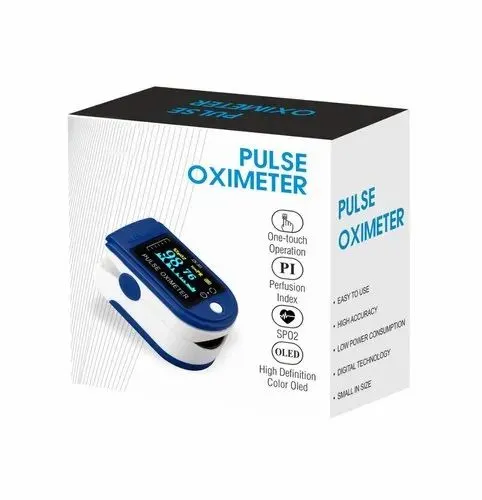
A pulse oximeter is a device that checks to see how much oxygen your blood is carrying.
Usually a small clip is put on the end of your finger. (Sometimes it's put on your toe or earlobe.) The device shines a light beam through the skin. It estimates your oxygen level by measuring the percentage of your blood that's carrying oxygen. Your oxygen level (or oxygen saturation, SpO2) shows on the display screen.
Pulse oximeters are used in doctors' offices and hospitals. Your doctor may think it's a good idea to use one at home. This may be the case for people who have a condition that affects their oxygen levels. Examples include people who have long-term heart or lung problems or an infection like COVID-19. Choose a device that has been approved to give accurate readings. Talk to your doctor if you want help choosing one.
steps to use pulse oximeter:
Turn on the pulse oximeter. (Check that it has batteries.) Clip it on the end of a finger. Your nail should be facing up. You'll see the results in a few seconds.
The device gives two results: your blood oxygen level (SpO2) and your pulse rate (PR). Your doctor can help you know what numbers are normal for you.
The device may not show any results if you have cold hands or you wear nail polish or artificial nails. Warm your hand, or remove the nail polish or nail. Or try a different finger.
Your doctor may suggest checking your oxygen level at different times, during exercise, or anytime your symptoms get worse. Keep a record of your levels in case you need to show it to your doctor.
Call your doctor if:
- Your blood oxygen level (SpO2) drops below 95%. This is true even if the number only drops when you're active.
If you have certain health problems, like COPD, your oxygen level may always be lower than 95%. Ask your doctor what oxygen number you should expect when using your pulse oximeter. Find out which number is a sign that you should call for help.
Watch closely for changes in your health, and be sure to contact your doctor if:
- Your symptoms get worse.
- You are not getting better as expected.
Periodic maintenance:
fruitful in handling and upkeep of the device When preventive maintenance is accompanied with sufficient documenting and digital records, it provides valuable knowledge. This is true in corrective maintenance, meaning maintenance after a failure, where previously recorded values in preventive maintenances may give insight where the problem lays. On the other hand, management can make a few valuable calculations from the service history database. These are, for example, the upkeep expenses considering a specific device, effectiveness of preventive maintenance and durability of different parts. Latter
comes handy in predicting when specific part is about to fail, so that the maintenanceinterval can be adjusted accordingly to exchange the specific part before any failure occurs. Additionally, management can increase inventory of that exchange part beforehand, cutting downtime and utilizing possible volume discounts.
- Physical Condition: Check to make sure the device is clean and decontaminated. Next, check to see if there is any physical damage to the case, display, mounts, cart or components. Both the switches and controls should be operable and correctly aligned. Check to see if the control numbers, labels and warnings are present. If so, are they legible? Next, check the inlets and hoses. Is the power cord and charger functioning properly? Last but not least, check both the filters and vents to make sure they are clean.
- Electrical Safety: Perform electical safety checks. Be sure to check the ground wire resistance and chassis leakage. Next, conduct a patient lead leakage current isolation test as well as an insulation test. All test results should fall within parameters set.
- Preventative Maintenance: First, clean the recorder paper compartment, rollers and paper guides. Next, lubricate the motor and paper drive mechanism. After lubrication, verify the date and time. Correct if necessary. The battery should be replaced every 24 months without question. If there are any additional, model-specific preventative maintenance procedures, be sure to complete these as well.
- Performance Testing: Verify the unit operates on battery. To do so, Check that the AC power indicator is lit when the power cord is plugged into an outlet. Now unplug the AC power cord and perform the remainder of the functional test on battery power. Next, check for both heart rate and SpO2 accuracy. Last but not least you should test the recorder operation and alarm function of your machine.
Best way of disposing of a pulse oximeter when it is no longer needed:
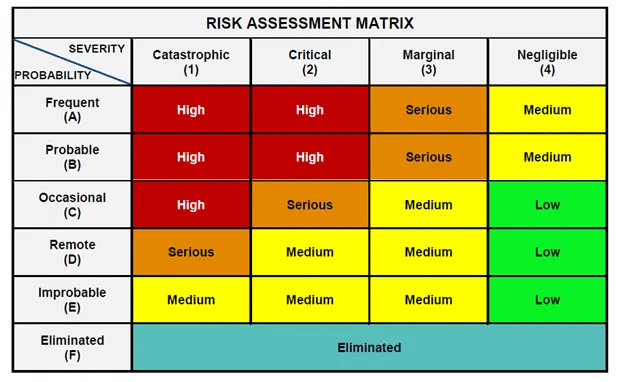
| Probability | Threats | ||||
|---|---|---|---|---|---|
| Very High / 0.9 | 0.05 | 0.09 | 0.18 | 0.36 | 0.72 |
| High / 0.7 | 0.04 | 0.07 | 0.14 | 0.28 | 0.56 |
| Moderate / 0.5 | 0.03 | 0.05 | 0.10 | 0.20 | 0.40 |
| Low / 0.3 | 0.02 | 0.03 | 0.06 | 0.12 | 0.24 |
| Very Low / 0.1 | 0.01 | 0.01 | 0.02 | 0.04 | 0.08 |
| Impact | Very Low / 0.05 | Low / 0.1 | Moderate / 0.2 | High / 0.4 | Very High / 0.8 |
| High risk | | Score > 0.14 | ||||
| Moderate risk | 0.05 < Score < 0.14 | ||||
| Low risk | Score < 0.05 | ||||