Project 1
1.
Multi-parameter patient monitors (MPMs) have become increasingly important in providing quality healthcare to patients. It is well known in the medical community that there exists an intrinsic relationship between different vital parameters in a healthy person, these include heart rate, blood pressure, respiration rate and oxygen saturation. For example, an increase in blood pressure would lead to a decrease in the heart rate, and vice versa. Although it is likely to improve the performance of MPM systems, this fact is not explored in engineering research. In this work, experiments show that deriving additional features to capture the intrinsic relationship between the vital parameters, the alarming accuracy (sensitivity), no-alarm accuracy (specificity), and the overall performance of MPMs can be improved. The geometric mean of the product of all the vital parameters taken in pairs of two was used to capture the intrinsic relationship between the different parameters. An improvement of 10.55% for sensitivity, 0.32% for specificity, and an overall performance improvement of 1.03% was obtained, compared to the baseline system using a classification and regression tree with the four vital parameters.
Multi-parameter patient monitors (MPMs) are widely used in intensive care units (ICUs) and general wards to continuously monitor patients’ health based on the following human vital parameters: heart rate; blood pressure; respiration rate; and oxygen saturation (SPO2). MPMs in general require lower missing probability, the probability for missing an alarm when an alarm is to be reported and false alarm probability, falsely reporting an alarm when there is no alarm to be reported. This means that the alarming accuracy, sensitivity and no-alarm accuracy and specificity should be as high as possible.
Studies on physiological parameters show that there is a well-established intrinsic relationship between vital parameters in healthy people. For example, when a heart rate is on the higher side, arterial blood pressure is expected to be on the lower side, and vice versa, otherwise the health condition is said to be abnormal. However, to the best of our knowledge, MPMs do not take advantage of this relationship.
Physiological monitoring systems assess aspects of human performance and either respond with corrective action or alert a human being to do so.
Physiologic monitors can measure and record temperature, heart rate, respiration, alertness, and activity.
Physiological parameters, such as heart rate, blood pressure, body temperature, serum levels of various stress hormones (e.g. cortisol) and immunological functions (e.g. suppression of lymphocyte activity) can be used to assess welfare.
Measurement of many of these parameters requires invasive monitoring techniques.
The primary sensors used within medical devices are pressure, force, airflow, oxygen, pulse oximetry, temperature, and barcode sensing. The above sensors play a critical role in the operation of the equipment.
[1]
2.
Block diagram of the multi-parameter monitoring system
[2]
3.
Innovative multiparameter patient monitor designs require:
- Precise, multiparameter measurements with high sensitivity.
- Wireless, secure connectivity for data logging and monitoring.
- Intuitive, responsive human machine interface (HMI).
It should feature intuitive controls and a large, vibrant and colorful, easy-to-understand visual display of the patient's situation presenting integrated information from all sensors.
It would be resistant to artifacts and only issue an alarm in case of a true positive event.
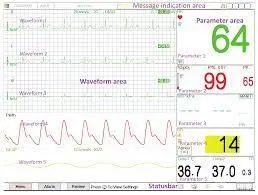
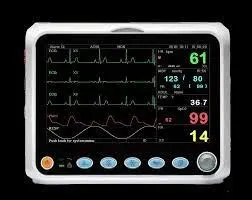
The multiparameter monitors are designed to give number of information on one screen and hence provides multiple information that is needed to understand the patient condition. It has emerged as a monitor to offer flexible solution for varying critical care need.
They provide a comprehensive understanding of patient by giving a broader monitoring scope. These monitors provide reading such as heart rate, central venous pressure, non-invasive blood pressure, ECG, SpO2, PaCO2 and invasive blood pressure and temperature. The monitor has alarm where the parameters can be set and the care giver will be alerted for change beyond the set parameter.
[3]
4.
safety requirements to be catered in the design
- Patient-centeredness, including using variable-acuity rooms and single-bed rooms
- ensuring sufficient space to accommodate family members
- enabling access to health care information
- having clearly marked signs to navigate the hospital
- Safety, including
- applying the design and improving the availability of assistive devices to avert patient falls
- using ventilation and filtration systems to control and prevent the spread of infections
- using surfaces that can be easily decontaminated
- facilitating hand washing with the availability of sinks and alcohol hand rubs
- preventing patient and provider injury
- addressing the sensitivities associated with the interdependencies of care, including workspaces and work processes
- Effectiveness, including use of lighting to enable visual performance
- use of natural lighting
- controlling the effects of noise
- Efficiency, including
standardizing room layout, location of supplies, and medical equipment - minimizing potential safety threats and improving patient satisfaction by minimizing patient transfers with variable-acuity rooms
Timeliness, - ensuring rapid response to patient needs
- eliminating inefficiencies in the processes of care delivery
- facilitating the clinical work of nurses
- Equity, by ensuring the size, layout, and functions of the structure meet the diverse care needs of patients
5.
MULTIPARAMETER INSTRUMENTS FOR ROUTINE FIELD MEASUREMENTS
a. Check the instrument—ensure that all submerged parts of the multiparameter instrument are clean before
beginning turbidity calibration. Sediment or other particulates from the sonde, wiper, or other parts can
contaminate the standard, leading to incorrect calibration and measurement.
b. Check the optical ports—the optical surface of theturbidity sensor must be clean and free of bubbles,
fingerprints, scratches, or other interferences.
c. Check the wiper—if your turbidity sensor has a wiper with a pad or brush, inspect the condition of the
pad/brush and replace it if necessary. Check that the wiper is parking properly and is operational.
d. If the sensor is without a mechanical wiper (for example, during discrete sampling), take extra care to
maintain a clean, bubble- and solid-material-free optical face. To remove bubbles from the optical face
during calibration or field measurement, agitate the sonde by moving it in a vertical or circular motion.
• If the sensor readings exceed the established calibration criteria for project data-quality objectives (for example, the greater of ±5 percent of the measured value or 0.5 turbidity units) during
the inspection process, the sensor requires calibration.
• If instrument calibration allows only a two-step process, use two calibration standards that cover the expected turbidity range and check for linearity using a third midpoint standard. If the
instrument calibration requires only turbidity-free water and one
calibration standard, select a midpoint standard to check for linearity.
Identify Which Equipment Needs to Be Tested. ...
Identify Inspection and Measurement Processes. ...
Decide on the Calibration Frequency. ...
Assign Responsibilities. ...
Decide on the Custody of Calibration Tools. ...
Identify the Relevant Standards.
[4]
6.
7.
PATIENT MONITORING SYSTEM AND DATA MANAGEMENT IN ICU:
Patients monitoring systems represent various devices used to supervise patients. The first approach of monitoring
patients started with the work done by Sanatoria in 1625 that was measuring the body temperature and blood pressure
Data generated by monitoring devices are characterized by being continuous, multiple, and arriving rapidly.
However, the majority of these monitoring systems have not enough memory capacity to save measured datacontinuously and to collect stream data each time. This problem of memory capacity makes the storage andinterpretation of data more difficult and complicate. There are many proposed works that have tried to improve thecurrent monitoring system. We can mention the digital signal processing where authors presented a clinical validation study for two recently developed on line signal filters, the trend extraction methodology expressing the time evolution of a signal, the monitoring systems based on machine learning techniques , that aim todetect the normal and critical states of patients. medical staff needs to collect important data to make the best decision and give the appropriate medicine. Based on a study made in , 13% of the total information used by doctors in the treatment of patients is taken from monitoring system. These help doctors to take their decisions. This fact proves the need of this information and their importance when making decisions at real time. The main problem of the current monitoring system is the risk of losing important information when not all data are stored.
The main cause of this risk is the collection of data each time interval and not continuously .
Missing data reporting critical states of patients in ICU can cause serious problems and make the doctor's decision inaccurate. It can even threaten the patient life when not taking the necessary treatment. In addition, the monitoring system has to allow the medical staff to be mobile
Doctors should measure and collect data at any time without losing any important information relative to the patient state. Besides, they could have all the current charts and data ready. In order to avoid these issues, the monitoring system has to be improved. To this end, we propose a new system based on data stream technology. This latter makes it possible to collect, store, and represent measured data as long as the doctors need them.
A record that is comprehensive contains:
- demographic data, administrative data, health risks and health status, patient medical history, current management of health conditions, and outcomes data.
- The sensor is found in the part of the device that is attached to the patient's body from where it collects the data that needs to be interpreted.
- For example, a Spo2 Sensor detects the oxygen levels in your blood and delivers it on the screen for the doctor to treat you accordingly.
8. [5]
- Every intensive care unit (ICU) should strictly follow protocols for investigating alarms.
Monitoring usually includes measurement of vital signs (temperature, blood pressure, pulse, and respiration rate), quantification of all fluid intake and output, and often daily weight. - The bedside cardiac monitor (oscilloscope) in the ICU provides a continuous display of not only the patient's ECG, which includes heart rate (measured as the number of QRS complexes) and rhythm, but also the oxygen saturation (SpO2).
- The Intensive Care Unit (ICU) is a separate, self-contained area within a medical facility, equipped with high-tech specialized facilities designed for close monitoring, rapid intervention, and often extended treatment of patients with acute organ dysfunction.
9.
Simplified remote monitoring devices may be attached to all segments of the network. These devices lack much of the sophistication of the monitors that have been described here. In particular, they possess no means of providing for direct user interaction.
A central monitoring station can interrogate each of the remote monitors and present the information as if it had been gathered locally. The communication with the remote devices may be in a band, using the same network that is being monitored, or out of band, using an alternative route.
The central monitoring station, in addition to being able to act as if it were connected to a single monitor at another point of the network, will be able to summarise data gathered from all of the remote devices. In this way, the user can gain an overall view of how the network is operating.
A provider identifies the condition(s) to manage remotely and launches a remote patient monitoring program to offer an RPM service to patients. Providers can use remote patient monitoring to collect a wide range of patient health data. This includes blood pressure, heart rate, vital signs, weight, and blood sugar levels.
A provider determines that a patient would benefit from remote physiologic monitoring of one or more of the types of health data that can be captured via RPM. With the patient's consent, the provider orders or prescribes RPM.
The patient is provided with a device to collect the health data. Remote patient monitoring devices must be electronically connected, which is most often accomplished via cellular networking or Bluetooth. The most common RPM devices are blood pressure monitors, weight scales, blood glucose meters, and spirometers. Other device types that are seeing increased RPM use include pulse oximeters and ECG machines.
Once the device is set up appropriately, health data is captured by the device and transmitted from patient to provider, usually electronically.
The provider analyzes this data and gives the patient health and wellness guidance and directions based on the results.
[6]
10.
An alarm is an automatic warning that results from a measurement, or any other acquisition of descriptors of a state, and indicates a relevant deviation from a normal state . Loeb surveyed the reaction of anesthesiologists to relevant changes in monitoring parameters, and showed that anesthesiologists needed a mean time of 61 seconds to recognize a change in the parameters; 16% of the changes were unrecognized for over 5 minutes In contrast, Morris and Montano studied the reaction of anesthesiologists to optical and acoustic warnings during maintenance of general anesthesia. The anesthesiologists showed a reaction time of 6 seconds to optical warnings and 1 second to acoustic warnings . An ideal alarm should only detect immediate or threatening danger that requires prompt attention. The alarm design should adequately represent the underlying situation. The announcement of the alarm should be instantly perceptible in critical situations. Additionally, the user should be informed of circumstances that impair the reliability of the alarming system.
Detection of life-threatening situations: The detection of life-threatening situations was the original purpose of monitor alarms. False negative alarms are not acceptable in such situations because of the danger of severe patient harm or death.
Detection of imminent danger: The early detection of gradual change that might indicate imminent danger.
Diagnostic alarms: These alarms indicate a pathophysiological condition (e. g., shock) rather than warning of 'out-of-range' variables.
Detection of life-threatening device malfunction: This ability is essential for all life-support devices, which must recognize malfunctions, such as disconnection from the patient, occlusion of the connection to the patient, disconnection from power, gas, or water supply, and internal malfunction.
Detection of imminent device malfunction: The early detection of device-related problems that could result in malfunction is an integral part of many therapeutic devices. These warning mechanisms range from simple aspects (e. g., low-battery warnings) to complex algorithms and sensors that track the wear of respiratory valves.
Alarms are typically displayed in two ways or as a combination of both
1.Acoustic
The alarm is given as a warning sound. Most manufacturers distinguish the priority of an alarm with different signals. Intuitive alarms with different tone sequences (e. g. 'short-long-short' for 'ven-ti-late') have been the object of research but have not found their way into routine clinical practice. Alarms directly mentioning organ systems, device hardware, or parts of it (e. g., ventilation or circulation) or alarms with direct labeling of the physiological problem ('blood pressure' or 'oxygen') have also not been introduced into practice .
2.Visual
Visual alarms involve mostly flashing or coloring of the related parameter in an eye-catching manner. Some systems provide integrated displays of several parameters. One example is a spider-display, which shows the relationship of different parameters in a stylized spider web. Such applications can be useful to display different parameters in context. Compared to other professions in industry and aviation, adoption of such new displays in healthcare has been slow.
[7]
11.
You can also drag and drop files into the external hard drive.
If you plug in an external hard drive, it usually opens in Finder.
Highlight your files, click and hold them, and then drag and drop them into the new drive you plugged in.
-
Connect your external storage device to your current PC.
-
On the taskbar, select File Explorer.
-
Locate the files you wish to copy, or the folders where those files are stored.
-
To copy multiple files, hold CTRL as you select additional files or folders.
-
Once you have files and folders highlighted, make sure you're in the Home tab, then select Organize > Copy to, and select your external storage device name from the list of options.
-
Your files and folders will begin copying to your drive. You may need to repeat steps 3 – 5 if you have files stored in multiple locations. Make sure to also move files from locations like your Documents, Desktop, Downloads.
References:
1. https://www.ncbi.nlm.nih.gov/pmc/articles/PMC4612731/
3. https://www.pediatriconcall.com/medical-equipment/monitors/2/multiparameter-monitor/17
4. https://pubs.usgs.gov/twri/twri9a6/twri9a68/twri9a6_6.8.pdf
5. https://zenodo.org/record/55621/files/66.pdf
6. https://www.sciencedirect.com/topics/engineering/remote-monitoring-device
7. https://ccforum.biomedcentral.com/articles/10.1186/cc12525