Project-1: Powertrain for aircraft in runways
Objectives: Powertrain for aircraft in runways
Part A
- Search and list out the total weight of various types of aircraft.
- Is there any difference between ground speed and airspeed?
- Why is it not recommended to use aircraft engine power to move it on the ground at the Airport?
- How an aircraft is pushed to the runway when it's ready to take off?
- Learn about take-off power, tire design, rolling resistance, tire pressure, and brake forces when landing.
Part B:
- With necessary assumptions, calculate the force and power required to push/pull an aircraft by a towing vehicle.
- Develop the model for the calculated force and power using Simulink.
- Design an electric powertrain with the type of motor, its power rating, and energy requirement to fulfill aircraft towing applications in Simulink. Estimate the duty cycle range to control the aircraft speed from zero to highest. Make all required assumptions. Prepare a table of assumed parameters. Draw a block diagram of the powertrain. (Hint: DC7 Block)
- Also, Design the parameters in an excel sheet.
1. Different types of aircraft and their total weight.
Aircraft is a vehicle, which is manufactured and made to fly in the air, and the airplane is a familiar and popular aircraft.
It is mainly classified into two types, they are aircraft that are lighter than air(aerostats) and aircraft that are heavier than air (aerodynes). Example: Hot air balloons
Aerostats use buoyancy like ships, which helps them to float in the air. Aerodynes push(air or gas) downwards, which helps to push aircraft upwards(Dynamic lift). The dynamic lift takes place in two methods. 1. Fixed wings depend on forwarding speed to create airflow all over the wings. Example glider, biplane, airplane. 2. Rotorcraft is a spinning motor that is like wings. example helicopter.
The maximum take-off weight(MTOW) of an aircraft is the maximum weight at which the pilot is allowed to attempt to take off, due to structural or other limits which are specified by the manufacturer.
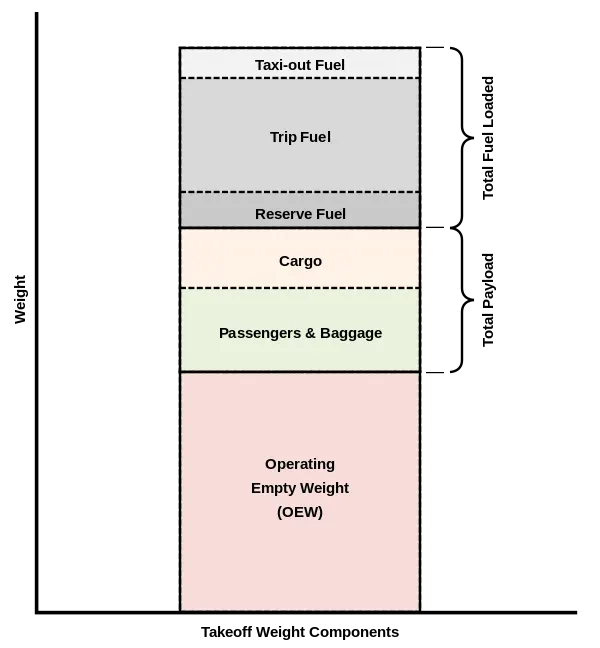
figure: Maximum Take-off weight.
MTOW is the sum of fuel, cargo, passengers, baggage, and operating empty weight.
Types of aircraft:
1. Amphibious aircraft(amphibian): Take off and land on both water and ground. MTOW is the maximum weight of the aircraft to safely takeoff considering structural or other limits. MTOW of Shinmaywa US- amphibious is 47.7t or 47700kg for land and 43t or 43000 kg for water.
2. Helicopter(chopper): horizontally spinning rotor help and aid the helicopter to lift and thrust. It can move vertically, horizontally, and fly both, backward, and forward. MTOW of helicopter mil mi 26 is 56t or 56000kg.
3. Biplane: It has a lower weight but with excellent stiffness and efficiency and it's a fixed-wing aircraft containing two planes. one is fixed above the cockpit and another is below the cockpit.MTOW of Biplane Avro 504 is 0.83t 0r 830 kg.
4. Glider: It is a fixed-wing aircraft that is supported in flight by the dynamic reaction of the air against its lifting surfaces, and whose free flight does not depend on an engine. Example: Rolladen-Schneider LS8. MTOW of glider Rolladen-Schneider LS8 is 0.525t or 525 kg.
5. Cargo aircraft(freight aircraft): It is a fixed-wing aircraft that is designed for the carriage of cargo rather than passengers. MTOW of cargo aircraft Antonov an-124 Ruslan is 402t or 4,02,000kg.
6. Tricycle landing gear: it has tricycle fashion fixed landing gear. The arrangement has a nose wheel in the front and two more in the main wheels. Tricycle gear aircraft are the easiest for takeoff, landing, and taxiing. MTOW of Mooney M20 Acclaim Ultra tricycle gear aircraft is 1.528t or 1528 kg.
2. Difference between ground speed and airspeed
Yes, there is a difference between ground speed and airspeed.
Airspeed is its speed relative to the air it is flying in.
Ground speed is the airplane’s speed relative to the surface of the Earth. It is determined by the vector sum of airspeed and wind speed.
The wind speed will be considered negative if it is a Headwind.
Ground speed = Airspeed - Wind speed (Headwind).
A headwind is a wind blowing in the opposite direction of an airplane and it will oppose the airplane's airspeed.
The wind speed will be considered Positive if it is a Tailwind. i.e., Ground speed = Airspeed + Windspeed(tailwind)
Ground speed = Airspeed + Wind speed (tailwind).
A tailwind is a wind blowing in the same direction as an airplane and it will support the airplane's airspeed.
for example (Note for simple understanding km/hr unit is taken here)
Let's assume the Ground distance is 1000km, and the airspeed is 500km/hr.
Case 1. The headwind is blowing 100km/hr,
Ground speed= 500-100 (Km/hr)=400km/hr, then it takes 2.5hrs to complete the ground distance of 1000km.
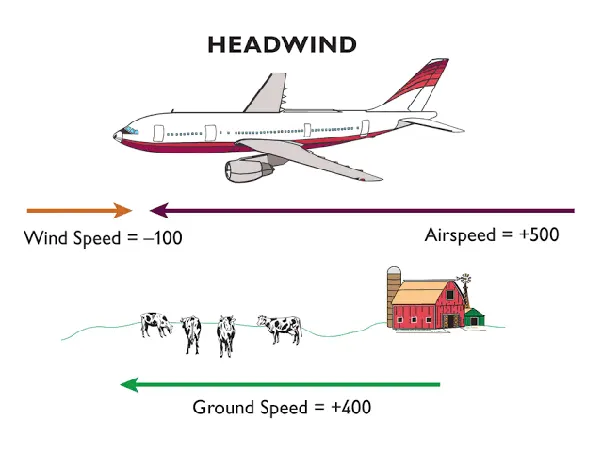
Case 2. The tailwind is blowing 100km/hr,
Ground speed=500+100(Km/hr)=600km/hr, then it takes 1 hr 40mins to complete the ground distance of 1000km.
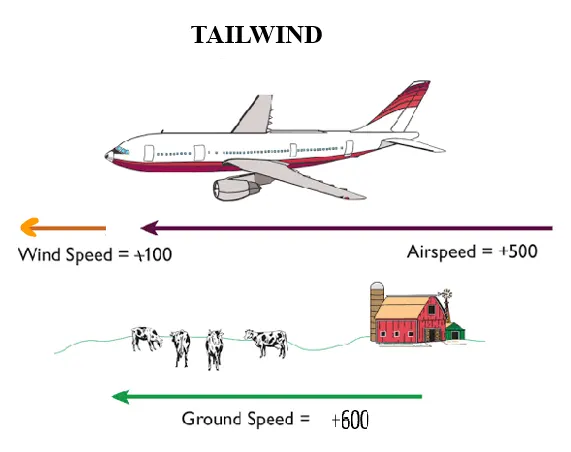
3. The engine power must be turned off to move it on the ground at the airport, if not then problems will occur. which is followed by
- If an aircraft's engine is activated, then thrust can create a high-speed wind that leads to damage to the airport terminal, surrounding ground vehicles, jetway, baggage, and ground personnel.
- Aircraft Engines consume more fuel which leads to high cost(economically insufficient) and generates extreme noise that can be harmful to ground personnel.
- The tiniest grains of dust into hazardous projectiles and create debris that can cause damage to engines.
- when the airplane is moving backward then it needs to maintain a speed of above 80knots by reverse thrust or else it will damage the engine.
- reverse thrust also resulting jet blast or prop wash would cause increased noise, damage to the terminal building or equipment, and hurt airport staff due to high-speed debris. This debris would also be sucked into the engine, as it is in normal use, and cause excessive wear - a major cause of wear on aircraft engines is during ground use.
4. An aircraft is pushed to the runway by pushback tractors or tugs.
It is pushed backward away from its parking position, usually at an airport gate by tractors or tugs. Pushback tractors use a low-profile design to fit under the aircraft's nose. For sufficient traction, the tractor must be heavy. A tractor has a drawbar pull of 334 kN to handle aircraft weight up to 54 tonnes. There are two types of pushback tractors: conventional and towbarless.
Although many aircraft are capable of moving themselves backward on the ground using reverse thrust(due to the demerit it, which is discussed above at the 5th point), pushback is the preferred method when ground-handling aircraft.
5. The take-off power, tire design, rolling resistance, tire pressure, and brake forces when landing.
Take off the power of an aircraft is calculated.
wkt kinetic energy =`1/2m*V^2`
Takeoff is a term used when the flight(aircraft) leaves the ground and becomes airborne. i.e., it starts to fly.
Takeoff power is the amount of power that an engine is allowed to produce for a limited period of time for takeoff.
The design of the tire is to withstand extremely heavy loads while landing, taking off, taxing, and parking. The number of wheels required for aircraft is increased with the weight of the aircraft.
Carcass plies(casing plies) are used to form the tire.
Tire supports the weight of an aircraft while it's on the ground, provides traction for braking and stopping an airplane, absorbs the shock of landing, and provides cushioning for the roughness of takeoff, roll-out, and taxi operation.
Tire pressure: The tire must be filled with an inert, dry gas. Nitrogen is used in a tire for inexpensive, and to reduce the chance of fire or explosion. tire pressure up to 200 psi(i.e., 13.79 bar)
Rolling resistance: It's the force resisting the motion when a body rolls on a surface. The rolling resistance formula is `F=mu_(rr)N`
where
F is the rolling resistance force
`mu_(rr)` is the rolling resistance coefficient or the coefficient of rolling friction, and
N is the Nominal force, the force perpendicular to the surface on which the wheel is rolling(i.e., the product of Mass of the body and acceleration due to gravity.
Braking force= `1/2(mv^2)/d`
m is the mass of the body
v is the velocity of the body
d is the distance taken to stop(braking) or reach steady state speed(accelerating).
considering Antonov An-124 Ruslan
Maximum landing weight: 330,000 kg
Speed : 230km/hr
Landing roll: 900m
Braking force =`1/2*(330000xx230^2)/900 implies=9698kN`
Part B:
6. a) calculate the force and power required to push/pull an aircraft by a towing vehicle.
The traction force required to pull or push`(F_t)` is the sum of the rolling resistance force `(F_(rr))`, Air drag force`(F_(ad))`, Hill climbing force `(F_(hc))`
hillclimbing force (F_(hc)) is not present on the runway, because there is a grade angle is zero on the runway. So the traction force becomes
`F_t=F_(rr)+F_(ad)`
Assumption:
- Speed is a constant and flat surface so Hill climbing force and acceleration force becomes zero.
- The coefficient of rolling resistance is 0.01 for tarmac surface.
- Air density (`(kg)/m^3`) is 1.25.
- Payload(i.e., airplane-Boeing 747 ) maximum landing weight for Boeing 747 is 265350 Kg(265.35 tonnes).
- Tow vehicle (kerb) eagle xl 40 is 40000lbs i.e 18145 kg.
- The front area of the tow vehicle (width is 2.515, height is 1.321) =2.515*1.321=3.32 m^2.
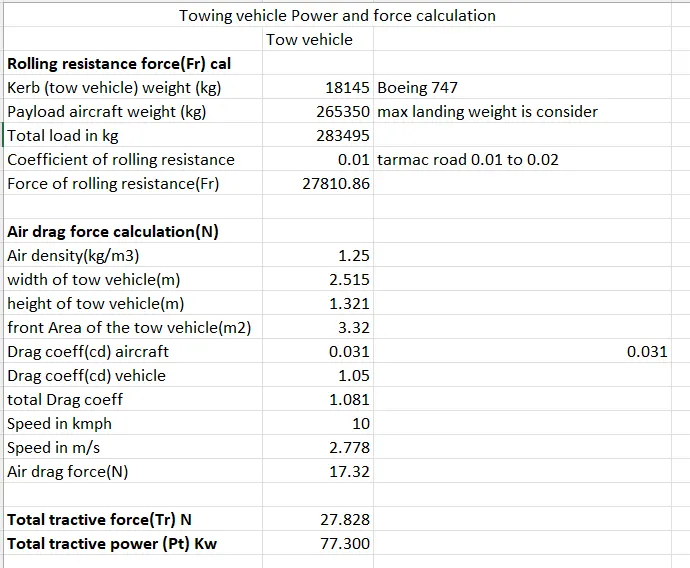
Rolling resistance force `(F_(rr))=mu_(rr)*m*g` N=27810.86 N
where
- `mu_(rr)` is the coefficient of rolling resistance (0.01 to 0.02 `(kg)/m^3` for the tarmac surface of the runway)
- m is the weight of the vehicle (kerb and payload) = 18145 + 265350 = 283495 kg.
- g is the acceleration due to gravity 9.81 `(m/s^2)`
- Rolling resistance force F_(rr)= 0.01*283495*9.81= 27810.86 N
Air drag force `(F_(ad))= 1/2*rho*C_(ad)*A*v^2`=17.34N
where
- `rho` is an air density of 1.25 kg/m^3
- C_(ad) is the drag coefficient (C_(ad) is 0.031 for Boeing 747)
- C_(ad) is the drag coefficient of tow vehicle 1.05
- A is the frontal area of the vehicle (A)m^2 = 3.32 m^2
- v is the velocity of the tow vehicle when loaded is 10km/hr (2.78 m/s).
- `(F_(ad))= 0.5(1.25)(0.031+1.05)(3.32)(2.78)^2`= 17.32 N.
Total traction force `F_t`= Rolling resistance force + Air drag force.
F_t = 27810.86+17.34 = 27828.2 N= 27.828kN
Total traction power P_t= F_t* v= 27.828*2.7778=77.30 kW.
The force and power required to push/pull an aircraft by a towing vehicle are 27.828kN and 77.30 kW respectively.
6. B) The model for the calculated force and power using Simulink.
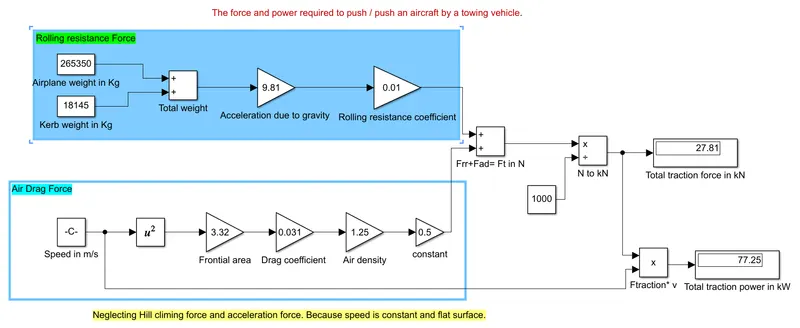
Model explanation:
Rolling resistance force= M*g*mu_(rr)
M is Total weight which is the sum of payload(aircraft) and kerb weight(tow vehicle) (265350 kg, 18145 kg respectively). using the adder block we get the total weight of the vehicle with payload.
The gain block is used for product operation. The total weight is multiplied by the acceleration due to gravity (9.81Kg/m3) and the rolling resistance coefficient(0.01). Now we get the rolling resistance force.
Air Drag force =`1/2(rho*C_d*A*v^2)`
Speed is squared with a square block then this squared speed is multiplied by air density(1.25), Air drag coefficient(0.031), frontal area(3.32), and 0.5 constant. Now we get the air drag Force.
By adding the rolling resistance force and air drag force we get the traction force. traction force is multiplied by speed to get the power.
Both the power and force are divided by 1000 to get the values in kilo range.
The display shows the value of power and total traction force is 77.30 kW and 27.83 kN respectively.
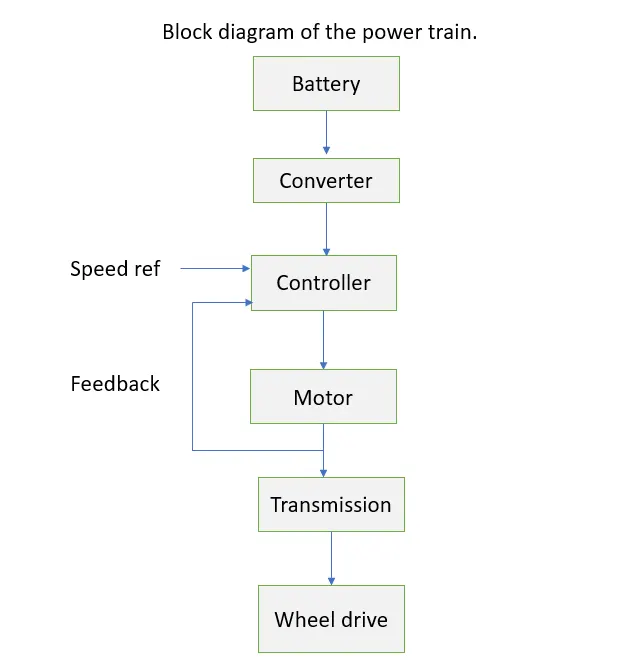
7. A. Design an electric powertrain with the type of motor, its power rating, and energy requirement to fulfill aircraft towing application in Simulink. Estimate the duty cycle range to control the aircraft speed from zero to highest. Make all required assumptions. Prepare a table of assumed parameters. Draw a block diagram of the powertrain.
Assumptions:
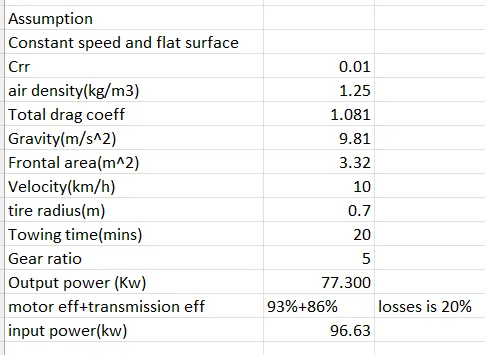
- Speed is a constant and flat surface so Hill climbing force and acceleration force becomes zero.
- Coefficient of rolling resistance = (0.01`(kg)/m^3`
- weight of the vehicle = 283495 kg
- acceleration due to gravity = 9.81 `(m/s^2)`
- air density = 1.25 kg/m^3
- drag coefficient = 1.081
- frontal area (A)m^2 = 3.32 m^2
- v is the velocity of the tow vehicle when loaded is 10km/hr (2.78 m/s).
- total traction force =27.83 kN.
- Power= 77.3 kW is the 80% input power
- Output power=(77.3*100)/80=96.63 kW
- 77.3kW output power and 96.63kW input power.
- radius of the tire= 0.7m
- towing time =20 mins
- gear ratio =5
Torque= power *radius of the tire `implies 77.3xx0.7=54.11 kN`
Total torque=96.63*0.7= 67.64kN
Total energy required = `Power*time implies 96.63xx20/60=32.21 kWh`
Battery required power is 32.21*1.10(10% for energy for the future)=35.43 KWh
`(omega)=Gv/r =5xx2.78/0.7=19.84 (rad)/sec`
`omega= N*2*pi/60 implies N=omega*30/pi`
N=19.84*30/3.14=189.58 RPM
Duty cycle = output power/input power=77.3/92.76=83.3
duty cycle is 83%.
The duty cycle range to control the aircraft speed from zero to highest(0 to 190 rpm) is 0 to 83%.
Block diagram of powertrain:
Model
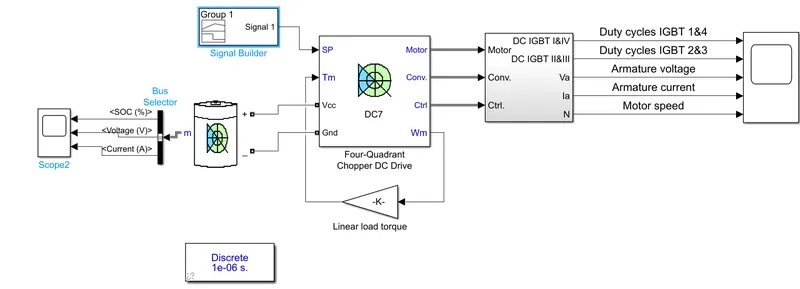
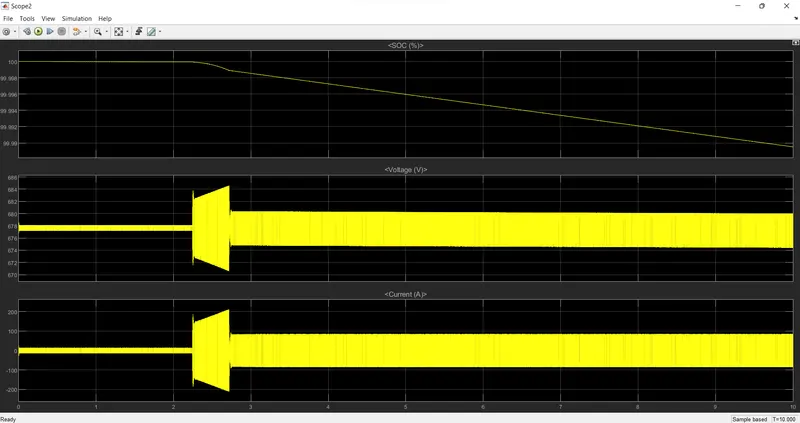
Battery parameters:
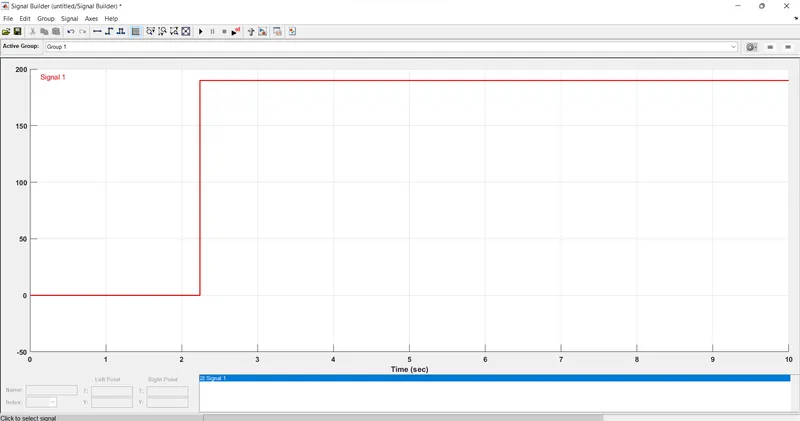
Reference speed:
Output: Motor drive
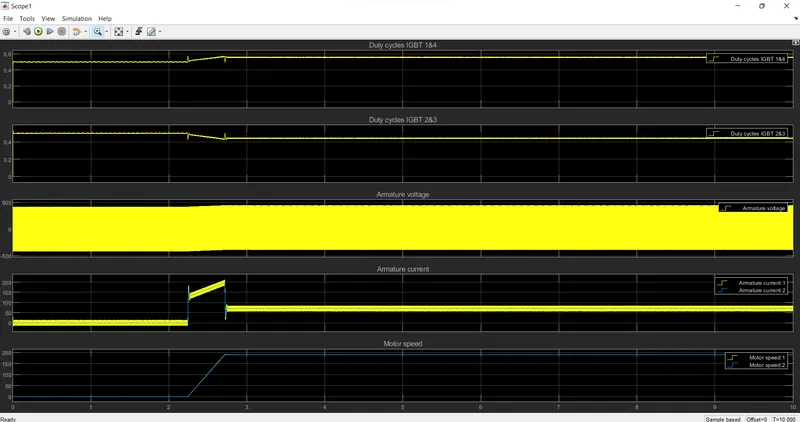
at 2.4 sec the reference speed is given so the output speed and reference speed are raised to 190 RPM
7. B. Also, Design the parameters in an excel sheet.
Calculation
Assumptions:
Excel sheet is attached below. Vehicle power and force cal.xlsx.