Project-1: Powertrain for aircraft in runways
EV live batch 17
Part A
ANS:1
Aircaraft empty weight
This is sometimes referred to as OEW – Operating Empty Weight and it is the weight of the aircraft with all its equipment on board but no fuel, no passengers or no cargo.
Aircraft maximum gross takeoff weight
This is the maximum permissible weight the aircraft can weigh as it lifts off the ground at takeoff. This includes the aircraft’s empty weight, the fuel, the crew, the passengers, and all the cargo.
Aircraft useful load
This is the weight that a pilot can place in the aircraft. Take the MGTW figure and subtract the AEW and this is the total useful load that can be placed into the aircraft. This is the fuel, crew, passengers, and cargo. The bigger the load, the more useful the aircraft can be to its customers,.
| Aircraft | Empty Weight | Max Fuel Weight | Max Cargo Weight | Max Gross Takeoff Weight |
| Antanov AN-225 | 628,000 lbs | 661,400 lbs | 417,000 lbs | 1,411,000 lbs |
| 285,000 kg | 300,000 kg | 190,000 kg | 640,000 kg | |
| Airbus A380-800 | 611,000 lbs | 560,000 lbs | 185,000 lbs | 1,268,000 lbs |
| 277,000 kg | 254,000 kg | 84,000 kg | 575,000 kg | |
| Boeing 747-800 | 485,300 lbs | 427,400 lbs | 295,000 lbs | 987,000 lbs |
| 220,100 kg | 194,000 kg | 134,000 kg | 447,700 kg | |
| Airbus A340-500 | 370,000 lbs | 386,300 lbs | 119,000 lbs | 820,000 lbs |
| 168,000 kg | 175,000 kg | 54,000 kg | 372,000 kg | |
| Boeing 777-300ER | 370,000 lbs | 320,800 lbs | 148,000 lbs | 776,000 lbs |
| 168,000 kg | 145,500 kg | 67,100 kg | 352,000 kg | |
| Boeing 787-10 | 299,000 lbs | 223,500 lbs | 126,300 lbs | 560,000 lbs |
| 135,500 kg | 101,500 kg | 57,300 kg | 254,000 kg | |
| Boeing 737-900 | 98,500 lbs | 53,100 lbs | 44,600 lbs | 187,000 lbs |
| 44,700 kg | 24,000 kg | 20,200 kg | 85,000 kg | |
| Airbus A320-100 | 93,900 lbs | 48,700 lbs | 44,000 lbs | 150,000 lbs |
| 42,600 kg | 22,100 kg | 20,000 kg | 68,000 kg | |
| Embraer 190 | 63,500 lbs | 28,600 lbs | 28,800 lbs | 106,000 lbs |
| 28,800 kg | 13,000 kg | 13,100 kg | 48,000 kg | |
| Gulfstream G650 | 54,000 lbs | 48,200 lbs | 6,500 lbs | 100,000 lbs |
| 24,500 kg | 21,900 kg | 3,000 kg | 45,200 kg | |
| Bombardier CRJ900 | 48,160 lbs | 19,600 lbs | 6,075 lbs | 80,500 lbs |
| 21,850 kg | 8,900 kg | 2,760 kg | 36,500 kg | |
| Bombardier Q400 | 39,300 lbs | 11,700 lbs | 18,700 lbs | 62,000 lbs |
| 17,800 kg | 5,300 kg | 8,500 kg | 28,000 kg | |
| Learjet 75 | 13,900 lbs | 6,060 lbs | 2,900 lbs | 21,500 lbs |
| 6,300 kg | 2,750 kg | 1,300 kg | 9,700 kg | |
| Cessna Citation CJ4 | 10,300 lbs | 5,800 lbs | 2,200 lbs | 17,200 lbs |
| 4,700 kg | 2,650 kg | 1,000 kg | 7,800 kg | |
| Beechcraft King Air B100 | 7,100 lbs | 3,200 lbs | 4,150 lbs | 12,000 lbs |
| 3,200 kg | 1,450 kg | 1,900 kg | 5,400 kg | |
| Diamond DA50 RG | 3,200 lbs | 340 lbs | 1,250 lbs | 4,400 lbs |
| 1,450 kg | 155 lbs | 560 kg | 2,000 kg | |
| Beechcraft Bonanza G36 | 2,500 lbs | 450 lbs | 850 lbs | 3,660 lbs |
| 1,150 kg | 200 kg | 385 kg | 1,660 kg | |
| Cessna 206H | 2,200 lbs | 520 lbs | 1,150 lbs | 3,600 lbs |
| 990 kg | 235 kg | 520 kg | 1,630 kg | |
| Sirrus SR22 | 2,250 lbs | 485 lbs | 950 lbs | 3,600 lbs |
| 1,000 kg | 220 kg | 430 kg | 1,630 kg | |
| Cessna 172R | 1,700 lbs | 380 lbs | 560 lbs | 2,425 lbs |
| 770 kg | 170 kg | 255 kg | 1,100 kg |
ANS:2 Difference between ground speed and air speed
Wind Speed
For a reference point picked on the ground, the air moves relative to the reference point at the wind speed. Notice that the wind speed is a vector quantity and has both a magnitude and a direction. Direction is important. A 20 mph wind from the west is different from a 20 mph wind from the east. The wind has components in all three primary directions (north-south, east-west, and up-down). In this figure, we are considering only velocities along the aircraft's flight path. A positive velocity is defined to be in the direction of the aircraft's motion. We are neglecting cross winds, which occur perpendicular to the flight path but parallel to the ground, and updrafts and downdrafts, which occur perpendicular to the ground.
Ground Speed
For a reference point picked on the ground, the aircraft moves relative to the reference point at the ground speed. Ground speed is also a vector quantity so a comparison of the ground speed to the wind speed must be done according to rules for vector comparisons.
Airspeed
The important quantity in the generation of lift is the relative velocity between the object and the air, which is called the airspeed. Airspeed cannot be directly measured from a ground position, but must be computed from the ground speed and the wind speed. Airspeed is the vector difference between the ground speed and the wind speed.
Airspeed = Ground Speed - Wind Speed
As mentioned above, true airspeed is simply the speed at which an aircraft is moving relative to the air it is flying in. As such, it’s also the speed at which the air is flowing around the aircraft’s wings.
Ground speed, on the other hand, is the aircraft’s speed relative to the ground. One thing that should be noted here is that it’s its horizontal rather than vertical speed – an aircraft climbing completely vertically would have a ground speed of zero.
In other words, while airspeed is what determines whether there is enough airflow around an aircraft to make it fly, ground speed is what determines how fast an aircraft will get to its destination.
ANS:3
Aircraft can move on their engine power all the time on the airport apron and taxiways under their own power to go towards runways and after landing taxi to their assigned gate. But the thrust produces results in jet blast might cause damage to the terminal buiulding or equipment. Engine close to the ground may blow sand and debris forward and them suck them in engine. Therefore pushback is preferred method to move the aircraft away from the gate. Also it can save the fuel.
1. Effetively a loss of control can happen during high power engine running, other aircraft aside and to itself also
2. There is risk of injury to the ground support personnel also
3. It is easier for the truck driver to see the surroundings better than the pilot sitting in the plane. The pushback driver knows the airport better than the pilot
4. It also saves the aircraft fuel
5. The plane engines are very loud. when more than one aircraft are there on airport creataes large sound which is unpleasant.
Therefore it is not recommenderd to use aircraft engine power to move it to the ground on airport.
ANS:4
In avation, pushback is an airport procedure during which an aircraft is pushed backwards away from its parking position, usually at an airport gate by external power. Pushbacks are carried out by special, low-profile vehicles called pushback tractors or tugs.
Although many aircraft are capable of moving themselves backwards on the ground using reverse thrust(a procedure referred to as a powerback, the resulting jet blast or prop wash would cause increased noise, damage to the terminal building or equipment, and hurt airport staff due to high-speed debris. This debris would also be sucked into the engine, as it is in normal use, and cause excessive wear - a major cause of wear on aircraft engines is during ground use. A pushback is therefore the preferred method when ground-handling aircraft.
Pushbacks at busy aerodoms are usually subject to ground clearance to facilitate ground movement on taxiways. Once clearance is obtained, the pilot will communicate with the tractor driver (or a ground handler walking alongside the aircraft in some cases) to start the pushback. To communicate, a headset may be connected near the nose gear.
Since the pilots cannot see what is behind the aircraft, steering is done by the pushback tractor driver and not by the pilots. Depending on the aircraft type and airline procedure, a bypass pin may be temporarily installed into the nose gear to disconnect it from the aircraft's normal steering mechanism.
Once the pushback is completed, the towbar is disconnected, and any bypass pin removed. The ground handler will show the bypass pin to the pilots to make it clear that it has been removed. The pushback is then complete, and the aircraft can taxi forward under its own power.
ANS:5
Takeoff power
Carcass plies are used to form the tire. They are sometimes called casing plies. An aircraft tyre is constructed for the purpose it serves.
- They support the weight of an aircraft while it is on the ground.
- It also provides the necessary traction for braking and stopping of an aeroplane.
- Tyre also helps to absorb the shock of landing and provide cushioning the roughness of takeoff, roll-out, and taxi operations.
Unlike an automobile or truck tyre, it does not have to carry a load for a long period of continuous operation. However, an aircraft tyre absorbs the high impact loads of landing, and also it’s operating at high speeds for a short time when required.
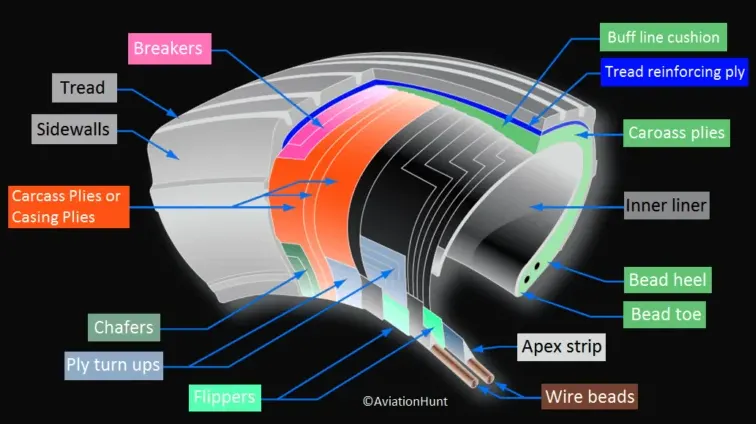
Load Rating – Load rating is the maximum permissible load at a specified inflation pressure.
Ply Rating – Ply Rating is used to identify the maximum recommended load rating and inflation pressure for a specified tyre. It is an index of tyre strength.
Speed Rating – The speed rating is the maximum takeoff speed to which the tyre has been tested.
Skid Depth – Skid depth is the distance between the tread surface and the deepest groove as measured in the mould.
Aircraft tyres are manufactured with tread rubber with conducting compounds to permit earthing of static charges.
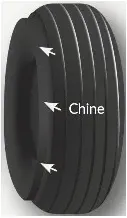
Chines are also called deflectors. Chine tyre used on the nose wheel of aircraft, specially fuselage-mounted jet engines. It diverts runway water away from the engine inlets.
Chines are circumferential protrusions that are moulded into the sidewall of nose tyres that deflect water sideways to help reduce excess water ingestion into the engines. Tyres may have chines on one or both sides, depending on the number of nose tyres on the aircraft
Rolling resistance
It is the force oppositing the motion when a body rolls on the surface. In aircraft rolling resistance is seen when aircraft takes off and landing on runways on their wheels.
Frr= urr *m*g.... urr is coefficient of rolling resistance, m is mass of aircraft, g is acceleration due to gravity
Tyre pressure
Because aircraft tires operate at such high extremes of pressure, load, and speed, their care and service is critically important. The most important action an operator can take to prevent tire-related events is to maintain proper tire inflation pressure
Aircraft tires are usually inflated with nitrogen to minimize expansion and contraction from extreme changes in ambient temperature and pressure experienced during flight. Dry nitrogen expands at the same rate as other dry atmospheric gases (normal air is about 80% nitrogen), but common compressed air sources may contain moisture, which increases the expansion rate with temperature
Braking force when landing
Wing spoilers
Many airplanes use wing spoilers to assist with braking when landing. Not to be confused with ailerons, spoilers are extendable flaps on the ends of an airplane’s wings. Pilots can raise the spoilers to decelerate the airplane as it approaches the runway. And even while on the runway, pilots will typically leave the wing spoilers raised. Raised wing spoilers create drag, which essentially slows down the airplane so that it’s able to brake more quickly.
Disc brakes
In addition to wing spoilers, airplanes use disc brakes. Airplane disc brakes are similar to the braking system in automobiles. They consist of a pair of calipers that, when engaged, squeeze pads against the rotors of an airplane’s landing gear.
Disc brakes are designed to remain static at all times. In other words, they don’t rotate with the wheels of an airplane’s landing gear. As the wheels turn, the disc brakes will remain static and stationary. They are a vital component of an airplane’s braking system because they are designed to apply pressure to the airplane’s wheels. Disc brakes will squeeze the wheels, thereby slowing down the speed at which they spin. In turn, this reduces the speed of the airplane so that it can come to a complete stop on the runway.
Reverse Thrust
Finally, many jet airplanes use reverse thrust to assist with braking during landings. Reverse thrust is a feature in jet engine airplanes that, as the name suggests, involves the reversal of the engines’ thrust. When flying, the thrust is projected out the rear of an airplane’s engines. When landing, however, pilots may use the reverse thrust feature. Reverse thrust changes the direction of the engines’ thrust. Rather than projecting out the rear, the thrust will be projected out the front. This reversal of thrust provides deceleration that allows airplanes to slow down more quickly when landing.
PART:B
ANS: 6
A]
Consider the following assumptions for the towing vehicle and aircraft
Mass of towing vehicle=m1=8300 Kg
Mass of aircraft= m2=575000 Kg
1.consider rolling resistance coefficient=urr=0.002
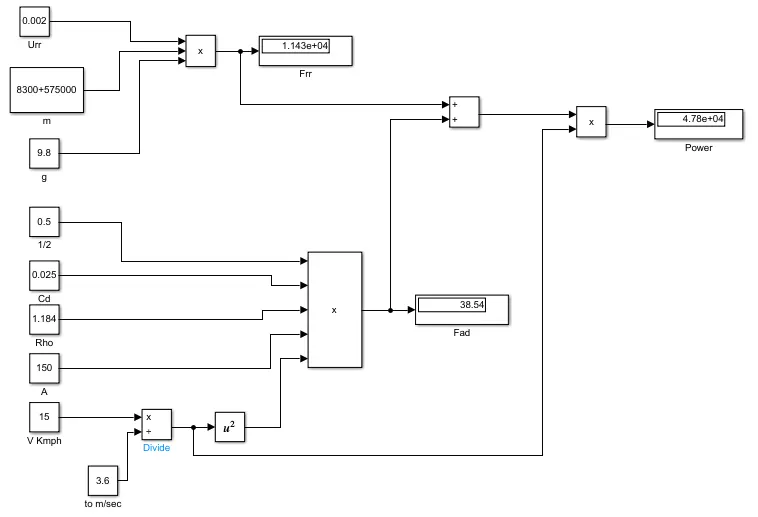
Rolling resistance force Frr= urr*(m1+m2)*g = 0.002*(8300+575000)*9.8 =11,432 N
2. Aerodynamice drag force
consider frontal area of towing vehicle A= 150m^2, velocity of tow vehicle=V=15 Kmph=4.16m/s
Air density=ρ=1.184 Kg/m^3
coefficient of drag=Cd=0.025
Fad=0.5*Cd*ρ*A*V^2 = 38.41 N
3. Hill climbing force
As runways are constructed for flat surface/no gradient, hill climbing force is zero
Total force= Frr+Fad = 11432+38.41= 11,470.41N
Power = force*velocity=11,470.41*4.16 = 47.716 KW
B] Simulink model
ANS:7
A]
Data for designing
Force required to tow the aircraft = 11,470.41 N ...(from previous question)
Power required to tow the aircraft at 15Kmph speed = 47.716 KW
Tyre radius for tow truck= 0.411m
Gear ratio=7
Transmission efficiency=TE=80%
Motor efficiency=ME=90%
Torque required at the wheel Tw
Tw= Total force*tyre radius=11,470.41*0.411= 4714.33 Nm
Motor torque Tm
Tm=(Tw)/(gear ratio*TE)=(4714.33)/(7*0.8)=841.84 Nm
Actual motor torque Tmac
Tmac=Tm/ME=841.84/0.9=953.38 Nm
To calculate battery capacity
The tow tractor takes 15 minutes for taxing
15min=0.25 Hrs
Electrical power Pac= 47.716/(0.8*0.9)=66.27 KW
Motor output Power= 66.27*0.9=59.64 KW= 59.64=80Hp
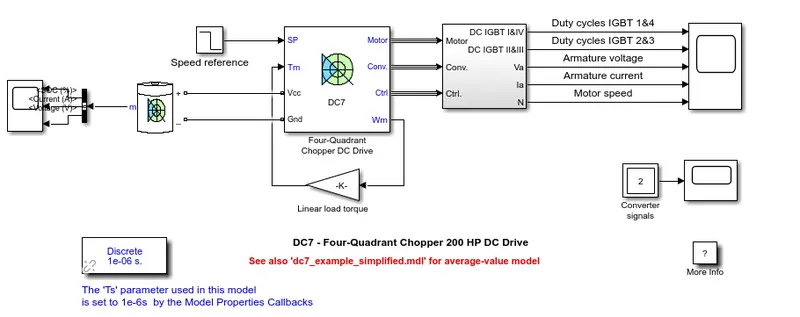
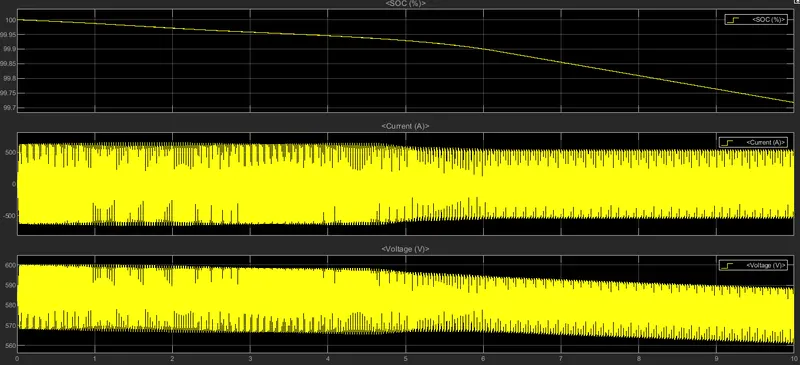
Let us consider 100 HP, 500 V motor in simulink,
Battery capacity=Pac*hrs=66.27*0.25 =16.56 KWh
Required AH rating =16.56*1000/500 =33.12 AH
If i use 100 Kw battery then i can run towing vehicel easily
Battery AH rating = 100*1000/500 =200 AH
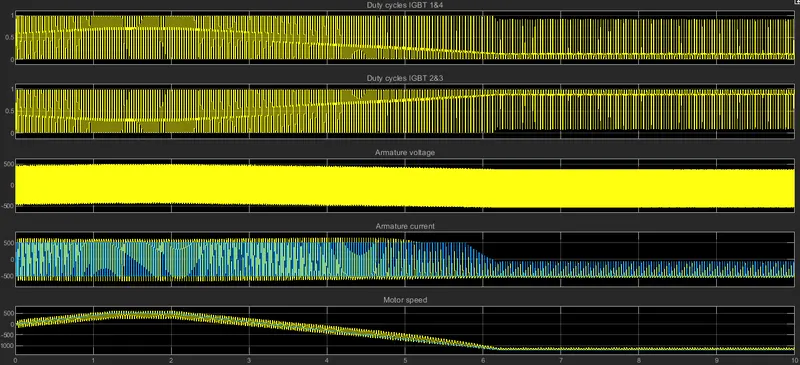
Duty ratio
Duty ratio= Pac/batterycapacity= 66.27/100=0.6627
Therefore to run towing vehicel for 15 minutes from 0 to 15kmhr speed, duty cycle varies from (0-0.6627)
At 0.6627 it raches maximum speed of 15kmhr.
B]
Excel sheet is attached