Project-1: Powertrain for aircraft in runways
NOTE: EV LIVE SESSION BATCH 16:
Part A:
Q1. Search and list out the total weight of various types of aircrafts.
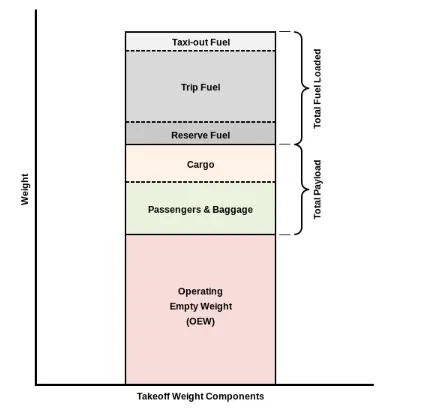
Aircraft Empty Weight (AEW):
- This is sometimes referred to as OEW – Operating Empty Weight and it is the weight of the aircraft with all its equipment on board but no fuel, no passengers or no cargo.
Aircraft Max Gross Takeoff Weight(MGTW):
- This is the maximum permissible weight the aircraft can weigh as it lifts off the ground at takeoff. This includes the aircraft’s empty weight, the fuel, the crew, the passengers, and all the cargo.
- This weight limit is set by the manufacturer and is gospel. Many aircraft accidents have been caused by an aircraft being overweight and the pilot/s have not had enough power or maneuverability to prevent the accident.
FOLOWING IS LIST OF AIRCRAFT WITH TOTAL WEIGHT:
| Aircraft Name | Empty Weight | Max Fuel Weight | Max Cargo Weight | Max Gross Takeoff Weight |
|---|---|---|---|---|
| Antanov AN-225 | 628,000 lbs 285,000 kg |
661,400 lbs 300,000 kg |
417,000 lbs 190,000 kg |
1,411,000 lbs 640,000 kg |
| Airbus A380-800 | 611,000 lbs 277,000 kg |
560,000 lbs 254,000 kg |
185,000 lbs 84,000 kg |
1,268,000 lbs 575,000 kg |
| Boeing 747-800 | 485,300 lbs 220,100 kg |
427,400 lbs 194,000 kg |
295,000 lbs 134,000 kg |
987,000 lbs 447,700 kg |
| Airbus A340-500 | 370,000 lbs 168,000 kg |
386,300 lbs 175,000 kg |
119,000 lbs 54,000 kg |
820,000 lbs 372,000 kg |
| Boeing 777-300ER |
370,000 lbs 168,000 kg |
320,800 lbs 145,500 kg |
148,000 lbs 67,100 kg |
776,000 lbs 352,000 kg |
| Boeing 787-10 | 299,000 lbs 135,500 kg | 223,500 lbs 101,500 kg |
126,300 lbs 57,300 kg | 560,000 lbs 254,000 kg |
| Boeing 737-900 | 98,500 lbs 44,700 kg |
53,100 lbs 24,000 kg |
44,600 lbs 20,200 kg |
187,000 lbs 85,000 kg |
| Airbus A320-100 | 93,900 lbs 42,600 kg |
48,700 lbs 22,100 kg |
44,000 lbs 20,000 kg |
150,000 lbs 68,000 kg |
| Embraer 190 | 63,500 lbs 28,800 kg |
28,600 lbs 13,000 kg |
28,800 lbs 13,100 kg |
106,000 lbs 48,000 kg |
| Gulfstream G650 | 54,000 lbs 24,500 kg | 48,200 lbs 21,900 kg | 6,500 lbs 3,000 kg |
100,000 lbs 45,200 kg |
| Bombardier CRJ900 | 48,160 lbs 21,850 kg | 19,600 lbs 8,900 kg | 6,075 lbs 2,760 kg | 80,500 lbs 36,500 kg |
| Bombardier Q400 | 39,300 lbs 17,800 kg |
11,700 lbs 5,300 kg |
18,700 lbs 8,500 kg |
62,000 lbs 28,000 kg |
| Learjet 75 | 13,900 lbs 6,300 kg | 6,060 lbs 2,750 kg |
2,900 lbs 1,300 kg |
21,500 lbs 9,700 kg |
| Cessna Citation CJ4 | 10,300 lbs 4,700 kg | 5,800 lbs 2,650 kg |
2,200 lbs 1,000 kg | 17,200 lbs 7,800 kg |
| Beechcraft King Air B100 | 7,100 lbs 3,200 kg | 3,200 lbs 1,450 kg |
4,150 lbs 1,900 kg |
12,000 lbs 5,400 kg |
| Diamond DA50 RG | 3,200 lbs 1,450 kg |
340 lbs 155 lbs |
1,250 lbs 560 kg |
4,400 lbs 2,000 kg |
| Beechcraft Bonanza G36 | 2,500 lbs 1,150 kg | 450 lbs 200 kg |
850 lbs 385 kg |
3,660 lbs 1,660 kg |
| Cessna 206H | 2,200 lbs 990 kg |
520 lbs 235 kg |
1,150 lbs 520 kg |
3,600 lbs 1,630 kg |
| Sirrus SR22 | 2,250 lbs 1,000 kg | 485 lbs 220 kg |
950 lbs 430 kg |
3,600 lbs 1,630 kg |
| Cessna 172R | 1,700 lbs 770 kg |
380 lbs 170 kg |
560 lbs 255 kg |
2,425 lbs 1,100 kg |
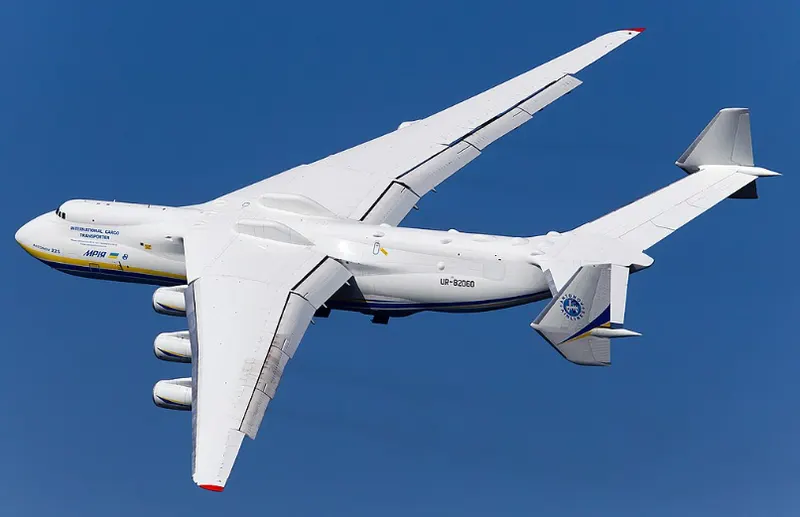
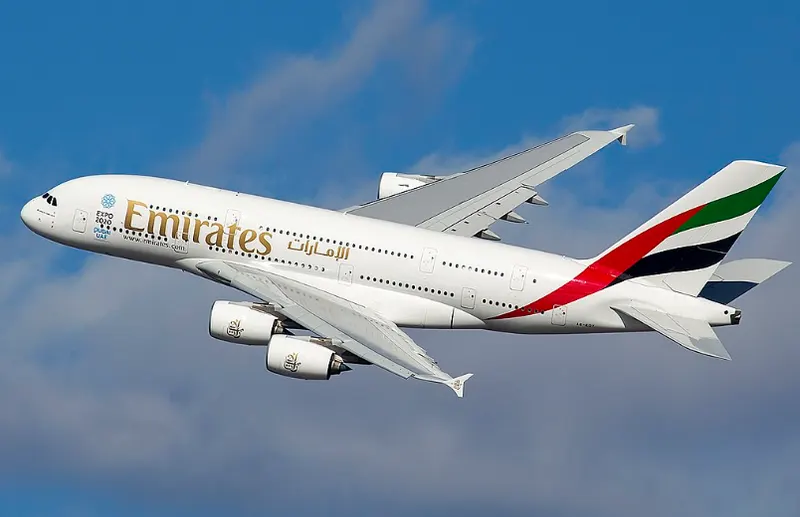
Following are some picture of aircraft
Antanov AN-225:
Airbus A380-800:
Boeing 747-800:
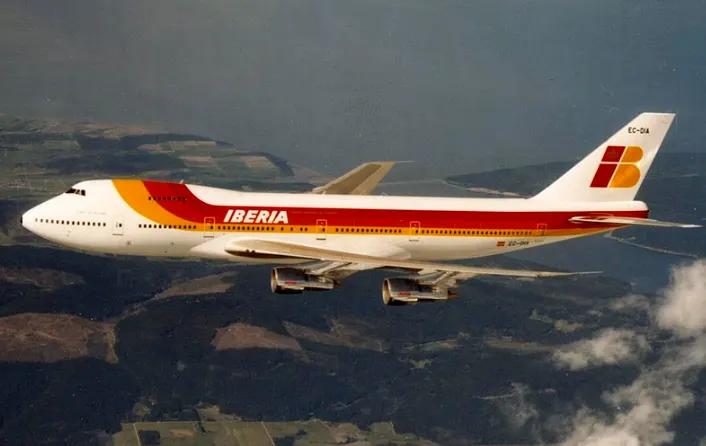
Airbus A340-500:
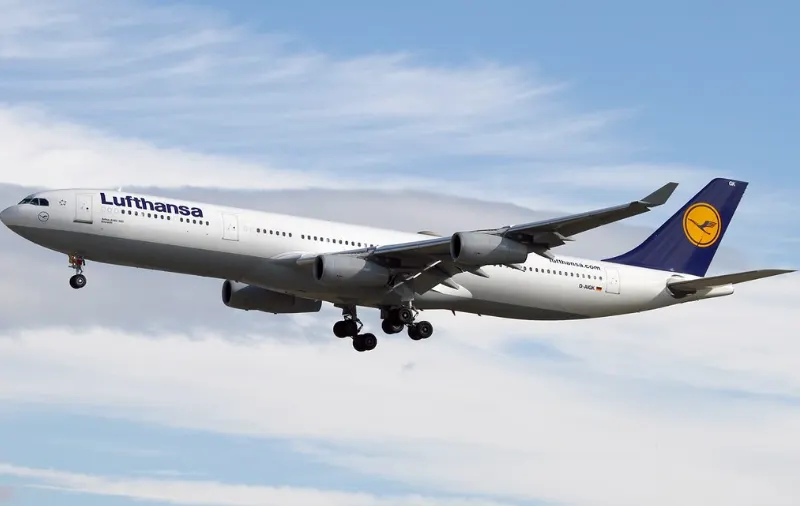
********************************************************************************
Q2. Is there any difference between ground speed and air speed?
ANS:
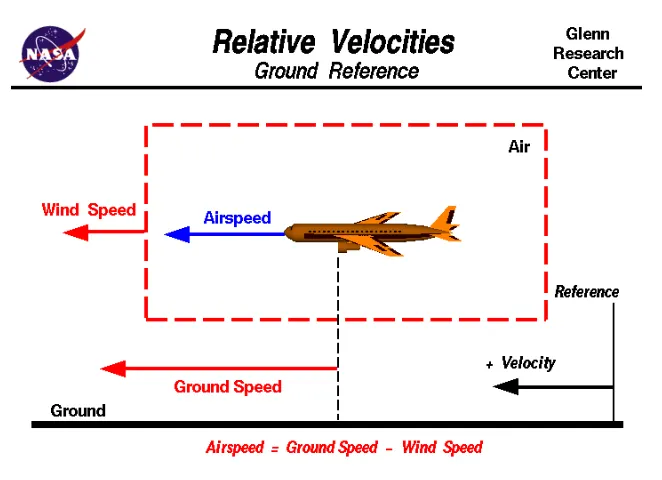
- Airspeed is simply the speed at which an aircraft is moving relative to the air it is flying in. As such, it’s also the speed at which the air is flowing around the aircraft’s wings.
- Ground speed, on the other hand, is the aircraft’s speed relative to the ground. One thing that should be noted here is that it’s its horizontal rather than vertical speed – an aircraft climbing completely vertically would have a ground speed of zero.
- In other words, while airspeed is what determines whether there is enough airflow around an aircraft to make it fly, ground speed is what determines how fast an aircraft will get to its destination.
- Ground speed = Airspeed+Wind speed
- Air speed is independent of Ground speed
Conclusion:
Yes, there is difference between airspeed and groundspeed, For pilots, both airspeed and ground speed are very important. While the airspeed helps them make sure they are flying fast enough to take off, not to stall, and so on, the groundspeed helps them figure out how long it will take them to get from one place to another.
******************************************************************************
Q3. Why is it not recommended to use aircraft engine power to move it on the ground at Airport?
reasones for Why is it not recommended to use aircraft engine power to move it on the ground at Airport
- Although many aircrafts are capable of moving in backward using reverse thrust, as result the jet blast or prop wash might cause damage to the terminal building or equipment. Engine close to ground may also blow sand and debris forward and then suck them into the engine, causing damage to the engine.
- The engine of aircraft are of high power therefore fuel cost also icrease by use of engine for ground moving
- The sound of engine also loud, when one or more aircraft are running at time it producing large sound which are not comfortable to passenger as well as surronding of airport
- It may high chances of get enjured for working ground staff
- If we used the low power engine then it highly chances of entering impurities from surrounding and ground in the engine
- When high power engine is running static running of engine may caused unintended movement of aircraft which leads to loss of control
- Surrounding view of pushback driver is better than the aircraft driver as aircraft driver setting in cockpit with limited view
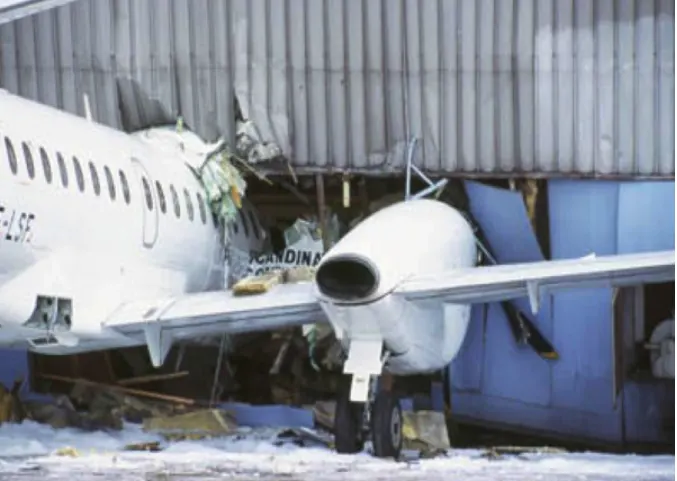
- The following picture shows that what happed if controll is lost
 T
T
*****************************************************************************
Q4. How an aircraft is pushed to runway when its ready to take off?
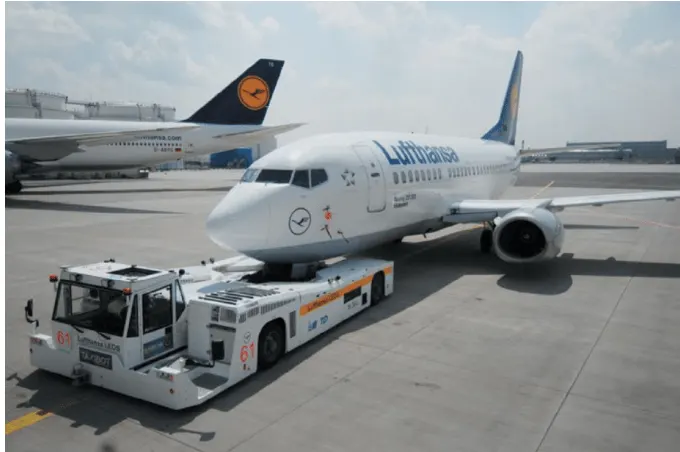
- Taxiing refers to the movement of an aircraft on the ground, under its own power. The aircraft moves on wheels. An airplane uses taxiways to taxi from one place on an airport to another; for example, when moving from a terminal to the runway.
- The aircrafts always moves on the ground following the yellow lines, to avoid any collision with the surrounding buildings, vehicles or other aircrafts. The taxiing motion has a speed limit. Before making a turn, the pilot reduces the speed further to prevent tire skids. Just like cars, there is a certain list of priorities during taxiing. The aircrafts that are landing or taking off have higher priority. The other aircrafts have to wait for these aircrafts before they start or continue taxiing.
- The thrust to propel the aircraft forward comes from its propellers or jet engines. Steering is achieved by turning a nose wheel or tail wheel/rudder; the pilot controlling the direction travelled with their feet. The use of engine thrust near terminals is restricted due to the possibility of jet blast damage. This is why the aircrafts are pushed back from the buildings by a vehicle before they can start their own engines for taxiing.
- many aircrafts are capable of moving in backward using reverse thrust, as result the jet blast or prop wash might cause damage to the terminal building or equipment. Engine close to ground may also blow sand and debris forward and then suck them into the engine, causing damage to the engine.
- Large jetliner passenger aircraft are pushed away from the passenger loading gate by a tug. This is a machine with wheels, some form of power such as an internal combustion engine, or a battery. When the large aircraft is being pushed backwards, there is someone on each wing tip. They are looking out to make sure nothing will touch the aircraft. The whole idea is to avoid expensive crunching noises.
- a small vehicle is needed to push the larger commercial airplanes backwards away from the terminal building, because even if a plane can reverse it’s thrust, it’s not always safe to hit the buildings with that reverse thrust. So the little trucks push the bigger planes back away from the buildings,
- pushback truck reverses the aircraft into taxiing position, pushing it with a towbar attached to the nose-wheel strut. Or, in the most modern versions, by actually lifting the wheel. That speeds up coupling and decoupling.
- An airliner might be pushed backwards off the ramp, and onto a taxi way. Then the engines can start, the aircraft can proceed forward under its own power. A twin engine jet might not start the second engine until it is close to takeoff runway, clearance is certain.
- A piston engine can run at idle power using only a small percentage of the fuel consumption used at operating power level. Turbine engines such as modern airliner turbo fan engine burn a lot of fuel once they are started. So, there is a lot of incentive to not run them until it is time to fly.
*****************************************************************************
Q5. Learn about take off power, tyre design, rolling resistance, tyre pressure, brake forces when landing.
Take off power:
- Takeoff is the phase of flight in which an aircraft goes through a transition from moving along the ground (taxiing) to flying in the air, usually starting on a runway. Usually the engines are run at full power during takeoff.
- Following the taxi motion, the aircraft stops at the starting line of the runway. Before takeoff, the engines, particularly piston engines, are routinely run up at high power to check for engine-related problems. This makes a consid-erable noise. When the pilot releases the brakes, the aircraft starts accelerating rapidly until the necessary speed for take-off is achieved.
- The amount of power that an engine is allowed to produce for limited period of time for takeoff. The use of takeoff power is usually limited to 5 min for reciprocating engines and up to 2½ min for gas turbine engines. This may not always be the case.
- Specifically, with respect to reciprocating engines, it is the brake horsepower developed under standard, sealevel conditions and under the maximum conditions of the crankshaft rotational speed and the engine manifold pressure approved for the normal take-off.
- It is limited in continuous use to the period of time shown in the approved engine specifications. With respect to gas turbine engines, it is the thrust developed under static conditions at a specified altitude and atmospheric conditions of the rotor shaft rotational speed and gas temperature approved for the normal takeoff
Tyre design:
- When it comes to safety, tyres are one of the most important components of aircraft. They help to absorb the shock of landing and provide cushioning. It also provides the necessary traction for braking and stopping of an aircraft.
- An aircraft tyre is designed to withstand extremely heavy loads while landing, take off, taxing, and parking. The number of wheels required for aircraft increases with the weight of the aircraft, as the weight of the aeroplane needs to be distributed more evenly.
- Carcass plies are used to form the tire. They are sometimes called casing plies. An aircraft tyre is constructed for the purpose it serves.
- They support the weight of an aircraft while it is on the ground.
- It also provides the necessary traction for braking and stopping of an aeroplane.
- Tyre also helps to absorb the shock of landing and provide cushioning the roughness of takeoff, roll-out, and taxi operations.
- Unlike an automobile or truck tyre, it does not have to carry a load for a long period of continuous operation. However, an aircraft tyre absorbs the high impact loads of landing, and also it’s operating at high speeds for a short time when required.
- A Boeing 737NG & 737MAX uses 6 wheels, Boeing 787 uses 10 wheels, Boeing 777 uses 14 wheels and Airbus A380 uses 22 wheels. Aircraft tyres work under extreme conditions, carrying up to 340 tons and accelerating at over 250 km/hour at takeoff, in addition to enduring varied environmental stress when in flight and taxiing.
- Each tyre manufacturer produces their own designs of the tyre with different tread patterns, wear patterns, wear limits etc, and in some cases, different names for the same part of the tyre. But all tyres must meet the approved standards before being accepted by the FAA or CAA.
- All commercial aircraft tyres approved under FAA Requirement Technical Standard Order (TSO) C62. A TSO is a minimum performance standard for specified materials, parts, and appliances used on civil aircraft.
Rolling resistance:
The force that resists the motion of a body rolling on a surface is called the rolling resistance or the rolling friction.
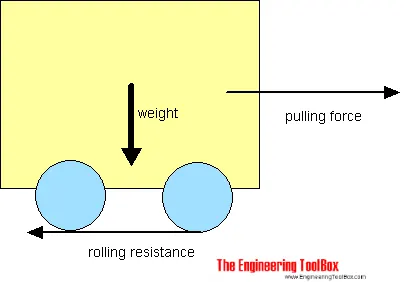
- Rolling resistance is a result of energy loss in the tyre, which can be traced back to the deformation of the area of tyre contact and the damping properties of the rubber. These lead to the transformation of mechanical into thermal energy, contributing to warming of the tyre.
- The rolling resistance term, Crrmgv, represents the power required to overcome the resistance of the tires to roll freely over the road where Crr is the rolling resistance coefficient, m is the mass of the vehicle, and g is the gravitational acceleration.
- Rolling resistance force given by
`F=C_(rr)*N`
- where F is the rolling resistance force, Crr is the coefficient of rolling resistance, and N is the normal force perpendicular to the surface on which the tire is rolling.
- Longitudinal model considering the rolling resistance forces during ground phases. The dotted line indicates ground level.
Tyre pressure:
- An aircraft tire or tyre is designed to withstand extremely heavy loads for short durations
- The high-flying rubber is typically inflated to 200 psi, roughly six times what you put in an automobile tire, and the tires on an F-16 fighter are pumped to 320 psi.It's really pressurized air that's so strong
- Depends on the weight of the plane and number of tires it has, but generally the cold pressure is between 200 and 300+ psi.
- They are rubber, like a car tire but specially formulated to stay flexible at -60 Deg F at altitude. They are still very cold after descent to touchdown.
- in research its found taht aircraft tyre withstand upto 800 psi.
- Of all the things that operators can do to improve the life of the aviation tire, maintaining good pressure maintenance is right at the top of every list.
Brake forces when landing:
- Topping a 200-tonne aircraft landing at 180 mph requires a lot of braking force. To do this, the 787 has one brake unit on each of the eight wheels on the main gear assembly. On other aircraft types, the brake units are powered by the hydraulics system. An electrical signal is sent from the flight deck to hydraulic actuators near the main landing gear. Here, hydraulic fluid at 3,000 pound per square inch is used to force the brake unit against the wheel, thus slowing it down.
- Brakes work by dissipating energy as heat through the action of friction. An aircraft wheel rotating at speed possesses a large amount of kinetic energy. By contacting the wheel with a semi-metallic or ceramic brake pad, an enormous amount of heat is generated as a result of the friction between the two contacting surfaces
- The main part of the aircraft kinectics energy is dissipated by the brake system when landing. The brake force is derived from the counter torque to the wheels movement, which is generated from the brake system actuators. The Fig shows the forces acting on the aircraft and the wheels during braking time and its electrical equivalent
*************************************************************************************
Part B:
6. A. With necessary assumptions, calculate the force and power required to push / pull an aircraft by a towing vehicle.
B. Develop the model for the calculated force and power using Simulink.
ANS:
Calculation for the force and power required to push / pull an aircraft by a towing vehicle. For calculation we assume data for towing truck and aircraft
mass of truck =8500 Kg
mass of aircraft =76000 Kg
lenth of aircraft =33.84 m
velocity of truck 26 Km/h=7.22 m/sec
height of aircraft =11.76 m
Air density(`rho`) =1.225 kg/`m^3`
Drtag coefficient (`C_d`)=0.75
Rolling resistance coefficient (`mu_(rr)`)=0.013
gravitational constant (g)=9.8 Nm
Total mass (m)=mass of truck+mass of aircraft =84500 kg
Area(A)=lenth of aircraft*height of aircraft=397.95 `m^2`
Rolling resistance(`F_(rr)`) given by
`F_(rr)=mu_(rr)*m*g`
`F_(rr)=10765.3` Nm
Airodynamic drag (`F_(ad)`) given by formula
`F_(ad)=0.5*rho*C_d*A*V^2`
`F_(ad)=`9529.50` N
Total force to push / pull an aircraft by a towing vehicle
`F_t=F_(rr)+F_(ad)`
`F_(t)=` 20294.8`
Total Power to push / pull an aircraft by a towing vehicle
`P=F_(t)*Velocity`
P=146528.45 Nm/se
P=146.528 Kw
---------------------------------------------------
B. Develop the model for the calculated force and power using Simulink.
ANS:
BELOW THE MODEL TO CALCULATE FORCE AND POWER
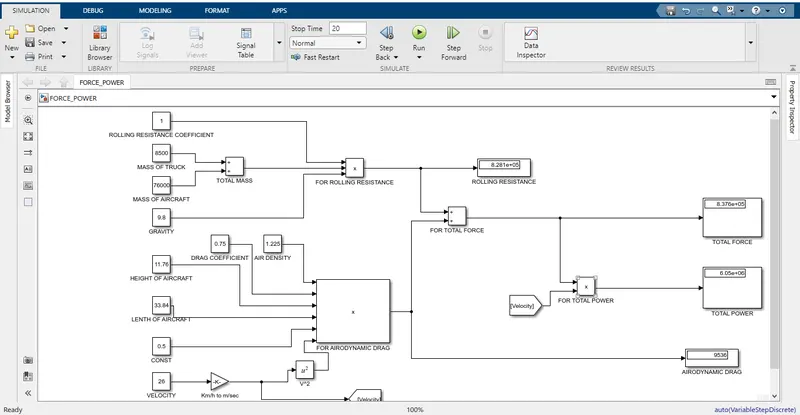
- To do this model we need constant block for our assumed data input
- Add block to calculate total mass
- Gain block to convert velocity km/h to m/sec
- Squre block for getting squre of velocity for aerodynamic drag calculation
- Product block for calculate rolling resistance and aerodynamic drag
- again ADD block for getting totol force and product block to calculate total power
- Display block are used to show result value of force and power
- set all block and connect them as per above formula
RESULT:
from above model we get following result
Rolling resistance= 8.281e+05
Airodynamic drag=9536
Total Force=8.376e+0.5
Total power=6.05e+06
************************************************************************************
7. A. Design an electric powertrain with type of motor, it’s power rating, and energy requirement to fulfill aircraft towing application in Simulink. Estimate the duty cycle range to control the aircraft speed from zero to highest. Make all required assumptions. Prepare a table of assumed parameters. Draw a block diagram of powertrain.
(Hint :DC7 Block)
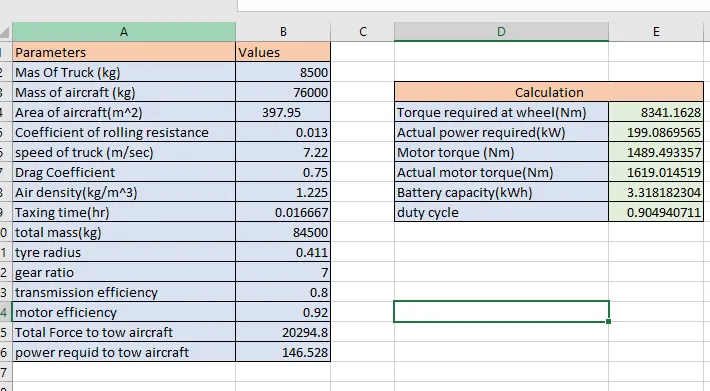
B. Also, Design the parameters in excel sheet.
ANS:
we concider same truck for towing as in privious question
parameter
mass of truck =8500 Kg
mass of aircraft =76000 Kg
lenth of aircraft =33.84 m
velocity of truck 26 Km/h=7.22 m/sec
height of aircraft =11.76 m
Air density(`rho`) =1.225 kg/`m^3`
Drtag coefficient (`C_d`)=0.75
Rolling resistance coefficient (`mu_(rr)`)=0.013
gravitational constant (g)=9.8 Nm
Total mass (m)=mass of truck+mass of aircraft =84500 kg
Area(A)=lenth of aircraft*height of aircraft=397.95 `m^2`
Rolling resistance(`F_(rr)`)
`F_(rr)=mu_(rr)*m*g`
`F_(rr)=10765.3` Nm
Airodynamic drag (`F_(ad)`)
`F_(ad)=0.5*rho*C_d*A*V^2`
`F_(ad)=`9529.50` N
tyre specification 315/70 R15
designing data:
Total force to push / pull an aircraft by a towing vehicle `F_(t)=` 20294.8`
Total Power to push / pull an aircraft by a towing vehicle P=146.528 Kw
radius of towing truck 0.411 m
gear ratio =7
transmission efficiency(`eta_t`) =80%
motor efficiency(`eta_m`) =92%
calculation:
wheel Torque req. (`T_w`)= Total Force*Radious of tyre=8341.16 Nm
Actual power require=`P_(ac)`= `(Total power)/(eta_t*eta_m)`=199.08
motor torque (`T_m`)=Tw/gear ratio*`eta_t`=1.489 kNm
actual motor torque(`T_(mac)`)=`T_m/eta_m`=1.619kNm
Calculation of battery capacity:
assumed that towing truck take 15 min for taxing=0.016667 hrs
battery capacity =`p_(ac)*hrs`= 3.31 kWh
we can say that if i used 220 kW bsattery then it will work easily
Duty cycle calculation
Duty cycle=required power Pac/battery capacity(rated)=199.08/220=0.904
means at 0.904 truck reach its max speed 7.22 m/sec.
the range is from 0 to 0.904
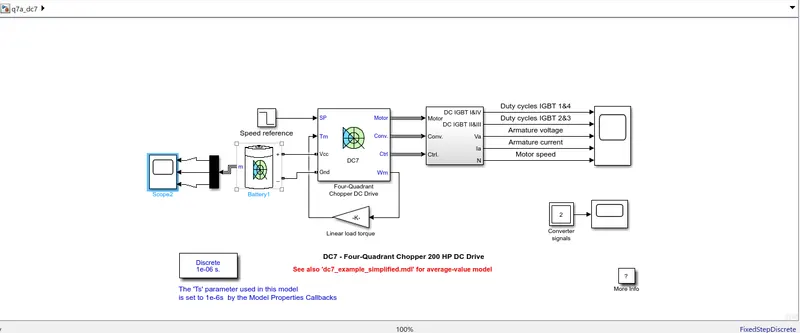
Power train block diagram
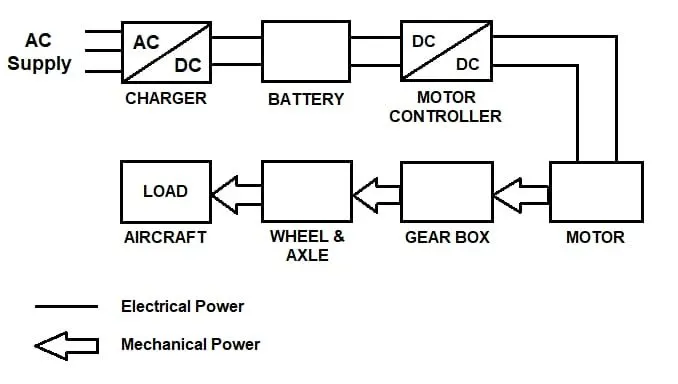
below is model in which we provide battery as per requirement of motor
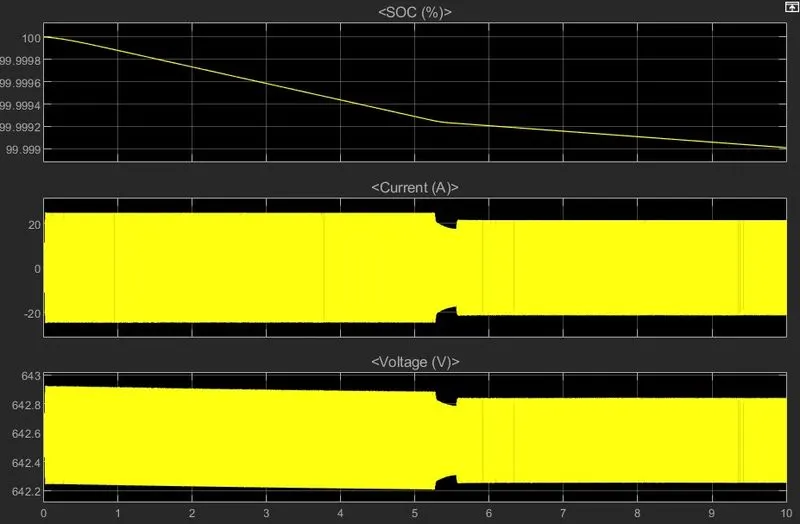
Results:
B)
i design the parameter and calculation in below excel sheet
and attached same sheet