Project-1: Powertrain for aircraft in runways
Aim :
- Search and list out the total weight of various types of aircrafts.
- Is there any difference between ground speed and air speed?
- Why is it not recommended to use aircraft engine power to move it on the ground at Airport?
- How an aircraft is pushed to runway when its ready to take off?
- Learn about take off power, tyre design, rolling resistance, tyre pressure, brake forces when landing.
- A. With necessary assumptions, calculate the force and power required to push / pull an aircraft by a towing vehicle.
B. Develop the model for the calculated force and power using Simulink.
7 A. Design an electric powertrain with type of motor, it’s power rating, and energy requirement to fulfill aircraft towing application in Simulink. Estimate the duty cycle range to control the aircraft speed from zero to highest. Make all required assumptions. Prepare a table of assumed parameters. Draw a block diagram of powertrain.
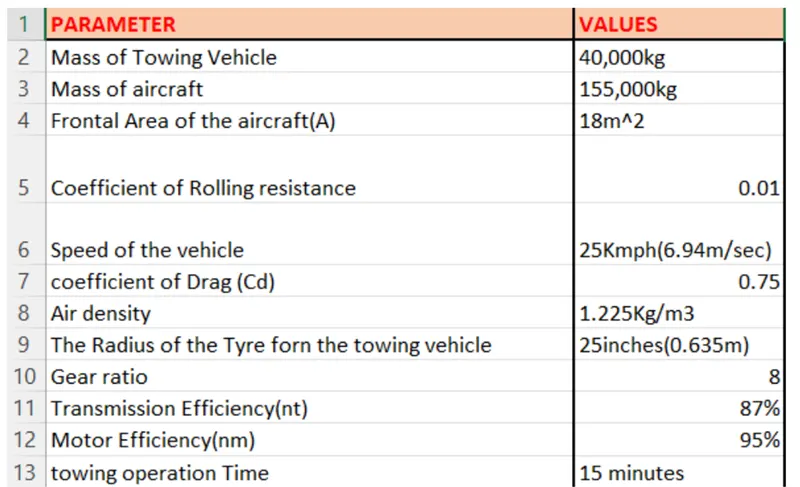
b) Also, Design the parameters in excel sheet.
Solution
- Aircraft Gross Weight: The aircraft gross weight (also known as the all-up weight and abbreviated AUW) is the total aircraft weight at any moment during the flight or ground operation.
|
Types of Aircraft |
Aircraft Gross Weight |
Examples |
|
Glider |
110 - 200 kg |
Sailplane, Hang gliders, Paragliders. |
|
Powered Lift |
160 kgs |
Bell Boeing V-22 Osprey, British Harrier |
|
Fighter Aircraft |
13500 kgs |
Tejas, Sukoi, MIG, Mirage 2000 |
|
Transport Planes |
250,000 kgs |
Airbus A300, Airbus A310, Airbus A320 family, Airbus A330, Boeing 727 |
|
Aerobatic Planes |
771 s |
MX Aircraft MX2 (2002), MX Aircraft MXS, North American P-51 Mustang (1940), North American SNJ/T-6 Texan (1935) |
- Difference between ground speed and air speed:
|
Ground Speed |
Air speed |
|
Ground speed is the airplane’s speed relative to the surface of the Earth |
Airspeed is the speed relative to the air it is flying in |
|
Ground speed is what determines how fast an aircraft will get to its destination |
Airspeed is what determines whether there is enough airflow around an aircraft to make it fly |
|
Airspeed is what determines whether there is enough airflow around an aircraft to make it fly |
It is independent of ground speed. |
3. why it is not recommended to use aircraft engine power to move it on the ground at Airport ?
Towing is coupling two or more objects together so that they may be pulled by a designated power source or sources. The towing source may be a motorized land vehicle, vessel, animal, or human, and the load being anything that can be pulled.
Although many aircraft are capable of moving themselves backwards on the ground using reverse thrust (a procedure referred to as a powerback), the resulting jet prop might cause damage to the terminal building or equipment. Engines close to the ground may also blow sand and debris forward and then suck them into the engine, causing damage to the engine. A pushback is therefore the preferred method to move the aircraft away from the gate.
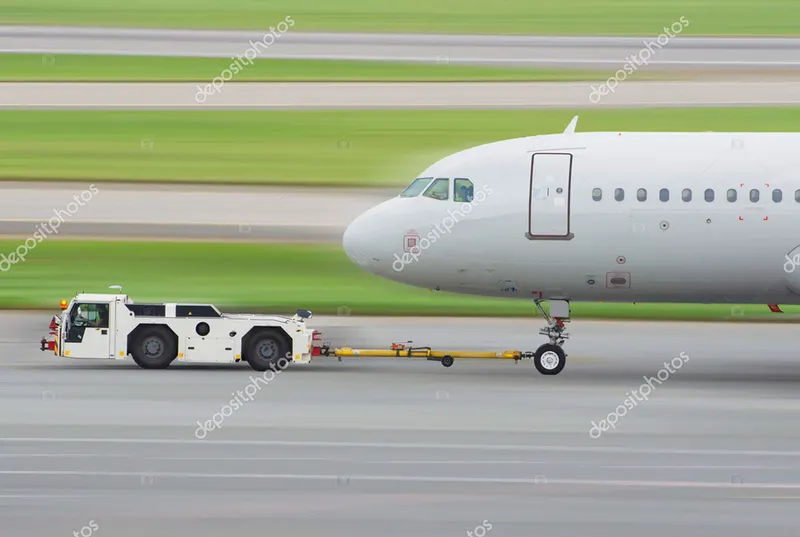
Although most aircraft are capable of moving themselves backwards on the ground using reverse thrust, a procedure called as a powerback, it is not typically done due to the following reasons:
- The jet blast from the engines can damage the terminal building and nearby equipment. It can even throw away people standing nearby.
- Engines can blow sand and debris.
- Engines can suck in sand and debris which can cause serious damage to the engine.
- It is easier for the truck driver to see the surroundings better than the pilot sitting in the cockpit with limited windows.
- The pushback truck driver knows the airport better than the pilot.
- The plane engines are very loud. This noise can add up substantially when multiple planes are moving around the airport. It won't be a pleasant experience for people sitting inside the terminal, as most people don't even like the sound of powerful motor-bikes.
- It saves fuel. Virgin Atlantic had proposed a new system in which the pushback trucks will push the plane all the way to the runway to save fuel and reduce impact on nearby environment.
- How an aircraft is pushed to runway when its ready to take off?
In aviation, pushback is an airport procedure during which an aircraftis pushed backwards away from an airport gate by external power. Pushbacks are carried out by special, low-profile vehicles called pushback tractors or tugs.
Although many aircraft are capable of moving themselves backwards on the ground using reverese thrust (a procedure referred to as a powerback), the resulting jetblast or propwash might cause damage to the terminal building or equipment. Engines close to the ground may also blow sand and debris forward and then suck them into the engine, causing damage to the engine. A pushback is therefore the preferred method to move the aircraft away from the gate.
Pushbacks at busy aerodromes are usually subject to ground control clearance to facilitate ground movement on taxiways. Once clearance is obtained, the pilot will communicate with the tractor driver (or a ground handler walking alongside the aircraft in some cases) to start the pushback. To communicate, a headset may be connected near the nose gear.
Since the pilots cannot see what is behind the aircraft, steering is done by the pushback tractor driver and not by the pilots. Depending on the aircraft type and airline procedure, a bypass pin may be temporarily installed into the nose gear to disconnect it from the aircraft's normal steering mechanism.
Once the pushback is completed, the towbar is disconnected, and any bypass pin removed. The ground handler will show the bypass pin to the pilots to make it clear that it has been removed. The pushback is then complete, and the aircraft can taxi forward under its own power.
5.Learn about take off power, tyre design, rolling resistance, tyre pressure, brake forces when landing.
a.Take off Performance :
Take off performance can be predicted using a simple measure of the acceleration of the aircraft along the runway based on force equilibrium.
The forces involved will be,
T – Thrust of propulsion system pushing aircraft along runway.
D – Aerodynamic Drag of vehicle resisting the aircraft motion.
F – Rolling resistance friction due to the contact of wheels or skids on the ground.
During take-off run the imbalance in these forces will produce an acceleration along the runway.
dv/dt = T - D - F /m
The procedure for take-off will be that the vehicle will accelerate until it reaches a safe initial flying speed. The pilot can then rotate the vehicle to an attitude to produce climb lift and it will ascend from the ground. The determination of this safe flying speed or rotation speed, V , is a critical factor in determining take-off performance.
For safety reasons V is usually determined as being 1.1 × Vstall
Tyre Design of aircrafts :
When it comes to safety, tyres are one of the most important components of aircraft. They help to absorb the shock of landing and provide cushioning. It also provides the necessary traction for braking and stopping of an aircraft.
An aircraft tyre is designed to withstand extremely heavy loads while landing, take off, taxing and parking. The number of wheels required for aircraft increases with the weight of the aircraft, as the weight of the aeroplane needs to be distributed more evenly.
Carcass plies are used to form the tire. They are sometimes called casing plies. An aircraft tyre is constructed for the purpose it serves.
Unlike an automobile or truck tyre, it does not have to carry a load for a long period of continuous operation. However, an aircraft tyre absorbs the high impact loads of landing and also it’s operating at high speeds for a short time when required.
Retreading – Retreading is methods of restoring a worn tyre by renewing the tread area or by renewing the tread area plus one or both sidewalls. Repairs are included in the tyre retreading process.
Load Rating – Load rating is the maximum permissible load at a specified inflation pressure.
Ply Rating – Ply Rating is used to identify the maximum recommended load rating and inflation pressure for a specified tyre. It is an index of tyre strength.
Speed Rating – The speed rating is the maximum takeoff speed to which the tyre has been tested.
Skid Depth – Skid depth is the distance between the tread surface and the deepest groove as measured in the mould. Aircraft tyres must have an approved speed and load rating and have sufficient clearance when retracted through landing gear to allow for tyre growth. Tyre growth is the increase in the size of the tyre due to centrifugal forces at high speed.
Rolling Resistance :
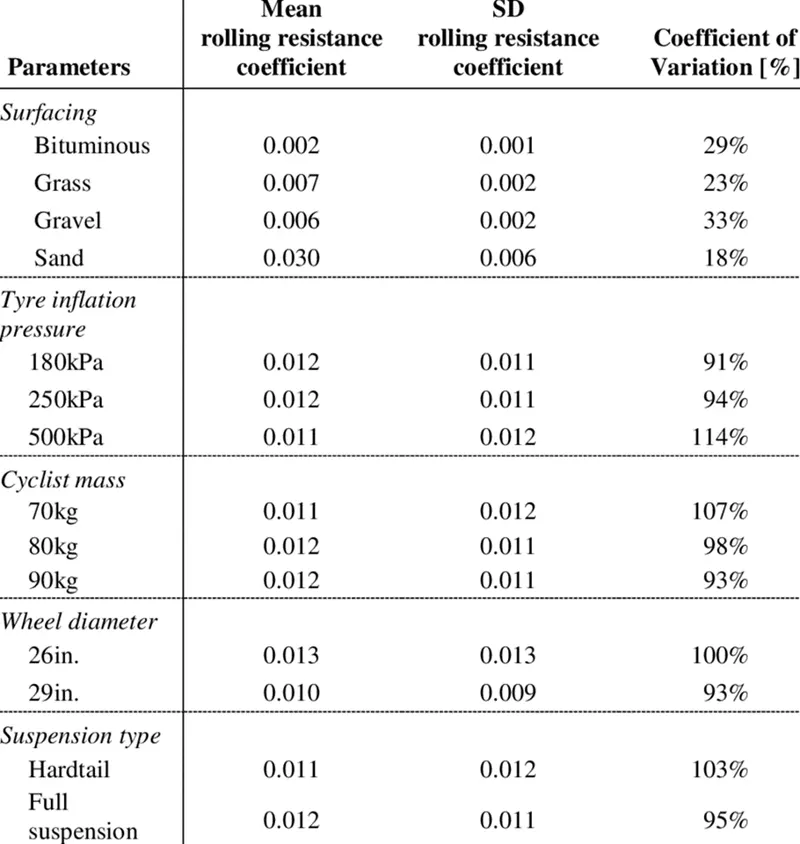
Rolling resistance, sometimes called rolling friction or rolling drag, is the force resisting the motion when a body (such as a ball, tire, or wheel) rolls on a surface. It is mainly caused by effects; thnon elastic at is, not all the energy needed for deformation (or movement) of the wheel, roadbed, etc., is recovered when the pressure is removed. Two forms of this are hysterisis losses , and permanent plastic deformation of the object or the surface (e.g. soil). Another cause of rolling resistance lies in the slippage between the wheel and the surface, which dissipates energy. Note that only the last of these effects involves friction, therefore the name "rolling friction" is to an extent a misnomer.
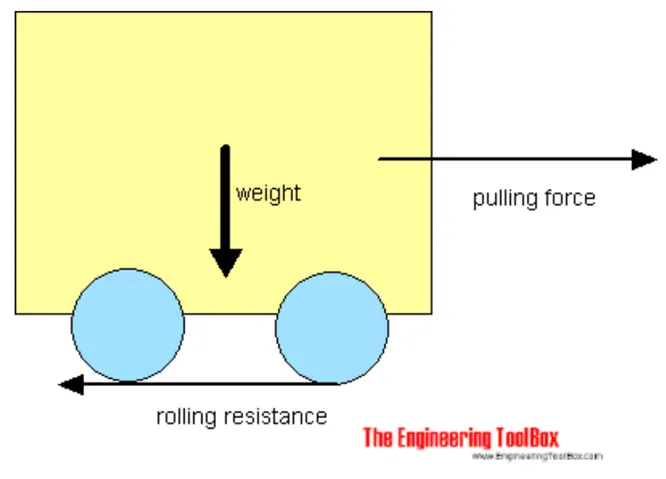
The rolling resistance can be expressed as
F = c W (1)
where
F = rolling resistance or rolling friction (N, lb )
c = rolling resistance coefficient - dimensionless (coefficient of rolling friction - CRF)
W = m a
= normal force - or weight - of the body (N, lb )
m = mass of body (kg, lb)
g = acceleration of gravity (9.81 m/s , 32.174 ft/s )
d.Tyre Pressure :
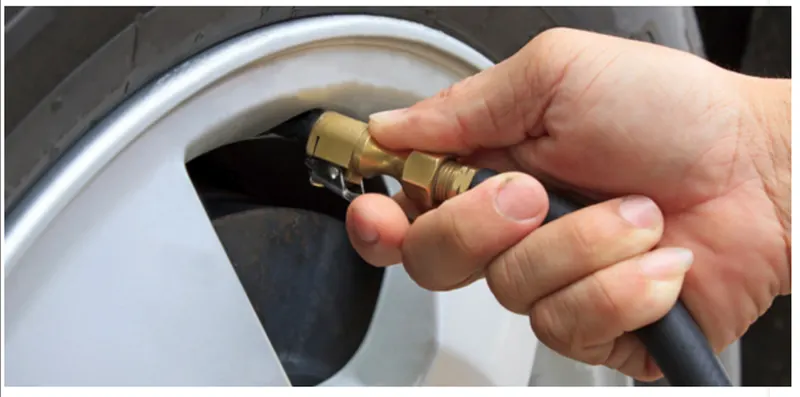
Car tyres aren’t just unsafe when they’re old and worn out – you need to ensure you know what tyre pressure you have in your tyres when you drive it because there are critical safety and economic implications.
Car tyre pressure is a measurement of how much air is in your pneumatic tyre, and ensures the tyres wear evenly and maintain the correct level of grip on the road surface. This is commonly expressed as PSI, or pounds-per-square-inch.
Brake forces:
-Braking an aircraft is a challenging job for most of the pilots especially during landing in a rainy and cross wind environment.
- Inorder to encounter this kinds of problem pilots usually make use of spoilers and reverse thust method inorder to have a safe landing so that the energy required to apply brakes on tires can be reduced and henceforth they do not skid.
-Now there is method which determines the brake force for aircrafts and they are as follows:
k =(1/2)(mv^2),
where
m= mass of aircraft and
v=velocity of aircraft.
A typical commercial landing speed will range between 150 to 165 MPH.And for passenger flight it is about 166 to 172mph.
- a)
The rolling resistance for the air plane can be calculated as
F = c m g
where F = rolling resistance (N)
c = rolling resistance coefficient
m = rolling mass (kg)
g = acceleration of gravity (9.81 m/s )
If the mass of a plane is 40000 kg and the rolling resistance co-efficient between the aircraft wheel and the runway is 0.02
The force required to overcome the rolling resistance can be calculated as
Fr = 0.02 * (40000 kg) *(9.81 m/s ) = 7848 N
The friction for the puller can be calculated to
Fr = μ W = μ m g
where
Fr = frictional force (N)
μ = friction coefficient
W = Weight (N)
m = friction mass (kg)
The friction coefficient between a pulling truck rubber wheels and dry runway is 0.9. Since pulling trucks are connected to air crafts nose wheels close to runway we simplify the calculation of required truck mass
mf = (7848 N) / (0.9 (9.81)) = 889 kg
Taking radius of the wheel R as 0.3m
The torque is given by T=F*R
T= 7848 * 0.3 = 2354 Nm
The power for pulling/push the aircraft can be calculated as
P=F*V
V= velocity of pull vehicle taken as 5 km/hr
V=1.388 m/s
P=7848*1.388 =10893 W =10.89 kW
6 B) Develop the model for the calculated force and power using Simulink.
Blocks Used:
1) Constant
2) Sum
3) Product
4)Square
5)Display
Simulink Model:
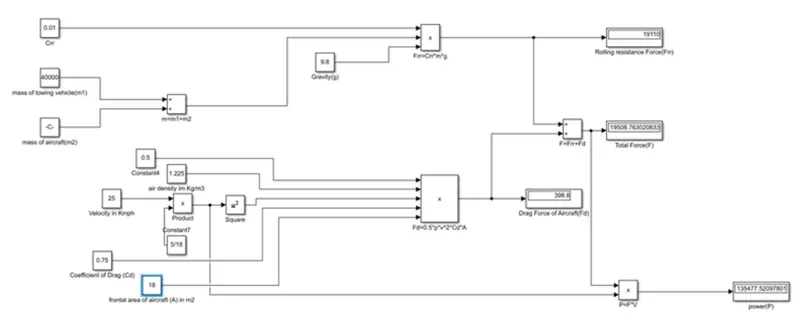
Explanation:
In order to understand the above simulink model we do reverse engineering
- For calculating power we have to multiply both total force(F) and velocity in m/sec for this we have used 'product' block (P-FV).
- For calculating the Total Force(F) we have added both Frr & Fd by using 'Sum' block as shown in the above figure
- To find the value of rolling resistance (Frr) we used product to multiply the values Crr., Total mass(m) & gravity (g) which are to be entered in the 'Constant block. .
- Similarly for calculating Drag force(Fd) we have to multiply the velocity in m/sec.Drag coefficient, Frontal area of aircraft(A) and a constant value 0.5 which are to be entered in constant block.
- In order to convert velocity in Kmph to m/sec we have multiplied it with 5/18.
7) A. Designing an electric powertrain with type of motor, it's power rating, and energy requirement to fulfill aircraft towing application in Simulink. Estimate the duty cycle range to control the aircraft speed from zero to highest. Make all required assumptions. Prepare a table of assumed parameters. Draw a block diagram of powertrain.
Block Diagram of Powertrain:
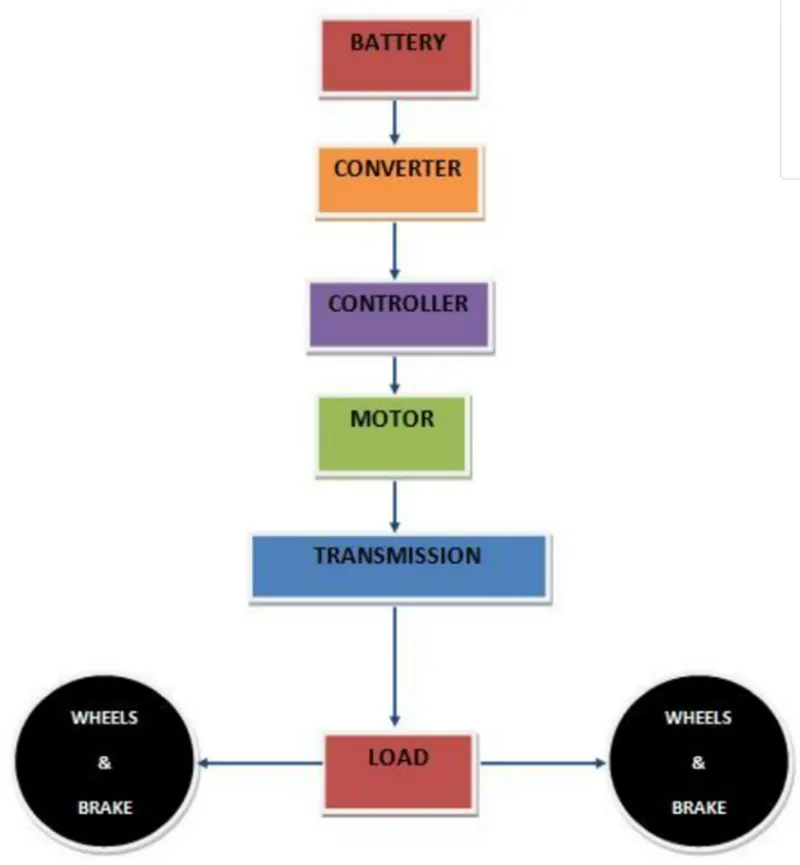
Based on the calculations done in 6A.
Force required to push/pull the aircraft = 19.508 KN
Power required = 135.478 kw
Let us assume,
The Radius of the Tyre for the Tug - 25inches = 0.635m
Gear ratio = 8
Transmission Effeciency (nt) =87%
Motor Efficiency (nm)=95%
Torque required for the wheels (Tw)=Total Force *Radius in meters
=19.508 *0.635 =12.387KNm
Motor Torque-Wheel torque/(Gear ratio'nt)
=12.387/(8 0.87)
=1.778KNm
For nm =95%. The required motor Torque (Tm)= 1.778/0.95 =1.871 kNm
Similarly.
The total power required by the motor considering all the efficiencies
(Pt) = 135.478/(0.87*0.95) = 163.917Kw
Let us assume the towing operation was done for a 15 minutes (0.25Hrs) duration.
Then, Total Energy consumed = 163.917* 0.25 = 40.98 KWh
If we consider the battery capacity=220 kw is used by the towing vehicle then. The duty cycle range to control the speed from O to max speed (3m/s) is given as
Duty Cycle (d) = (Required Power)/ (Rated power) = 163.917/220 = 0.75
Therefore the controller will be able to provide a duty cycle ranging from 0 to 75% in order to control the towing speed.
Simulink Diagram of powertrain:
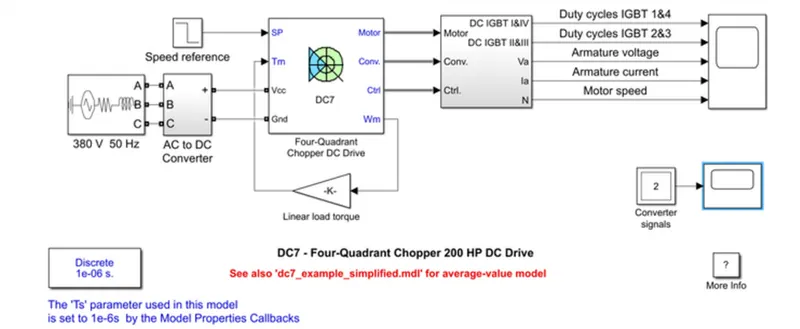
Output :
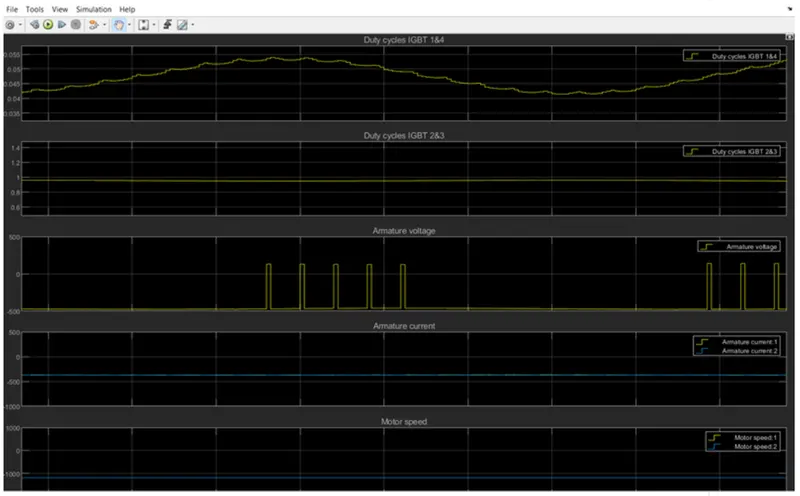
B. Designing the parameters in excel sheet.
Conclusion :
- listed the total weight of various types of aircrafts.
- Explained the difference between ground speed and air speed.
- Explained why is it not recommended to use aircraft engine power to move it on the ground at Airport?
- Explained how an aircraft is pushed to runway when its ready to take off?
- Learnt about take off power, tyre design, rolling resistance, tyre pressure, brake forces when landing.
- A. With necessary assumptions, calculated the force and power required to push / pull an aircraft by a towing vehicle.
- Developed the model for the calculated force and power using Simulink.
- A. Designed an electric powertrain with type of motor, Simulink. Estimated the duty cycle range to control the aircraft speed from zero to highest.
- Designed the parameters in excel sheet.