Project-1: Powertrain for aircraft in runways
EV Live Batch 13
Part A:
#1. Search and list out the total weight of various types of aircrafts.
The aircraft gross weight (also known as the all-up weight and abbreviated AUW) is the total aircraft weight at any moment during the flight or ground operation. An aircraft's gross weight will decrease during a flight due to fuel and oil consumption. An aircraft's gross weight may also vary during a flight due to payload dropping or in-flight refuelling. During the flight gross weight is reffered as inflight weight.
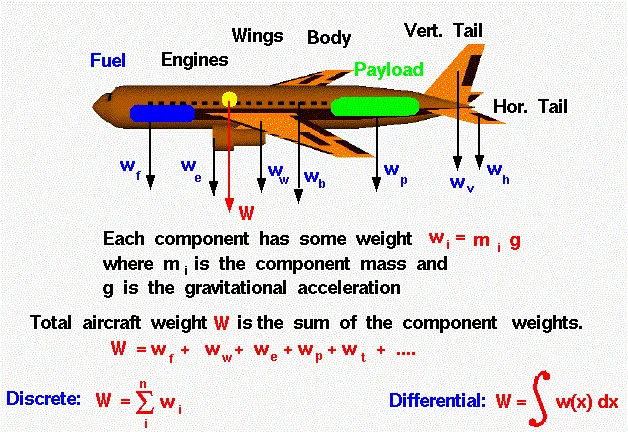
Differernt components which contribute the Aircraft Gross Weight
The different terms represent different weights or masses are:
- Manufacturer's empty weight (MEW)
- Zero-fuel weight (ZFW)
- Operating empty weight (OEW)
- Payload
- Maximum takeoff weight (MTOW)
- Regulated takeoff weight (RTOW)
- Maximum landing weight (MLW)
- Maximum ramp weight (MRW)
List of some various types of aircrafts and their total weight is given below
| Type | MTOW [kg] | MLW [tonnes] |
| Boeing 747-8F | 4,47,700 | 346.091 |
| Boeing 747-8 | 4,43,613 | 306.175 |
| Boeing 747-400ER | 4,12,770 | 295.742 |
| Boeing 747-400 | 3,96,900 | 295.742 |
| Airbus A340-500 | 3,71,950 | 240 |
| Airbus A340-600 | 3,67,400 | 256 |
| Airbus A350-1000 | 3,08,000 | 233.5 |
| Boeing 777-300 | 2,99,370 | 237.683 |
| Boeing 777-200ER | 2,97,550 | 213 |
| Airbus A340-300 | 2,76,700 | 190 |
| Airbus A330-900 | 2,51,000 | 191 |
| Ilyushin IL-96-300 | 2,50,000 | 175 |
| Airbus A330-300 | 2,42,000 | 185 |
| Boeing 787-8 | 2,28,000 | 172.365 |
| Ilyushin IL-86 | 2,08,000 | 175 |
| Boeing 767-400ER | 2,04,000 | 158.758 |
| Airbus A300-600R | 1,92,000 | 140 |
| Airbus A300-600 | 1,63,000 | 138 |
| Airbus A310-300 | 1,57,000 | 124 |
#2. Is there any difference between ground speed and air speed?
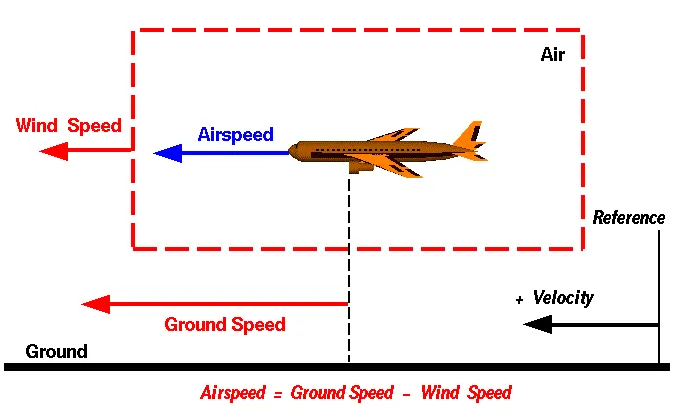
Ground Speed
- Ground speed is the aircraft’s speed relative to the ground.
- It is the horizontal speed rather than vertical speed.
- Ground speed will determine how fast the aircraft reaches the destination
- Groung speed is the sum of air speed and wind speed.
Airspeed
- Airspeed is simply the speed at which an aircraft is moving relative to the air it is flying in.
- Airspeed is independant of ground speed
- Airspeed is the difference of ground speed and wind speed.
#3. Why is it not recommended to use aircraft engine power to move it on the ground at Airport?
- Although many aircrafts are capable of moving in backward using reverse thrust, as result the jet blast or prop wash might cause damage to the terminal building or equipment. Engine close to ground may also blow sand and debris forward and then suck them into the engine, causing damage to the engine.
- When the aircraft is started using reverse thrust it will consume a lot of fuel and causes high noise.
- It is reccomemented to use towing vehicle which will help the aircraft in forward and backward direction until it is safe in the runway for take off.
#4. How an aircraft is pushed to runway when its ready to take off?
- In aviation, pushback is an airport procedure during which an aircraft is pushed backwards away from its parking position, usually at an airport gate by external power. Pushbacks are carried out by special, low-profile vehicles called pushback tugs.
- Although many aircraft are capable of moving themselves backwards on the ground using reverse thrust the resulting jet blast or prop wash would cause increased noise, damage to the terminal building or equipment, and hurt airport staff due to high-speed debris. A pushback is therefore the preferred method when ground-handling aircraft.
- Pushbacks at busy aerodromes are usually subject to ground control clearance to facilitate ground movement on taxiways. Once clearance is obtained, the pilot will communicate with the tractor driver to start the pushback. To communicate, a headset may be connected near the nose gear.
- Since the pilots cannot see what is behind the aircraft, steering is done by the pushback tractor driver and not by the pilots.
- Once the pushback is completed, the towbar is disconnected, and any bypass pin removed. The ground handler will show the bypass pin to the pilots to make it clear that it has been removed.
- After these procedures the pushback is then complete, and the aircraft can taxi forward under its own power.
#5. Learn about take off power, tyre design, rolling resistance, tyre pressure, brake forces when landing.
Take off power
Aircrafts usually full power is used during takeoff. The take off power may vary on the size of aircrafts and runway speed. In some emergency cases, the power used can then be increased to increase the aircraft's performance. Before takeoff, the engines, particularly piston engines, are routinely run up at high power to check for engine-related problems. The aircraft is permitted to accelerate to rotation speed. The term rotation is used because the aircraft pivots around the axis of its main landing gear while still on the ground, usually because of gentle manipulation of the flight controls to make or facilitate this change in aircraft attitude.
The nose is raised to a nominal 5°–15° nose up pitch attitude to increase lift from the wings and effect liftoff. For most aircraft, attempting a takeoff without a pitch-up would require cruise speeds while still on the runway.
The speeds needed for takeoff are relative to the motion of the air. A headwind will reduce the ground speed needed for takeoff, as there is a greater flow of air over the wings.
The take off power is determined by forces Thurst od propelsion system, Aerodynamic drag, Rolling Resistance.
Tyre Design
Carcass plies / Casing plies are used to form the tire.An aircraft tyre is constructed for the purpose it serves.
- They support the weight of an aircraft while it is on the ground.
- It also provides the necessary traction for braking and stopping of the aircraft.
- Tyre also helps to absorb the shock of landing and provide cushioning the roughness of takeoff, roll-out, and taxi operations.
An aircraft tyre absorbs the high impact loads of landing, and also it’s operating at high speeds for a short time when required. Aircraft tyres must have an approved speed and load rating and have sufficient clearance when retracted through landing gear to allow for tyre growth.
Load Rating – Load rating is the maximum permissible load at a specified inflation pressure.
Ply Rating – Ply Rating is used to identify the recommended load rating and inflation pressure for a specified tyre.
Speed Rating – The speed rating is the maximum takeoff speed to which the tyre has been tested.
Skid Depth – Skid depth is the distance between the tread surface and the deepest groove as measured in the mould.
Rolling Resistance
Rolling resistance is the energy that vehicle/aircraft needs to send to your tires to maintain movement at a consistent speed over a surface. It is the effort required to keep a tire rolling. The main contributor to rolling resistance is the process known as hysteresis.
Tyre Pressure
Aircraft tyres are designed to withstand heavy loads during the takeoff and landing and is nessesary to distriute weight evenly. The tyre pressure is sensed before takeoff and landing.
Aircraft tyres are usually inflatted with nitrogen to reduce expansion and contraction.
Aircraft tyres can sustain s maximum pressure of 800psi. The normal tyre pressure of the aircraft varies to different aircrafts according the size and load of the aircraft.
Brake Forces when landing
Spoilers and reverse thrust method is used apart from tyre braking inorder to reduce the skiding of tyre and speed of the aircraft diring landing.
Wing spoilers to assist with braking when landing.The spoilers are extendable flaps on the ends of an airplane’s wings. Pilots can raise the spoilers to decelerate the airplane as it approaches the runway. And even while on the runway, pilots will typically leave the wing spoilers raised. Raised wing spoilers create drag, which essentially slows down the airplane so that it’s able to brake more quickly.
In addition to wing spoilers, airplanes use disc brakes. Airplane disc brakes are similar to the braking system in automobiles.
Reverse thrust to assist with braking during landings. Reverse thrust changes the direction of the engine thrust. This reversal of thrust provides deceleration that allows airplanes to slow down more quickly when landing.
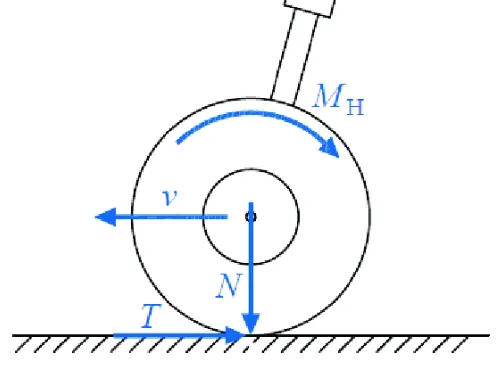
MH - Braking Torque produced by brakes
T - Friction force compensating the braking force
N - Pressure force od wheel
v - Speed of the wheel
Part B:
#6.
A. With necessary assumptions, calculate the force and power required to push / pull an aircraft by a towing vehicle.
TMX-150-9 is considered as Towing Vehicle and Airbus A319 is considered as aircraft.
TMX-150-9 Specifications
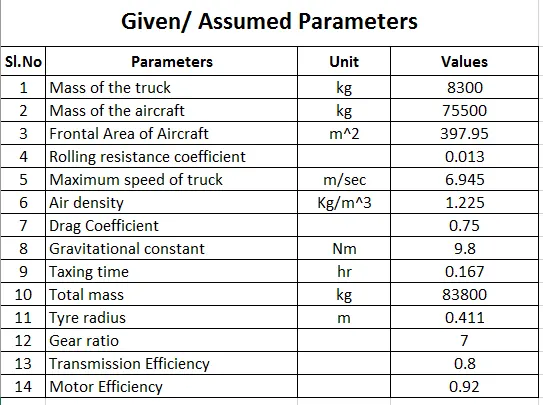
Total mass = 8300 Kg (18260 lbs)
Length = 4.5 m (4500 mm)
Height = 2 m (2000 mm)
Max. Velocity, V= 25 kmph (6.945 m/s)
Airbus A319 Specifications
Mass (MTOW)= 75500 Kg (166449 lbs)
Length = 33.84 m (33840 mm)
Height = 11.76 m (11760 mm)
Assumed Data
Air Density, ρ = 1.225 kg/m^3
Drag Coefficient, Cd = 0.75
Rolling Resistance Coefficient, μrr = 0.013
Gravitational constant, g = 9.8 Nm
-------------------------------------------------------------------------------------------------------------------------------------------
Rolling Resistance, Frr = μrr . m . g
= 0.013 x (75500+8300) x 9.8
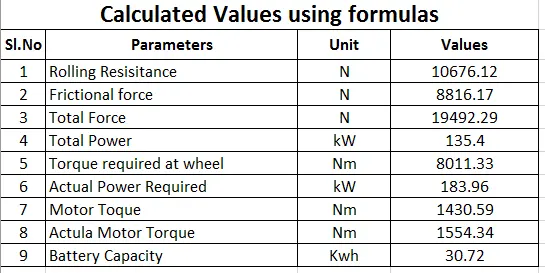
= 10676.12 N
Frictional Force, Ff = 1/2 . ρ . Cd . A . V^2
Frontal Area, A = Length x Height
= 33.84 x 11.76
= 397.95 m^2
Frictional Force, Ff = 0.5 x 1.225 x 0.75 x 397.95 x 6.945^2
= 8816.17 N
Total Force, Ft = Frr + Ff
= 10676.12 + 8816.17
= 19429.29 N
Power = Ft x V
= 19429.29 x 6.945
= 135363 W = 135.4 kW
B. Develop the model for the calculated force and power using Simulink.
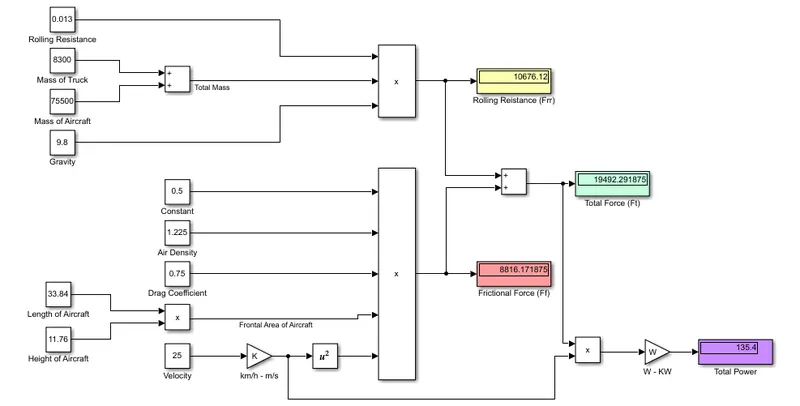
#7.
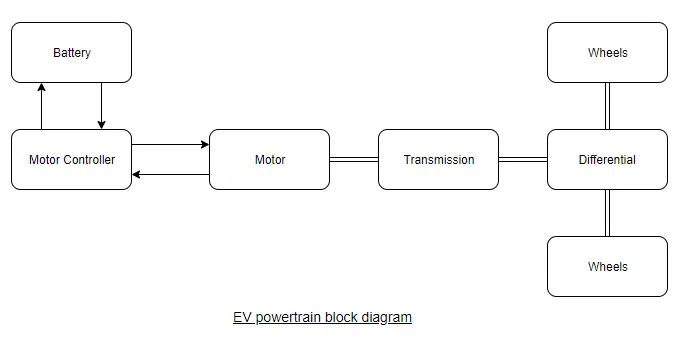
A. Design an electric powertrain with type of motor, it’s power rating, and energy requirement to fulfill aircraft towing application in Simulink. Estimate the duty cycle range to control the aircraft speed from zero to highest. Make all required assumptions. Prepare a table of assumed parameters. Draw a block diagram of powertrain.
Powertrain for TMX-150-9 having a tyre specification 315/70 R15
From the above question,
Total Force to towing aircraft = 19492.29 N
Total Power to towing aircraft = 135.4 kW
Tyre Raduis, R = 0.411 m
Gear Ratio, Gr= 7
Transmission Efficiency = 80% = 0.8
Motor Efficiency = 92% = 0.92
-------------------------------------------------------------------------------------------------------------------------------------------
Torque required at wheel, Tw= Total Force x Tyre Radius
= 19492.29 x 0.411
= 8011.33 Nm
Actual Power required, Pa = Total power / (Tranmission Efficiency x Motor Efficiency)
= 135.4 / (0.8 x 0.92)
= 183.96 kW
Motor Torque, Tm = Tw / Gear Ratio x Tranmission Efficiency
= 8011.33 / (7 x 0.8)
= 1430.59 Nm
Actual Motor Torque, Ta = Tm / Motor Efficiency
= 1430.59 / 0.92
= 1554.34 Nm
Battery Capacity = Pa x Time (Assume time as 10 min = 0.167 Hours)
= 183.96 x 0.167
= 30.72 kWh
Duty Cycle = Pa / Battery Capacity
= 183.96 / 30.72
= 6 Duty Cycle
Simulink Model
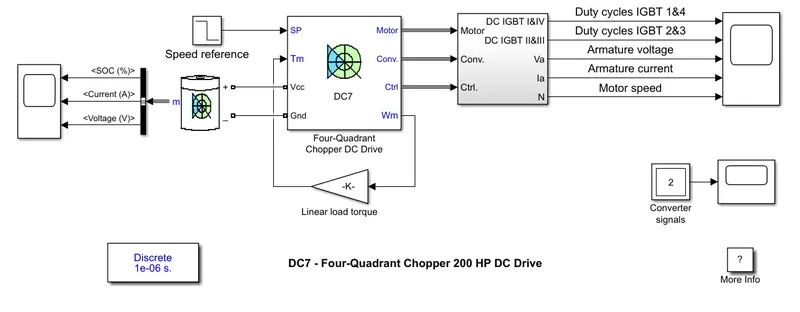
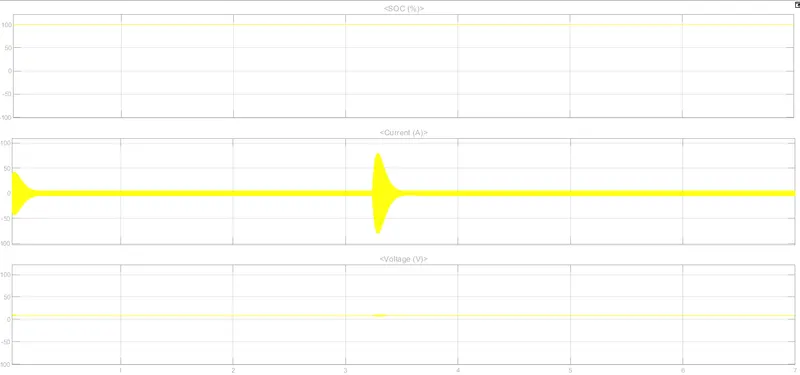
Output
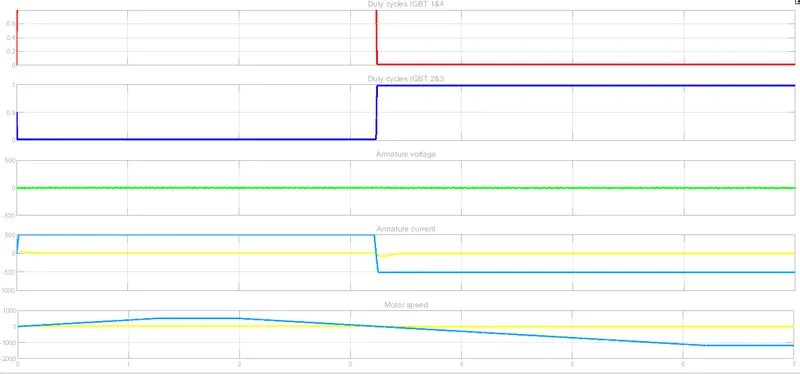
Block diagram of Powertrain
B. Also, Design the parameters in excel sheet.