Design of powertrain of a towing vehicle for Aircraft in runway.
PART 1 :-
Question 1 :- Search and list out the total weight of various types of aircrafts.
Answer :-
| Aircraft | Empty Weight | Max Fuel Weight | Max Cargo Weight | Max Gross Takeoff Weight |
|---|---|---|---|---|
| Antanov AN-225 | 285,000 kg |
300,000 kg |
190,000 kg |
640,000 kg |
| Airbus A380-800 | 277,000 kg | 254,000 kg | 84,000 kg | 575,000 kg |
| Boeing 747-800 | 220,100 kg | 194,000 kg | 134,000 kg | 447,700 kg |
| Airbus A340-500 | 168,000 kg | 175,000 kg | 54,000 kg | 372,000 kg |
| Boeing 777-300ER | 168,000 kg | 145,500 kg | 67,100 kg |
352,000 kg |
| Boeing 787-10 | 135,500 kg | 101,500 kg |
57,300 kg | 254,000 kg |
| Boeing 737-900 | 44,700 kg | 24,000 kg | 20,200 kg | 85,000 kg |
| Airbus A320-100 | 42,600 kg | 22,100 kg | 20,000 kg | 68,000 kg |
| Embraer 190 | 28,800 kg | 13,000 kg | 13,100 kg | 48,000 kg |
| Gulfstream G650 | 24,500 kg | 21,900 kg | 3,000 kg |
45,200 kg |
| Bombardier CRJ900 | 21,850 kg | 8,900 kg | 2,760 kg | 36,500 kg |
| Bombardier Q400 | 17,800 kg | 5,300 kg | 8,500 kg | 28,000 kg |
| Learjet 75 | 6,300 kg | 2,750 kg |
1,300 kg |
9,700 kg |
| Cessna Citation CJ4 | 4,700 kg | 2,650 kg |
1,000 kg | 7,800 kg |
| Beechcraft King Air B100 | 3,200 kg | 1,450 kg |
1,900 kg |
5,400 kg |
| Diamond DA50 RG | 1,450 kg |
155 kg |
560 kg |
2,000 kg |
| Beechcraft Bonanza G36 | 1,150 kg | 200 kg |
385 kg |
1,660 kg |
| Cessna 206H | 990 kg |
235 kg |
520 kg |
1,630 kg |
| Sirrus SR22 | 1,000 kg | 220 kg |
430 kg |
1,630 kg |
| Cessna 172R | 770 kg |
170 kg |
255 kg |
1,100 kg |
Question 2 :- Is there any difference between ground speed and air speed?
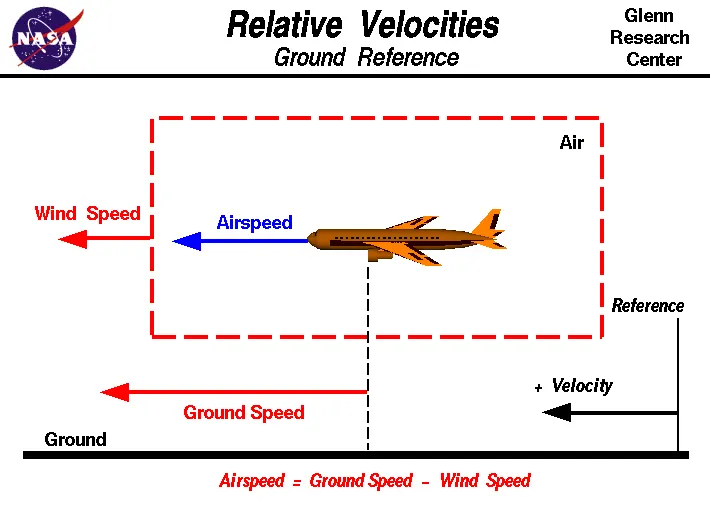
Answer :- Airspeed is simply the speed at which an aircraft is moving relative to the air it is flying in. As such, it’s also the speed at which the air is flowing around the aircraft’s wings.
Ground speed, on the other hand, is the aircraft’s speed relative to the ground. One thing that should be noted here is that it’s its horizontal rather than vertical speed – an aircraft climbing completely vertically would have a ground speed of zero. In other words, while airspeed is what determines whether there is enough airflow around an aircraft to make it fly, ground speed is what determines how fast an aircraft will get to its destination.
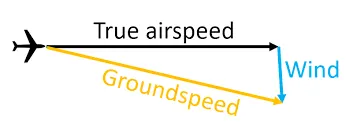
The relationship between airspeed and ground speed is fairly simple. Ground speed is simply the sum of airspeed and wind speed. If the aircraft is flying in the same direction as the wind is blowing, the aircraft experiences tailwind, and its ground speed is higher than its airspeed. On the other hand, if the wind is blowing against the direction the aircraft is traveling in, the aircraft experiences headwind, and its ground speed is lower than its airspeed.
Question 3 :- Why is it not recommended to use aircraft engine power to move it on the ground at Airport?
Answer :- Many aircrafts are capable of moving in backward using reverse thrust, as result the jet blast or prop wash might cause damage to the terminal building or equipment. Engine close to ground may also blow sand and debris forward and then suck them into the engine, causing damage to the engine.
Engines like clean Air. Debris larger than grains of sand will destroy them. Even sand and dirt will grind up the compressor and turbine blades.
Question 4:- How an aircraft is pushed to runway when its ready to take off?
Answer :-
Ready for take-off in ten steps…
- The pilot parks the aircraft in exactly the right place. Usually with the help of an automatic system, but occasionally guided by a marshaller waving two paddles or wands. Dozens of handling personnel are already standing by to perform a whole range of tasks simultaneously.
- As soon as the aircraft is stationary and the engines are switched off, the first priority is to disembark the passengers as quickly as possible. The apron handler places chocks in front of the wheels and connects the ground power. Meanwhile, the passenger bridge manoeuvres up to the door and a belt loader rolls up to the cargo hold. Luggage is unloaded and transferred to the terminal on baggage carts.
- Refuelling begins, usually from a hydrant at the stand. A hose is attached to this from a special vehicle called a dispenser, with the other side connected to the fuel tank in the wing.
- Now it is time to service the aircraft. The caterer loads new meals and takes away the food waste and used cutlery and crockery. Other activities include draining the lavatories, replacing the headrest covers, removing rubbish and distributing fresh blankets and in-flight magazine.
- A specialist team – or sometimes the crew themselves – cleans the cabin so that the new passengers board a pristine aircraft.
- Meanwhile, specialists from the airline conduct a technical check to make sure that the engines, wings, control surfaces, landing gear, instruments, doors and other equipment are in full working order.
- The aircraft is now ready for baggage to be loaded for the next flight. This is a quick process, on average taking only 10-15 minutes. A little later the passengers start boarding. As soon as they are all in their seats, the door is closed and the pilot informs air-traffic control that the flight is ready for departure.
- The apron handler removes the chocks. A so-called pushback truck reverses the aircraft into taxiing position, pushing it with a towbar attached to the nose-wheel strut. Or, in the most modern versions, by actually lifting the wheel. That speeds up coupling and decoupling.
- The aircraft taxis to the runway to depart at the agreed time.
- The pilot waits for permission to take off from air-traffic control. This is possible once the departure route is clear. As soon as the go-ahead is received, the plane takes to the air at full power.
Question 5:- Learn about take off power, tyre design, rolling resistance, tyre pressure, brake forces when landing.
Answer:-
1. Take off power :-
The amount of power that an engine is allowed to produce for a limited period of time for takeoff. The use of takeoff power is usually limited to 5 min for reciprocating engines and up to 2½ min for gas turbine engines. This may not always be the case.
Specifically, with respect to reciprocating engines, it is the brake horsepower developed under standard, sealevel conditions and under the maximum conditions of the crankshaft rotational speed and the engine manifold pressure approved for the normal take-off. It is limited in continuous use to the period of time shown in the approved engine specifications.
With respect to gas turbine engines, it is the thrust developed under static conditions at a specified altitude and atmospheric conditions of the rotor shaft rotational speed and gas temperature approved for the normal takeoff. It is limited in continuous use to the period of time shown in the approved engine specifications.
2. Aircraft Tyre design :-
Carcass plies are used to form the tire. They are sometimes called casing plies. An aircraft tyre is constructed for the purpose it serves.
- They support the weight of an aircraft while it is on the ground.
- It also provides the necessary traction for braking and stopping of an aeroplane.
- Tyre also helps to absorb the shock of landing and provide cushioning the roughness of takeoff, roll-out, and taxi operations.
Unlike an automobile or truck tyre, it does not have to carry a load for a long period of continuous operation. However, an aircraft tyre absorbs the high impact loads of landing, and also it’s operating at high speeds for a short time when required.
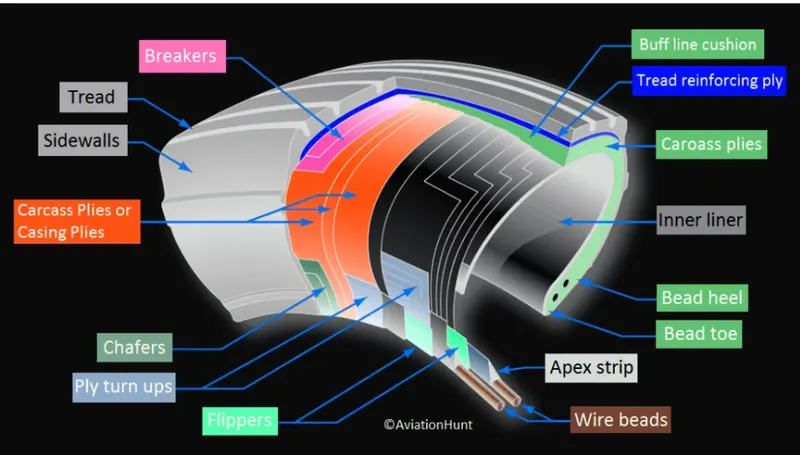
Retreading – Retreading is methods of restoring a worn tyre by renewing the tread area or by renewing the tread area plus one or both sidewalls. Repairs are included in the tyre retreading process.
Load Rating – Load rating is the maximum permissible load at a specified inflation pressure.
Ply Rating – Ply Rating is used to identify the maximum recommended load rating and inflation pressure for a specified tyre. It is an index of tyre strength.
Speed Rating – The speed rating is the maximum takeoff speed to which the tyre has been tested.
Skid Depth – Skid depth is the distance between the tread surface and the deepest groove as measured in the mould.
Each tyre manufacturer produces their own designs of the tyre with different tread patterns, wear patterns, wear limits etc, and in some cases, different names for the same part of the tyre. But all tyres must meet the approved standards before being accepted by the FAA or CAA. All commercial aircraft tyres approved under FAA Requirement Technical Standard Order (TSO) C62. A TSO is a minimum performance standard for specified materials, parts, and appliances used on civil aircraft.
3. Rolling resistance :- The force that resists the motion of a body rolling on a surface is called the rolling resistance or the rolling friction.
4.Typre pressure of Aircraft :-
Aircraft tires generally operate at high pressures, up to 200 psi (14 bar; 1,400 kPa) for airliners, and even higher for business jets. The main landing gear on the Concorde was typically inflated to 232 psi (16.0 bar), whilst its tail bumper gear tires were as high as 294 psi (20.3 bar). The high pressure and weight load on the Concorde tyres were a significant factor in the loss of Air France Flight 4590. Tests of airliner aircraft tires have shown that they are able to sustain pressures of maximum 800 psi (55 bar; 5,500 kPa) before bursting.
During the tests the tires have to be filled with water, to prevent the test room being blown apart by the energy that would be released by a gas when the tire bursts. Aircraft tires are usually inflated with nitrogen to minimize expansion and contraction from extreme changes in ambient temperature and pressure experienced during flight. Dry nitrogen expands at the same rate as other dry atmospheric gases (normal air is about 80% nitrogen), but common compressed air sources may contain moisture, which increases the expansion rate with temperature.
The requirement that an inert gas, such as nitrogen, be used instead of air for inflation of tires on certain transport category airplanes was prompted by at least three cases in which the oxygen in air-filled tires had combined with volatile gases given off by a severely overheated tire and exploded upon reaching autoignition temperature. The use of an inert gas for tire inflation eliminates the possibility of tire explosion.
5. Aircraft brake forces :-
Aircraft braking systems include:
Aircraft disc brakes in the landing gear, used to brake the wheels while touching the ground. These brakes are operated hydraulically or pneumatically. In most modern aircraft they are activated by the top section of the rudder pedals ("toe brakes"). In some older aircraft, the bottom section is used instead ("heel brakes").
Levers are used in a few aircraft. Most aircraft are capable of differential braking. Thrust reversers, that allow thrust from the engines to be used to slow the aircraft. Air brakes, dedicated flight control surfaces that work by increasing drag.
Large drogue parachutes, used by several former and current military and civilian aircraft (examples include the American B-52 and the soviet Tu-134 and Tu-144) and in the Space Shuttle.
PART B :-
Question 6:-
A. With necessary assumptions, calculate the force and power required to push / pull an aircraft by a towing vehicle.
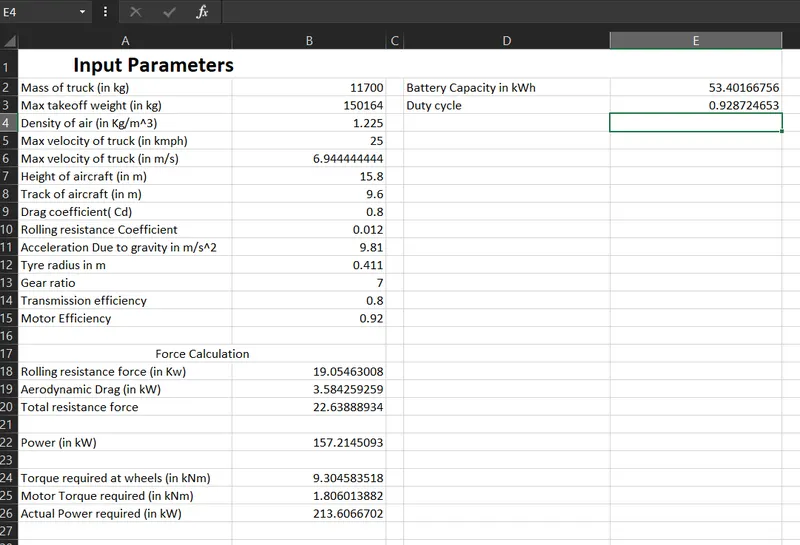
Answer :- For this calculations the TMX-150-12 tow truck and A310 airbus is used. The data is taken from the sources mentioned below.
Input data :-
* Mass of the truck = 11,700 kg
* Max take off weight of aircraft = 150,164 kg
* Max Velocity of truck = 25 kmph (6.94 m/s)
* Height of aircraft = 15.8 m
* Track of aircraft = 9.60 m
* Air density(ρ) = 1.225 kg/m^3
*Drag coefficient(Cd) = 0.8
* Rolling resistance Coefficient = 0.012
* Acceleration Due to gravity (g) = 9.81 m/s^2
1. Rolling Resistance Force:- Frr = μ*m*g
= 0.012*(11,700+150,164)*9.81
Frr = 19.054 kN.
2. Aerodynamic Drag :- Fad = 0.5*Cd*ρ*A*V^2
= 0.5*0.8*1.225*(15.8*9.6)*6.94^2
Fad = 3.58 kN
Grade force and inertia are neglected. Therefore total force = 19.054+3.58
F = 22.634 kN
Power Required = F*V
= 22.634*6.94
P = 157.07 kW
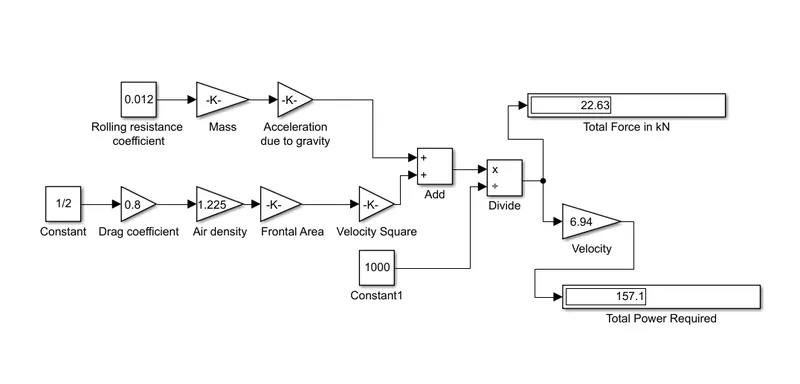
B. Develop the model for the calculated force and power using Simulink.
Answer :- The mathematical simulink model for above calculations is done and shown as below. The results from mathematical model are matched with manual calculations.
Question 7 :-
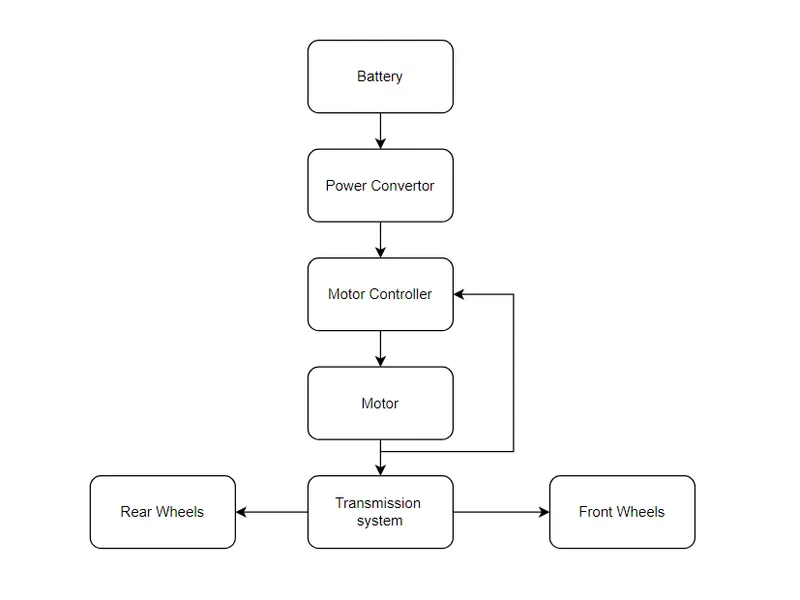
A. Design an electric powertrain with type of motor, it’s power rating, and energy requirement to fulfill aircraft towing application in Simulink. Estimate the duty cycle range to control the aircraft speed from zero to highest. Make all required assumptions. Prepare a table of assumed parameters. Draw a block diagram of powertrain.
Answer :- Block diagram of power train is shown as below.
The simulink electric power train is designed based on the previous calculations.
For TMX-150-12, 315/70 R15 tyres are used.
The rolling radius for the above tire will be (315*0.7) +(15*25.4)/2
r = 0.411m
Data from calculations:-
Force required = 22.634 kN
Power required = 157.07 kW
Tyre radius = 0.411 m
Assume
Gear ratio = 7
Transmission Efficiency(ηt) = 80%
Motor Efficiency (ηm) = 92%
1. Torque required at wheels = 22.634 *0.411 = 9.3 kNm
2. Motor Torque = Torque at wheels/(Gear ratio*ηt*ηm) = 9.3/(7*0.8*0.92)
Tm = 1.8 kNm
3. Actual power required = Power required/(ηt*ηm) = 157.07/(0.8*0.92)
Pa = 213.4 kW
Motor power rating should be around Pam = 220 kW
Calculating Battery Capacity :-
* Towing takes place for 15 minutes(0.25 Hours)
* Battery Capacity = 213.4*0.25
Battery Capacity = 53.35 kWh
Duty cycle :-
* If we use 230 kW battery, Duty cycle will become 213.4/230 = 0.927.
* at 0.927, the towing truck reaches a maximum speed of 25kmph(6.94 m/s).
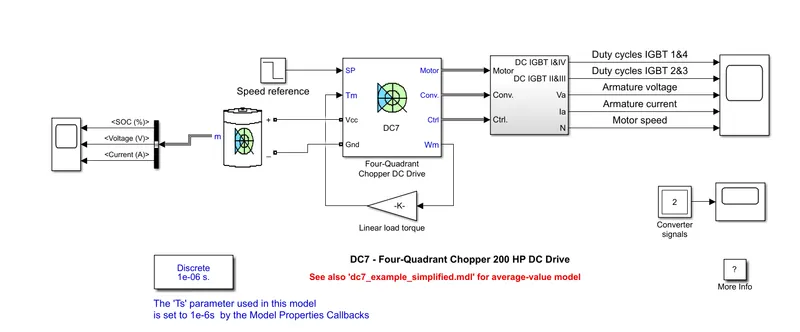
The simulation is done in simulink as shown by using DC7 block.
Results :-
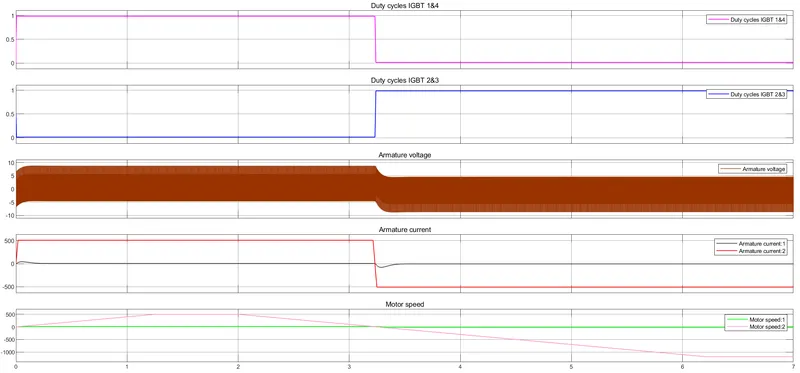
From the above plots we can check the duty cycle of power convertor. By using this DC7 convertor the motor is tested in both forward and reverse directions.
Question 7, B:- Also, Design the parameters in excel sheet.
Answer :- The excel sheet is attatched with the challenge.