Project-1: Powertrain for aircraft in runways
Part A:
1. To search and list out the total weight of various types of aircraft.
2. To list out the difference between ground speed and airspeed?
3. Why is it not recommended to use aircraft engine power to move it on the ground at the Airport?
4. How an aircraft is pushed to the runway when it is ready to take off?
5. To learn about take-off power, tyre design, rolling resistance, tyre pressure, and brake forces when landing.
Part B:
6. A. To calculate the force and power required to push/pull an aircraft by a towing vehicle with necessary assumptions.
B. To develop the model for the calculated force and power using Simulink.
7. A. To design an electric powertrain with a type of motor, its power rating, energy requirement to fulfill aircraft towing application in Simulink. Estimate the duty cycle range to control the aircraft speed from zero to highest. Make all required assumptions. Prepare a table of assumed parameters and draw a block diagram of the powertrain.
(Hint: DC7 Block)
B. Also, Design the parameters in an excel sheet.
Solution: Part A:
1. Search and list out the total weight of various types of aircrafts.
The aircraft gross weight (also known as the all-up weight and abbreviated AUW) is the total aircraft weight at any moment during the flight or ground operation. An aircraft's gross weight will decrease during a flight due to fuel and oil consumption. An aircraft's gross weight may also vary during a flight due to payload dropping or in-flight fueling. At the moment of releasing its brakes, the gross weight of an aircraft is equal to its takeoff weight. During flight, an aircraft's gross weight is referred to as the en-route weight or in-flight weight. An aircraft's structural weight capability is typically a function of when the aircraft was manufactured, and in some cases, old aircraft can have their structural weight capability increased by structural modifications
1. Maximum design taxi weight (MDTW)
The maximum design taxi weight (also known as the maximum design ramp weight (MDRW)) is the maximum weight certificated for aircraft maneuvering on the ground (taxing or towing) as limited by aircraft strength and airworthiness requirements.
2. Maximum design takeoff weight (MDTOW)
is the maximum certificated design weight when the brakes are released for takeoff and is the greatest weight for which compliance with the relevant structural and engineering requirements has been demonstrated by the manufacturer.
3. Maximum design landing weight (MDLW)
The maximum certificated design weight at which the aircraft meets the appropriate landing certification requirements. It generally depends on the landing gear strength or the landing impact loads on certain parts of the wing structure. The MDLW must not exceed the MDTOW. The maximum landing weight is typically designed for 10 feet per second (600 feet per minute) sink rate at touch down with no structural damage
4. Maximum design zero-fuel weight (MDZFW)
The maximum certificated design weight of the aircraft less all usable fuel and other specified usable agents (engine injection fluid, and other consumable propulsion agents). It is the maximum weight permitted before usable fuel and other specified usable fluids are loaded in specified sections of the airplane. The MDZFW is limited by strength and airworthiness requirements. At this weight, the subsequent addition of fuel will not result in the aircraft design strength being exceeded. The weight difference between the MDTOW and the MDZFW may be utilized only for the addition of fuel.
5. Minimum flight weight (MFW)
Minimum certificated weight for flight as limited by aircraft strength and airworthiness requirements. In order to design electric towing tractors, we need to know their load operating conditions so the weights of various types of aircrafts are shown below.
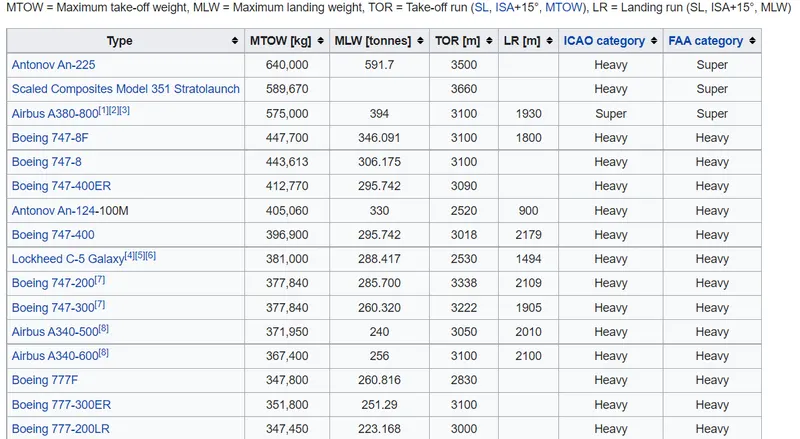
List of the total weight of various aircrafts
2. Difference between ground speed and air speed?
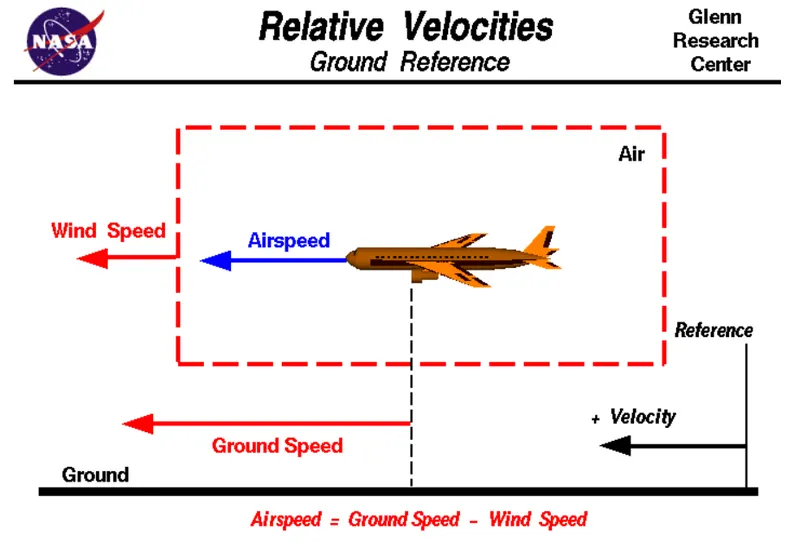
Wind Speed
For a reference point picked on the ground, the air moves relative to the reference point at the wind speed. Notice that the wind speed is a vector quantity and has both a magnitude and a direction. Direction is important. A 20 mph wind from the west is different from a 20 mph wind from the east. The wind has components in all three primary directions (north-south, east-west, and up-down). In this figure, we are considering only velocities along the aircraft's flight path. A positive velocity is defined to be in the direction of the aircraft's motion. We are neglecting crosswinds, which occur perpendicular to the flight path but parallel to the ground, and updrafts and downdrafts, which occur perpendicular to the ground.
Ground Speed
For a reference point picked on the ground, the aircraft moves relative to the reference point at the ground speed. Ground speed is also a vector quantity so a comparison of the ground speed to the wind speed must be done according to rules for vector comparisons.
Airspeed
The important quantity in the generation of lift is the relative velocity between the object and the air, which is called the airspeed. Airspeed cannot be directly measured from a ground position but must be computed from the ground speed and the wind speed. Airspeed is the vector difference between the ground speed and the wind speed.
Airspeed = Ground Speed - Wind Speed
On a perfectly still day, the airspeed is equal to the ground speed. But if the wind is blowing in the same direction that the aircraft is moving, the airspeed will be less than the ground speed.
3. Use of aircraft engine power to move it on the ground at Airport
It is not recommended to use FULL engine power to move the aircraft in the airport because of safety reasons and to prevent hazards. Aircraft operated at full thrust could create high volumes of air spreading debris or damaging other aircraft or ground vehicles.
Some of the disadvantages of using aircraft power include:
• Risk of injury to the ground staff person who may be in close proximity to the aircraft
• The pilot who is in the cockpit may not have a better view to taxi the aircraft when compared to the view of the pushback truck driver.
• Using aircraft engine power could also consume a considerable amount of the fuel
• Aircraft when using engine power is prone to much noise.
However, when we are assuming passenger commuter aircraft and large airliners, Aircraft move using their own engine power (Limited Power) all the time on the airport apron and taxiways under their own power to go towards runways and after landing taxi to their assigned gate.
The only time they use external assistance is to push back from the gate. Large turbofan aircraft need help to reverse via a pushback. tractor. The engines are turned on after the pushback is complete and the aircraft can move forward under its own power.
To be accurate, some aircraft can reverse using a variable pitch prop or thrust reversing on turbofans but generally reversing is done via pushback tractors. Blasting jet reversers blows debris in the crowded gate area creating foreign object damage hazards for adjacent aircraft, gate equipment, or terminal waiting area glass windows.
4. How an aircraft is pushed to the runway when it is ready to take off?
Airplanes have engines, and they can use them to move forward along the ground. So they push themselves to the runway. It is true that most of the time, a small vehicle is needed to push the airplane backward away from the terminal building because even if a plane can reverse its thrust, it's not always safe to hit the buildings with a jet blast. So the little trucks push the jets back away from the buildings but after that. the plane can apply a small amount of engine power to roll forward.
5. Learn about take-off power, tyre design, rolling resistance, tyre pressure, brake forces when landing.
Take-off power:
Takeoff is the phase of flight in which an aerospace vehicle leaves the ground and becomes airborne. . For aircraft that take off horizontally, this usually involves starting with a transition from moving along the ground on a runway
• The takeoff speed required varies with air density, aircraft gross weight, and aircraft configuration
• The power from the engine of the aircraft used to achieve the flight is called take-off power
• For light aircraft, usually full power is used during takeoff.
• Large transport category (airliner) aircraft may use a reduced power for takeoff, where less than full power is applied in order to prolong engine life, reduce maintenance costs and reduce noise emissions.
Tyre Design:
Aircraft tires are designed in such a way that they can withstand extremely high loads for short durations of time. The number of tires on an aircraft is proportional to its weight, meaning that the heavier the aircraft is, the more tires it will need. This is because for a given weight of an aircraft if the number of tires is insufficient, the weight cannot be distributed evenly enough amongst the tires. The tread patterns on aircraft tires are designed in such a way that they can provide stability to flights during crosswind conditions. The tread design also helps to direct water off of the tires to prevent hydroplaning and they also aid in the braking action.
Aircraft tires are designed with fusible plugs. A fusible plug is a threaded metal cylinder made of bronze, brass, and gunmetal with a drilled hole that extends through its entire length. This hole is filled with a metal of low melting point. When the temperature of the metal exceeds its melting point, this will cause the deflation of the tires. During emergency landings or aborted takeoffs, an aircraft's wheels experience high friction with the runway surface and the use of the plugs will control the deflation of the tires in a safe manner. Without them, there is a risk of an explosion which can damage the aircraft and other nearby objects.
Rolling Resistance:
The Rolling resistance force is mainly experienced by the tyre when the vehicle moves over any surface. The rolling resistance force is given by the expression,
`F_(rr) = mu_(rr)* (m.g)`
Where,
`mg` = weight in Newton
`mu_(rr)` = coefficient of rolling resistance.
The coefficient of rolling resistance (`mu_(rr)`) depends on many factors like the tyre pressure, tyre temperature, material of the tyre, thread pattern of the tyre, and also the road roughness and liquids on the Road. These factors determine the rolling resistance force.
Tyre Pressure:
The pressure generally is very high in an aircraft tire to reduce the rolling resistance and to withstand the weight. Usually, it will be around 200 to 300 psi of pressure and they change based on the type of the aircraft Tests of airliner aircraft tyres have shown that they are able to sustain pressures of a maximum of 800 psi. Aircraft tyres are usually inflated with nitrogen to minimize expansion and contraction from extreme changes in ambient temperature and pressure experienced during flight.
Brake forces when landing:
Aircraft has disc rotors in the landing gear, used to brake the wheels while touching the ground. These brakes are operated hydraulically or pneumatically.
Thrust reversers:
Thrust reversers allow thrust from the engines to be used to slow the aircraft. This is also very effective in bringing down the speed of the aircraft. By using a negative angle plane, we are turning the wind that is coming into the propeller to flow in the opposite direction
Air Brake:
Air brake dedicated flight control surfaces that works by increasing the drag force, air brakes are designed to increase drag while making little change to lift, resulting in a higher stall speed. These are some of the types of braking methods used to bring down the aircraft's speed while landing the flight.
Large drogue parachutes: It is used by several former and current military and civilian aircraft (examples include the American B-52 and the soviet Tu-134 and Tu-144) and in the Space Shuttle.
Part B:
6. Calculate the force and power required to push/pull an aircraft by a towing vehicle making necessary assumptions.
We are taking an aircraft model as Airbus A310 as considered as pushback operation. The advanced technologies of A310 and some specifications are given below,
The A310 helped pioneer the use of composites in commercial jetliners, with its vertical stabilizer built with carbon-fiber materials that offer significant weight savings over conventional metallic structures. Other major applications of composites on the A310 include floor struts and panels, spoilers, and main landing gear doors.
Standard or Higher gross weight = 164000 kg
Height = 15.80 m
Width = 43.90 m
Drag coefficient (Cd) = 0.0265
To find:
The Total Force and Power required to push/pull an aircraft by the towing vehicle.
Formula used:
Total force = Fte = Frr + Fad
Rolling resistance force = Frr = urr - m.g
Drag force = Fad = 0.5.A.Cd.v^2
Solution:
Total force = Fte = Frr + Fad
In the first step, we want to find the rolling resistance force and air drag force for both towing vehicle and airbus to obtain the force and power value during the towing process,
To find rolling resistance force
Rolling resistance force = Frr = urr - m.g
Here mass (m) = mass of the towing vehicle + mass of the airbus
(m) = 35000+164000
m = 199000kg
Substitute mass (m) value in rolling resistance formula
Rolling resistance force = Frr = 0.02*199000*9.81
Frr = 39043.8 N
To find the air drag force
Drag force = Fad = 0.5.p.A.Cd.v^2
According to the International Standard Atmosphere (ISA) values = 1.225 kg/m^3.
`rho = 1.225 frac{kg}{m^3}`
Frontal area A = Height of the airbus * Width of the airbus
A = 15.80 * 43.90
A = 693.62 m^2
Substituting the `rho` and A values in the drag force formula,
Assume that vehicle running at the speed of 20 kmph
V = (20*5/18) = 5.56 m/s
Fad = 0.5*1.225*693.62*0.0265*(5.56)^2
Fad = 11.258*(5.56)^2
Fad = 348.03 N
Now find the total force = Fte = Frr + Fad
Fte = 39043.8 + 348.03
Fte = 39391.83 N
To find the power required by towing vehicle
Therefore find the power value of towing vehicle by equating the total force value in the power formula,
Power required for towing vehicle Ptow = Fte*v = 39391.83 * 5.56
Ptow = 219018.57 W
By converting the unit of power we get,
Ptow = 219.018 KW
To find the torque of the vehicle
Torque (T) = Fte * R = 39391.83*0.5715
T = 22512.43 N-m
Hence power and torque of towing vehicle during the speed of 20kmph is obtained and they are given below
Power = 219.018 KW
Torque = 22512.43 N-m
6 B
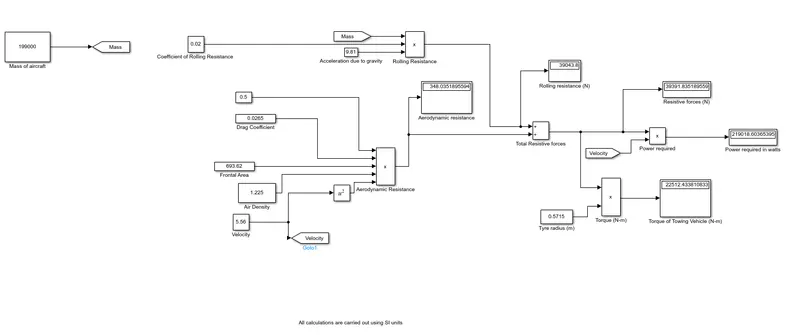
7 A & B
From the above study-6, we obtain the value of the power of towing vehicle and torque to push/pull an aircraft with respect to our given velocity is obtained and now we want to find the energy required for the vehicle.
To find the Energy required for the vehicle
Energy (E) = P_tow*t
where t = time taken for towing
Here we consider the time taken for towing as 20 mins
E = 219.018*(1200/3600)
`E = 73.006 KWh`
The above data shows how much power is taken at the speed of 20 kmph and how much energy is consumed in 20 mins of time. In this case, we want to find the input power to drive the duty cycle of the towing vehicle. The output power is considered from the study-6 that values are based upon certain assumptions and calculations from the towing vehicle model as Douglas Tugmaster type TBL-280 Mk4 from the website. The formula for the duty cycle is given below.
Duty cycle = Power input/Power output
Power = Voltage*Current
Assuming,
Input Voltage supply (Battery specification) = 400 V
Input Current value = 620 A
Now substitute the voltage and current value in the power formula to get input power data.
Power = Voltage*Current
Assuming,
Input Voltage supply (Battery specification) = 400 V
Input Current value = 620 A
Now substitute the voltage and current value in the power formula to get input power data,
Power = Voltage * Current
Power Input = 400*620 = 248000 W
By converting the unit of power from W to KW we get,
Power Input = 248 KW
Therefore we obtain power input and power output now substitutes these values in duty cycle,
Duty cycle = Power output/Power input = 219.018/248 = 0.883
Duty cycle = 88.3% for the towing vehicle Douglas Tugmaster type TBL-280 Mk4.
This duty cycle is obtained for our system based upon several assumptions.
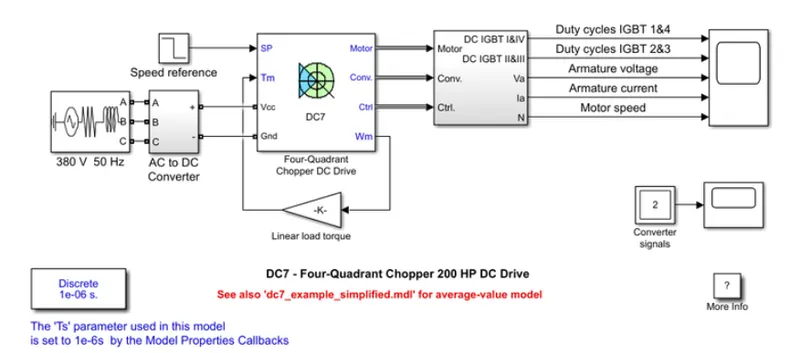
Block diagram of electric powertrain:
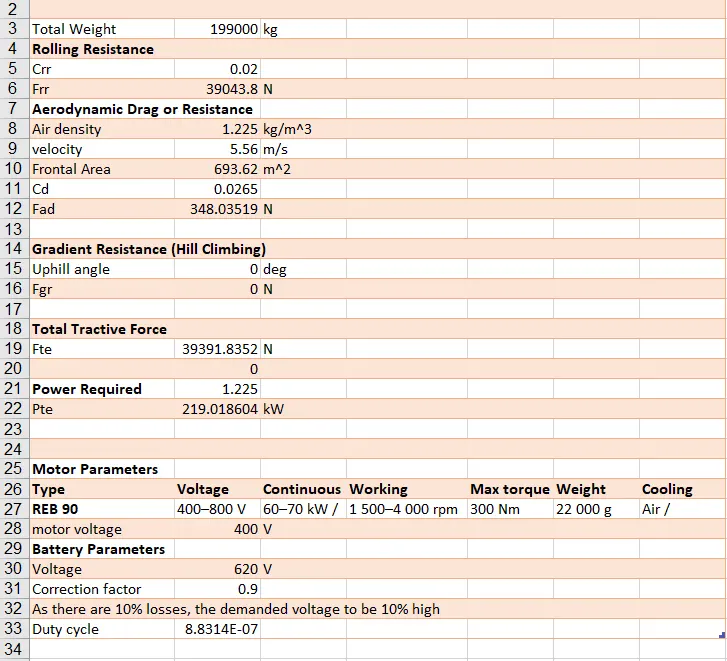
Excel File snapshot: