Project-1: Powertrain for aircraft in runways
Project-1: Power Train for Aircraft in Runway
- Search and list out the total weight of various types of aircraft.
Various types of aircraft weight considered are as followed.
Maximum Taxi Weight (MTW)
The maximum taxi weight is the maximum weight authorized for maneuvering (taxiing or towing) an aircraft on the ground as limited by aircraft strength and airworthiness requirements. It includes the weight of taxi and run-up fuel for the engines and the APU.
Maximum Take-off Weight (MTOW)
The maximum take-off weight is the maximum weight authorized at brake release for take-off, or at the start of the take-off roll. The maximum take-off weight is always less than the maximum taxi weight as the fuel burned during taxi by the engines and the APU are reduced.
Maximum Landing Weight (MLW)
The maximum weight authorized for the normal landing of an aircraft. The MLW must not exceed the MTOW. The fuel load of the plane is reduced during the journey.
Maximum Zero-Fuel Weight (MZFW)
The maximum permissible weight of the aircraft less all usable fuel and the other specified usable agents. It is the maximum weight permitted before usable fuel and other specified usable fluids are loaded in specified sections of the airplane.
Take-off Run (TOR)
The length of the runway declared available and suitable for the ground run of an airplane taking off.
Landing Run (LR)
The length of the runway that is declared available and suitable for the ground run of an airplane landing.
Total weight of various types of Aircraft.
|
Type |
MTOW [kg] |
MLW [tonnes] |
TOR [m] |
LR [m] |
ICAO category |
FAA category |
|
Antonov An-225 |
640,000 |
591.7 |
3500 |
Heavy |
Super |
|
|
Airbus A380-800 |
575,000 |
394 |
3100 |
1930 |
Super |
Super |
|
Boeing 747-8f |
447,700 |
346.091 |
3100 |
1800 |
Heavy |
Heavy |
|
Boeing 747-8 |
443,613 |
306.175 |
3100 |
Heavy |
Heavy |
|
|
Boeing 747 – 400ER |
412,770 |
295.742 |
3090 |
Heavy |
Heavy |
|
|
Antonov An-124-100M |
405,060 |
330 |
2520 |
900 |
Heavy |
Heavy |
|
Boeing 747-400 |
396,900 |
295.742 |
3018 |
2179 |
Heavy |
Heavy |
|
Lockheed C-5 Galaxy |
381,000 |
288.417 |
2530 |
1494 |
Heavy |
Heavy |
|
Boeing 747-200 |
377,840 |
285.7 |
3338 |
2109 |
Heavy |
Heavy |
|
Boeing 747-300 |
377,840 |
260.320 |
3222 |
1905 |
Heavy |
Heavy |
|
Airbus A340-500 |
371950 |
240 |
3050 |
2010 |
Heavy |
Heavy |
|
Airbus A340-600 |
367,400 |
256, |
3100 |
2100 |
Heavy |
Heavy |
|
Boeing 777F |
347,800 |
260.816 |
2830 |
Heavy |
Heavy |
|
|
Boeing 777-300ER |
351,800 |
251.29 |
3100 |
Heavy |
Heavy |
|
|
Boeing 777- 200LR |
347,450 |
223.168 |
3000 |
Heavy |
Heavy |
|
|
Boeing 747-100 |
340,200 |
265.3 |
Heavy |
Heavy |
||
|
Airbus A350-1000 |
308 |
233.5 |
Heavy |
Heavy |
||
|
Boeing 777-300 |
299,370 |
237.683 |
3380 |
Heavy |
Heavy |
|
|
Boeing 777-200ER |
297,550 |
213 |
3380 |
1550 |
Heavy |
Heavy |
|
Airbus A340-300 |
276,700 |
190 |
3000 |
1926 |
Heavy |
Heavy |
|
McDonnell Douglas MD-11 |
273,300 |
185 |
2990 |
1890 |
Heavy |
Heavy |
|
Airbus A350-900 |
270,000 |
175 |
2670 |
1890 |
Heavy |
Heavy |
|
Ilyushin II-96M |
270,000 |
195.40 |
3115 |
2118 |
Heavy |
Heavy |
|
McDonnell Douglas DC-10 |
256,280 |
183 |
2990 |
1890 |
Heavy |
Heavy |
|
Boeing 787-10 |
254,000 |
201.849 |
Heavy |
Heavy |
||
|
Airbus A340-200 |
253,500 |
181 |
2990 |
Heavy |
Heavy |
|
|
Ilyushin IL-96-300 |
250,000 |
175 |
2600 |
1980 |
Heavy |
Heavy |
|
Airbus A330-300 |
242,200 |
185 |
2500 |
1750 |
Heavy |
Heavy |
|
Airbus A330-200 |
242,000 |
180 |
2220 |
1750 |
Heavy |
Heavy |
|
Lockhead L-1011-500 |
231,300 |
166.92 |
2636 |
Heavy |
Heavy |
|
|
Ilyushin IL-86 |
208,000 |
175 |
Heavy |
Heavy |
||
|
Boeing 767-400ER |
204, |
158.758 |
3414 |
Heavy |
Heavy |
|
|
Airbus A300-600R |
192,00 |
140 |
2385 |
1555 |
Heavy |
Heavy |
|
Boeing 767-300ER |
187,000 |
136.08 |
2713 |
1676 |
Heavy |
Heavy |
|
Concorde |
185,000 |
111.1 |
3440 |
2220 |
Heavy |
Heavy |
|
Airbus A300-600 |
163,000 |
138 |
2324 |
1536 |
Heavy |
Heavy |
|
Boeing 767-300 |
159,000 |
136.078 |
2713 |
1676 |
Heavy |
Heavy |
|
Airbus A310-300 |
157,000 |
151.9 |
Heavy |
Heavy |
||
|
Vickers VC10 |
152,000 |
151.9 |
Heavy |
Heavy |
||
|
Boeing 707-320B |
151,000 |
97.5 |
Heavy |
Heavy |
||
|
Boeing 707-320C |
151,000 |
112.1 |
Heavy |
Heavy |
||
|
Douglas DC-8-61 |
147,000 |
Heavy |
Heavy |
|||
|
Airbus A310-200 |
142,000 |
123 |
1860 |
1480 |
Heavy |
Heavy |
|
Airbus A400M |
141,000 |
122 |
980 |
770 |
Heavy |
Heavy |
|
Douglas DC-8-32 |
140,000 |
Heavy |
Heavy |
|||
|
Douglas DC-8-51 |
125,000 |
Medium |
Large |
|||
|
Boeing 757-300 |
124,000 |
101.6 |
2550 |
1750 |
Medium |
Large |
|
Boeing 707-120B |
117,000 |
86.3 |
Medium |
Large |
||
|
Boeing 757-200 |
116,000 |
89.9 |
2347 |
1555 |
Medium |
Large |
|
Boeing 720B |
106,000 |
79.5 |
Medium |
Large |
||
|
Boeing 720 |
104,000 |
79.5 |
Medium |
Large |
||
|
Tupolev Tu-157M |
104,000 |
80 |
Medium |
Large |
||
|
Tupolev Tu-204SM |
87,500 |
87.5 |
2250 |
Medium |
Large |
|
|
Convair 880 |
87,500 |
Medium |
Large |
|||
|
Boeing 737-900 |
85,000 |
66.36 |
2500 |
1704 |
Medium |
Large |
|
Boeing 737-900ER |
85,000 |
71.35 |
2804 |
1829 |
Medium |
Large |
|
Boeing 727-200 Adnvcd |
84,000 |
70.1 |
Medium |
Large |
||
|
Airbus A321-100 |
83,000 |
77.8 |
2200 |
1540 |
Medium |
Large |
|
Boeing 737-800 |
79,000 |
65.32 |
2308 |
1634 |
Medium |
Large |
|
Boeing 727-200 |
78,000 |
68.1 |
Medium |
Large |
||
|
McDonnell-Douglas Md-83 |
73,000 |
63.28 |
Medium |
Large |
||
|
Boeing 727-100 |
72,500 |
62.4 |
Medium |
Large |
||
|
Boeing 727-100C |
72,500 |
62.4 |
Medium |
Large |
||
|
McDonnell-Douglas MD-90-30 |
71,000 |
64.41 |
2165 |
1520 |
Medium |
Large |
|
de Havilland Comet 4 |
70,700 |
Medium |
Large |
|||
|
Boeing 737-700 |
70,000 |
58.06 |
1921 |
1415 |
Medium |
Large |
|
Boeing 737-400 |
68,000 |
54.9 |
2540 |
1540 |
Medium |
Large |
|
de Havilland Comet 3 |
68,000 |
54.66 |
1796 |
1340 |
Medium |
Large |
|
Boeing 377 |
67,000 |
Medium |
Large |
|||
|
Boeing 737-600 |
66,000 |
54.66 |
1796 |
1340 |
Medium |
Large |
|
Hawker Siddeley Trident 2E |
65,000 |
Medium |
Large |
|||
|
Airbus A319 |
64,000 |
62.5 |
1850 |
1470 |
Medium |
Large |
|
Boeing 737-300 |
60,000 |
49.9 |
1832 |
1360 |
Medium |
Large |
|
Airbus A220-100 |
59,000 |
50.80 |
1463 |
1356 |
Medium |
Large |
|
Airbus A220-100 |
59,000 |
57.5 |
1375 |
1340 |
Medium |
Large |
|
Boeing 717-200HGW |
55,000 |
47.174 |
1950 |
Medium |
Large |
|
|
Douglass Dc-7 |
55,000 |
Medium |
Large |
|||
|
de Havilland comet 2 |
54,000 |
Medium |
Large |
|||
|
Douglas DC-6A |
48,600 |
Medium |
Large |
|||
|
Embraer 190 |
48,000 |
43 |
2056 |
1323 |
Medium |
Large |
|
Caravelle lll |
46,000 |
39.95 |
1621 |
1350 |
Medium |
Large |
- Difference between ground speed and airspeed:
The difference between ground speed and airspeed is caused by the influence of winds on the overall velocity of the aircraft.
The true airspeed is simply the speed at which an aircraft is moving relative to the air it is flying in. As such, it’s also the speed at which the air is flowing around the aircraft’s wings. Ground speed, on the other hand, is the aircraft’s speed relative to the ground. One thing that should be noted here is that it’s horizontal rather than vertical speed, an aircraft climbing completely vertically would have a ground speed of zero. In other words, while airspeed is what determines how fast an aircraft will get to its destination.
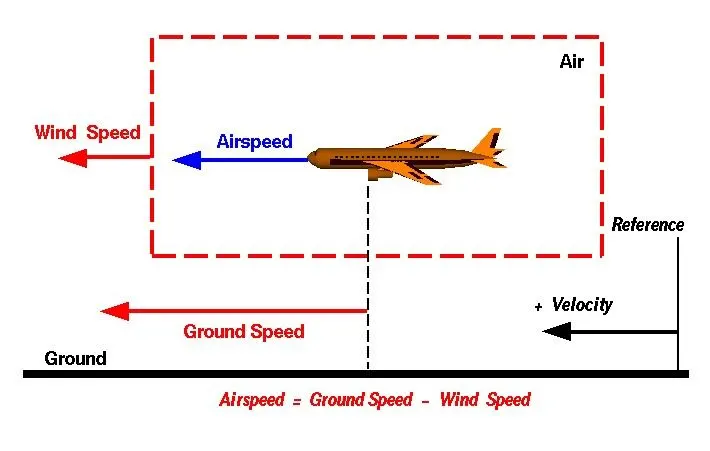
Ground Speed:
For a reference point picked on the ground, the aircraft moves relative to the reference point at the ground speed. Ground speed is also a vector quantity. So a comparison of the ground speed to the wind speed must be done according to rules for vector comparisons.
Airspeed:
The important quantity in the generation of lift is the relative velocity between the object and the air, which is called the airspeed. Airspeed cannot be directly measured from a ground position, but must be computed from the ground speed and the wind speed. Airspeed is the vector difference between the ground speed and the wind speed.
Airspeed = ground speed – wind speed
On a perfectly still day, the airspeed is equal to the ground speed. But if the wind is blowing in the same direction that the aircraft is moving, the airspeed will be less than the ground speed.
Wind speed:
For a reference point picked on the ground, the air moves relative to the reference point at the wind speed. Notice that the wind speed is a vector quantity and has both a magnitude and a direction. Direction is important. A 20mph wind from the west is different from 20mph wind from the east. The wind has components in all three primary directions (north-south, east-west, and up-down). A positive velocity is defined to be in the direction of the aircraft’s motion. We are neglecting crosswinds, which occur perpendicular to the flight path but parallel to the ground and updrafts and downdrafts, which occur perpendicular to the ground.
3. Why it is not recommended to use aircraft engine power to move it on the ground at the airport.
It is not recommended to use aircraft engine power to move it on the ground at airport because there are certain extreme conditions for it. The term aircraft ground running is usually used to describe the operation of some or all of the engines of an aircraft, whilst on the ground, for the purpose of functionality checking the operation of either engines or aircraft systems. This takes place prior to the release to service of an aircraft from maintenance. Ground running may be carried out either prior to, during or after the rectification of a defect or scheduled work on an engine. Although the aircraft may need to be taxied or towed to an approved ground running position under a clearance from ATC, most operators and maintenance organisations do not require pilots to be on board because aircraft technicians can be trained and approved for these duties.
Jet blast is the phenomenon of rapid air movement produced by the jet engines of aircraft particularly on or before take-off. A large jet-engine aircraft can produce winds of up to 100 knots (190 km/hr) as far as 60 meters behind it at 40% maximum rated power. Jet blast can be a hazard to people or other unsecured objects behind the aircraft and is capable of flattening buildings and destroying vehicles. The immediate area in front of a jet engine creates an area where people and equipment can be sucked in to the engine if anything is too close to the intake. So in order to avoid such conditions it is not recommended to use aircraft engine power to move it on the ground at the airport.
4. How an aircraft is pushed to the runway when its ready to take-off?
The aircraft is pushed to the runway using a taxing vehicle. Taxiing refers to the movement of an aircraft on the ground, under its own power. The aircraft moves on wheels. An airplane uses taxiways to taxi from one to another place, for moving inside terminal. The aircraft always moves on the ground following the yellow lines, to avoid any collision with the surrounding buildings, vehicles or other aircraft. The taxiing motion has a speed limit. Before making a turn, the pilot reduces the speed further to prevent tire skids. The aircraft that are landing or takinf off have higher priority. The other aircraft have to wait for these aircraft before they start or continue taxiing.
The thrust to propel the aircraft forward comes from its propellers or jet engines. Steering is achieved by turning a nose wheel or tail wheel/rudder; the pilot controlling the direction travelled with their feet. The use of engine thrust near terminals is restricted due to the possibility of jet blast damage. This is why the aircraft is pushed back from the buildings by a vehicle before they can start their own engines for taxiing.
Take-off power
Take-off is the phase of flight in which an aircraft goes through a transition from moving along the ground to flying in the air and during this phase the engines are run at full power during take-off. Aircraft employ the concept of the take-off V-speeds, V1 and V2. These speeds are determined not only by the above factors affecting take-off performance but also by the length and slope of the runway. Below V1, in case of critical failures, the take-off should be aborted; above V1 the pilot continues the take-off and returns for landing. After the co-pilot calls V1, then V2(the safe takeoff speed) is called. This speed must be maintained after an engine failure to meet performance targets for the rate of climb and angle of climb. The power required to achieve the take-off speed is take-off power.
Tyre Design:
Tires are used to absorb the shock of landing and provide cushioning. It is made up of three components steel, rubber and fabric. It also provides the necessary traction for braking and stopping of an aircraft. An aircraft tire is designed to withstand extremely heavy loads while landing, take-off, taxiing and parking. The number of wheels required for aircraft increases with the weight of the aircraft, as the weight of the airplane needs to be distributed more evenly.
Tread: the tread is made of rubber mixed with other additives to obtain the desired level of toughness, durability and resistance to wear. The tread pattern is designed to aircraft operational requirements with the ribbed tread design used widely due to its good traction under varying runway conditions.
Sidewall: the sidewall is a protective layer of rubber that covers the outer casing ply. It extends from the tread edge to the bead area.
Tread reinforcing ply: one or more layers of fabric that strengthens and stabilizes the tread area for high-speed operation. It also serves as a reference for the buffing profess when tires are retreaded.
Breakers: breakers are reinforcing plies of rubber-coated fabric placed under the buff line cushion to protect casing plies and strengthen and stabilize the tread area. They are considered and integral part of the casing construction.
Casing piles: alternate layers of rubber-coated fabric (running at opposite angles to one another) provide the strength of the tire.
Wire beads: hoops of high tensile strength steel wire that anchor the casing plies and provide a firm mounting surface on the wheel. The outer edge of the bead that fits against the wheel flange is called the bead heel. The inner bead edge is called the bead toe.
Apex strip: a wedge of rubber affixed to the top of the bead bundle.
Flippers: layers of rubberized fabric that help anchor the bead wires to the casing and improve the durability of tire.
Ply turnups: the casing plies are anchored by wrapping them around the wire beads, thus forming the ply turnups.
Chafer: a protective layer of rubber and fabric located between the casing plies and wheel to minimize chafing.
Liner: In tubeless tires, the liner is a layer of low permeability rubber that acts as a built-in tube and restricts gas from diffusing into the causing plies. In tube-type tires, a thinner liner is used to prevent tube chafing against the inside ply.
Rolling Resistance:
It is the resistance that the tires offer against the motion while on the ground. In cases of aircrafts rolling resistance can be experienced while take-off and while landing.
Tire Pressure:
Aircraft tires: generally operate at high pressures, up to 200psi for airliners. Overinflation can damage the tires by causing uneven traed war, reduced traction, increased susceptibility to cutting and increased stress on the wheel assemblies, underinflation is by far more damaging. Underinflation produces uneven tead wear and shortens tire life due to excessive flex heating. The bead area of an underinflated tire can be 50 percent hotter than that of a properly inflated one. Heat is damaging to tire rubber compounds and fabrics. It contributes to tread and carcass seperations and bead failures.
Brakes forces when landing:
Brake systems have an anti-lock braking system (ABS) that prevents the tires from sliding down a wet runway. The advantage of the automatic brake system is that the aircraft brakes comfortably at a constant deceleration. Passengers experience a constant force that presses them into their seats. The brake system automatically applies the wheel brakes just enough to create them into their seats. The brake system automatically applies the wheel brakes just enough to create a constant deceleration independent of the air resistance, spoilers and reverse thrust. It is only in the last phase of braking, known as the rollout, that the pilot takes over the wheel brakes by pressing on both brake pedals. This deactivates the automatic brake system. Immediately after landing, the aircraft is still moving fast enough that aerodynamic devices are much more efficient than the brakes.
Electric Brakes
The brake system sends an electronic signal to the left and right brake system control units (BSCUs). These then send signals to the four electronic brake actuator controllers (EBAC) which control the rate of braking on the wheels. Each wheel has four electric brake actuators (EBA), a kind of piston which presses against the carbon brake discs. The brake discs themselves are made up of two parts. Firstly there are the rotors. These are connected to the wheel by drive tabs. As these drive tabs are in contact with the inside of the wheel, they spin at the same speed. Depending on the brake manufacturer, there are either four or five of these rotors on each brake assembly. The second part of the discs is the stators. These sit around each rotor and are fixed in place and thus don’t move. As the wheel turns, the rotors spin round inside the stators.
There are two other systems that help slow the aircraft down on landing are spoilers and the reverse thrust.
Spoilers:
The spoilers are used to spoil the airflow over the wing. This dumps any remaining lift the wings are generating, allowing the wheels to take all the weight and achieve maximum efficiency from the brakes.
Reverse thrust:
The final part of the gracing process comes from the reverse thrust. Just after we have touched down, we pull two levers on top of the thrust levers to engage the reverse thrust by a reverse gear for jet engines. There are two stages of reverse thrust- idle reverse and max reverse. The idle reverse is used on most landings and the max reverse is used when the landing performance requires it, normally when the aircraft is landing at hot or high elevation airfields.