Project 1 Mechanical design of battery pack
AIM=
Battery pack capacity: 18 kWh
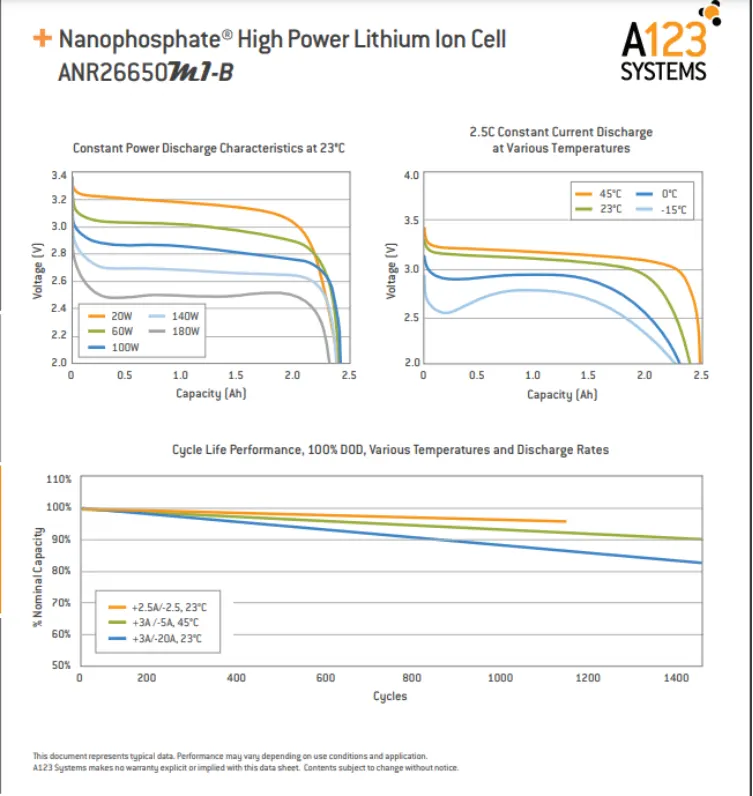
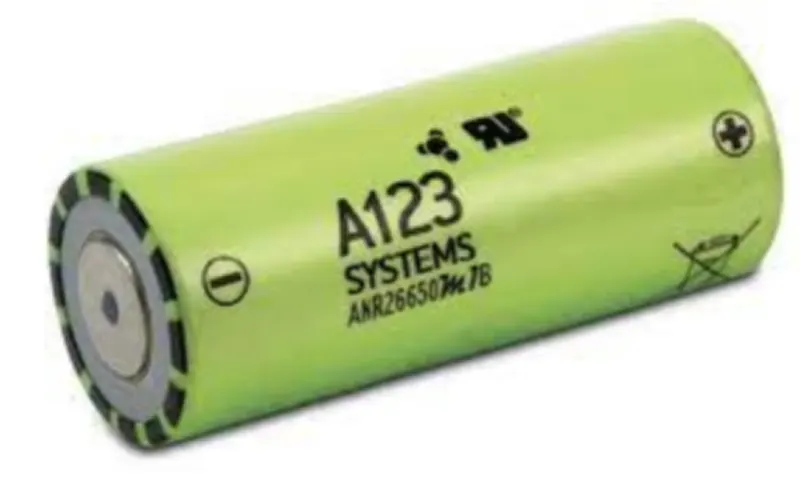
Cell: ANR26650M1-B
Prepare a detailed battery pack drawing along with its enclosure. State your assumptions.
Abstracts-
In this whole module we will collect brief information about battery ANR26650M1-B and this battery
- Temperature
- Depth of discharge
- Operation current
- Energy density
- Work cycle
- Battery capacity
- State of charge
- State of health
- Ampere-hour capacity
Geometrical
- Size
- Weight
- Volume
- Area
that's how it works
What is a lithium-ion battery?
Lithium-ion is the most popular rechargeable battery chemistry used today. Lithium-ion batteries power the devices we use every day, like our mobile phones and electric vehicles.
Lithium-ion batteries consist of single or multiple lithium-ion cells, along with a protective circuit board. They are referred to as batteries once the cell, or cells, are installed inside a device with the protective circuit board.
What are the components of a lithium-ion cell?
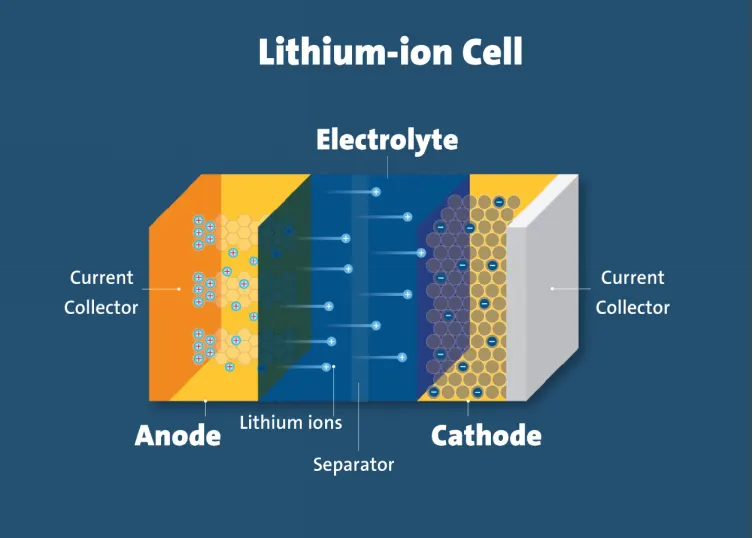
- Electrodes:The positively and negatively charged ends of a cell. Attached to the current collectors
- Anode: The negative electrode
- Cathode: The positive electrode
- Electrolyte:A liquid or gel that conducts electricity
- Current collectors:Conductive foils at each electrode of the battery that are connected to the terminals of the cell. The cell terminals transmit the electric current between the battery, the device and the energy source that powers the battery
- Separator:A porous polymeric film that separates the electrodes while enabling the exchange of lithium ions from one side to the other
How does a lithium-ion cell work?
In a lithium-ion battery, lithium ions (Li+) move between the cathode and anode internally. Electrons move in the opposite direction in the external circuit. This migration is the reason the battery powers the device—because it creates the electrical current.
While the battery is discharging, the anode releases lithium ions to the cathode, generating a flow of electrons that helps to power the relevant device.
When the battery is charging, the opposite occurs: lithium ions are released by the cathode and received by the anode.
ANR26650M1-B-
Temperature-
battery is too cold
effect on the battery when it is too cold low temperature effects
< 5c (can not be fast charged)
< 0c ( battery lose charge loss in power acceleration and driveing range)
Methods of battery coolin
1] Air cooling
2] Refrigerant cooling
3] liquid cooling
4] PCM (phase change material)
This battery (ANR26650M1-B)operating temperature to, When the battery is brought into operating condition, it is charged and discharged many times in the battery operating condition itself, so this battery can work at temperatures ranging from 30 ° C to 50 ° C.
State of Charge (SOC): State of charge denotes the charge present in the battery, how much percent charge your battery is and how much percent discharge is calculated, it is measured by how much voltage input and how much voltage output is in the battery to calculate it. This battery Depth of Discharge (DOD): Any battery has a discharge point and it tells that your battery is discharged. The percentage of battery capacity that has been discharged expressed as a percentage of maximum capacity. A discharge to at least 80 % DOD is referred to as a deep discharge.
SOC=
10* Battery capacity in amp hours/appliance load In watts
DOD=
dividing the number of hours it took to charge/discharge the battery by the battery capacity (in Ah)
Cycle Life: The cycle life of batteries is the number of charge and discharge cycles that a battery can complete before losing performance. The cycle life of Li-ion batteries is affected significantly by the depth of discharge . This battery (ANR26650M1-B) cycle life at 20A Discharge, 100% DOD (>1000 cycles)
To find battery lifetime, divide the battery capacity by the current draw of the load
Where:
Bi=Bc/Ij
- Bi= Battery lifetime in hours
- Bc= Battery capacity in mAh
- Ij = Load device current draw in mA
Capacity or Nominal Capacity: Battery capacity is measured in Ampere-Hour (Ah) or Watt-Hour (Wh). The maximum amount of energy that can be taken from a battery is its capacity. Cell capacity (nominal/minimum )(0.5c-rate)2.5/2.4Ah
Energy or Nominal Energy: the total Watt-hours available when the battery is discharged at a certain discharge current (specified as a C-rate) from 100 percent state-of-charge to the cut-off voltag
Power Density (W/L): it is a denoted by how to store power in unit mass, cell (ANR26650M1-B) 2600W/Kg
C-rates-The C-rate of any battery tells the time taken to charge and discharge that battery. In how much time will the battery be fully charged and in how much time will the battery be discharged
Power P [W] is the product between voltage U [V] and current I [A]:
P = U* I
The total battery pack voltage is determined by the number of cells in series. For example, the total (string) voltage of 6 cells connected in series will be the sum of their individual voltage.
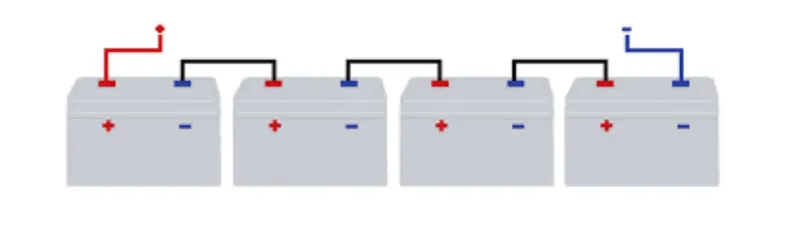
In order to increase the current capability the battery capacity, more strings have to be connected in parallel. For example, 3 strings connected in parallel will triple the capacity and current capability of the battery pack.
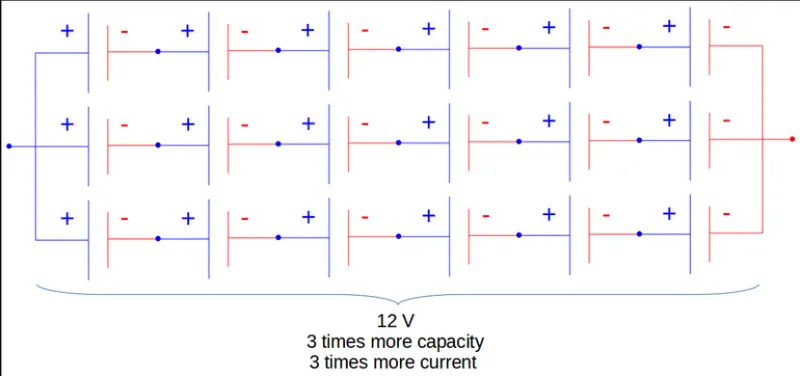
parallel and series connection-
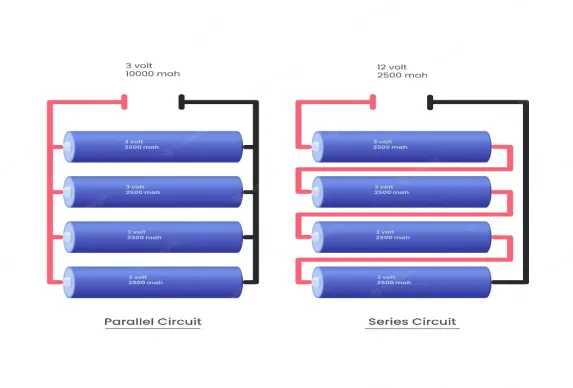
Cell Energy= Cell Capacity (Ah) × Cell Voltage (V)
Battery pack calculation:
Now we calculated parallel and series combinations so we can now calculate total no of cells required
Total no of cells: Series cells * parallel cells
So from series and parallel combination, we can calculate the voltage of battery pack and the current of the battery pack.
Voltage= no of cell in series* nominal voltage.
Current=No of parallel cells * cell capacity
So now we can calculate the how much mount of energy this combination have by product of voltage and current, and check the it will satisfied or not our requirement
Energy= Voltage * Current
now we have total no of cells and volume of single cell so we can calculate the total volume required for battery pack
Total volume = no of cells * Volume of single cell
We also have single cell weight from that we can calculate the total weight of battery pack without other mechanical and electrical connections.
Weight = No of cells * weight of single cell.
Energy dencity= volume * battery pack energy
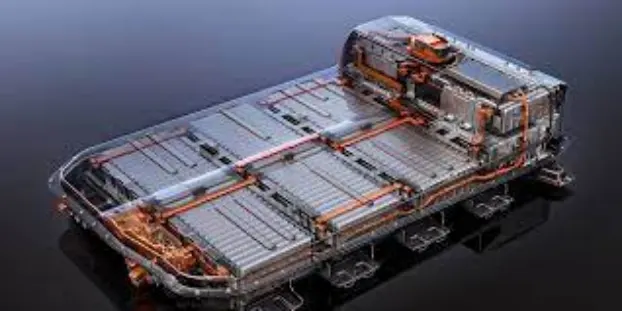
Here I also configure battery pack into electric vehicle lower floor panel case, a simple layout of the battery pack in an electric vehicle is shown below:
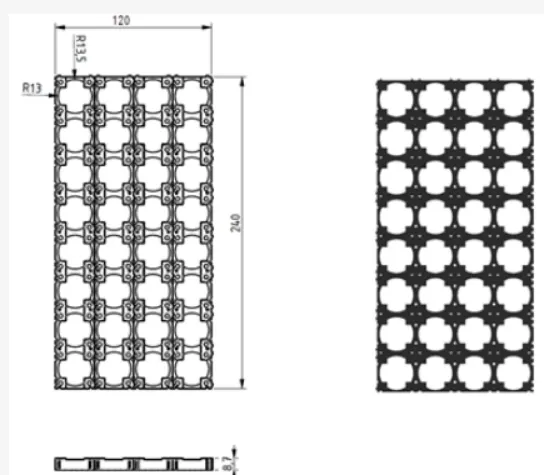
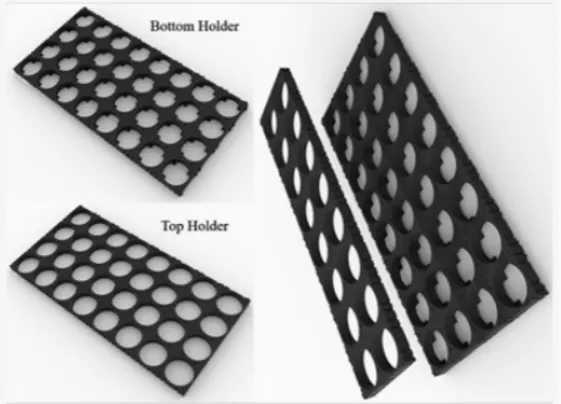
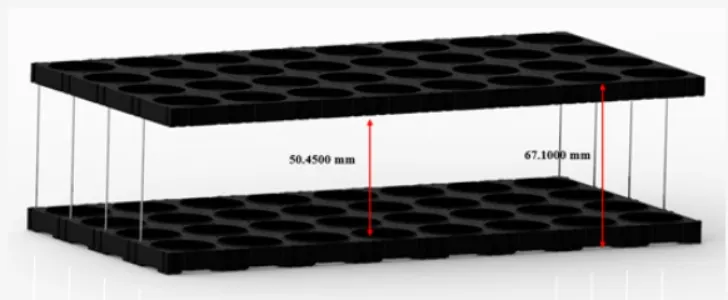
Design of cell holder (Bottom and Top)
The main function of a battery holder is to keep cells fixed in place safely and securely also it is used to keep cells in a proper arrangement so that there will be a decrease in mechanical vibration, and have a better thermal runway in between the cell gaps. Most of the cell holder is made up of polypropylene or nylon bodies rated for 80–100 °C.
Design of pack cover
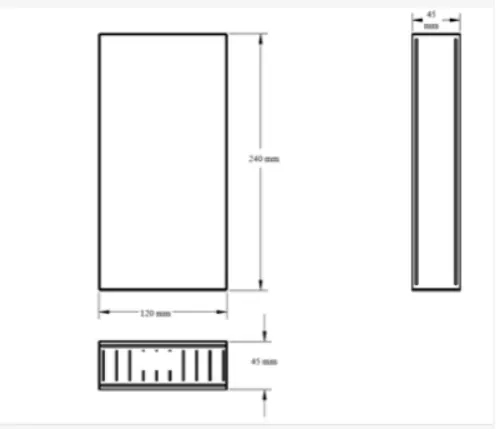
Basically, Pack cover is made up of Aluminium and the reason behind is to keep battery pack for lightweight. The casing/cover thickness is 0.5 mm and the design is as shown below:
A bottom cover is shown to cover below the bottom battery holder.
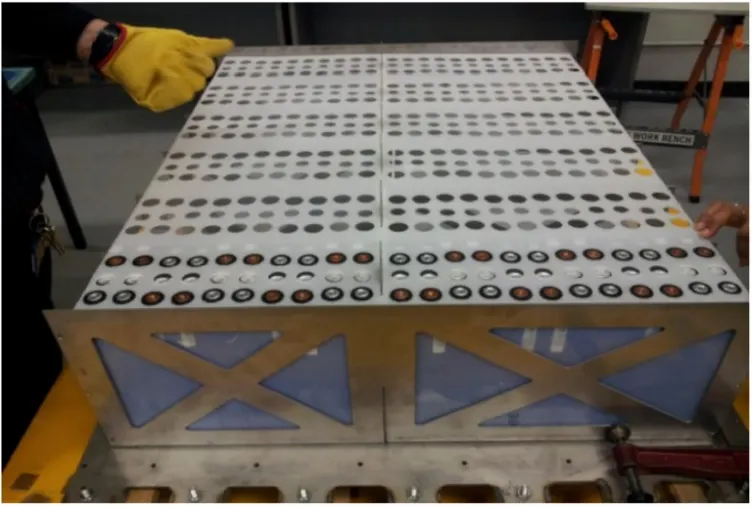
Design of Lower floor case for battery pack
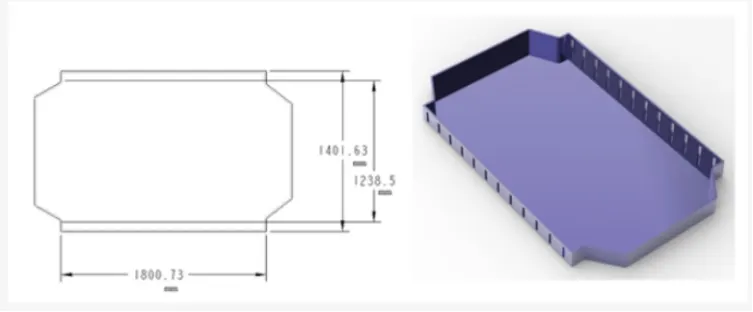
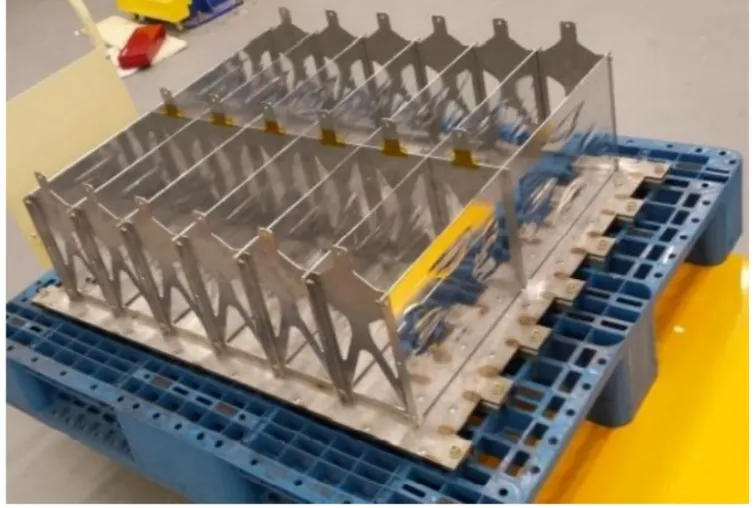
Basically, the lower case is a part which is fitted in an electric vehicle for the assembly of the battery pack. A lower case is also made up of aluminum and it has top cover and bottom cover to battery pack from dust and environmental pollution.
The design of the lower case is shown
Positive and Negative Clip
A positive and negative clip is used to connect the battery end cap i.e (+) and (-). Design is shown below:
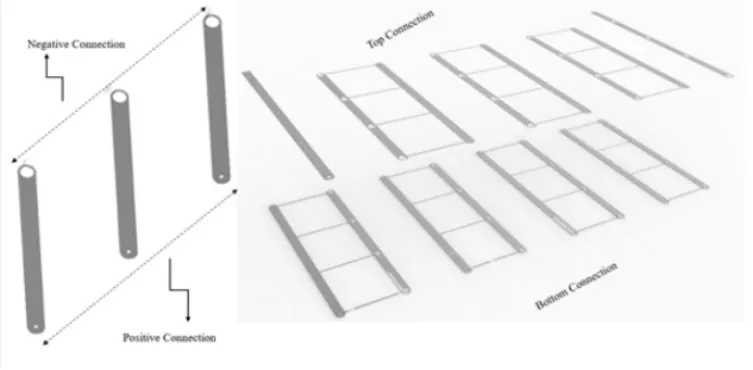
To make the battery pack, you have to connect the many cells together by means of Nickel strips or thick wire. Generally, Nickel strips are widely used for this. In general two types of nickel, strips are available in the market: nickel-plated steel strips and pure nickel strips. I will suggest buying a pure nickel. It is a little bit costlier than nickel-plated steel, but it has much lower resistance. Low resistance means, less heat generation during the charging and discharging, which leads to longer useful battery life.
Nickel strips come with different dimensions and lengths.
Joining of Cylindrical Cell Battery Pack
Cylindrical cells have improved thermal management efficiency because of compact shape, but have low packaging efficiency because of their round cross-section. Here I use a positive and negative tab to connect multi cells.
The suitability of joining methods to build battery packs using cylindrical cells is shown below:
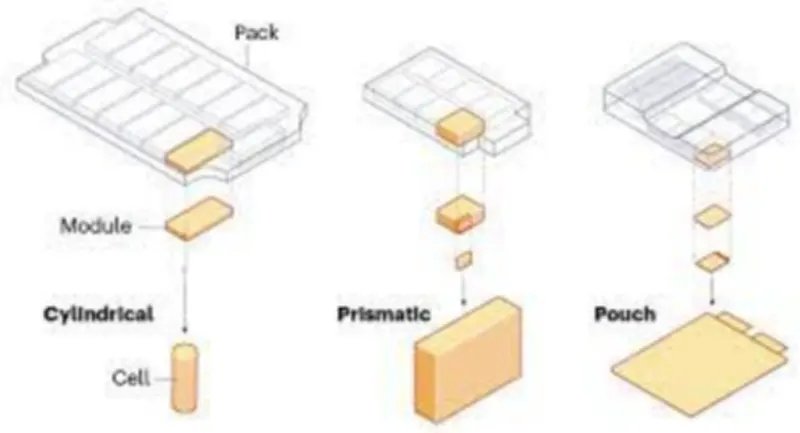
Some other design options for battery pack constructions: