Project 1 Mechanical design of battery pack
Design a battery pack capacity of 18kWh using ANR266650M1-B
Given data:
Cell: ANR26650M1-B
Battery pack capacity: 18 kWh
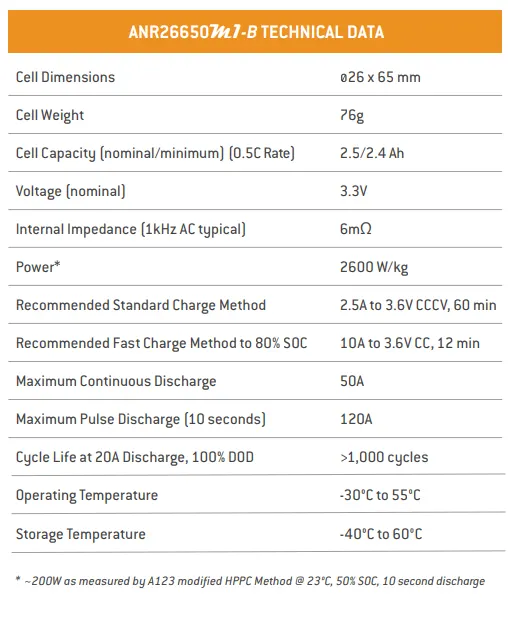
Data from the Datasheet:
Cell Dimension: Diameter is 26mm=0.026m(Radius is half of the diameter. so r=0.013m) and Height(h) is 65mm=0.065mm
Cell weight: 76g =0.076kg
The nominal voltage of a single cell is 3.3V
battery capacity is 2.5Ah.
The energy capacity of each cell is the product of the Nominal voltage of each cell and the Cell capacity of each cell.
`E_(ec) =C_(ec)*V_(ec)`
Where
E_(ec) - Battery Energy of each cell in Wh
C_(ec) - Battery capacity of each cell in Ah
V(ec) - Battery Voltage of each cell in volt.
The energy capacity of each cell is 3.3V*2.5Ah= 8.25 Wh
=18000/8.25= 2181.82 cell
Battery pack energy is given `E_(bp)` as 18000Wh
Assuming the battery pack voltage `V_(bp)` is 660 V
The Battery pack current capacity is calculated by the ratio of battery pack energy capacity and battery pack voltage.
`C_(bp) = E_(bp)/V_(bp)` Ah= 18000/660= 27.27 Ah.
In a series connection, voltage is increased and the current capacity is constant
In a parallel connection, the Current capacity is increased and the voltage is constant.
If you need to increase the current capacity then the cells must be connected in parallel.
As we know that the ANR26650M1-B cell has a current capacity `C_(ec)` of 2.5Ah (each cell).
The total no of cells that need to be connected in parallel is calculated by the ratio of the Battery pack current capacity and the Current capacity of each cell.
`N_p=C_(bp)/C_(ec) = 27.27 /2.5= 11 cells`(10.908 Cells cannot be integer so round off we get 11cell)
11 cells need to be connected in parallel to achieve 27.27 Ah battery current capacity.
Batteries are connected in parallel to increase the pack voltage. Single-cell voltage `V_(ec)` is 3.3V.
The total no of cells that need to be connected in series is calculated by the ratio of the Battery pack voltage and the voltage of each cell.
`N_s=V_(bp)/V_(ec)=660/3.3=`200 cells
No of the series cell is split into 20 and 10 (20*10=200cells)to make a module.
The total no of cells is a product of series and parallel connected cells
`N_(Tsp)`=11*200=2200 cells.
Module Calculation:
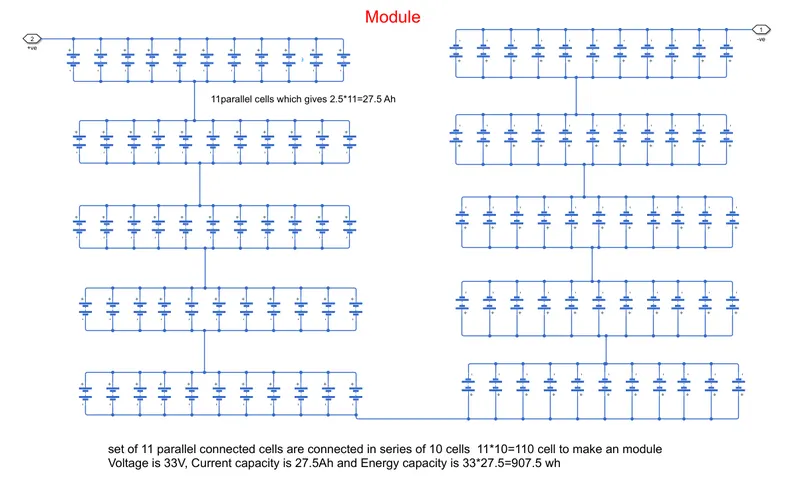
10 cells that are connected in series and 11 cells that are connected in parallel will make the module
The total no of cells in the module is 10*11=110Cells.
Module voltage is a product of each cell voltage and no of cell connected in series within the module
Module voltage `V_(m)` = 3.3*10=33volt
Module current capacity is a product of each cell's current capacity and the of cells connected in parallel within the module
Module current capacity`C_(m)`=2.5*11=27.5Ah
Module Energy capacity`(E_(m))`is a product of Module voltage and module current capacity
`E_m=V_m*C_m=33xx27.5=907.5 Wh.`
Batteries are connected as such as shown in the figure to make a module.
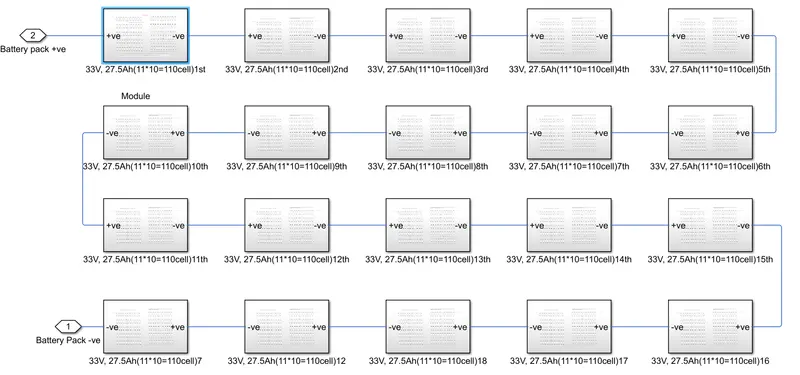
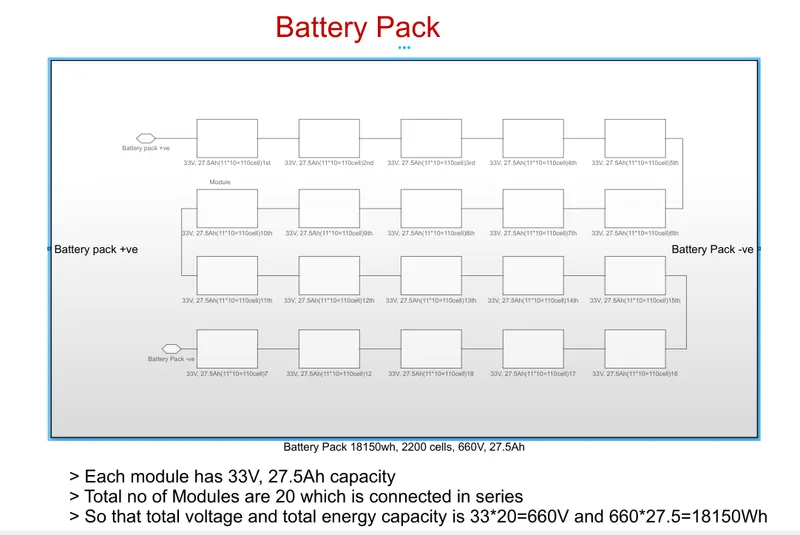
These modules are connected in series to make a battery pack. 20 no of modules is connected in series. Connections are shown below figure.
Battery Capacity Calculation: Revised
No of the modules in the battery pack is 20 modules and they are connected in series N_m=20
Battery pack Voltage`(V_(bp))` is the product of the total no of cells connected in series `(N_s)` and the Voltage of each cell`(V_(ec))`=3.3*200=660 V
or
It is a product of the module voltage and the Total no of modules in a pack(because the module is connected in series). `V_(bp)=V_(m)*N_m=33xx20=660.`
Revised data
The battery pack current capacity is `C_(bp)=27.5Ah.`(Battery pack Current capacity same as the module because the modules are connected in series).
Battery pack Energy capacity`(E_(bp))`= Battery pack voltage`(V_(bp))` * Battery pack current capacity`(C_(bp))`
`(E_(bp))=660xx27.5=18150Wh`.
or
Its a product of a module energy capacity and No of the module. `E_(bp)=907.5**20=18150Wh`
hereafter in calculation Battery pack current capacity and battery pack energy capacity use revised data only. i.e, use `C_(bp)` is 27.5Ah and `E_(bp)` is 18150Wh
Battery energy density Calculation:
For a single cell
The volume of the cylindrical cell, `V_c(m^3)=pir^2h`
`V_c=pi*0.013^2*0.065=0.0000345(m^3)=0.0345(lit)`
note: 1000m^3=1litre
mass of the single cell is 0.076kg
For Battery pack
The volume of the battery pack is a product of the Volume of a single cell and the total no of cells in the pack
`V(bpc)=V_c* N_(Tsp)`= 0.0345*2200=75.9 lit=0.0759m^3.
The required space for the battery pack is 0.08 cubic meter
The mass of the battery pack`(m_(bp))` is a product of the single cell mass and the total no of cells = 0.076*2200=167.2kg
Common for single cell and battery pack
Volumetric energy density, `U_v[(Wh)/l]`is the ratio of Battery cell energy capacity or battery pack and the Volume of cell or battery pack`U_v[(Wh)/l]=E_(ec)/V_c or E_(bp)/V_(bpc)=8.25/0.0345or 18150/75.9=239.13 (Wh)/l`
Gravimetric energy density,`U_g[(Wh)/(kg)]` is the ratio of Battery cell energy capacity or battery pack and the Mass of the cell or battery pack
`U_g[(Wh)/(kg)]=E_(ec)/m_(ec) or E_(bp)/m_(bp)=8.25/0.076 or 18150/167.2 =108.55 [(Wh)/(kg)]` .
Assume the vehicle runs for a 200km range for the fully charged battery pack.
The total energy capacity is 18150 wh
The energy consumption of the vehicle is calculated by the ratio of total energy capacity and vehicle range.
Energy consumption(Wh/km)= E_(bp)/Distance = 18150/200= 90.75 Wh/km.
Assume liquid coolant is used in this battery pack
BMS:
For module, Connections are given as shown below
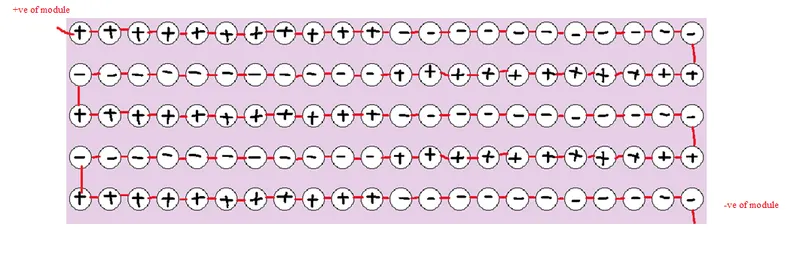
22 cells in a row and 5 cells in a column as connected to make the module.
Calculation of space(volume) required to place the battery pack in the vehicle.
Assumption:
The gap between two cells is 0.005m,
The gap at the corner cell is 0.01m,
The gap between the two modules is 0.05m,
The gap at the corner module is 0.05m.
Length of the module= (Total no of cells connected in a row*Diameter of the cell)+(Gap between two cells in a row*No of the gap between the cells)+(Gap at the corner cells*2)
breadth of the module= (Total no of cells connected in a column*Diameter of the cell)+(Gap between two cells in a column*No of the gap between the cells)+(Gap at the corner cells*2)
Height of the module= height of the cell +2(gap at the terminal)
Length(mod)=(22*0.026)+(0.005*21)+(2*0.01)=0.697m
Breadth(mod)=(5*0.026)+(0.005*4)+(2*0.01)=0.17m
Height(mod)/height of battery=0.065+2(0.005)=0.165m.
The volume required for 1module = length*breadth*height=0.697*0.17*0.165=0.01955 cubic meter.
The battery is connected as shown in the below figure
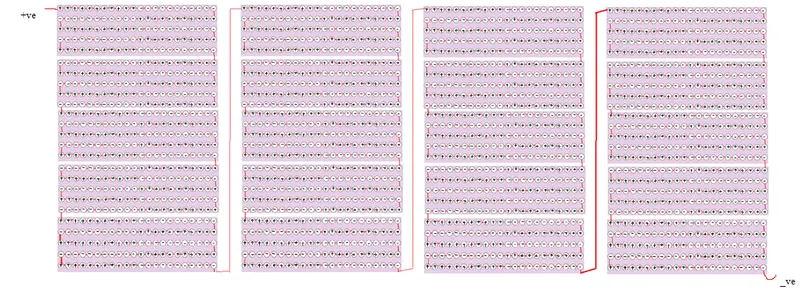
Modules are connected 4row and 5column manner to get the battery pack.
Length of the battery pack (4row module)= Length(mod)*no of the module in a row+ (Gap between two modules in a row*No of the gap between the modules)+(Gap at the corner module*2)
Length(battery)=(0.697*4)+(3*0.05)+(2*0.05)=3.038m
breadth of the battery pack= (Breadth(mod)*No of module in a column)+(Gap between two modules in a column * No of the gap between the modules)+(Gap at the corner module*2)
Breadth(Battery)=(0.17*5)+(4*0.05)+(2*0.05)=1.15m
Height(battery)=0.165m
The volume of the battery pack =Length(bp) *breadth(bp)*height(bp)=3.038*1.15*0.165=0.5765 Cubic meter.
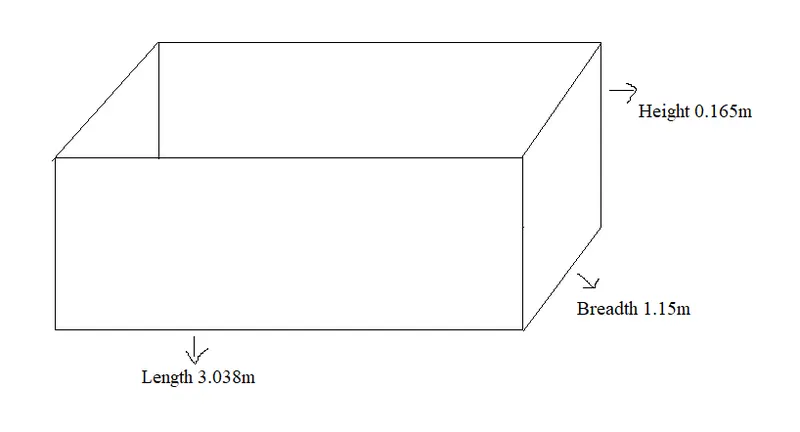
The space required to place the battery pack in a vehicle is 0.5765 m^3