Project 1 Mechanical design of battery pack
NOTE: LIVE SESSION BATCH 16 BY ALWIN SIR
Aim: Prepare a detailed battery pack drawing along with its enclosure.
Objective:
- By using ANR26650M1-B cells create a battery pack of 18 KWh capacity
- To Understand the battery pack building mechanical step up
Theory:
Battery Pack:
- A battery pack is a set of number of identical individual cells. It may be configured in a series, parallel or a mixture of both for deliver the desired voltage, capacity, or power density.
- The term battery pack is often used in reference to battery electric vehicles , radio-controlled hobby toys, and cordless tools.
- Components of battery packs include the individual cells, and the interconnects which provide electrical conductivity between them. Rechargeable battery packs often contain a temperature sensor, which the battery charger uses to detect the end of charging.
- Interconnects are also found in batteries that connect each cell, as per our requirement battery connection configuration.
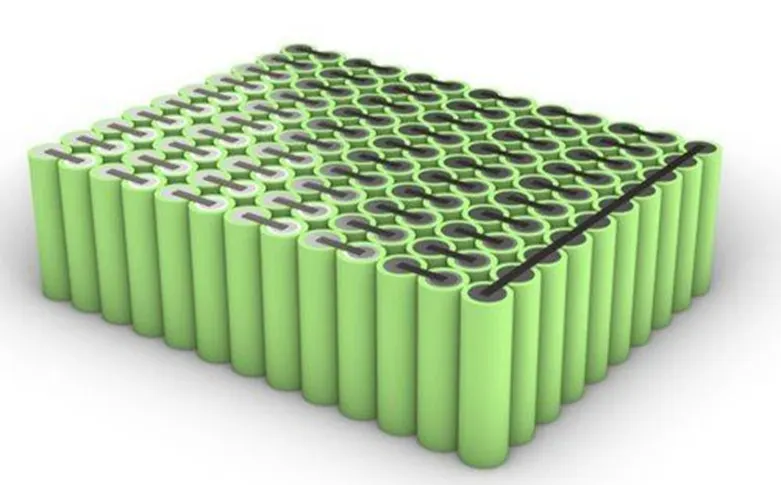
- series connection is made if we want more voltage than the individual one cell and connect cells in parallel mannar if we want more current capacity
- it looks similar to the figure below.
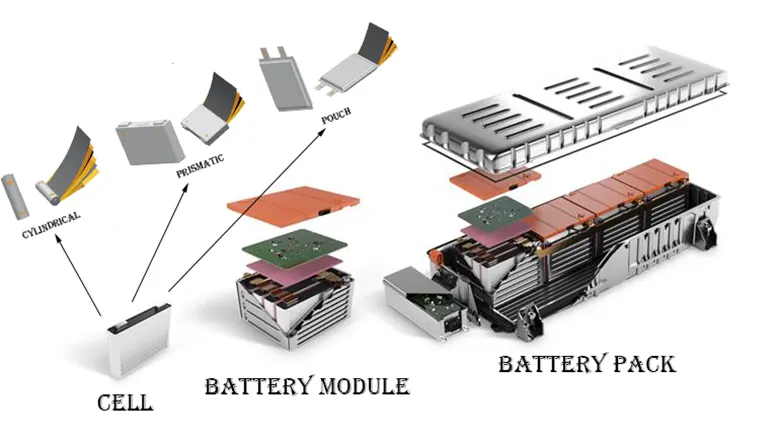
- The battery pack is not made directly from cells in electric vehicles and any bigger pack
- By making series or parallel connection in between cell, first made module and its called series or parallel module. And then this module again connected series or parallel as per our requirement and designed the battery pack.
- It provides flexibility in electrical connection, mechanical placement and thermal arrangement due to these methods
Battery Pack Major Component:
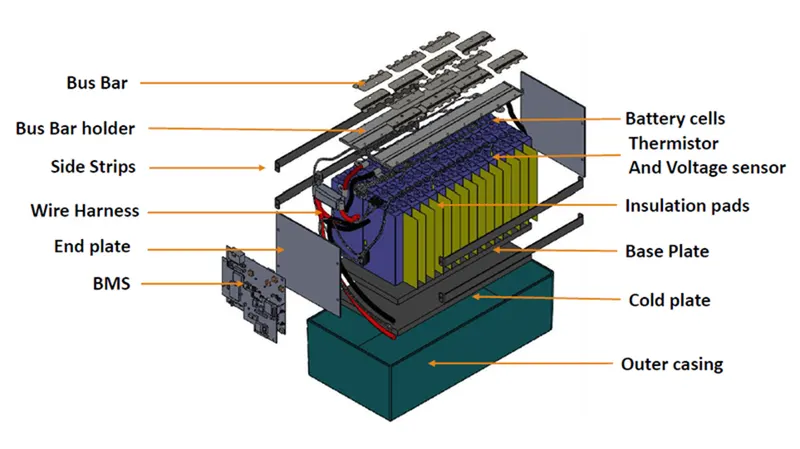
- Battery Cells: It is the most important component in the battery pack.we can store the electrical energy into the chemical form in cells.
- Thermistor and Voltage Sensor: The temperature and voltage of the battery pack is calculate by using Thermistor and Voltage Sensor for safety and measurement purposes.
- Insulation Pads: These insulate the two adjacent battery cells.
- Base Plate: used for holding the entire battery pack.
- Cold Plate: thermal management component for maintaining the battery pack temperature within the limits.
- Busbar: for making connections between two cells its used
- Busbar Holder:To hold busbar at a proper position.
- End Plates: This are used for applying the required mechanical pressure on the battery pack in a distributed manner from the side.
- Side Strips: Side strips hold the end plates and assert pressure on end plates.
- Wire Harness: It is used for connecting the module also makes connection from battery pack to appliances.
- Battery Management System (BMS):BMS systems manage the battery or cells in a proper manner.
- Outer Casing: Outer Casing provides a platform to the battery pack.
Battery Pack Mechanical Design Stages:
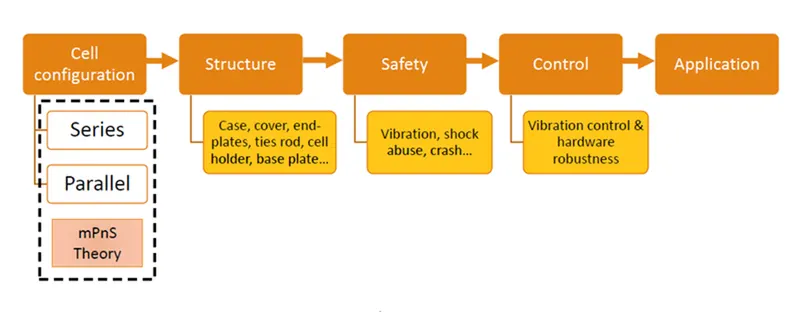
Battery Cells:
- It is the smallest unit of a battery, comprising four key components including cathode, anode, electrolyte and separator.
- The characteristics of a battery cell play a pivotal role in the overall performance of electrified vehicles.
- There are various forms of a cell such as prismatic, cylindrical, and polymer for automotive applications.
- Multiple cells connected in series and/or parallel, encased in a mechanical structure form a module
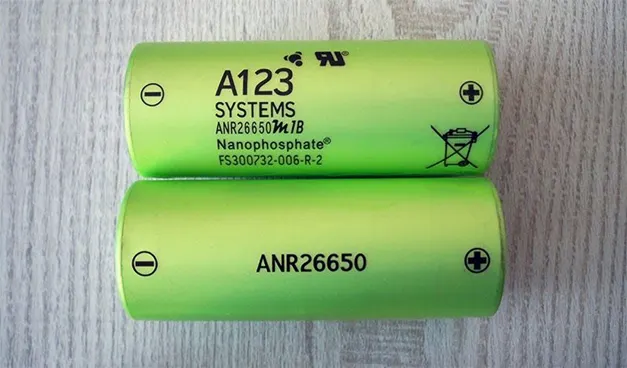
Nanophosphate High Power Lithium Ion Cell ANR26650M1-B
- Lithium Works 26650 cells are capable of delivering very high power due to its use of patented Nanophosphate battery
technology. - Lithium iron phosphate chemistry (LiFePO4 ) cells are inherently safe over a wide range of temperatures and conditions based on lithium iron phosphate chemistry (LiFePO4 ), Whether the application requires outstanding cycle life or stable float reliability, the Lithium Werks’ 26650 cells are suitable for a wide variety of power, pulse, or stand-by applications.
- Stable chemistry, faster charging, consistent output, excellent cycle life and superior cost performance offer by Nanophosphate battery technology
- also provides the foundation for safe systems while meeting the most demanding customer requirements.
- To achieve an energy storage solution with superior safety and abuse tolerance compared to metal oxide lithium-ion chemistries Multiple layers of protection are employed at the chemistry, cell and system level
Cell dimensions
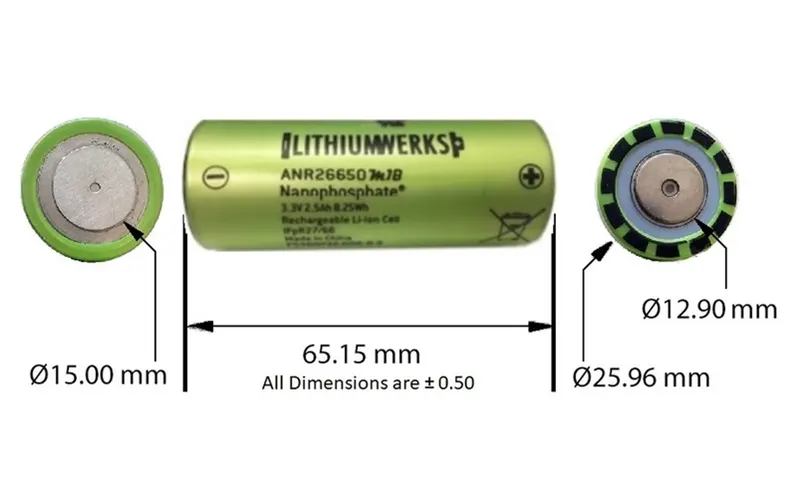
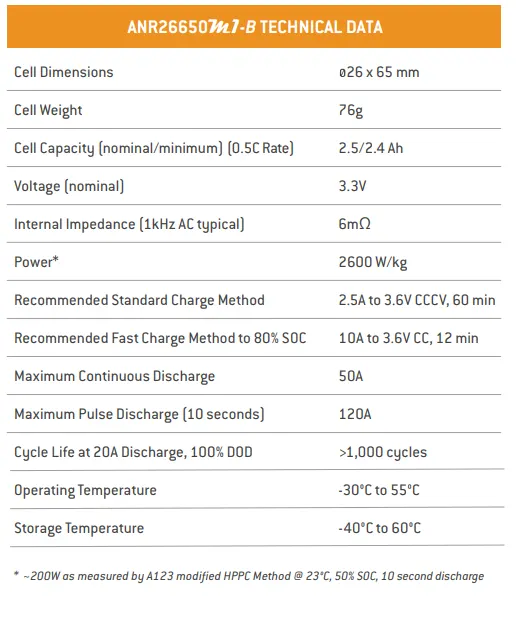
Cell Technical Specification:
|
Cell Parameters |
Parameters Values |
|
Cell Dimension |
ø 26 x 65 mm |
|
Cell Weight |
76 gm |
|
Cell Capacity (nominal/minimum) (0.5C Rate |
2.5/2.4 Ah |
|
Nominal Voltage |
3.3 V |
|
Internal Impedance (1kHz AC typical) |
6 mΩ |
|
Power* |
2600 W/Kg |
|
Recommended Standard Charge Method |
2.5A to 3.6V CCCV, 60 min |
|
Recommended Fast Charge Method to 80% SOC |
2.5A to 3.6V CCCV, 60 min |
|
Maximum Continuous Discharge |
50 A |
|
Maximum Pulse Discharge (10 seconds) |
120 A |
|
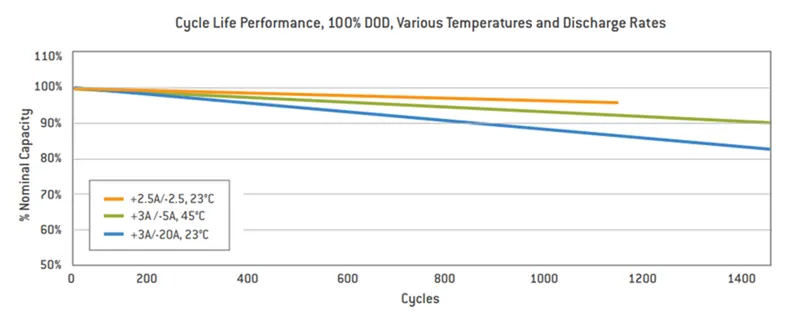
Cycle Life at 20A Discharge, 100% DOD |
> 1000 Cycles |
|
Operating Temperature |
-30°C to 55°C |
|
Storage Temperature |
-40°C to 60°C |
Cell Performance Plot:
Discharge Characteristic:
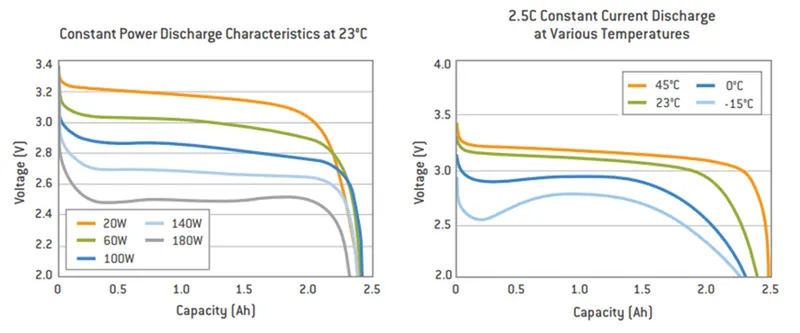
Cycle Life Performance:
Spot Welding:
- To drive portable electric tools electric bicycles, and electric hybrid vehicles Battery packs are increasingly used.
- the cells are connected in series or parallel to achieve the required voltage and capacity in these applications,.
- Following three methods available for welding batteries: laser beam, ultrasonic and resistance spot welding but spot welding is most common in lithium ion cylindrical batteries.
- spot welding is that the process does not need any filler material. It involves pressure and heat applying to the welding area.
- A copper-alloy electrode transmits current through the material so that it melts and fuses the parts.
- the pressure maintains to solidify weld, current is off at that time and so the joint forms. Usually, the pressure stays a bit longer whereas the current only runs in a flash.
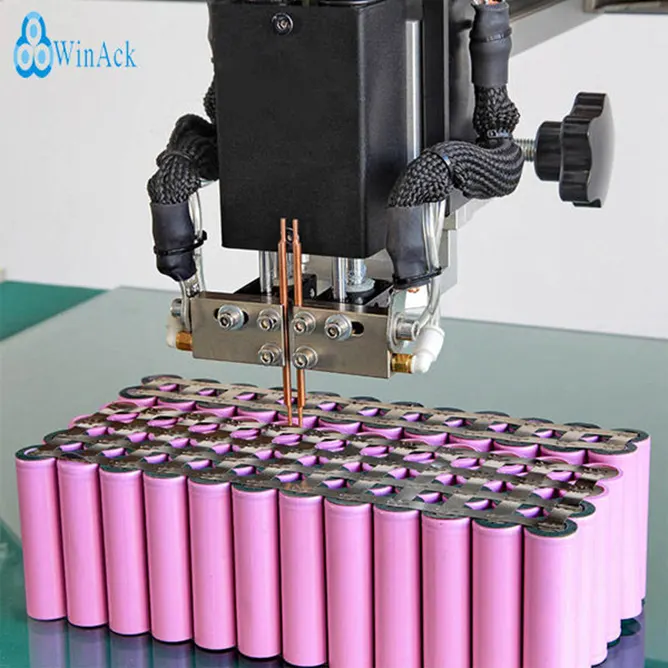
- As it uses the current flowing through the electrodes it can provide reliable results and form long-lasting welds., there is no need for filler material
- It is a cost-saving option on this note
- The welding area is restricted. It only takes place exactly where the tip of the electrode makes contact. Therefore, the energy is focused and heat generation is reduced is the other advantage
- Disadvantages :spot welding method is not suitable for all materials also the cost is relatively higher for mass-production lines when dealing with small-scale projects.
- Besides the cost issue, the welding quality is a concern if the process is not conducted properly.
- The joints will not be strong enough and hence susceptible to vibration or cracks if the heat and pressure are not high enough.Also it does not work well for irregular protrusions or hard-to-reach locations.
Nickel strips:

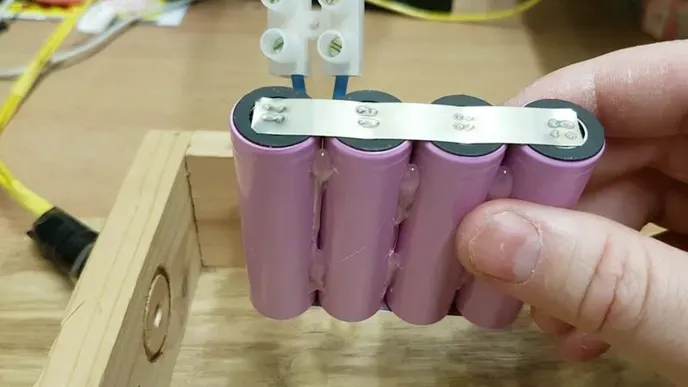
- This are generally used in battery building.
- Its due to its efficiency of usage in spot welding and soldering as well its high corrosion resistance over time.
- nickel strips has good properties and excellent resistance to many corrosive environments. The pure nickel will never get rust after it applied to battery packs.
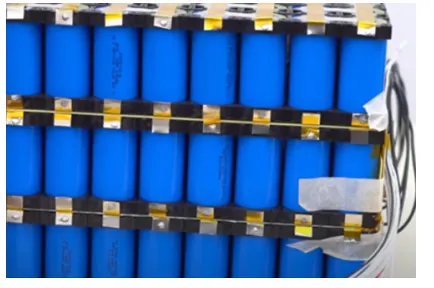
This is a battery holder and we can connect them as per requirements
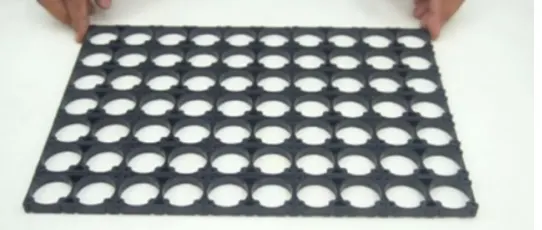
Battery are placed on this holder and holder is covered at top and bottom of the battery rigid enough for use
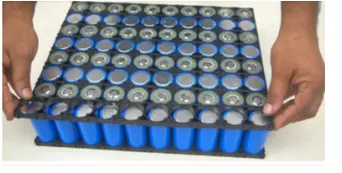
After that connect it by nickel strips
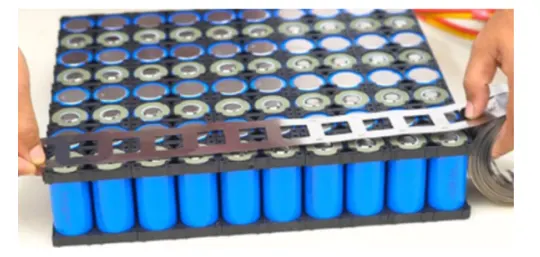
Next is spot welding is used to connect the cells
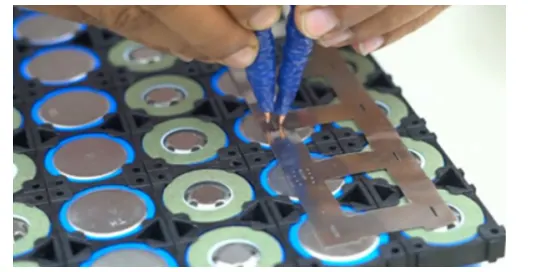
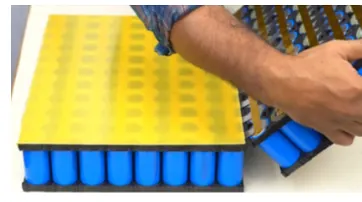
To connect the multiple pack of the battery and Multiple pack is again connected by the
nickel strip PVC heat sink films is used
Mechanical Material:
From outer environment conditions like dust, vibration, shocks, etc. We can use the base plate, end plate, side strip, outer casing, for battery packs Protection. So now o pack is ready.
Mechanical Test Standards:
For validation of EV’s Battery pack, different test standards are generally followed:
- Harmonic Vibration Test - AIS 048: 2009
- Shock Abuse Test - AIS 048: 2009
- Random Vibration test - SAE J 2380