Project 1 - 2D meshing on the instrumental Panel
AIM:
1. The project aims to mesh the given automotive dashboard with 2D elements with respect to the prescribed criteria by extracting mid surface.
2. Assign the thickness for the shell elements according to the parent geometry.
|
S.No |
Quality Criteria |
Value |
|
1 |
Target/Average length |
4 |
|
2 |
Minimum Length |
2 |
|
3 |
Maximum Length |
6 |
|
4 |
Aspect |
3 |
|
5 |
Warpage |
15 |
|
6 |
Skewness |
45 |
|
7 |
Jacobian |
0.7 |
|
8 |
Minimum Quad Angle |
45 |
|
9 |
Maximum Quad Angle |
135 |
|
10 |
Minimum Tria Angle |
30 |
|
11 |
Maximum Tria Angle |
120 |
|
10 |
Tria Percentage |
15 |
INTRODUCTION:
When the geometry has smaller thickness value when compared to its span length its ideal to mesh the components with 2D shell elements by
extracting the mid surface and then assigning the properties like thickness and material for the mesh so has to achieve the original properties of
the geometry. The preprocessing stage of FEA has 3 major steps.
1. Topology cleanup.
It is necessary to perform topology/geometry cleanup for the components in order to eliminate the geometrical errors, critical surfaces and to
enhance the mesh quality and flow.
2. Mid surface extraction.
Mid surface is the exact replica of the geometry in a 2D surface form. The mid surfaces were generated either manually or automatically depending
upon the requirement. Some of the advantages of midsurface and 2D meshing are as follows.
- Without much difficulty accurate results can be achieved.
- Reduces the meshing time by reducing the number of elements (3D meshing requires much more time)
- Reduces the processing time and computation time by increasing the simulation speed.
- Any revisions or mesh modifications can be done easily.
3. 2D meshing.
A 2D shell is a one-dimensional element that has constant thickness. 2D elements either can be 4 node quad element or 3 node tria element. The
automotive plastic components are analyzed for crash and impact so combination of quad and tria elements can be used for meshing.
PROCEDURE:
1. Import the given IP substrate model to ANSA, perform topo and check for geometry errors if found fix the issue and orient the faces.
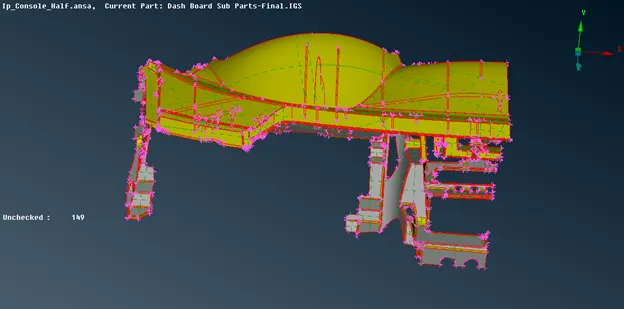
Fig: Imported model.
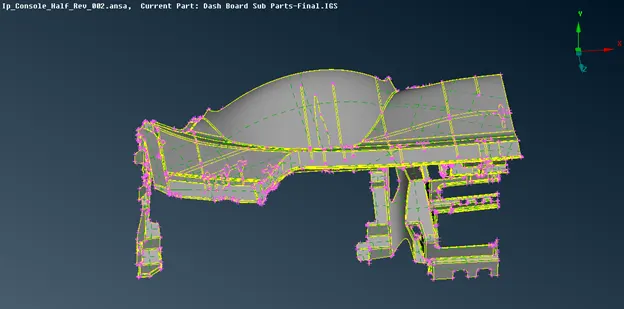
Fig: Corrected model.
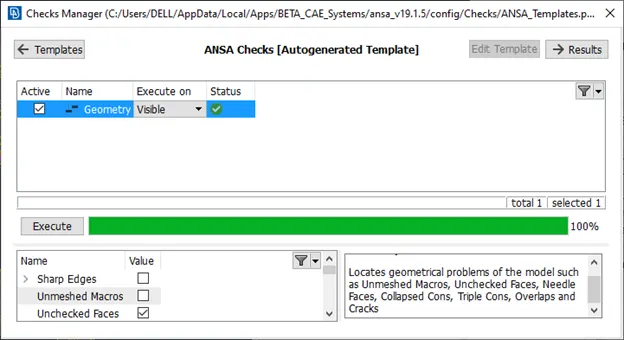
Fig: Geometry checks.
2. Since the component is huge and has varying thickness it’s ideal to extract mid surface manually.
3. Measure the thickness of all the features.
4. Initially offset the major surface which is a major base surface of the component.
5. Assign the thickness and properties for the extracted midsurface.
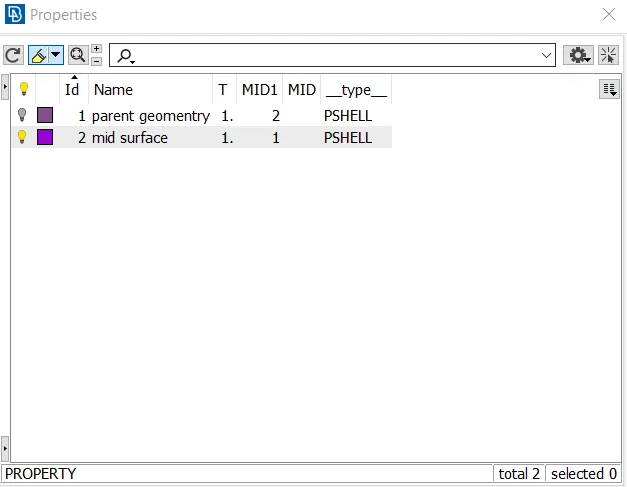
Fig: Assigning thickness.
6. Offset the ribs surfaces and extend them to the base surface as shown.
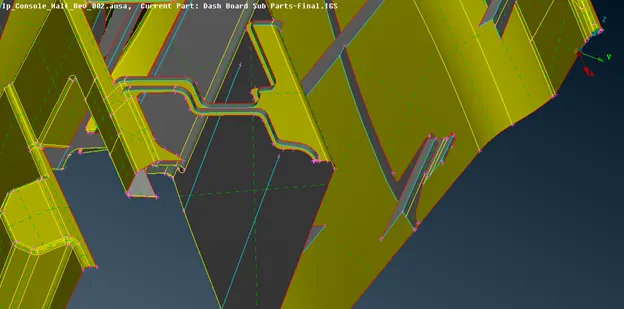
Fig: Extension of ribs.
7. Assign the thickness and properties for ribs immediate after extracting midsurface.
8. Assign the rib thickness value for the doghouse attached to the rib.
9. The edge fillets of ribs may create size differences in the surface so in order to avoid this create middle curve and project them to the base surface.
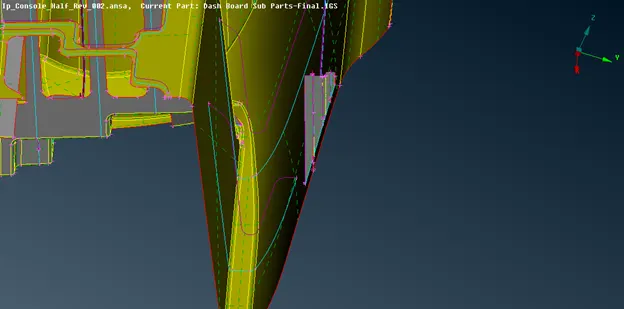
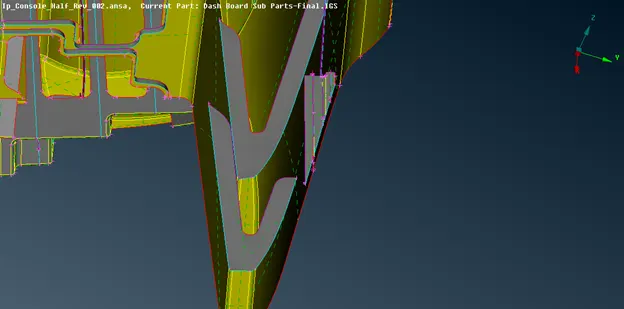
Fig: Creating rib midsurface using mid curves.
10. Create a new surface using mid curves and created cons.
11.After all the operations has been done the final mid surface is shown in below fig.
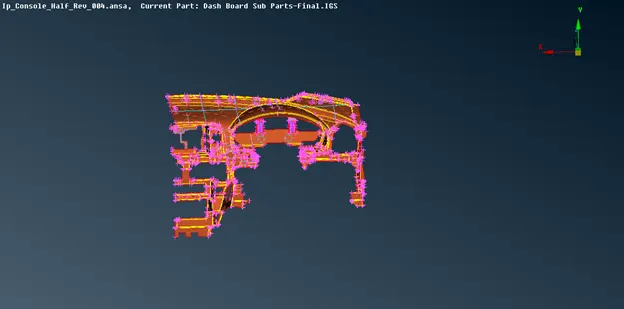
Fig: Final midsurface.
12. Once all the mid surfaces extracted successfully check for the erros if any and set the length as 4mm.
13. Enter the mesh and quality criteria for the elements and mesh the surfaces.
14. Alter some of the features (defeaturing) to avoid the elemental failures.
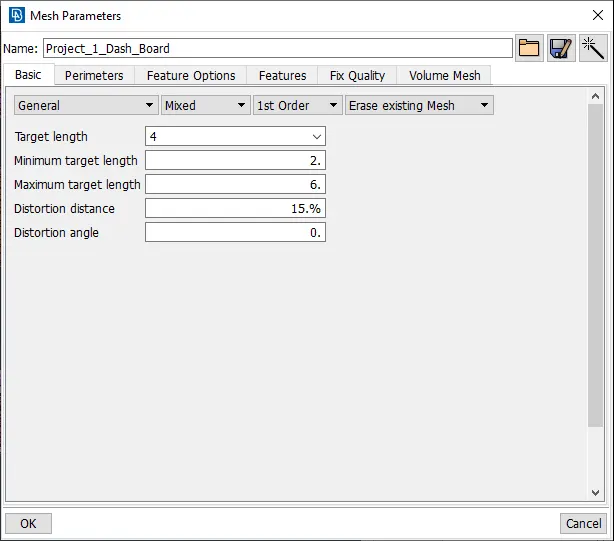
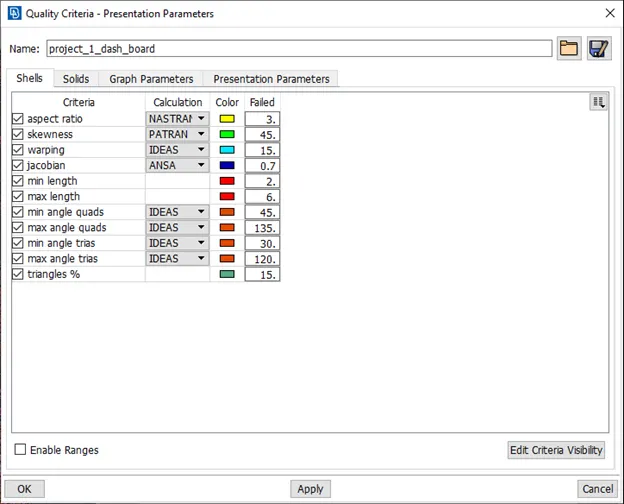
Fig: Mesh and quality parametrs.
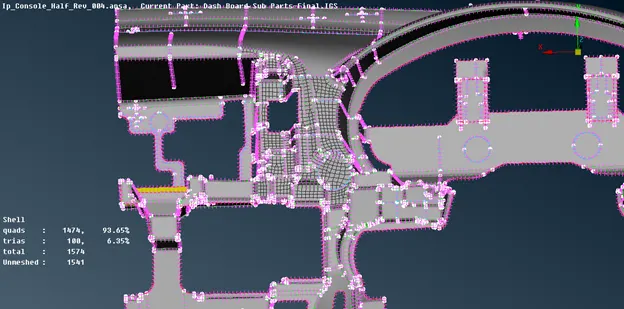
Fig: Starting of mesh from complex regions.
15. Most of elements near to the triple con junctions may fail because of the feature.
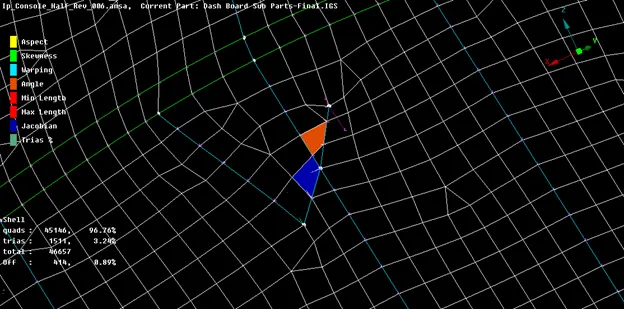
Fig: Elemental failure due to triple con and feature.
16. Mesh the surfaces if necessary include some of the cuts on the surfaces and join them after meshing.
17. Resolve the quality issues by smoothing the elements.
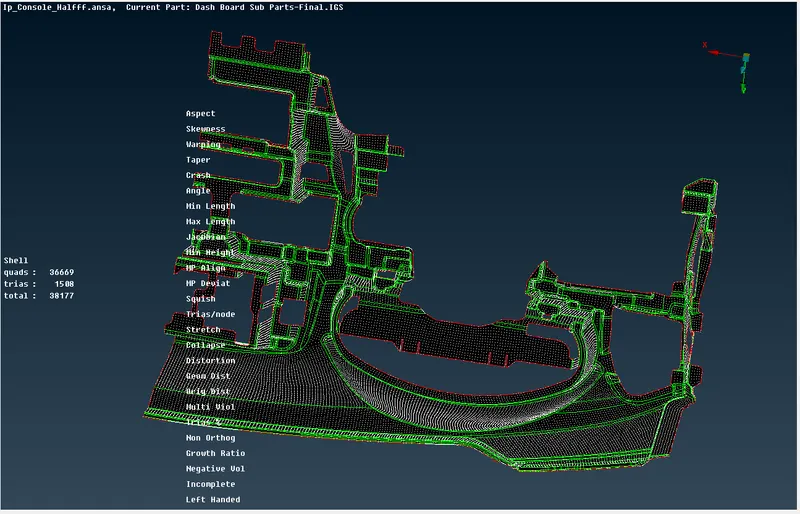
Fig: Meshed model.
18. Once the meshing is completed select the draw shell as solid option to view the elements in solid.
LEARNING OUTCOMES:
- Handling and meshing of huge component in ANSA.
- Midsurface extraction of complicated ribs.
- Resolving quality issues in the intricate profiles and features.
- Capturing and representation of dog houses.
- Meshing of intersecting ribs and features.
RESULT:
The given Dash board component is meshed according to the specified quality and mesh parameters and properties and thickness were assigned
according to the parent geometry.