Project 1
Forearm Crutch:
Many people who are recuperating from an accident or who have impairments use forearm crutches. They help to maintain balance and stability by shifting the lower body's weight to the upper body. Depending on the degree of the injury or impairment, one or two crutches are utilised.
The four main requirements that a set of crutches has to meet are strength, comfort, coordination, and comfort. The bulk of a crutch is made of aluminium alloys, which are strong and lightweight and provide the stability needed to support the user's weight without bending or deforming the metal.
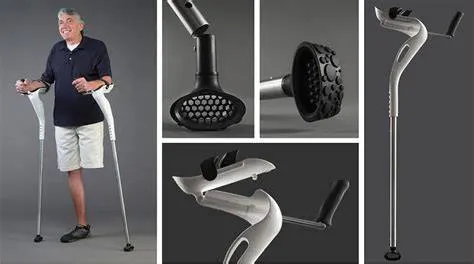
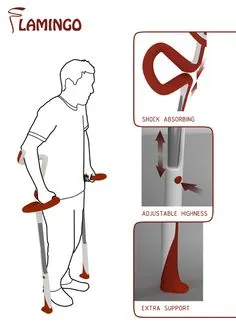
Forearm crutches include cuffs that are constructed of plastic that can bend, allowing the user to put their arm through them while yet being stable when walking. Depending on the manufacturer or the demands of the customer, the crutch handles can be made of plastic or rubber. While plastic is more durable, rubber is more comfy.
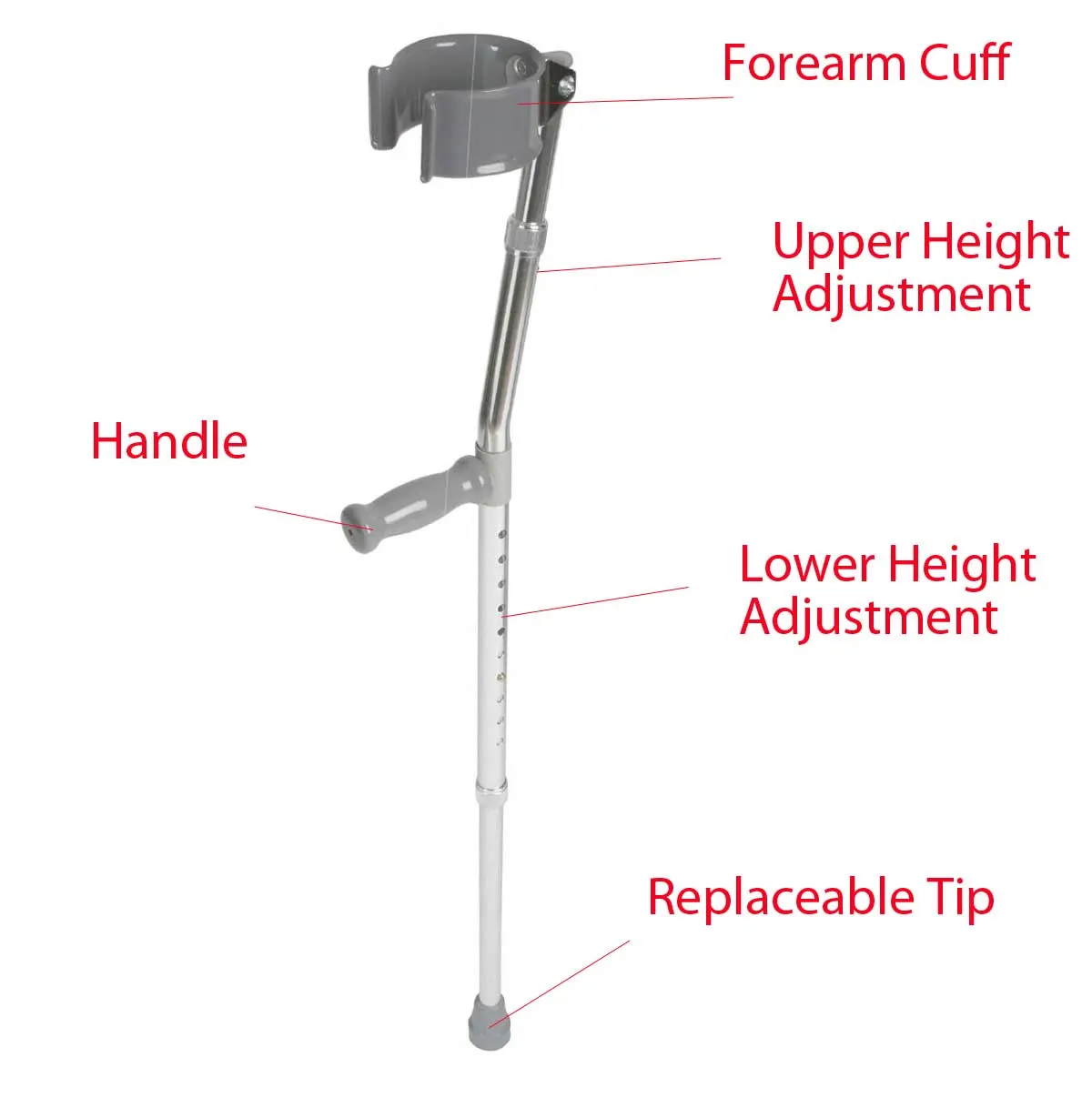
The shock-absorbing gel is commonly enclosed in a rubber tip on a crutch. Bolts, screws, and height adjusters are often constructed of stainless steel.
Materials and mechanical properties:
A frame, grip handle, cuff, tip, and height adjustments make up the forearm crutch. These components are all manufactured out of different materials, each chosen for its ability to meet the part's specific mechanical needs.
The forearm crutch's frame is often constructed of an alloy of aluminium. Aluminum is lightweight and portable due to its low density, making it easy to manoeuvre. Moreover, it is quite strong, allowing the crutch to hold a person's whole weight without bowing or bending. To ensure a long life, aluminium is also simple to work with and resistant to corrosion
The forearm crutch is secured with plastic cuffs. Typically, it is constructed of a plastic like nylon-6/6. To manage the constant rubbing against skin and contact with hydrocarbons when walking, it has strong abrasion and hydrocarbon resistance. It also features a lot of rigidity and strength to provide the user a lot of support.
The forearm crutch's grip handles can be manufactured out of rubber or the same plastic as the cuffs. While rubber is more pleasant and has a greater capacity for shock absorption, plastic offers greater wear resistance and durability.
Rubber is used to make the forearm crutch's tip. To stop slippage when walking, there is enough of grip and stability provided by the rubber. Moreover, it offers superior shock absorption to lessen the impact of walking.
There are many different kinds of mechanisms for adjusting the height, such as clamps and adjustment pins. The majority of these mechanisms are made of stainless steel. This provides a stable connection between the various parts of the main frame thanks to its high strength and low deformation. It is also resistant to abrasion, making it long-lasting and suitable for outdoor use.
Manufacturing process:
There are two main steps in the manufacturing process for forearm crutches:
the production of the plastic arm cuffs, hand grips, and replaceable rubber tips made of aluminum hollow tubes.
Despite the fact that some crutch manufacturers would rather purchase ready-made hollow tubes in a variety of sizes and shapes, many others would rather manufacture their own to achieve the precision and quality they desire.
Drawing is the process by which a highly heated starting billet (stock) is drawn through a die to reduce its diameter and stretch its length under high pressure to create the aluminum hollow tube. The process improves the desired tube's dimension accuracy and surface finish, requiring the starting billet to be hollow at first. The initial heating process preserves the material's internal properties by allowing it to be soft while maintaining its solid nature. Once this drawing process is finished, the tube is rapidly cooled through water quenching.
The hollow tube is bent and holes are punched through it at various points along its length, depending on the crutch's desired shape. This is for the final assembly, where the remaining components must be attached.
An injection molding process employing an IMM (injection moulding machine) or injection press is used to produce the arm cuffs, hand grips, and rubber tips. For the various part shapes that are desired, this machine can be mounted with a variety of mold cavities.
The process begins with feeding the plastic polymer into the machine's heating unit to melt it. The molten material is then injected into specific mold cavities using high pressure to form the arm cuff, hand grip, or rubber tip through an opening known as a sprue. The cavities are then filled and more material is poured into the machine than just to fill the moulds, this is to compensate for the shrinkage that will occur once the material starts to solidify. The moulds are then held together until the part is fully shaped and cooled, thereafter the moulds are opened and the part is ejected from the machine.
Because of its precision and accuracy in shaping parts and the complexity of the shapes it can make, this particular manufacturing is best suited to making rubber and plastic materials like arm cuffs and hand grips.
The forearm crutch as a finished product is assembled after all of the parts have been finalized and checked for quality.
Possible design changes;
We looked at a standard aluminum underarm crutch with plastic cuffs at the top and rubber padding on the handle. Despite their effectiveness, these crutches have a few drawbacks: The first is that these crutches use a lot of energy, and the second is that the user gets hurt when they hit their hands and wrists too often. One-piece, curved graphite crutches would be an alternative design to the aluminum crutches.
Below this design alteration will be analyzed according to; functionality, cost, and sustainability.
Functionality
Curving the crutches
The crutches become shock absorbers by being curved, significantly reducing the impact on the user's upper body. It will also make it possible for the user to retain energy and propel themselves forward when the crutch is straightened. This will save the user a lot of effort and make it less painful and tiring to walk longer distances with crutches.
One Piece design
Because the crutch is now only one piece, there are fewer parts. This makes the crutch easier to make and will make it last longer because there are fewer parts that can break.
Graphite
Additionally, graphite has a much higher energy retention rate than aluminum and is able to bend without giving way. Additionally, the graphite is lighter than aluminum, allowing the user to save energy.
Cost
The price of the aluminum, at 1990 USD per ton, is slightly less than the price of the graphite, which is 2000 USD per ton. The design advantages of using aluminum far outweigh the additional expense, despite the fact that aluminum is less expensive than graphite. Compared to aluminum crutches, the user would rather pay a small amount more for the additional benefits.
Sustainability / Environment
Since aluminum is a material that can be easily recycled, it seems illogical to use graphite instead, which can't be recycled as easily. However, sustainability is more than just recycling.
Graphite is a material that is extremely long-lasting and won't be significantly affected by wear and tear. As a result, the crutches can be used multiple times without losing their functionality or aesthetic appeal.