Configuration of Lithium ion Battery
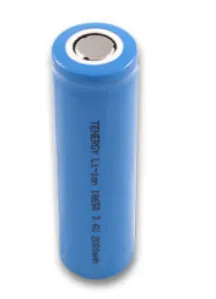
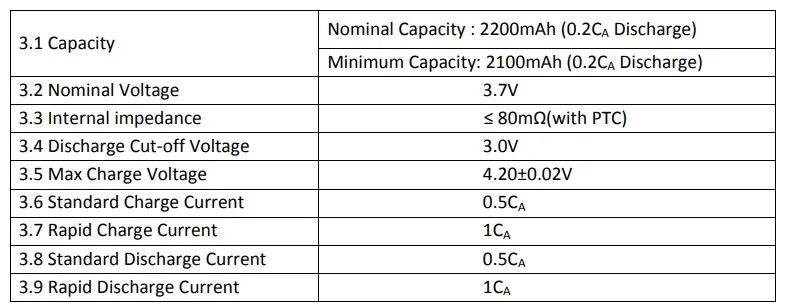
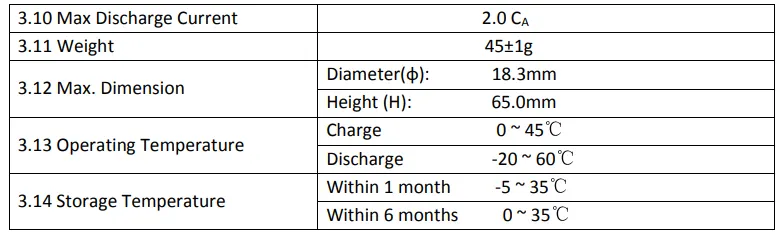
From datasheet of a lithium ion battery (TENERGY 18650 2200mAh Li-Ion Cell) configuring the generic battery model in MATLAB.
Lithium-ion cell Datasheet:
Company name: Tenergy Corporation
Product Name: Tenergy Lithium Ion 18650 Cell
Product Number: 30003
Battery Model: 18650 2200mAh
Battery Chemistry: Lithium Ion Rechargeable
Dimension:
Max Diameter (φ): 18.3mm
Max Height (H): 65.0mm
Software used:
MATLAB R2020a (Simulink)
Generic battery model in MATLAB:
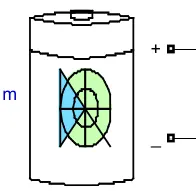
The Battery block implements a generic dynamic model that represents most popular types of rechargeable batteries.
This figure shows the equivalent circuit that the block models.
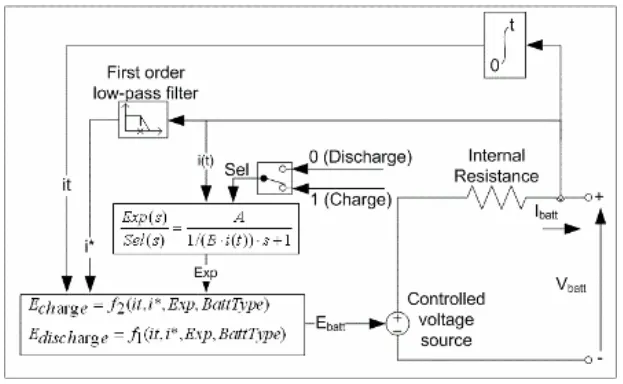
Equivalent circuit
Charge and Discharge Characteristics:
The circuit parameters can be modified to represent a specific battery type and its discharge characteristics. A typical discharge curve consists of three sections.
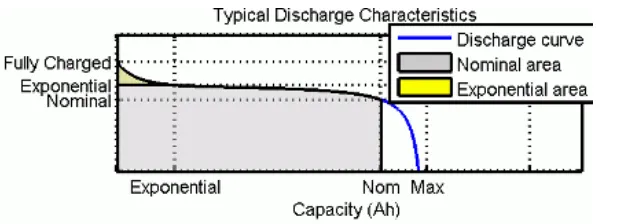
The first section represents the exponential voltage drop when the battery is charged. The width of the drop depends on the battery type. The second section represents the charge that can be extracted from the battery until the voltage drops below the battery nominal voltage. Finally, the third section represents the total discharge of the battery, when the voltage drops rapidly.
Governing Equations:
For the lithium-ion battery type, the model uses these equations.
Discharge Model (`i`* > 0)

Charge Model (`i`* < 0)

Where,
`E_0`is the constant voltage, in V.
`K` is the polarization constant, in V/Ah, or polarization resistance, in Ohms.
`i`* is the low-frequency current dynamics, in A.
`i` is the battery current, in A.
`it` is the extracted capacity, in Ah.
`Q`is the maximum battery capacity, in Ah.
`A` is the exponential voltage, in V.
`B` is the exponential capacity, in Ah−1.
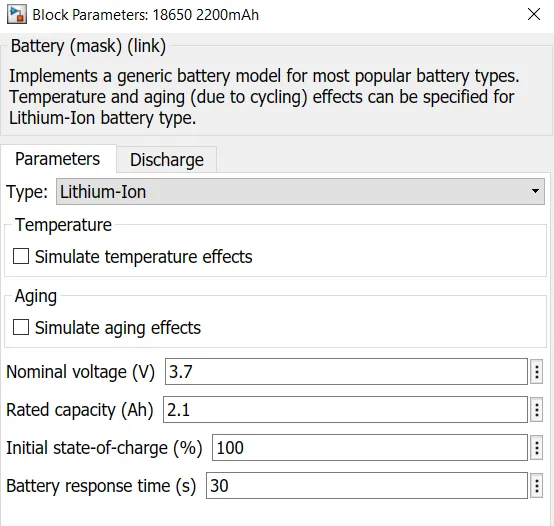
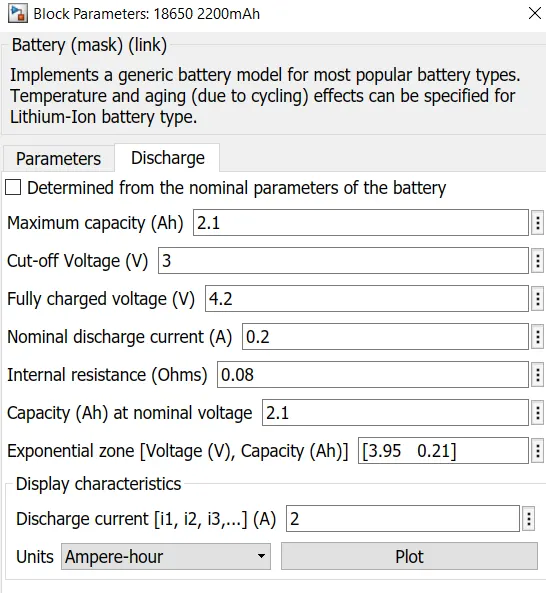
Here I used the 'TENERGY 18650 2200mAh Li-Ion Cell' rechargeable cell Datasheet to configue the generic battery model.
Discharge Characteristics:
At the Nominal discharge is 0.2A & Discharge 2A , the Voltage(V) Vs Capacity(Ah) plot:
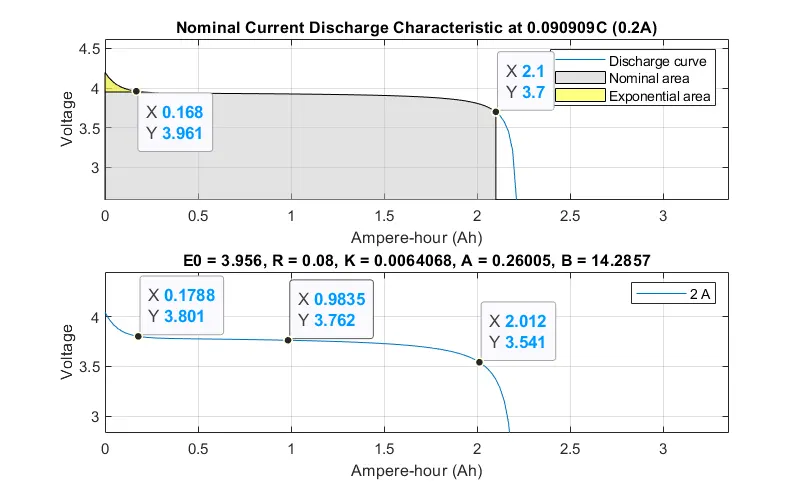
- The exponential area is under 0 to 0.168 Ah and 3.961to 4.2 V.
- Nominal Area is under 0 to 2.1 Ah and 3.9 V.
- Voltage is reduced gradyally under exponential area and constant from nominal Capacity. The nominal capacity is 2.1 Ah at 3.7V. At the end of the rated capacity the voltage of the battery is reduces suddenly as shown in the plot.
At the Nominal discharge is 0.2A & Discharge 2A , the Voltage(V) Vs Time(hrs & Min) plot:
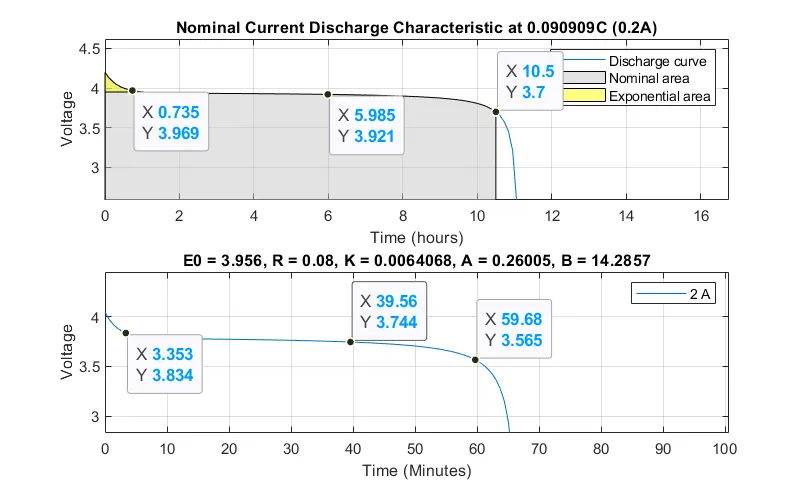
This plot shows the Time Vs Voltage of the battery. At the end of the 10.5 hrs the battery is getting drained out and voltage droped to 0V.
Parameters of TENERGY 18650 2200mAh Li-Ion Cell are:
Constant voltage`(E_o) =3.956`
Internal Resistance`(R) =0.08 Omega`
Polarization constant`(K) =0.0064068`
Exponential voltage`(A) =0.26005`
Exponential voltage`(B) =14.2857`
By using Lithium-ion Battery with DC motor, observed the parameters of Battery (SOC, Voltage) and Motor (Speed, Armature current).
To check the
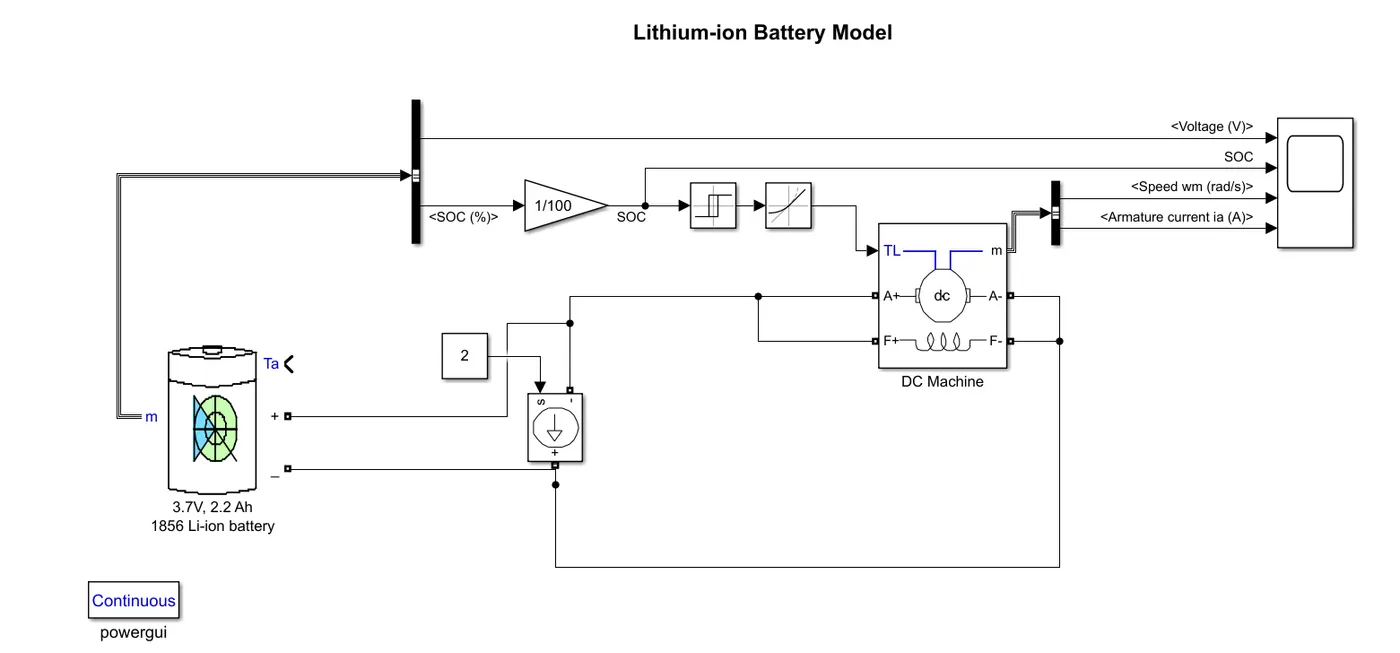
Procedure & construction:
- Battery is connected to DC Motor through the controlled current source. The Positive terminal of the battery is connected to -ve terminal of the current source and +ve terminal of the motor armature and filed connection. The Negative terminal of the battery is connected to the +ve terminal of the voltage and -ve terminal of the motor and field connection. To check the State of charge (SoC) of battery is connected to the motor TL through Relay and Rate limiter. By running the simulation we can observe the battery and motor parameters.
- Initially, the current flows to the motor through controlled current source and runs the motor. On the other hand from the bus sellector SoC and voltage of the battery is selected and measures as the motor is running.
- The battery is connected to a constant load of 2 Amps. The DC machine is connected in parallel with the load and operates at no load torque. When the State-Of-Charge (SOC) of the battery goes under 0.4 (40%), a negative load torque of 200 Nm is applied to the machine so it acts as a generator to recharge the battery. When the SOC goes over 80%, the load torque is removed so only the battery supplies the 2 amps load.
- Battery voltage, SOC, Motor speed and Motor current signals are available at the output of the block.
Results:
The maximum Speed of the motor is 1200 ras/sec, and the maximum regeneration of current is 1000 amps.
At t = 0 s, the DC machine is started with the battery power. The speed increases to approx. 1200 rad/s at 590s. The battery is also discharged by the constant DC load of 2 amps. At t = 590 s, the SOC drops under 40%. A mechanical torque of -200 Nm is applied to the machine so it acts as a generator and provides a current of 1000 amps. Hence, 2 amps goes to the load and the rest goes to recharge the battery. At t = 592 s, the SOC goes over 80%. The mechanical torque is removed and the machine operates free. And the cycle restarts.
By using this Li-ion model we can clearly observe chaging and discharging characteristics of a battery.