Injection Molding and Injection Mold Nomenclature - Challenge 2
1. What are the Types Of Injection Moulding Machines?
- Plunger type Injection Moulding Machine
- Screw-Plunger type Injection Moulding Machine
- Plunger-Plunger type Injection Moulding Machine
- Reciprocating Screw Injection Moulding Machine
- Plunger Type Injection Moulding Machine:
The plunger injection moulding machine uses the plunger to push the plastic in the barrel forward, make it pass through the diverter shuttle, and then inject it into the mould through the nozzle. The heat of plastic melting into a flow state is provided by electric heating outside the material Jane. Due to its simple structure, convenient operation, and low technical requirements, this plunger-type machine can meet the moulding of general small parts or parts with fewer precision requirements. In the plunger machine, the diverter shuttle in the barrel needs to be studied and improved. It’s a simple method and used in small-scale industries for some small products, now it’s very rare.
- Screw Plunger Type Injection Moulding:
In screw plunger type injection moulding machine there are two chambers, one chamber is to plasticize the raw material and another chamber is used for injecting the material inside the mould, so upper section consists of plasticizing chamber in which the hopper is attached the material which is inside the hopper is transmitted in the plasticizing chamber and then the plasticized material will be transmitted to the injection plunger area (another chamber), then injection plunger will move forward and the material will be filled inside the cavities of the mould, the functioning of the screw is rotating and the material which is being plasticized has been accumulated in the injecting chamber, when you close the mould, the material is being charged from the hopper to the barrel, in the barrel section, there is a screw which is rotating and along with a screw, the barrel consists of some band heaters along with screw, they both helps in plasticizing the raw material, the melted raw material move toward another chamber which is called the injection chamber, in that injection chamber, there is a plunger which moves forward and the raw material which is in melted form is being injected inside the mould.
- Plunger-Plunger Type Injection Moulding:
Plunger-plunger type injection moulding machines and screw plunger type injection moulding machines are quite common. The function for the plunger-plunger type injection moulding machine is the same, instead of a screw which is in the plasticizing chamber. There is a plunger and heaters used for plasticizing, the functions of both the plunger type injection moulding machine and a screw plunger type injection moulding machine are quite similar, but the result and efficiency of a screw plunger type machine are more efficient than plunger type injection moulding, in plunger-plunger type injection moulding machine, the raw material is plasticized by heaters the band heaters which are being attached over the barrel and then the plunger moves that raw material into the injection plunger chamber and then what happened that injection plunger moves forward and the entire plasticized material is injected inside the mould.
- Reciprocating Screw Injection Moulding:
The heating elements are attached to the barrel, inside the barrel, there is a reciprocating screw, that’s why the name of the machine is called reciprocating screw type injection moulding. The reciprocating screw is divided into three zones, which are feed zone, transition zone, and metering zone. In the feed zone, the material is transferred from the hopper to the barrel, transition zone also known as compression zone, the material is being compressed, the third is the metering zone in front of that screw there is an NRV which prevents backflow of material that it does not return back inside the barrel at the time of injection. When you charging the material from hopper to barrel but while rotating the screw backward, the material is being charged, now we have filled our barrel with the plasticized raw material, materials are basically in the granules, it’s time for injection. But before injection we have to close the mould using the clamping system either it is toggle ram or fully electric, when the mould is closed, the cooling pipes will cool down the mould with a temperature controller or water system. When you inject the plasticized raw material which has been accumulated inside the barrel, the reciprocating screw will move forward and the material is being accumulated over the tip of the screw material, material is being injected inside the mould, this process is done with high pressure, and this type is the most common and efficient injection moulding machine in the plastic industries.
2. Define Drooling?
When nozzles are moved away from the mould after injection moulding has been carried out, trickles of plastic from the sprue gate occur. This trickle of plastic is generally called Drooling.
Causes of Drooling:
- High nozzle temperature
- More back pressure
- Wrong nozzle design
3. What is Injection Capacity or Short Capacity?
Shot Capacity is the maximum volume/weight of material that the screw can inject into one operation cycle. The shot capacity is also known as "Injection Capacity". The shot weight of a product is the amount of material required to be injected into the mould to manufacture the product, including the feed system.
4. What is Plasticizing Capacity?
The plasticizing capacity is the volume of injectable molten plastic resin that can be prepared in unit time, and this affects the volume of the moulded article that can be prepared.
5. What is Injection Pressure?
Injection pressure refers to the force applied by the screw to push molten plastic material into a mould cavity. It is balanced against the clamping pressure of the machine. Injection pressure is the melt pressure at the head of the screw during the injection. The injection pressure is used to overcome the resistance of the molten material from the barrel to the cavity, give the material a certain filling rate and compact it. Injection pressure can be measured by a sensor on the nozzle or hydraulic pipeline. It has no fixed value, and the more difficult it is to fill the mould, the higher the injection pressure.
6. What do you mean by Clamping Force?
Clamping force is the force exerted by the clamping unit of an injection moulding machine on the mould. The clamping force is also known as clamping tonnage because the force is measured in tons. The injection moulding machine of 200 tons can exert 200 tons of clamping force.
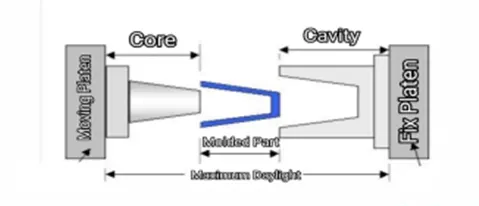
7. What is Maximum Daylight?
The maximum opening between the fixed and moving platens when the clamp is wide open. It is related to mould opening stroke and minimum or maximum mould height as follows,
- For a toggle clamp,
Maximum daylight = Mould opening stroke + Maximum mould height
- For direct hydraulic clamp,
Maximum daylight = Mould opening stroke + Minimum Mould height
8. What are the Types Of Injection Mould?
- Hot runner injection mould
- Cold runner injection mould
- Two plate mould
- Three plate mould
- Single cavity mould
- Multi cavity mould
- Stacked mould
9. What is Two Plate Mould?
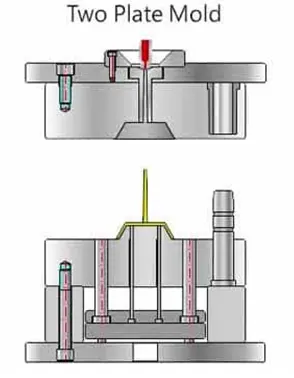
- Two-plate mould or single parting surface mould is the simplest and most widely used mould in injection moulding.
- The 2 plates mould is divided into two parts: the moving half and the fixed half by P/L.
- The core side is in the moving mould half, and the cavity side is in the fixed mould half.
- The runner is in the fixed mould, and the main runner is arranged on the parting surface.
- After moulding, the injection-moulded product and runner remain in the moving mould half, the product and the injection system are ejected off from the same parting surface.
- And the movable mould half is equipped with ejection systems to push the products away after opening the mould.
- Other moulds are the development of two-plate moulds.
10. What is a 3 Plate Mould?
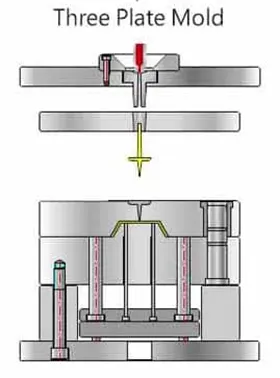
- 3 plates mould is also called double parting surface mould.
- The mould is divided into three parts, a runner stripper plate is added between the top clamping plate and cavity plate.
- This structure is suitable for products are not allowed to have gate marks along sidewall, or item with a large projection area and to need multi-point gates.
- This kind of mould adopts a pinpoint gate.
- This kind of mould has a more complicated structure and needs an additional distance parting mechanism.
- The three-plate mould is divided into normal three-plate moulds and the simplified three-plate mould.
- Simplified three-plate mould doesn’t have four guide pins between moving and fixed half.
11. What is Hot Runner Mould?
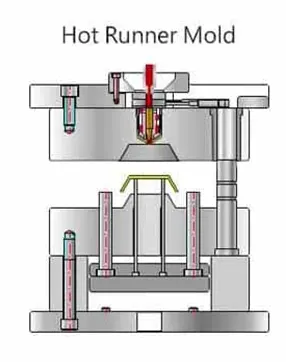
- Hot runner mould is also called runner less mould, including insulated hot runner mould and heated runner’s mould.
- The plastic in the gating system is always in a molten state, so there will be no gating system material such as two-plate mould and three-plate mould in the process.
- The hot runner mould integrates the advantages of the simple action of the two-plate mould and the melt of the three-plate mould entering from any point in the cavity.
- In addition, the hot runner mould has no loss of pressure, temperature and time in the runner, so it not only improves the injection moulding quality but also shortens the moulding cycle, which is a major innovation in the gating system technology of the injection mould.
12. Note down the Advantages of Runner Mould?
- Shorten the cycle time. Because there is no limitation of the cooling time of the runner system, the part can be ejected soon after solidification. Many thin-walled parts produced with hot runner moulds can be moulded in less than 5 seconds;
- Plastic Raw Materials Saving. Because there is no runner material in the hot runner mould, there is no production cost. This is especially significant for reducing the cost of raw materials. The major hot runner manufacturers in the world have developed rapidly, for plastic raw materials are expensive now because hot runner technology is an effective way to reduce the cost of materials.
- Reduce the failed parts and improve the product quality. For the hot runner mould production, the plastic melt temperature is accurately controlled in the runner system. Plastic can flow into each mould cavity in a more uniform state, producing parts with consistent quality. In addition, hot runner moulding has beautiful gate relics, low residual stress, and smaller part deformation. Therefore, many high-quality products on the market are produced by hot runner moulds.
- Eliminate the subsequent operation. The finished product is obtained after the finished product is moulded by a hot runner mould, and subsequent operations such as trimming a gate and regrinding a cold runner are not required. It is good for production automation.
13. What is Insulated Runner Mould?
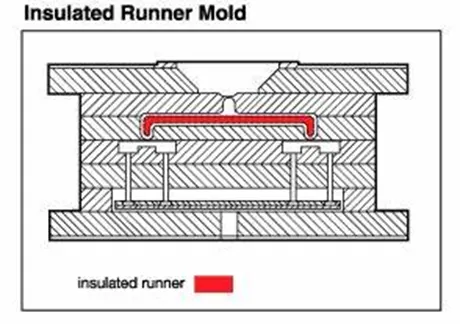
plastic injection moulding using insulated runner moulds, an excellent option when a large number of plastic parts need to be manufactured quickly. Insulated runner systems are inexpensive alternatives to traditional hot runners, where the mould is not heated, but the runner channels are extremely thick and stay molten during continuous cycling.
14. What is Hot Manifold Mould?
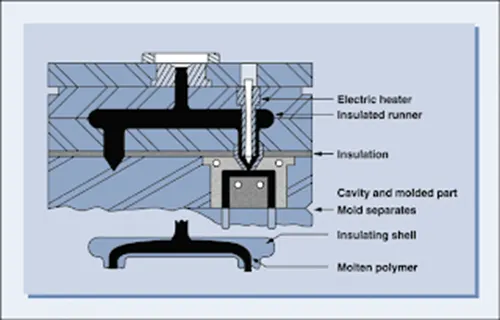
An injection mould equipped with an internal heater located in the centre of the melt stream in the manifold and nozzle system. This type of mould was developed for thermally sensitive resins to provide gentler heating and avoid the decomposition problems experienced with external heating techniques because of excessive temperature differences.
15. What is Transfer Mould?
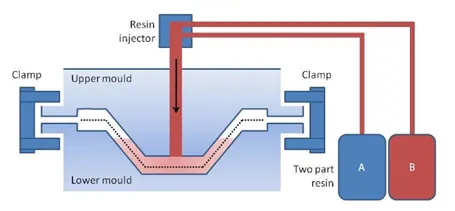
Transfer moulding is a moulding process that involves the creation of a new part or product by filling a mould cavity with raw material. The raw material is injected into the mould cavity. After the raw material solidifies, it creates the casting. The casting is then ejected from the mould cavity, which is essentially the part or product.
16. Explain Vacuum Moulding?
Vacuum moulding, sometimes called vacuum forming, is a straightforward moulding process that uses vacuum pressure to force a sheet of heated and stretched plastic onto a single-surface mould. The plastic is heated to a forming temperature and the suction holds the plastic sheet against the mould until the desired shape is achieved.